
Experiential marketing can deliver 300–500% ROI, yet only 2% of marketers say they're confident measuring it. That gap isn't a creative problem. It's a strategy problem. Most brands pour budget into activations that look spectacular on recap decks but never connect to revenue, pipeline, or brand equity. This guide is for executives who are done settling for moments that fade. We'll walk through the strategic definition of brand activation, the frameworks powering today's most effective programs, the metrics that actually matter, and the steps your team can take to turn investment into owned outcomes.
Table of Contents
- Defining brand activation: Beyond the buzzword
- The science of impact: Brand activation ROI, measurement, and challenges
- Experiential innovation: Frameworks and tactics that drive engagement
- Making brand activation actionable: Steps for executive teams
- Our perspective: Why true brand activation means owning the customer outcome
- How King Sixteen can help elevate your brand activation
- Frequently asked questions
Key Takeaways
| Point | Details |
|---|---|
| Brand activation defined | It’s the strategic creation of immersive experiences that drive measurable consumer actions for premium brands. |
| ROI evidence is compelling | Executives can expect 300–500% ROI, sales increases, and measurable perception lifts from the best activations. |
| Frameworks matter | The most effective activations now use gamification, CRM integration, and physical-digital hybrids. |
| Executive leadership is critical | Success depends on active executive involvement in goal-setting, program design, and post-event optimization. |
| Measurement remains a challenge | Sophisticated strategies are necessary to accurately track and prove brand activation outcomes. |
Defining brand activation: Beyond the buzzword
Brand activation is one of the most overused terms in marketing, and also one of the most misunderstood. It gets lumped in with sponsorships, advertising campaigns, and general event production. But activation is its own discipline, with a distinct purpose and a specific mechanism for creating results.
At its core, brand activation is the process of bringing a brand to life through direct, two-way engagement with a target audience. It's not about broadcasting a message. It's about creating a condition where the audience participates in the brand story, develops an emotional connection, and takes a measurable action. That might be a purchase, a data opt-in, a referral, or a shift in perception.
Here's how activation differs from related tactics:
- Advertising delivers a message to a passive audience. Activation puts the audience in an experience.
- Sponsorships associate a brand with an event or entity. Activation creates the event itself.
- PR generates coverage. Activation generates behavior and data.
For high-end and luxury brands, the stakes are higher. Your audience is sophisticated, skeptical of manufactured moments, and quick to detect inauthenticity. Activation for this segment requires precision: the right environment, the right sensory cues, and the right follow-through after the experience ends.
The core elements of effective brand activation are experience, engagement, and measurable action. These three work together. Without experience, there's no emotional resonance. Without engagement, there's no data or relationship. Without measurable action, there's no accountability or ROI case.
"Brand activation isn't an event. It's a strategic intervention in the customer journey, designed to accelerate trust, behavior, and loyalty."
For brand experience examples that show what this looks like at the highest level, the common thread is intentionality. Every touchpoint, from the invitation to the post-event follow-up, serves a strategic purpose. And the results are hard to ignore: 85% of consumers are more likely to purchase after participating in an experiential activation. That's not a soft metric. That's a sales signal.
The science of impact: Brand activation ROI, measurement, and challenges
Every CMO wants to know the same thing: what does this actually return? The evidence is strong, but the measurement gap is real, and understanding both is essential before you build your activation strategy.
Let's start with the performance benchmarks. Leading programs have documented 48% sales growth in direct response campaigns, over $500,000 in event-driven revenue per activation in tourism and retail, a 25% improvement in brand perception, and an 11% increase in conversion rates. These aren't outliers. They're the result of structured programs with clear goals, integrated measurement, and disciplined follow-through.
Here's a summary of what the data shows across activation types:
| Activation type | ROI metric | Documented result |
|---|---|---|
| Product launch events | Sales lift | 48% growth |
| Tourism and destination activations | Revenue per event | $500,000+ |
| Brand perception programs | Perception improvement | 25% lift |
| Conversion-focused activations | Conversion rate | 11% increase |
| Experiential vs. digital campaigns | Engagement rate | 38% vs. 19.7% |
The challenge isn't generating results. It's proving them. Only 2% of marketers describe themselves as very confident in measuring experiential ROI. The rest struggle with attribution, fragmented data, and the lag between the live experience and downstream sales behavior.
The root cause is usually a measurement architecture problem. Most teams plan the activation and then ask how to measure it afterward. That's backward. Measurement infrastructure needs to be built before the first attendee arrives.
Pro Tip: Integrate your CRM and marketing automation into your activation workflow from day one. Tag every interaction, whether it's a badge scan, a digital touchpoint, a sample request, or a conversation at the event, with a source code that flows into your pipeline data. That way, you can track deals closed 90 days post-event that trace back to a specific activation touchpoint. This is how experiential marketing ROI becomes a board-level story, not just a marketing team talking point. For real-world proof, look at case studies for impact that show exactly how this pipeline tracking translates into executive confidence.
Experiential innovation: Frameworks and tactics that drive engagement
Knowing the ROI case is only the beginning. The next question is execution: which frameworks actually work, and what separates the activations that get remembered from the ones that get recycled into a slide deck?
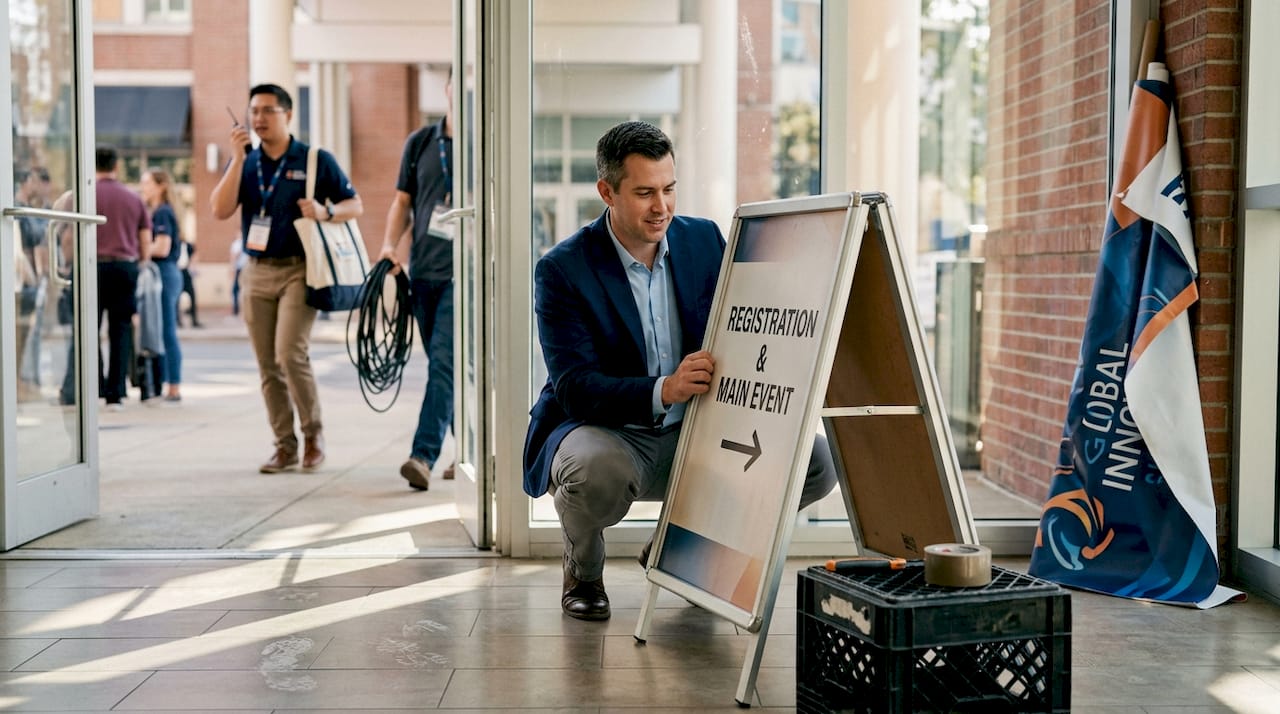
Three models consistently outperform in high-end brand contexts. First, interactive experiences put the audience in control. They choose their path through the activation, which increases time-on-site and emotional investment. Second, immersive environments replace passive observation with full sensory engagement, using spatial design, sound, scent, and lighting to make the brand feel like a place rather than a product. Third, digital-physical hybrid activations bridge the live moment with digital persistence, using real-time data capture, social amplification, and post-event retargeting to extend the experience well beyond the event itself.
How does experiential compare to digital-only campaigns? The data is clear: experiential campaigns deliver a 38% engagement rate versus 19.7% for digital ads alone. That gap matters when your goal is emotional connection, not just impressions.
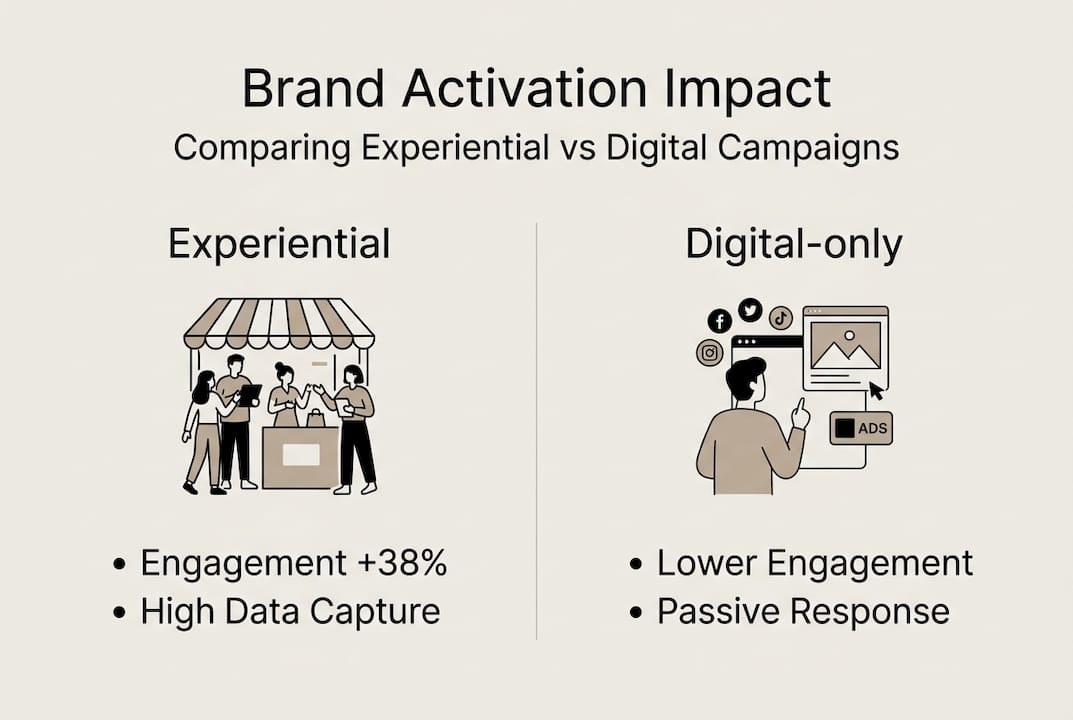
Here's a comparison worth keeping in front of your team:
| Approach | Engagement rate | Data quality | Brand recall |
|---|---|---|---|
| Experiential activation | 38% | First-party, high intent | High |
| Digital advertising only | 19.7% | Modeled, low intent | Moderate |
| Hybrid (experiential + digital) | 45%+ | First-party + behavioral | Very high |
The top five tactics that executive-led programs are using right now:
- Immersive product environments that simulate ownership or use before purchase
- VIP previews and restricted-access experiences that drive exclusivity and urgency
- Gamified engagement layers with live leaderboards and incentivized data capture
- Real-time social amplification stations that turn attendees into brand advocates
- Data-rich touchpoint sequencing that feeds CRM and retargeting pipelines
Pro Tip: Gamification in brand activation delivers 35 to 55% data capture rates, far above passive methods. Pair that with geoframing for event targeting to retarget attendees after the event, and your activation footprint extends weeks beyond the live date. Add social amplification strategies to multiply organic reach from a single event.
Making brand activation actionable: Steps for executive teams
Frameworks are useful. But what does world-class activation actually look like when it moves from strategy deck to execution? Here's the blueprint your team needs.
Step 1: Set outcomes before creative. Define what success looks like in business terms before any concept work begins. Is this program designed to generate pipeline, shift brand perception, launch a product into a new market, or capture first-party data? Every creative decision should serve a defined outcome.
Step 2: Design for the full journey, not just the event day. The most common mistake high-end brands make is over-investing in the live moment and under-investing in the before and after. Your pre-event communication, on-site experience design, and post-event follow-up sequence are equally important. They're all part of the activation.
Step 3: Integrate measurement infrastructure early. As noted above, CRM tagging, lead capture tools, and attribution models need to be in place before the event opens. Not after.
Step 4: Assign clear ownership across teams. Activation lives at the intersection of marketing, sales, and sometimes product. Someone needs to own the full customer journey, not just the production logistics.
Step 5: Optimize based on post-event data. After every activation, run a structured debrief. What did attendees engage with most? Where did they drop off? What did the pipeline look like 30, 60, and 90 days later?
For luxury brands, two pitfalls deserve special attention. First, authenticity gaps: if your activation doesn't feel congruent with your brand positioning, sophisticated audiences will notice immediately and disengage. Second, weak follow-up: the conversion window after an activation is narrow. A great live experience followed by generic email outreach is a wasted opportunity.
The evidence supports a disciplined approach. Programs that follow this structure see 25% improvement in brand perception and consistent 11% conversion lifts, with top performers generating over $500,000 in event-driven revenue. Explore how event management strategies at this level are built for exactly these outcomes.
Pro Tip: Measure beyond attendance. Track influencer amplification, earned media value, post-event social engagement, and sales pipeline generated within 90 days. These are the numbers that get activation budgets protected at the board level.
Our perspective: Why true brand activation means owning the customer outcome
Most brands treat activation as a moment. We treat it as a claim. When you invest in a world-class experiential program, you're not just creating a memory. You're establishing a position in the customer's mind that should translate into measurable behavior over time.
Here's the uncomfortable truth we've observed working with brands like Porsche, Audi, and Churchill Downs: the programs that fail aren't the ones with small budgets. They're the ones where the executive team signed off on production without owning the outcome. The creative was stunning. The follow-through was weak. The attribution was an afterthought.
Evidence-based frameworks consistently outperform creative stunts because they tie every activation decision back to a business goal. That's not a constraint on creativity. It's a condition for it. When your team knows what winning looks like, great creative has a target to aim at.
Activation is executive strategy. If it's being managed three levels below the CMO, it's probably not being managed at all. The brands that treat ROI-focused experiential as a boardroom priority are the ones that build lasting equity and defend their marketing budgets year after year.
How King Sixteen can help elevate your brand activation
You've seen the framework. Now the real question is execution. The brands that consistently win with activation aren't doing it alone. They're working with partners who can move fast, think strategically, and handle every detail without gaps.
King Sixteen is built for exactly this. From experiential solutions that drive pipeline and data to auto launch activations that build demand from the first touchpoint, we handle everything: concept, fabrication, staffing, AV, logistics, and digital integration. Our event service packages are designed for high-end brands that need precision execution with zero margin for error. If your activation program needs to move from strategy to impact, let's talk about what that looks like for your brand.
Frequently asked questions
What is the main goal of brand activation?
Brand activation drives direct engagement, measurable actions, and emotional connections between a brand and its audience. 85% of consumers are more likely to purchase after experiencing a live activation.
How can executives measure brand activation ROI?
Track CRM-attributed pipeline, sales lifts, brand perception scores, and post-event conversion rates to build a complete ROI picture. Programs have documented 48% sales growth alongside a 25% perception lift and 11% conversion improvement.
What types of experiential tactics yield the best results?
Immersive, interactive, and gamified experiences consistently outperform traditional and digital-only campaigns in both engagement and first-party data capture. Gamification alone yields 35 to 55% data capture rates versus passive methods.
Why is measuring experiential marketing ROI still a challenge?
Complex attribution models, fragmented data sources, and delayed conversion windows make ROI measurement difficult for most teams. Only 2% of marketers report high confidence in their experiential measurement approach.