
Most marketing leaders spend months perfecting their logo, messaging, and digital presence, yet overlook the single most powerful brand asset they control: the physical space where customers actually experience the brand. Research confirms that physical space design is a key driver in shaping consumer behavior and measurable business outcomes. Brand environment design bridges that gap. This guide walks you through what it is, how its core elements work together, how to plan and measure it strategically, and why the brands doing it best are the ones willing to break convention.
Table of Contents
- What is brand environment design?
- Core elements and sensory extensions
- Strategic planning for immersive brand experiences
- Measuring impact: Brand environment design and business outcomes
- Why the best brand environments break the expected rules
- Take the next step with immersive brand environments
- Frequently asked questions
Key Takeaways
| Point | Details |
|---|---|
| Brand environments influence behavior | Physical spaces designed with brand identity and sensory cues can drive measurable customer engagement and loyalty. |
| Alignment is essential | All design and sensory elements must match your brand’s positioning to avoid confusion and maximize impact. |
| Strategic planning delivers ROI | Thoughtful brand environment design translates branding strategy into environments that produce business results. |
| Measurement guides success | Tracking dwell time, repeat visits, and engagement helps optimize investment in your brand spaces. |
What is brand environment design?
Most conventional branding focuses on what people see on a screen or a package. Brand environment design takes a fundamentally different position. It treats the physical world as the medium.
"Brand environment design is a comprehensive approach to creating physical spaces that embody a brand's identity, values, and narrative through architectural elements, interior design, sensory experiences, and spatial planning."
In practical terms, this means every surface, sound, scent, and spatial arrangement in a room is a deliberate brand statement. The ceiling height in a luxury showroom, the temperature of the lighting in a product launch space, the way a corridor narrows before opening into a reveal moment. None of these details are accidental in a well-designed brand environment. They are all choreographed.
This is what separates brand environment design from traditional branding approaches:
- Traditional branding relies on visual identity systems, logos, color palettes, and messaging delivered through screens, print, or packaging.
- Brand environment design uses three-dimensional space to surround the audience with the brand, making the message felt rather than just seen.
- The key outcome is emotional resonance. People remember how a space made them feel far longer than they remember a banner ad or a tagline.
The scope of brand environment design includes architecture and structural layout, interior design and material selection, lighting and acoustic engineering, technology integration such as interactive displays and digital installations, and deliberate spatial sequencing that guides visitor movement and attention.
Real-world examples make this concrete. When Porsche opens an experience center, the path you walk mirrors the sensation of a test drive. When a luxury retailer designs a flagship, the journey from entrance to checkout is a carefully paced story. When experiential marketing activations are built around a product launch, every element of the environment is engineered to create demand before a single conversation starts.
For marketing executives and brand decision-makers, understanding brand environment design means recognizing that your spaces are either working for your brand or against it. There is no neutral ground. A poorly designed environment can contradict even the strongest visual identity, while a thoughtfully designed one amplifies every other brand investment you've made.
Core elements and sensory extensions
A successful brand environment is not one thing. It is a system of interconnected elements working in harmony. Here is how those elements break down.
| Core element | Sensory extension | Example |
|---|---|---|
| Architecture and layout | Spatial flow and scale | Grand entry atrium creating awe |
| Interior design and materials | Texture and touch | Raw concrete vs. warm timber |
| Lighting design | Visual warmth and contrast | Warm spotlights on hero products |
| Sound design | Ambient audio and acoustics | Curated music matching brand tempo |
| Scent design | Olfactory memory | Signature scent in retail spaces |
| Technology integration | Interactive and visual stimuli | Motion-triggered digital displays |
Each element contributes to what sensory branding researchers call immersion. But immersion is only valuable when it is coherent. Sensory extensions such as sound and scent amplify immersion but require congruence with brand positioning to avoid overload. A high-energy scent in a brand built on calm luxury creates cognitive dissonance. The audience feels it, even if they can not articulate why.
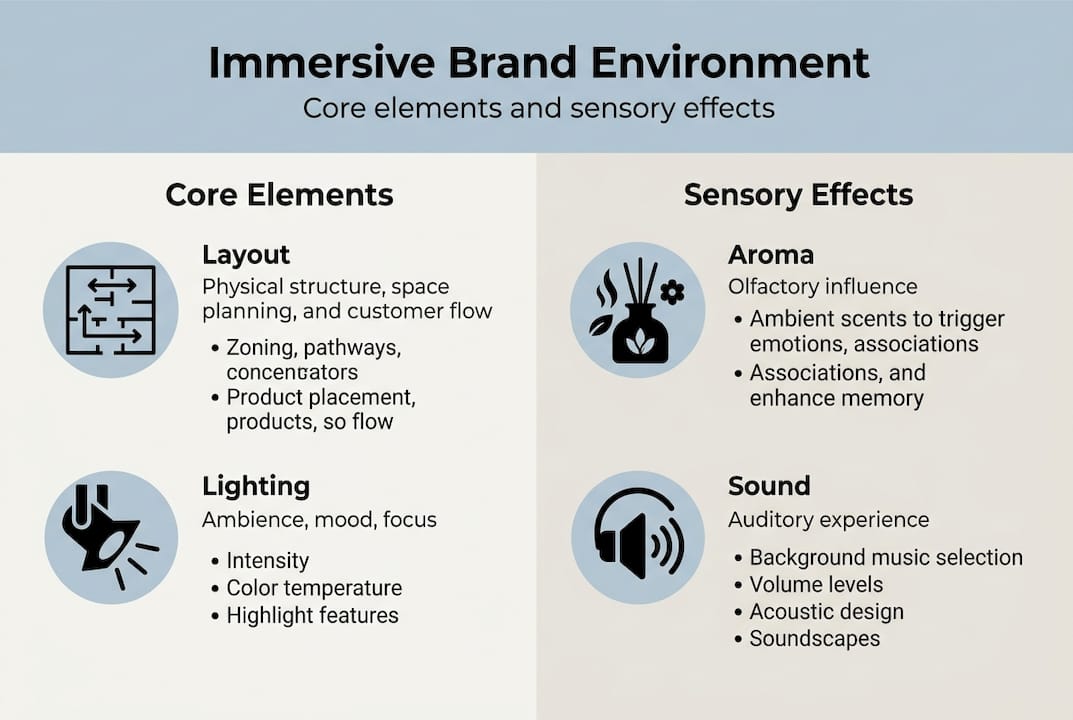
To build that congruence, use spatial planning techniques that align every design decision back to a core brand feeling. Before selecting materials, finishes, or technology, ask: what is the single emotional response we want visitors to leave with? Then make sure every sensory layer supports that answer.
Pro Tip: Create a simple sensory brief before any environment design project. Map your brand's core values to specific sensory cues: what does trust smell like in your category? What does innovation sound like? That brief becomes your filter for every design decision.
Here is a practical alignment checklist to use when reviewing any brand environment:
- Does the lighting reinforce the brand's energy level, whether high-contrast and dramatic or soft and approachable?
- Does the soundscape match the pace and personality of your brand?
- Are material choices communicating the quality tier your brand promises?
- Is the spatial flow guiding visitors toward the moments that matter most, such as a product reveal or a conversation point?
- Are sensory elements working together, rather than competing for attention?
When these five dimensions align, the environment stops feeling like a room and starts feeling like the brand itself.
Strategic planning for immersive brand experiences
Understanding the building blocks is only the starting point. Translating vision into a physical space that actually performs requires a strategic planning process that most brands skip.
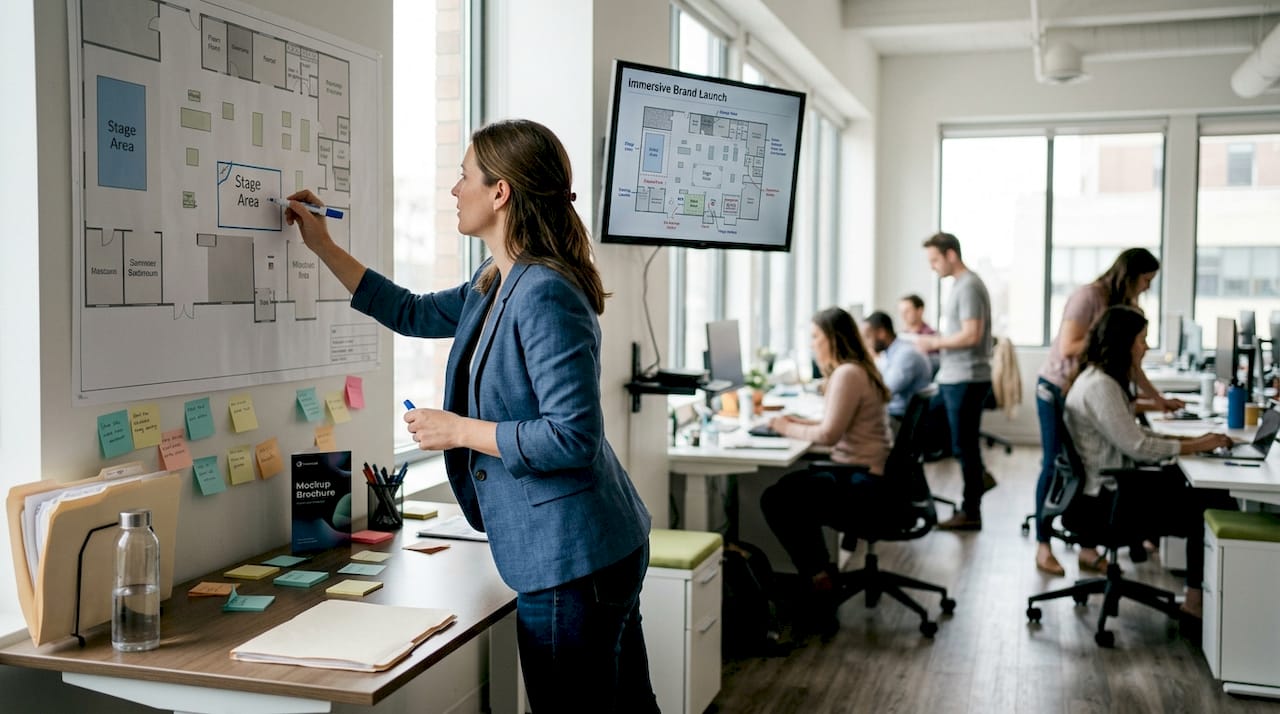
Start with an honest audit of your current spaces. Walk through them as a visitor, not as someone who designed or approved them. Notice the first impression, the sound level, the temperature of the light, the ease of navigation. Then ask: does this space tell the story we want told?
Brand environment design drives measurable outcomes when strategic planning connects physical engagement to psychological engagement. That connection requires intentionality at every phase.
| Immersive design approach | Traditional design approach |
|---|---|
| Starts with the desired emotional outcome | Starts with aesthetic preferences |
| Every element serves a strategic purpose | Design decisions made for appearance |
| Visitor journey is mapped and sequenced | Layout is functional but unscripted |
| Sensory layers are coordinated and tested | Individual elements chosen independently |
| Results are measured against brand metrics | Success is judged visually |
Here is how to plan effectively:
- Define the emotional outcome first. What should someone feel when they leave? Inspired, reassured, energized? Name it before you design anything.
- Map the visitor journey. Identify every touchpoint from arrival to departure. Assign a brand intention to each one.
- Audit sensory gaps. Most spaces have strong visual design but neglect sound and scent entirely. These are often the highest-impact opportunities.
- Integrate geo frame marketing strategies to extend the brand environment's influence beyond the physical walls, capturing and re-engaging audiences who visited the space.
- Build in feedback loops. Plan how you will capture visitor responses from day one, not as an afterthought.
Your environment should also align directly with your current marketing strategy and campaign goals. A product launch environment should be designed to generate social content. A conference environment should be designed to facilitate high-value conversations. Explore event service strategies that treat the environment as a revenue-generating asset, not just a backdrop.
Measuring impact: Brand environment design and business outcomes
Once a strategic plan is implemented, measurement is where investment gets justified and refined. The good news is that brand environments generate several trackable signals that connect directly to business performance.
Key metrics to track:
- Dwell time: How long visitors stay in the space is a direct proxy for engagement. Longer dwell time correlates with higher purchase intent and deeper brand recall.
- Net Promoter Score (NPS): Survey visitors immediately after an experience. A well-designed brand environment consistently lifts NPS compared to standard event formats.
- Repeat visitation rate: Loyalty is demonstrated by return behavior. Environments that resonate bring people back.
- Social amplification: Count organic social posts, stories, and shares generated from within the space. Highly designed environments produce significantly more unprompted content.
- Sales uplift: Compare conversion rates or revenue performance at events or locations with intentional environment design versus those without.
Physical space design is a key driver in influencing consumer behavior and measurable business outcomes.
Consider a hypothetical but realistic scenario: a premium automotive brand redesigns its product reveal event environment, replacing a standard hotel ballroom setup with a fully immersive, sensory-layered space built around the vehicle's performance story. Average dwell time increases by 40%. Social content generated at the event triples. Post-event NPS rises by 22 points. These are not accidental outcomes. They are the direct result of treating space as a strategic tool.
Pro Tip: Set your measurement baseline before the event or environment launches. Capture dwell time, NPS, and social volume from your previous activation. Then compare directly. Without a baseline, even strong results look like guesswork.
For deeper insight into what works across industries, reviewing experiential case studies from brands that have committed to environment design reveals consistent patterns: immersion drives attention, attention drives memory, and memory drives loyalty.
Why the best brand environments break the expected rules
Here is the honest truth that most brand environment guides skip: following best practices produces forgettable spaces. The brands that achieve lasting impact, the ones whose environments get photographed, shared, and talked about for months after the moment, are the ones that made a deliberate choice to do something unexpected.
Conventional design thinking prioritizes comfort and familiarity. It defaults to what has worked before. But comfort is the enemy of memorability. When an audience walks into a space that feels exactly like every other high-end event they have attended, nothing sticks.
The risk of sensory overload is real, but the solution is not restraint for its own sake. It is intentional contrast. One element that surprises, one moment that disrupts expectation, one detail that makes a visitor stop and think. That is what drives loyalty.
We have seen this firsthand working on innovative brand launches where the brief called for something unexpected. The brands that allowed genuine creative risk consistently outperformed those that played it safe on every measurable dimension. Courageous, human-centered environments build the kind of emotional connection that no digital campaign can replicate.
Take the next step with immersive brand environments
If this article has shifted how you think about your brand spaces, the next step is acting on that shift before your next major activation.
At King Sixteen, we specialize in designing and executing experiential marketing solutions that turn physical environments into strategic brand assets. From full-scale product launches to conference environments and custom fabrication, our turnkey model handles every detail. We also integrate VR services and interactive brand experiences to extend immersion beyond the physical footprint. If you are ready to build environments that make your brand felt, not just seen, let's talk.
Frequently asked questions
How is brand environment design different from traditional branding?
Brand environment design integrates physical space and sensory cues to immerse audiences, unlike traditional branding, which relies mainly on visuals and messaging. As the Design Encyclopedia defines it, it is a comprehensive approach to creating physical spaces that embody a brand's identity.
What types of spaces benefit most from brand environment design?
Retail stores, corporate headquarters, event venues, and showrooms see the highest impact from immersive brand environment design, particularly where in-person audience engagement drives purchase or loyalty decisions.
What are the top measurable benefits of brand environment design?
Brand environment design can increase dwell time, boost repeat visits, and drive higher sales conversions through deeper consumer engagement, with physical space confirmed as a key driver of measurable business outcomes.
How do I ensure sensory cues align with my brand without overwhelming visitors?
Use only sensory elements that complement your brand positioning, and periodically audit for consistency and guest feedback to maintain balance. Research confirms that sensory extensions require congruence with brand positioning to avoid overload.