
Most marketing executives treat an event like a logistics problem. Get the venue, book the speakers, set up the signage, and call it done. But that framing leaves serious revenue on the table. Consistent branding increases revenue by 23%, yet the majority of established brands still treat event identity as a visual afterthought rather than a strategic asset. This guide cuts through the confusion. We'll define what event brand identity actually means, break down its essential building blocks, show you real benchmarks, and give you a framework for applying these principles to your next high-stakes event.
Table of Contents
- Defining event brand identity: More than a logo
- Essential elements of strong event brand identity
- Event brand identity in action: Benchmarks and best-in-class examples
- Nuancing your approach: Flexibility, adaptation, and the pitfalls of over- or under-branding
- The uncomfortable truth: Event brand identity isn't a 'nice to have,' it's a strategic growth lever
- Advance your event brand identity with King Sixteen
- Frequently asked questions
Key Takeaways
| Point | Details |
|---|---|
| Brand identity drives ROI | Strategic event branding can directly boost revenue and attendee engagement when executed with consistency and intent. |
| Consistency and flexibility | Top-performing events balance cohesive visual systems with adaptability for cultural and audience diversity. |
| Measure what matters | Track metrics like attendee perception, dwell time, and post-event impact—not just awareness or design trends. |
| Learn from the best | Case studies show how global leaders use memorable experiences and data-backed strategies to set benchmarks for event branding. |
Defining event brand identity: More than a logo
Let's settle something upfront. Event brand identity is not a logo slapped on a step-and-repeat banner. It is not a color palette applied to name badges. Those are outputs, not strategy.
True event brand identity is the full orchestration of how an event feels, sounds, looks, and behaves, aligned with both the event's specific purpose and the parent brand's long-term positioning. Think of it as the experience architecture that surrounds every attendee decision and interaction, from the registration email to the closing reception.
Event brand identity is a strategic process, aligning unique event experiences with the parent brand. That means the story your event tells has to be consistent with who you are as a company while still creating something distinct and memorable enough to stand on its own.
Why does this distinction matter so much? Because executives who conflate identity with visual design consistently underinvest in the aspects that drive real ROI: the narrative arc of the event, the sensory consistency of the environment, the emotional journey of each attendee segment. When those elements are missing, an expensive event can still feel forgettable.
Here is what event brand identity actually encompasses:
- Narrative positioning: The story the event tells and why it exists
- Sensory environment: Sound, scent, lighting, spatial design
- Audience journey: How attendees move through and emotionally experience the event
- Visual language: Applied consistently across all touchpoints, not just on-stage
- Brand voice: Tone in all copy, from email sequences to signage
- Post-event extension: How the identity lives on through content and follow-up
"The brands that win at events are not the ones with the biggest budgets. They are the ones with the clearest sense of who they are and the discipline to express it at every single touchpoint."
Pro Tip: Before your next event, write a single positioning sentence for it, just as you would for a product launch. If your team cannot agree on that sentence, your event brand identity has a clarity problem worth solving before any vendor gets hired.
For brands exploring experiential marketing strategies, the distinction between surface-level design and deep identity work is often the difference between an event people remember and one they forget by Monday morning.
Essential elements of strong event brand identity
Once you understand what event brand identity is, the next question is: what does it actually take to build one? The answer involves more components than most teams plan for, and missing even one creates visible gaps in the experience.
Here are the five core building blocks, in order of impact:
- Visual identity system: Logo, color palette, typography, iconography, and graphic language applied across every physical and digital surface with discipline.
- Theme, message, and positioning: The event's core idea, a memorable tagline, and a clear value proposition for attendees. This is the foundation everything else builds on.
- Digital asset suite: Event website, registration flow, app design, email sequences, and social templates. These are often the first brand impression and the most frequently neglected.
- Physical environment: Signage, fabricated installations, swag, breakout zone design, and stage presence. This is where event service elements become tangible and felt by every person in the room.
- Multisensory consistency: Music programming, lighting transitions, scent, catering presentation, and staff wardrobe. These details signal intentionality and elevate perceived brand quality.
Consistent visual and experiential components drive positive attendee perception and measurably improve engagement scores. The data consistently shows that when attendees sense coherence across these layers, trust and brand affinity increase.
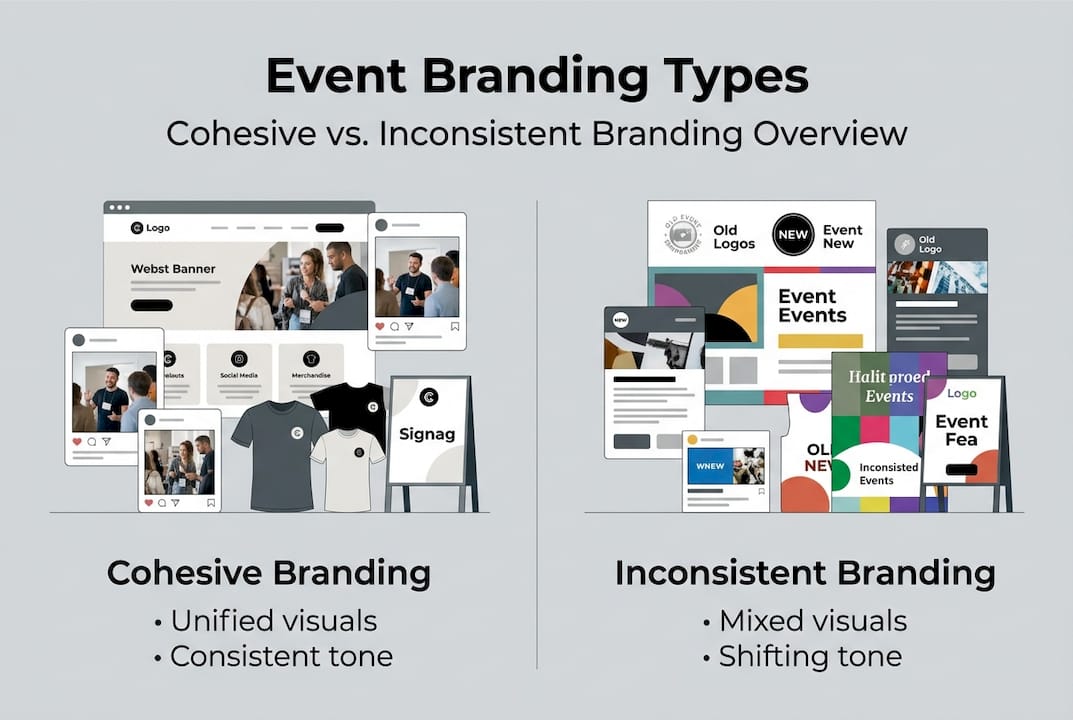
The table below illustrates what cohesive versus inconsistent event branding looks like in practice:
| Element | Cohesive branding | Inconsistent branding |
|---|---|---|
| Visual identity | Single system across all surfaces | Mixed fonts, colors, and logo versions |
| Messaging | One clear event narrative | Competing themes by department |
| Digital and physical | Seamlessly matched | Registration feels like a different event |
| Staff and environment | Wardrobe and spaces reinforce brand | Generic staging, unbranded staff |
| Post-event touchpoints | Follow-up mirrors the event's voice | Generic email with stock imagery |
Pro Tip: Audit your last event by printing every attendee touchpoint, from the invite to the follow-up email, and laying them side by side. If they do not feel like they belong to the same family, you have an identity gap that your attendees already noticed, even if they could not name it.
Event brand identity in action: Benchmarks and best-in-class examples
Strategic investment in event brand identity pays measurable dividends. Here are the numbers that should inform your next budget conversation.
Key benchmarks from the industry:
- Revenue increases 23% with consistent brand application across events
- 84 to 91% of attendees report feeling more positive about a brand after a well-branded event
- 57% of brands are actively increasing event spend, citing brand impact as the primary driver
These numbers are not aspirational. They are what organized, identity-driven brands are already achieving. Now look at who is doing it well.
Dreamforce (Salesforce): This conference is perhaps the most studied example of a corporate event with its own distinct identity. Every element, from the city-wide activations in San Francisco to the music acts and keynote staging, is designed to make attendees feel they are part of something bigger than a software conference. The result is one of the highest-attended and most media-covered B2B events globally.
Apple Keynotes: Apple treats its product reveals as brand events first and product announcements second. The spatial design, lighting, sound, and scripted presenter movement are all deliberate identity choices. Attendees and live-stream viewers experience a brand, not just an announcement.
HERE Technologies: This company tied its event identity to a sustainability narrative, embedding environmental values into every physical and digital component. The outcome was measurable improvement in stakeholder sentiment and earned media coverage that extended the event's brand impact well past the event date.
For teams building toward similar results, tracking event ROI strategies through pre and post event measurement is essential. The brands benchmarked above do not rely on gut feel. They measure NPS, brand lift, pipeline attribution, and media impressions with precision.
The takeaway is direct: world-class event brand identity is not an accident. It is a system, and it produces outcomes you can put in a board presentation.
Nuancing your approach: Flexibility, adaptation, and the pitfalls of over- or under-branding
Here is where most execution stumbles. Organizations either lock their event into a rigid brand cage that feels stale and corporate, or they over-experiment with a creative identity so far removed from the parent brand that attendees forget who hosted the event. Both extremes erode equity.
Modern event branding requires balancing consistency with adaptability, as demonstrated by the LA28 Olympics, which uses a flexible logo system with rotating creative expressions while maintaining a coherent visual and cultural identity across all markets. This is the model worth studying.
The decision between a distinct event sub-brand and a direct extension of the master brand should be driven by audience, purpose, and frequency. A flagship annual conference for your top clients might earn its own name, logo, and identity system. A quarterly regional roadshow probably does not.
Pitfalls to watch for:
- Over-transformation: Creating an event identity so different from your core brand that attendees are confused about who you are
- Template fatigue: Using the same identity system across every event until it becomes invisible
- Vanity-first design: Prioritizing visual novelty over strategic clarity, chasing trends at the expense of brand coherence
- Measurement gaps: Investing heavily without defining what success looks like before the event begins
"The brands most at risk are not the ones that do too little with their event identity. They are the ones that do too much without a clear strategic reason."
Pro Tip: Build a simple rule-based flexibility framework. Define which brand elements are non-negotiable (primary logo, core color palette, brand voice), which are adaptable (typography, secondary colors, graphic style), and which are fully customizable per event. This gives your creative team freedom without the risk of brand drift. Exploring adaptable brand identity lessons from category leaders is a useful exercise for building this framework.
Designing multi-touchpoint event experiences that feel both fresh and familiar is the real craft. It requires discipline, not just creativity.
The uncomfortable truth: Event brand identity isn't a 'nice to have,' it's a strategic growth lever
We have spent years working inside the room where brand decisions get made. And the pattern we keep seeing is this: event brand identity is treated as a line item to compress when budgets tighten, not as an investment to protect. That instinct is expensive.
Most organizations measure events by attendance numbers and social posts. Those metrics feel good but tell you almost nothing about whether the event actually moved the business. Prioritizing pre and post measurement as an ROI driver changes that conversation entirely. Brands that track pipeline influenced, NPS delta, dwell time, and long-term brand lift come away from events with data that justifies bigger, smarter investment the next time.
The other uncomfortable reality is that design trends are not a strategy. We see brands chase immersive aesthetics because a competitor did it, or refresh their event identity every year because it feels progressive. Neither approach builds the accumulated brand recognition that compounds over time.
What actually works is rule-based flexibility, sustainability in identity choices, and a measurement culture that links experiential marketing investment directly to business outcomes. Treat your event brand identity like you treat your product roadmap: intentional, sequential, and tied to measurable goals.
Advance your event brand identity with King Sixteen
Building a truly powerful event brand identity takes more than good design. It takes strategic clarity, production discipline, and a team that has done it at the highest level across industries.
At King Sixteen, we specialize in experiential marketing services that translate brand strategy into immersive, measurable experiences. From high-impact event services including custom fabrication and live production to private event solutions for your most important audiences, we handle every element so your brand shows up with authority and intention. If you are ready to turn your next event into a growth driver, not just a calendar item, let's talk.
Frequently asked questions
How does event brand identity impact attendee engagement?
A cohesive event brand identity ensures every touchpoint feels intentional, which drives stronger emotional connection. 84 to 91% of attendees report feeling more positive about a brand after a consistently branded event.
What are the risks of inconsistent event branding?
Inconsistent branding creates cognitive friction for attendees, reducing recall and weakening long-term brand equity. Inconsistent visuals dilute recall and make it significantly harder to attribute measurable business outcomes to your event investment.
Can an event have a unique identity while aligning with the parent brand?
Absolutely. The most effective event identities use flexible systems that allow creative expression while anchoring to core brand standards. Dreamforce and LA28 are strong models of this balance in practice.
What measurements matter most for event brand identity ROI?
Vanity metrics like reach and impressions are a starting point, not a finish line. Pipeline, NPS, and dwell time provide a far more accurate picture of whether your event brand identity is driving real business value.