
Your brand experience is set. The venue is booked, the concept is locked, and your guest list is confirmed. Then, three hours before doors open, you realize two staff members called out, your lead coordinator doesn't fully understand the guest journey, and nobody knows who handles the VIP escalation path. That single gap can unravel months of planning in real time. Great event staffing isn't just about filling seats on a roster. It's about building a team that can execute under pressure, represent your brand with precision, and adapt when the unexpected happens. This guide walks you through every step, from defining roles to post-event audits, so your next activation runs exactly as designed.
Table of Contents
- Start with clear roles and requirements
- Source, vet, and schedule your team
- Equip, train, and empower your team
- Monitor, support, and audit during and after the event
- Why staffing for pressure—not averages—transforms events
- Take your next event to the elite level with expert staffing
- Frequently asked questions
Key Takeaways
| Point | Details |
|---|---|
| Define roles early | Clarifying staff responsibilities from the start prevents last-minute surprises. |
| Vet and schedule smartly | Using tech and proven processes builds a reliable event team matched to your needs. |
| Invest in training | Pre-event prep and onsite support turn good teams into exceptional brand ambassadors. |
| Audit and improve | Systematic post-event reviews provide actionable data for stronger future events. |
Start with clear roles and requirements
Before you post a single job listing, you need to know exactly who you're hiring and why. Vague staffing briefs produce vague results. Clear roles and upfront requirements minimize last-minute chaos and raise team accountability across every position on your floor.
Start by anchoring your staffing plan to your core event objectives. A product launch for a luxury automotive brand demands different staff profiles than a multi-day conference or a pop-up retail activation. Ask yourself: What do guests need to feel, learn, or do at this event? The answer shapes every hire.
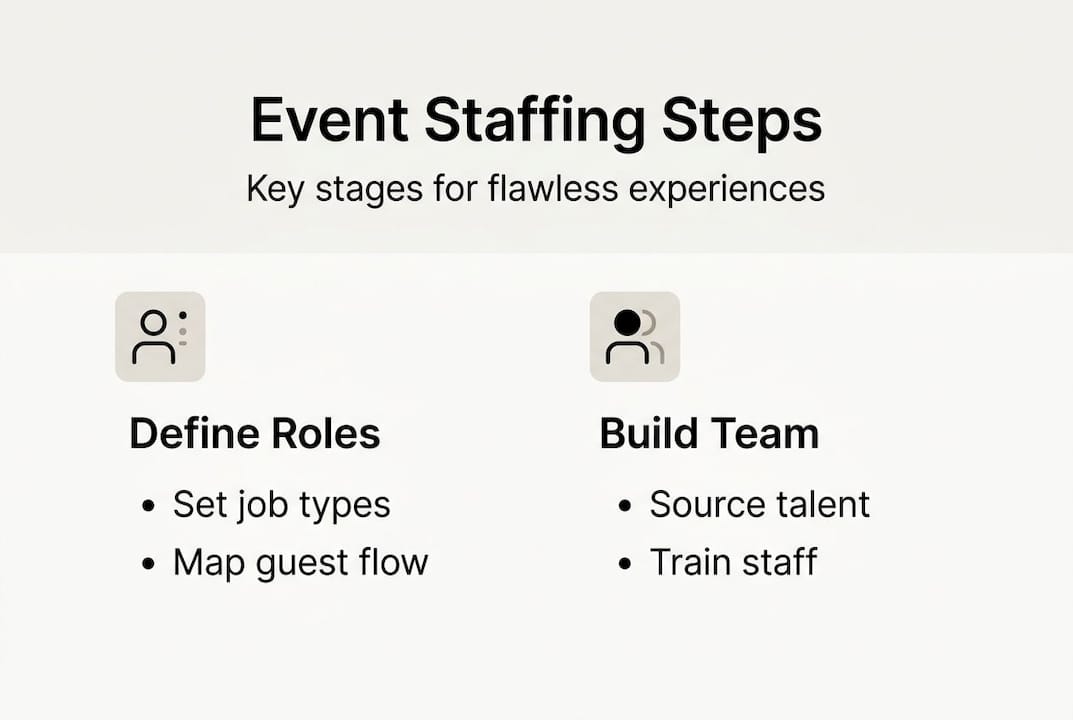
For most immersive brand experiences, your event staffing services roster will include a combination of the following roles:
- Brand ambassadors: Front-line representatives who embody your brand voice and guide guest interactions
- Tech support staff: On-call troubleshooters for AV, digital activations, and interactive installations
- Event coordinators: Logistics leads who manage run-of-show timing and vendor coordination
- Registration and check-in hosts: First impression specialists who set the tone from arrival
- VIP hosts: Dedicated staff for high-value guests requiring elevated, personalized attention
- Floaters: Flexible generalists who can step into any role as demand shifts
Volume per role should never be calculated from event averages. Instead, map your staffing to guest flow patterns and peak traffic stress points. If your activation has a signature moment, a product reveal, a live demonstration, or a tasting experience, that's where your highest concentration of staff belongs.
| Role | Guests per staff member | Priority timing |
|---|---|---|
| Brand ambassador | 20 to 30 | All hours |
| Tech support | 1 per activation zone | Peak and launch moments |
| Registration host | 50 per hour | First 90 minutes |
| VIP host | 5 to 10 | Arrival and key moments |
| Floater | 1 per 75 guests | Surge windows |
Also define hard requirements upfront: years of relevant experience, specific certifications (food handling, first aid), language skills, and brand familiarity. The more precise your brief, the better your matches. Understanding the distinct staff roles for trade shows versus product launches helps you build a smarter, more targeted roster from day one.
Pro Tip: Always include at least one floater for every 75 guests. These are your insurance policy against no-shows, unexpected surges, and roles that evolve mid-event.
Source, vet, and schedule your team
Once each position is defined, it's time to fill your bench with the best talent and lock in their schedules. Where you source staff matters as much as who you hire.
Technology can improve matching and scheduling efficiency for high-pressure events, and modern staffing platforms make it easier to filter candidates by geography, experience type, and availability. But technology alone won't close the gap between a warm body and a brand-ready professional.
Here's a comparison of your three primary sourcing options:
| Sourcing method | Cost | Speed | Local expertise | Reliability |
|---|---|---|---|---|
| Staffing agency | Higher upfront | Fast | Strong | High |
| Direct sourcing | Lower upfront | Slower | Variable | Variable |
| Hybrid model | Moderate | Moderate | Strong | High |
For experiential event staffing, the hybrid model often delivers the best balance. You leverage an agency's vetted talent pool for specialized roles while sourcing locally for general support positions. This keeps costs manageable without sacrificing quality at the moments that matter most.
Your vetting process should follow these steps:
- Post detailed role briefs with specific requirements, not generic descriptions
- Screen resumes for relevant brand experience and event type alignment
- Conduct structured interviews with scenario-based questions (how would you handle an upset VIP guest?)
- Run test scenarios for high-stakes roles like tech support or brand ambassador positions
- Complete background checks for any staff handling sensitive guest data or premium assets
- Send confirmed calendar invites with all logistics, parking, attire, and reporting details included
Scheduling is where most teams underinvest. Build your schedule around stress points, not shifts. If your event peaks between 6 and 8 PM, that window needs your deepest bench. For staffing for retreats or intimate brand experiences, you'll need fewer people but a higher caliber of individual performance. For trade show staffing, volume and rotation matter more.
Pro Tip: Schedule 15% more staff than your model requires for peak windows. The cost of one overstaffed hour is far lower than the brand damage of one understaffed moment.
Equip, train, and empower your team
With your roster set, the next requirement is to prepare your staff for performance, fast. Training isn't a formality. It's the mechanism that turns a hired person into a brand extension.

Ongoing training and clear communication drive event engagement and flawless execution. The best pre-event briefing covers five essential areas: event objectives, guest personas, brand voice guidelines, escalation protocols, and the physical layout of the space.
Your training program should address:
- Product knowledge: Staff should be able to speak fluently about what your brand does and why it matters
- Brand storytelling: Every interaction is a story moment. Train staff on the narrative arc of the experience
- Tech troubleshooting: For activations with digital or interactive elements, staff need basic troubleshooting skills
- Guest flow management: Staff should know how to read crowd density and redirect guests smoothly
- Escalation guides: Who does staff contact if a guest has a medical issue, a complaint, or a technical failure?
For talent booking for events, the briefing process starts before the event day. Send a digital pre-brief 48 hours in advance. Then run a 30-minute onsite walkthrough before doors open. Use that time to walk the space, assign zones, and answer questions.
Training do's and don'ts:
- Do use real guest scenarios in your training, not hypotheticals
- Do assign a team lead to each zone for real-time support
- Don't assume experienced staff know your brand's specific voice without guidance
- Don't skip the walkthrough, even for veteran staff
- Do run pulse check-ins every 90 minutes during the event to monitor morale and flag issues early
"Your staff must be empowered to act, not just instructed."
This is the difference between staff who follow a script and staff who genuinely represent your brand. Structured event team training builds the confidence your team needs to make real-time decisions that protect your brand experience.
Monitor, support, and audit during and after the event
Staff preparation is only half the battle. Ongoing monitoring and post-event analysis ensure continuous improvement and smarter staffing decisions for every activation that follows.
During the event, your team leads serve as the connective tissue between your staff and your command center. Assign one lead per zone with a clear communication channel, whether that's a radio, a group chat, or a dedicated app. Digital check-ins every 60 to 90 minutes keep morale visible and problems surfaced before they escalate.
Real-time support looks like this: a team lead notices a registration bottleneck forming. They pull a floater from a quieter zone and redirect them to check-in. The guest experience stays smooth. That kind of agility only happens when your monitoring structure is already in place.
Events using structured post-audits show measurable increases in attendee satisfaction scores across subsequent activations. The data is consistent: teams that debrief formally perform better the next time.
Your post-event audit should follow these steps:
- Gather staff feedback within 24 hours while memory is fresh
- Review KPIs tied to staffing: guest satisfaction scores, wait times, incident reports
- Highlight wins by role and zone so top performers are recognized and retained
- Document fixes with specific action items, not vague notes
- Build a playbook that captures role definitions, scheduling models, and training materials for your next event
Post-event audits are critical for refining staff selection, training, and assignments for future events. The brands that treat every event as a learning system compound their advantage over time. Your private event staffing model gets sharper with every iteration when you build this habit into your process.
Why staffing for pressure—not averages—transforms events
Most staffing guides focus on headcount. Get the right number of people in the room, and you're covered. We've seen this approach fail at events with perfectly adequate average coverage, because averages don't capture the moments that define a brand experience.
The moments that matter most, the product reveal, the VIP arrival, the interactive installation queue, are also the moments of highest pressure. That's exactly when average staffing breaks down. Industry leaders recommend planning staffing for peak moments, not average traffic, and the brands that follow this principle consistently outperform those that don't.
Our contrarian take: overstaff and cross-train, then measure the impact. Yes, it costs more upfront. But the brand damage from one chaotic peak moment, captured on a phone and shared online, costs exponentially more. Build a team that's resilient, not just sufficient. Cross-train your floaters so they can step into any role without a briefing. Then audit the results.
"The margin for error at an immersive event is razor thin. Overprepare for peaks only."
This is the staffing philosophy we bring to every experiential marketing insights conversation with our clients. It's not about excess. It's about precision under pressure.
Take your next event to the elite level with expert staffing
Flawless execution at a high-stakes brand event isn't accidental. It's the result of deliberate planning, precise role definitions, rigorous vetting, and a team built to perform when the pressure is highest.
King Sixteen has delivered exactly this for brands like Porsche, Audi, Ray-Ban, and Churchill Downs. Our turnkey model covers staffing alongside design, fabrication, AV, and logistics, so nothing falls through the cracks. If you're planning an activation that demands more than average execution, explore our experiential marketing solutions and comprehensive event services to see how we build teams that make brands unforgettable.
Frequently asked questions
What is the most important first step in event staffing?
Clearly defining each role and its required skill set is the foundation for effective event staffing. Without precise role definitions, even experienced staff can't perform to the standard your brand requires.
How can technology improve event staffing?
Tech platforms speed up sourcing and scheduling, making it easier to match qualified candidates to specific roles quickly. They also streamline communication so your team stays aligned from pre-brief to post-event debrief.
Why staff for high-pressure moments and not just averages?
Staffing for surges builds the resilience your team needs to prevent breakdowns when attendee numbers peak. Average coverage leaves you exposed at the exact moments that define your brand's reputation.
How do post-event audits improve future staffing?
Audits capture specific lessons about role performance, scheduling gaps, and training effectiveness, giving you a concrete blueprint to improve. Refining staff selection through structured review is what separates brands that improve with every event from those that repeat the same mistakes.