Most marketing leaders have seen it done wrong. A logo printed on a vinyl banner. A branded wall that nobody photographs. A "sustainability corner" with recycled paper cups and no story behind it. These aren't environmental branding strategies. They're decoration with a brand mark slapped on top. True environmental branding is something entirely different, and the gap between those two realities is where your competitive advantage either lives or dies. As immersive experiential branding continues to evolve, the brands that win are those treating their physical environments as strategic, measurable business tools.
Table of Contents
- What is environmental branding and why does it matter?
- The five-layer framework for immersive brand environments
- Sustainability, credibility, and risk: The realities of green environmental branding
- Balancing innovation, multi-sensory experience, and accessibility
- Operationalizing and scaling: Best practices for marketing leaders
- Why environmental branding maturity means saying no as often as yes
- Ready to elevate your brand experience?
- Frequently asked questions
Key Takeaways
| Point | Details |
|---|---|
| Layered branding matters | Using a multi-layered system ensures immersive, measurable brand experiences. |
| Sustainability must be defended | Substantiate and govern all green claims to protect and grow credibility. |
| Accessibility balance | Innovative sensory features must include options for inclusivity and low-stimulation needs. |
| Scaling needs structure | Best results come from process maturity, collaboration, and ongoing measurement. |
| Restraint boosts impact | Focusing on clarity and resonance creates more powerful environments than overloading with features. |
What is environmental branding and why does it matter?
Building on the need for sophistication, let's clarify what environmental branding truly means and why it's a critical boardroom priority.

Environmental branding is not signage. It's not a color palette applied to your office walls. It is the intentional design of a physical space to communicate brand identity, express values, guide behavior, and generate measurable emotional responses. Think flagship retail environments like Apple's glass staircases and open floor plans, or the way Porsche's showrooms create a sense of precision and exclusivity before a customer ever touches a vehicle. These are not accidents. They are engineered brand experiences built around a specific strategic intent.
The scope of environmental branding covers a wide range of applications:
- Flagship stores and retail environments where product discovery is inseparable from brand story
- Corporate campuses designed to reinforce culture and attract talent
- Live events and experiential activations where the space itself becomes the message
- Conference environments where a brand's presence sets the tone for every business conversation that follows
- Trade show booths and pop-up spaces that must communicate brand authority in seconds
What makes environmental branding matter at the boardroom level is its proven influence on perception, loyalty, and purchase intent. When a space is designed to express a clear brand narrative, visitors don't just notice the brand. They feel it. That emotional register is the difference between a forgettable visit and a relationship that deepens over time.
As the environmental branding basics principle holds, a compelling brand environment is a system built on narrative, proof, interaction, sensory, and measurement layers, not a collection of aesthetic choices.
"The best brand environments aren't designed to impress. They're designed to connect. And connection is what drives every downstream business outcome worth measuring."
The five-layer framework for immersive brand environments
With clarity on the strategic value, let's explore how a robust environmental branding program is actually structured.
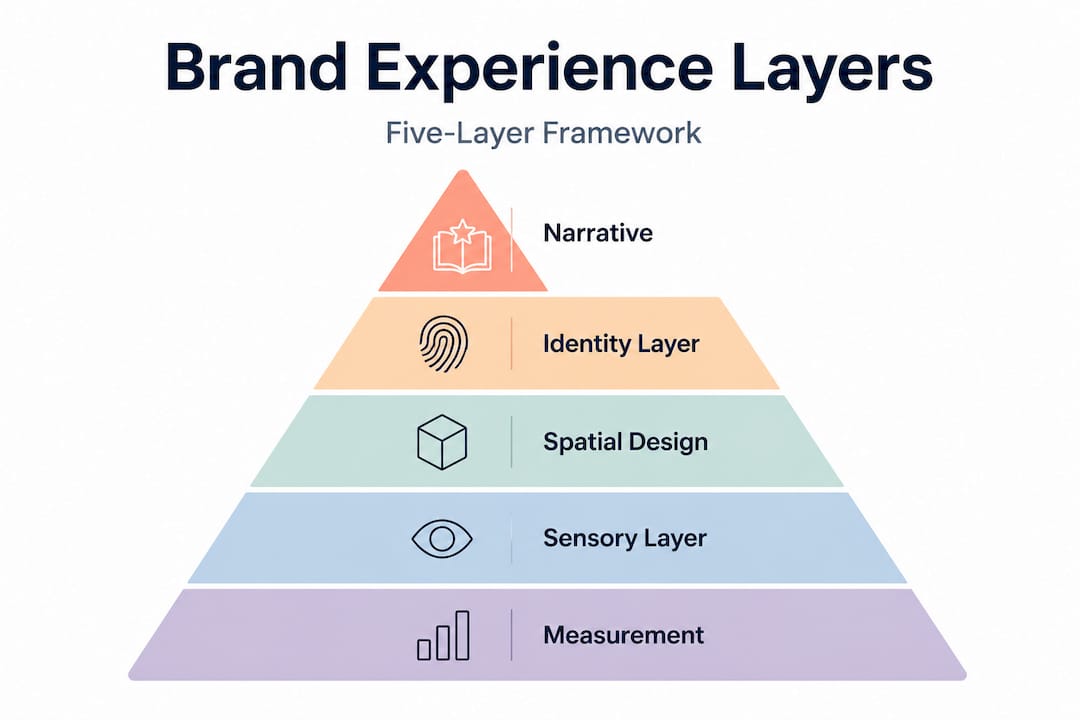
The five-layer structure gives marketing leaders a practical model for designing, evaluating, and improving any brand environment. Each layer has a distinct function, and the strength of your program depends on how well those layers work together.
-
Narrative layer. This is the story your environment tells. What does your brand stand for? What tension does it resolve? What aspiration does it represent? Every design decision from material choices to lighting temperature should support this narrative consistently.
-
Proof layer. Story alone isn't enough. The proof layer backs up your brand narrative with tangible evidence. This could be archival materials, product demonstrations, testimonials built into the space, or data visualizations that reinforce credibility. Audi, for example, uses precision engineering displays at events to substantiate their "advancement through technology" promise.
-
Interaction layer. How do visitors participate in the environment? Passive observation rarely creates lasting memory. The interaction layer covers touchpoints where guests engage directly, whether that's a product configuration station, a custom photo moment, or a guided tour structure that gives visitors agency.
-
Sensory layer. Multi-sensory design is one of the fastest-growing areas of environmental branding because research consistently shows that memory is encoded more deeply when multiple senses are engaged simultaneously. Sound, scent, texture, temperature, and spatial proportions all contribute to how a space feels and how long it stays in memory.
-
Measurement layer. This is where many programs fall short. Without defined KPIs and tracking mechanisms, you can't improve what you can't measure. The experiential marketing strategies that deliver the best ROI are those tied to event-driven brand metrics from day one, not retrofitted after the fact.
| Layer | Primary function | Example application |
|---|---|---|
| Narrative | Communicates brand story | Themed zones, timeline walls |
| Proof | Validates the story | Product demos, archive displays |
| Interaction | Drives engagement | Hands-on stations, custom moments |
| Sensory | Creates emotional memory | Curated scent, spatial audio |
| Measurement | Tracks and improves outcomes | Foot traffic analytics, NPS scoring |
Pro Tip: Restraint is a design choice. A space that tries to activate every sensory channel at maximum intensity usually ends up being forgettable because it's overwhelming. Coherence across all five layers matters far more than saturation within any single one.
Sustainability, credibility, and risk: The realities of green environmental branding
Once you've got a layered experience design, consider the special scrutiny and risks that come with sustainability in environmental branding.
Sustainability is no longer a nice-to-have in brand environments. Increasingly, it's a source of either significant credibility or significant risk. The challenge is that most brands are navigating this terrain without a clear map. Regulators in the US and Europe are tightening rules on environmental claims, and consumers have become skilled at detecting when sustainability is surface-level theater.
The Sustainability Perceptions Index 2026 makes the stakes clear: brands that cannot defensibly substantiate their environmental claims face measurable credibility losses, while those with robust governance frameworks protect and even grow brand value.
Here's how substantiated and vague claims compare in practice:
| Claim type | Example | Risk level |
|---|---|---|
| Substantiated | "This installation uses 80% recycled aluminum, verified by ISO 14040 lifecycle assessment" | Low |
| Vague | "This space is eco-friendly" | High (greenwashing exposure) |
| Greenhushed | No sustainability communication despite genuine practices | Medium (missed value signal) |
The risks break down into three categories you need to actively manage:
- Greenwashing: Overstating or fabricating environmental credentials. This can trigger regulatory action and significant reputational damage.
- Greenhushing: Under-communicating legitimate sustainability efforts out of fear of scrutiny. This leaves real brand value on the table.
- Perception gap: The distance between what your brand believes it communicates and what audiences actually receive. This is often where the biggest losses occur.
The mitigation approach is straightforward, though not always easy to execute. Audit every sustainability claim before it enters the environment. Build continuous reporting into your design process from the start. Make transparency a visible part of the experience itself, not just a footnote in a press release. Refer to your branding compliance best practices to ensure every claim in your space can withstand scrutiny.
Key statistic: Brands with auditable sustainability programs and transparent storytelling consistently outperform peers on the Sustainability Perceptions Index, translating directly into higher perceived brand value among target audiences.
Balancing innovation, multi-sensory experience, and accessibility
With credibility and governance addressed, let's look at the balance of cutting-edge sensory experiences and practical accessibility needs.
Innovation in environmental branding is not about stacking technology features until the space feels futuristic. It's about integrating the right elements in ways that serve the experience without alienating parts of your audience. This is a distinction that separates strategically mature programs from those that look impressive in photos but fail in practice.
Multi-sensory branding must proactively manage sensory overload and accessibility issues, including low-stimulation zones or opt-outs. This isn't just an ethical consideration. It's a business one. If a segment of your audience leaves your brand environment feeling overwhelmed or excluded, that experience becomes the story they tell.
Practical ways to maintain the balance include:
- Zone your space so high-intensity sensory experiences are contained and visitors can choose their level of engagement
- Offer quiet zones or low-stimulation areas adjacent to immersive zones for guests who need them
- Use clear navigational cues that work for visitors with visual or auditory differences
- Design entry and exit points that don't force guests through sensory-heavy areas without warning
- Communicate what to expect in pre-event or pre-visit communications so guests can prepare
When working on sensory-rich brand spaces, think about how your design serves every visitor archetype, not just the most enthusiastic one. The same principle applies when designing trade show sensory design where foot traffic is unpredictable and dwell time varies wildly.
Pro Tip: Before full deployment, pilot new sensory features with a test group that includes individuals with sensory sensitivities. You'll surface response patterns that controlled design reviews almost never catch, and you'll avoid costly post-launch adjustments.
"The most memorable brand environments give every visitor the space to engage on their own terms. Flexibility isn't a concession to accessibility requirements. It's what makes an experience truly powerful."
Operationalizing and scaling: Best practices for marketing leaders
After covering the what and why, it's time for the practical: how leaders can operationalize, mature, and scale their efforts.
Designing a great brand environment is one challenge. Building the internal systems that allow you to replicate, measure, and improve it across locations, events, and time is another. Here's a numbered action plan for moving from pilot to scale.
-
Define governance structures early. Establish who owns environmental branding decisions, who reviews compliance, and how design standards are maintained across executions. Without governance, quality degrades fast.
-
Build a KPI framework before you build the space. What does success look like? Foot traffic, dwell time, social amplification, lead capture, or post-event brand recall surveys? Define these metrics before fabrication begins, not after.
-
Secure cross-functional buy-in. Environmental branding often touches marketing, real estate, HR, legal, and operations. Getting alignment early prevents costly late-stage changes and ensures the space serves all relevant stakeholders.
-
Start with a pilot. Test your concept at one location or event before committing to a full rollout. Use the pilot to surface practical issues, collect baseline data, and build internal advocacy with real results.
-
Engage professional frameworks. SEGD's EGD professional practice group provides open guidelines, budgeting tools, and best practices for scaling environmental branding programs responsibly and effectively.
-
Iterate systematically. Use debrief sessions after each execution to capture what worked, what didn't, and what changed in the competitive landscape. Treat environmental branding as a living program, not a one-time project.
-
Explore professional guidance for environmental programs that can provide strategic oversight for complex, multi-site rollouts.
Pro Tip: Structure your post-event debriefs to include both quantitative inputs like traffic and engagement data and qualitative inputs like staff observations and guest feedback. The combination surfaces insights that neither data set can provide alone.
Why environmental branding maturity means saying no as often as yes
Here's a candid view on what most leadership teams get wrong, and what strategically mature brands do differently.
We've seen brand environments built with enormous budgets, flawless production values, and genuinely impressive technology that still miss the mark. And we've seen relatively modest spaces that leave visitors talking for weeks. The difference is almost never about how much was done. It's about how deliberately choices were made, and how willingly the team said no to things that didn't serve the core intention.
The most common mistake is treating environmental branding as an additive exercise. Leaders assume more touchpoints, more features, and more sensory stimulation equals more impact. In reality, every element you add competes with every other element for the visitor's attention. A space that tries to say ten things says nothing.
The brands whose environments consistently outperform expectations are the ones that actively protect white space. They leave room in the experience for moments of quiet, reflection, or simply being with the brand. A Porsche activation that allows visitors to simply sit in a vehicle for five minutes with carefully considered ambient sound and lighting often creates more purchase intent than a crowded floor of spinning displays and branded giveaways.
Data's role in decision-making is critical here. When you track which features of your environment drive meaningful KPI movement and which ones generate activity without outcomes, you build the evidence base to make deliberate cuts. That's the maturity marker. Not the ability to build bigger. The willingness to build better by building less.
Guide your teams toward restraint as a strategic discipline. The question is never "what else can we add?" It's "what absolutely must stay, and what can we remove without losing the essence of the experience?" That mindset is what separates iconic brand environments from expensive ones.
Ready to elevate your brand experience?
If you're ready to make environmental branding a high-impact lever for your business, we'd like to show you what a systematized, measurable approach actually looks like in practice.
At King Sixteen, we design and execute custom experiential marketing programs that move well beyond visual branding into fully immersive environments that produce real outcomes: engagement data, brand recall, and measurable demand generation. Whether you're planning a flagship product launch, a multi-day conference, or a complex trade show presence, our expert event services team handles every element from concept through measurement. Let's start with a discovery session to define what your brand environment could do at its best.
Frequently asked questions
What's the difference between environmental branding and experiential marketing?
Environmental branding shapes the entire physical environment to express brand identity on an ongoing basis, while experiential marketing typically focuses on specific, time-bound events or activations. Both rely on a system of narrative, proof, interaction, sensory, and measurement layers for maximum impact.
How can we measure the ROI of environmental branding?
Define KPIs tied to your measurement layer before the space is built, covering metrics like foot traffic, dwell time, engagement rates, and pre-to-post shifts in brand perception scores.
What is "greenhushing" and how does it affect brand credibility?
Greenhushing is when brands deliberately under-communicate their genuine sustainability efforts, often out of fear of scrutiny. According to the Sustainability Perceptions Index 2026, this approach results in measurable brand value losses because audiences interpret silence as a lack of transparency or progress.
How should brands address accessibility in multisensory environments?
Design low-stimulation zones into your floor plan from the beginning, provide clear opt-out paths, and communicate the sensory intensity of different areas in advance. Multi-sensory branding that accounts for diverse audience needs creates stronger overall engagement, not weaker.
Are there industry standards for implementing environmental branding?
Yes. SEGD's EGD practice group provides open guidelines covering tools, budgeting frameworks, and collaboration standards for teams building and scaling environmental branding programs at a professional level.