Most marketing professionals assume working with a custom event fabrication company means long timelines, ballooning budgets, and a complicated back-and-forth that slows everything down. That assumption costs brands real impact. The truth is that when you find the right partner, custom fabrication becomes one of the most efficient tools in your event marketing program. It gives you physical environments that communicate brand value in ways no digital channel can replicate. This article walks you through what fabrication services actually include, how timelines and budgets work in practice, what quality standards to require, and how to select a partner who delivers without the chaos.
Table of Contents
- Key takeaways
- What a custom event fabrication company actually delivers
- Production timelines: what to expect from start to finish
- Budget realities for custom fabrication projects
- Quality and safety standards to require from any fabrication partner
- My take on where custom fabrication projects actually go wrong
- How Kingsixteen brings custom fabrication to life for your brand
- FAQ
Key takeaways
| Point | Details |
|---|---|
| Scope goes beyond decor | A full-service fabrication company handles staging, props, signage, interactive elements, and structural builds. |
| Timeline planning is non-negotiable | Substantial builds require 8 to 12 weeks of lead time; starting late forces costly rush premiums. |
| Budget structure is predictable | Design and fabrication typically represent 35 to 45 percent of total event costs, with logistics adding significant additional spend. |
| Safety certifications must be verified | Fire-resistant fabric certifications can be invalidated by finishing processes; always request fresh documentation. |
| Integration is the differentiator | The best fabrication partners combine design, build, and logistics under one roof to reduce approval delays and on-site surprises. |
What a custom event fabrication company actually delivers
The phrase "event fabrication" gets used loosely, so it helps to understand what the full scope of work looks like before you start evaluating vendors.
At its core, a custom event fabrication company operates as a sketch-to-structure partner. They translate a concept, a brand brief, or a mood board into physical, three-dimensional reality. That means working across a wide range of deliverables.
Here is what a full-service fabrication engagement typically covers:
- Custom staging and set pieces: Branded stages, presenter risers, backdrop walls, and architectural elements that define a space visually
- Props and themed installations: Sculptural elements, oversized product replicas, interactive photo moments, and environmental storytelling pieces
- Signage and graphics: Printed banners, dimensional lettering, wayfinding systems, and branded surface wraps
- Structural builds: Truss systems, modular walls, kiosks, bars, and branded booths for trade shows or activations
- Interactive elements: Technology-integrated installations, sensory zones, and custom display fabrication built specifically around a brand experience brief
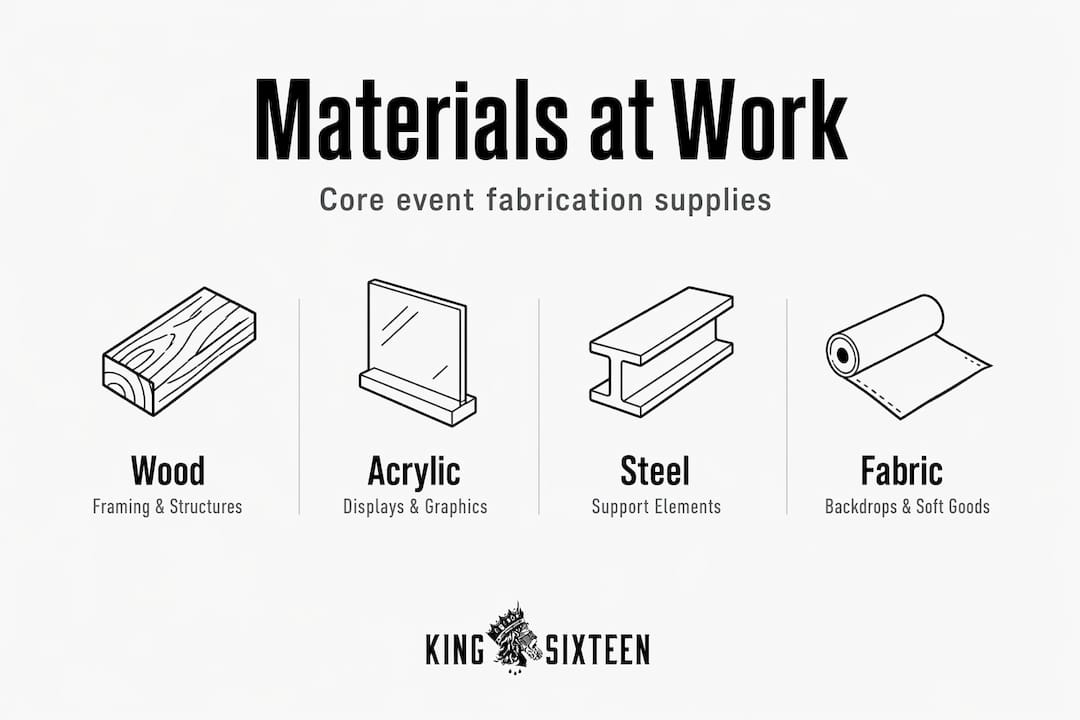
The materials used across these deliverables span wood, foam, steel, fabric, acrylic, printed graphics, and specialty finishes. The choice of material affects both the look and the long-term durability of the piece. A team with in-house fabrication capability can prototype, test, and revise details before anything ships to site. That control directly improves quality.
Pro Tip: Ask any fabrication vendor whether they build in-house or subcontract. In-house shops have faster iteration cycles, tighter quality control, and clearer accountability when something needs to change on short notice.
The collaboration between your marketing team and a fabrication partner is where bespoke event production really takes shape. The most productive partnerships start during the concept phase, not after the design is finalized. When fabricators are involved early, they can flag what is actually buildable within your timeline and budget before you fall in love with something that requires six weeks of lead time you do not have. This is the model Kingsixteen uses across its experiential marketing work. Design and build teams communicate from day one, which means fewer surprises and faster execution on site.
Production timelines: what to expect from start to finish
One of the most common errors marketing teams make is treating fabrication like a print order. It is not. Physical builds require sequential work: design, engineering review, material sourcing, fabrication, finishing, quality check, shipping, and installation. Each phase has its own dependencies.
Here is a realistic timeline breakdown for a mid-size to large custom event environment:
- Pre-production and planning: 4 to 12 weeks depending on project complexity. This covers design development, approvals, engineering reviews, and material procurement.
- Fabrication and finishing: 2 to 6 weeks for the physical build, depending on scale and the number of custom pieces involved.
- Logistics and shipping: 1 to 2 weeks, sometimes more for international events or oversized structures.
- Load-in: Anywhere from 4 to 72-plus hours depending on venue access windows, union labor rules, and structural complexity.
- Build and install on site: Typically 1 to 3 days for mid-size events with complex staging and AV integration.
- Rehearsals and pre-show checks: Often a half-day to full day before doors open.
- Teardown: Usually faster than build but still requires coordinated labor and logistics scheduling.
For substantial outdoor or structural builds, 8 to 12 weeks of total lead time from brief to opening is a realistic baseline. Smaller projects using modular or semi-custom components can often move in 4 to 6 weeks.
What most planners do not fully account for is that build schedules are dominated by approvals, logistics coordination, and venue load-in windows rather than fabrication time alone. A venue that allows access only 24 hours before show open changes your entire installation plan, regardless of how early the fabrication is complete.
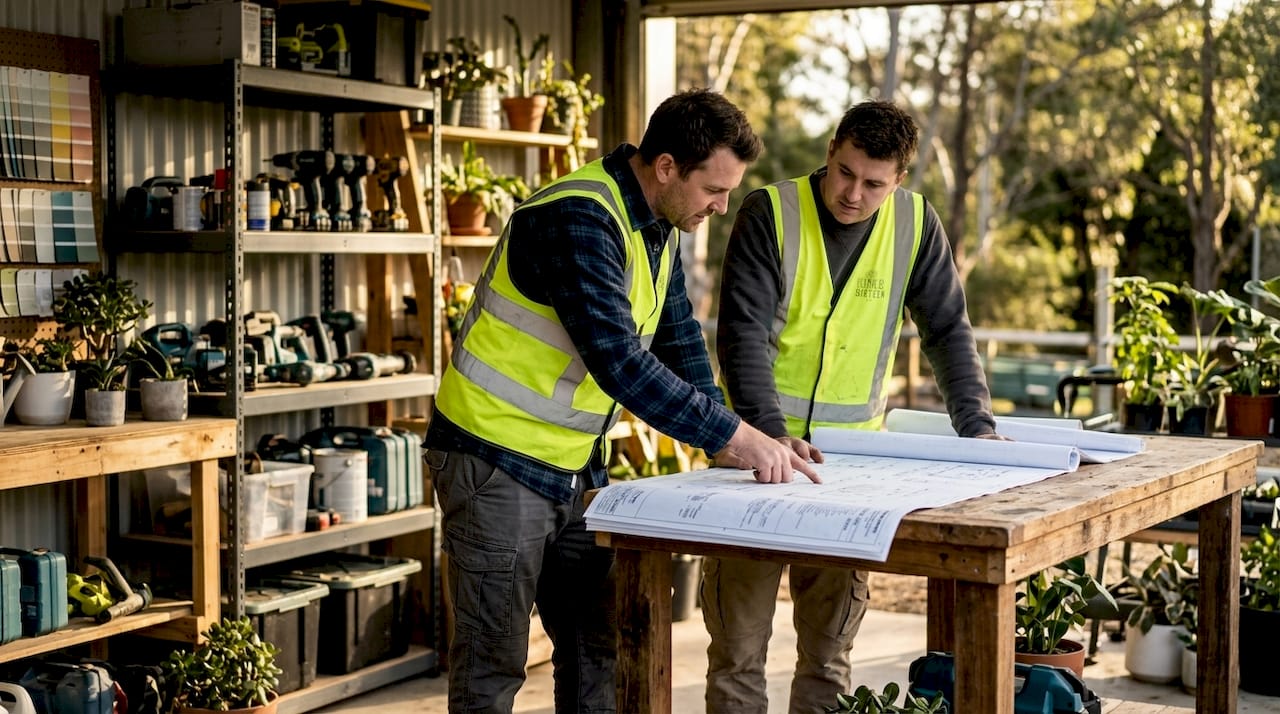
The practical move is to lock your venue access agreement and staffing plan at the same time you brief your fabrication partner. These three elements are interdependent. Securing them in parallel, rather than sequentially, is one of the most effective ways to compress your overall timeline without cutting quality.
Pro Tip: If you are working with a tight calendar, ask your fabrication partner about rental-based event structures, which can turn around in 4 to 6 weeks. You can blend rental elements with custom pieces to hit your brand requirements without blowing the schedule.
Budget realities for custom fabrication projects
Custom event staging and fabrication can feel financially unpredictable if you do not understand how costs are structured. The reality is that pricing follows a clear logic once you know the categories.
Here is how costs typically break down across a custom trade show or event environment:
| Cost category | Typical percentage of total budget |
|---|---|
| Design and fabrication | 35 to 45 percent |
| Logistics, shipping, and drayage | 15 to 25 percent |
| Installation and labor | 15 to 20 percent |
| AV, lighting, and technology | 10 to 20 percent |
| Miscellaneous and contingency | 5 to 10 percent |
Total investments for custom trade show environments can range from $5,000 for a simple branded display to $80,000 or more for fully immersive, multi-element builds. The size of the footprint, the number of unique fabricated pieces, and the finishing quality are the three biggest cost drivers.
Rush premiums are a real line item. When you compress the timeline, you are often paying 20 to 30 percent more on fabrication costs alone. That premium rarely feels worth it when you realize it could have been avoided with an earlier brief.
The rental versus full custom question comes up in almost every project. Rental solutions carry lower upfront cost and shorter timelines. Full custom fabrication costs more but gives you brand-specific assets you can reuse across multiple events, amortizing the cost over time. For brands that activate three or more times per year, owning custom assets typically wins on total cost of ownership.
Pro Tip: When reviewing proposals, ask for an itemized breakdown rather than a lump-sum number. This gives you visibility into where cost is concentrated, and it makes it easier to find areas where you can trade off without compromising the most visible brand elements.
Quality and safety standards to require from any fabrication partner
This is the area where marketing professionals most often take partners at their word without verifying. Do not do that.
There are specific standards any credible custom event fabrication company should be able to document:
- Fire-resistant fabric certification: Fabrics used in event environments must comply with NFPA 701-2019 or equivalent. The detail most planners miss is that finishing processes can invalidate certifications. If a fabricator paints, coats, or adheres materials to a certified fabric, the original certification no longer applies unless the piece has been re-tested.
- In-house materials control: The safest fabrication partners maintain oversight of their materials pipeline from sourcing through finishing. Any step outsourced without supervision creates a gap in your quality chain.
- Engineering for outdoor environments: Outdoor builds require structural analysis for wind loading, UV degradation, and precipitation. This is not optional. Venues and local authorities often require stamped engineering drawings before they will approve an outdoor structure.
- Reusability and durability specifications: If you plan to use fabricated assets more than once, ask specifically how they are built for repeated transport and installation. The joint systems, protective cases, and material gauges used for a one-time build are different from those required for a traveling installation.
- Venue and local compliance: Some venues have restrictions on what materials can enter the building, how structures must be anchored, and what certifications labor crews must carry. A fabrication partner with broad event experience will know these requirements before you ask.
Request documentation on all of the above before you sign a contract. A credible partner will have this material ready.
My take on where custom fabrication projects actually go wrong
I've seen a pattern repeat itself across brands of every size, and it almost always starts with the same mistake: the fabrication partner gets briefed too late.
What happens when the marketing team finalizes creative before the fabrication company is in the room is that design decisions get locked in without any production reality check. Then the fabrication team inherits a brief with expensive materials, impossible tolerances, or a lead time that requires weekend fabrication at rush rates. What started as a vision becomes a negotiation about what you can afford to cut.
In my experience, the brands that get the best results treat their fabrication partner as a creative collaborator, not a vendor executing instructions. The event staffing and logistics coordination conversation needs to happen in parallel with the design conversation, not after the renders are approved.
The other thing I've learned is that material and design compromises made under budget pressure tend to show up on event day in ways that photographs capture permanently. A cheap print on a major backdrop. A seam that separated during installation. These are the moments that undercut an otherwise strong activation.
When evaluating partners, I'd prioritize three things: their ability to show you past work at similar scale, their willingness to give you an honest timeline before you push them to commit to yours, and whether they have in-house fabrication or are coordinating subcontractors. The third factor matters more than most planners realize. When a fabrication company controls its own shop, the problem-solving happens faster and the quality control has nowhere to hide.
— Tyler
How Kingsixteen brings custom fabrication to life for your brand
When your brand needs more than a backdrop, the fabrication partner you choose determines everything from the first render to the last piece loaded out of the venue.
Kingsixteen operates as a fully integrated experiential marketing agency, handling design, fabrication, staging, AV, logistics, and staffing through a single point of contact. That means your creative vision and your production reality are always in the same conversation. No gaps between the agency that designed it and the shop that built it. No surprises on load-in day. Kingsixteen has delivered custom fabrication and event design services for brands like Porsche, Ray-Ban, Fossil, and the Natural Diamonds Council, each time building environments that perform as well as they photograph. If you are ready to bring a brand environment to life, start the conversation at kingsixteen.com.
FAQ
What does a custom event fabrication company do?
A custom event fabrication company designs and builds physical brand environments for events, including staging, props, signage, interactive installations, and structural displays. They typically work from a creative brief through to on-site installation and teardown.
How far in advance should I brief a fabrication partner?
For substantial builds, brief your fabrication partner at least 8 to 12 weeks before your event open date. Smaller or modular projects may move in 4 to 6 weeks, but earlier engagement always reduces cost and improves quality.
How do I choose between rental and custom fabrication?
Rental is faster and costs less upfront, making it a good fit for one-off events with tight timelines. Custom fabrication costs more initially but creates reusable brand assets that deliver better value across multiple activations per year.
What safety certifications should I require from fabricators?
Require documented NFPA 701-2019 flame-resistance certification for all fabrics used in your build. Confirm that certifications reflect the final finished state of materials, since coatings and paint can invalidate original certifications if not re-tested.
What is a realistic budget range for custom event environments?
Budgets for custom trade show and event builds typically range from $5,000 for simple branded displays to $80,000 or more for fully immersive multi-element environments. Design and fabrication usually represent 35 to 45 percent of total project costs.