
Brand engagement is not a vanity metric. It's not your follower count, your average likes per post, or even your email open rate. Those numbers tell you that people noticed you. What they don't tell you is whether those people care, trust you, or would choose you over a competitor when it actually matters. For marketing executives and brand strategists at established brands, the real question is: how do you build relationships that move people from passive observers to loyal advocates? This guide breaks down what genuine brand engagement looks like, how to measure it, and how immersive experiential campaigns are redefining what's possible.
Table of Contents
- What is brand engagement? Going beyond awareness and clicks
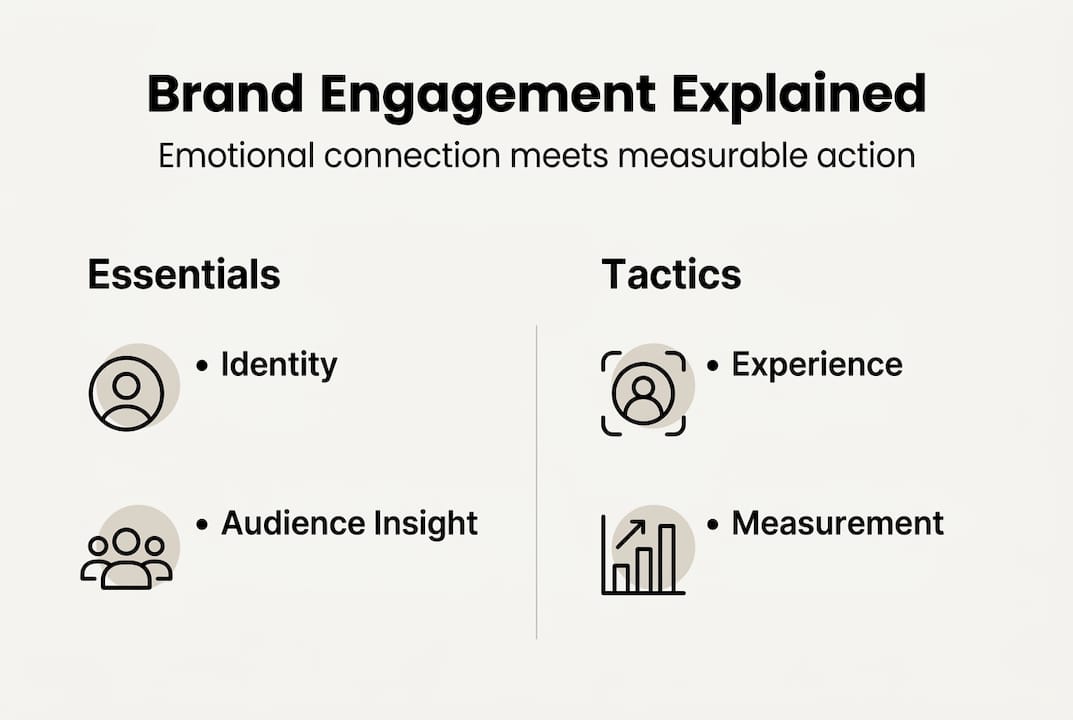
- Core levers of engagement: Identity, audience insights, experience, and measurement
- Experiential campaigns and live events: The new battleground for authentic engagement
- Benchmarking engagement: Platforms, personalization, and what the numbers really mean
- Innovating with AI and employee engagement: The invisible drivers of genuine connection
- Our take: Why deep engagement demands brave creativity and radical transparency
- Bring your brand engagement strategy to life with King Sixteen
- Frequently asked questions
Key Takeaways
| Point | Details |
|---|---|
| Engagement is multifaceted | True brand engagement combines emotional, behavioral, and cognitive interactions beyond simple awareness. |
| Experiential marketing drives results | Immersive campaigns and live events deliver measurable impact on social relevance, loyalty, and revenue. |
| Benchmark with context | Engagement rate benchmarks are useful—but personalizing experiences and focusing on real interactions matter more. |
| AI and employee involvement | Leverage AI for personalization but support it with transparency and employee advocacy for genuine connection. |
What is brand engagement? Going beyond awareness and clicks
Most brands confuse awareness with engagement. Awareness means someone has seen your name. Engagement means they've felt something because of it. These are fundamentally different outcomes, and conflating them leads to misallocated budgets and campaigns that look great on paper but fall flat in reality.
That definition carries real weight. It tells you that engagement is not a single moment. It's a journey across multiple touchpoints, each one building or eroding the relationship. Think of it as a spectrum:
- Emotional engagement: Does your audience feel something when they interact with your brand? Pride, excitement, trust, belonging?
- Cognitive engagement: Are they actively thinking about your brand, comparing it, and choosing it deliberately?
- Behavioral engagement: Are they taking action? Purchasing, sharing, attending, advocating?
- Advocacy: Are they bringing others into the relationship without being asked?
The Elaboration Likelihood Model, a psychological framework, explains why not every interaction triggers real engagement. When a message feels low-relevance or low-risk to someone, they process it passively. They scroll past it. Only when the message connects to something personally meaningful do they engage actively. This is why a beautifully produced ad can generate millions of impressions and zero genuine connection. For high-value brands, the goal is to design touchpoints that consistently trigger active, meaningful processing. That requires more than clever creative. It requires strategic intent.
Core levers of engagement: Identity, audience insights, experience, and measurement
Understanding this multi-dimensional concept, it's crucial to get clear on the core levers executives must pull to strengthen engagement. Best practices point to four essential components that work together as a system.
- Brand identity: Clarity on who you are, what you stand for, and how that translates visually and verbally across every channel. Inconsistency here fragments the relationship before it begins.
- Audience insights: Go beyond demographics. Use social listening tools, segmentation, and direct surveys to understand what your audience values, fears, and aspires to. The more specific your insight, the more relevant your engagement.
- Meaningful experiences: Design touchpoints that match what your audience actually cares about. Personalization is not a luxury; it's the baseline expectation.
- Iterative measurement: Track the metrics that signal real relationship depth, not just surface activity.
| Metric | What it signals |
|---|---|
| Engagement rate (ER) | Surface interaction volume |
| Customer lifetime value (CLV) | Depth of loyalty and repeat behavior |
| Churn rate | Relationship health over time |
| Net Promoter Score (NPS) | Advocacy and referral potential |
Pro Tip: Don't just measure what's easy to measure. If you're only tracking ER, you're reading the first chapter of a much longer story. Build a dashboard that connects behavioral signals to revenue outcomes.
Consistency across touchpoints is as critical as creative innovation. A brand that delivers a stunning event experience but follows up with a generic email sequence breaks the relationship it just built. Every interaction must reinforce the same identity.
Experiential campaigns and live events: The new battleground for authentic engagement
With a clear framework in place, let's see how immersive, real-world experiences have become the most powerful channel for brand engagement. Experiential marketing strategies don't just generate impressions. They create memories, and memories drive decisions.
The numbers back this up. Real-world campaign results show what's possible when brands commit to immersive formats: Visa's "Live at Le Louvre" generated 9.3 million social impressions and a 6% Gen Z relevancy increase. Coach's "Explore Your Story" co-creation initiative delivered 25% revenue growth. An AR scavenger hunt format produced a 340% sponsor engagement increase and $2.3 million in measurable value.
| Campaign type | Key outcome |
|---|---|
| Immersive live event | 9.3M impressions, +6% Gen Z relevancy |
| Co-creation activation | 25% revenue growth |
| AR scavenger hunt | 340% sponsor engagement, $2.3M value |
These aren't outliers. They're the result of deliberate design. Co-creation is particularly powerful because it shifts the audience from observer to participant. When someone contributes to a brand story, they own a piece of it. That ownership translates directly into advocacy.
Pro Tip: When planning auto launch experiences or product activations, design at least one moment where the audience creates something. A photo, a choice, a personalized output. Participation is the fastest path to emotional investment.
For brands targeting Gen Z and Millennial audiences, live events also multiply social reach organically. Attendees share in real time, extending the campaign's footprint far beyond the physical venue. The event staffing decisions you make also shape the experience quality. Every person representing your brand at an activation is a touchpoint. Get that right and your event activation services investment compounds.

Benchmarking engagement: Platforms, personalization, and what the numbers really mean
Immersive experiences drive real outcomes, but how do you measure and benchmark engagement in today's multi-channel landscape? Platform-specific benchmarks give you a starting point, but context determines everything.
2026 social media benchmarks show TikTok leading with a median engagement rate of 4.25%, Instagram at 1.81%, and LinkedIn at 2.94%, the fastest growing year over year at plus 12.6%. These numbers matter, but they don't tell the full story.
| Platform | Median ER (2026) | YoY growth |
|---|---|---|
| TikTok | 4.25% | Stable |
| 2.94% | +12.6% | |
| 1.81% | Moderate |
Personalization dramatically changes these outcomes. Tailored experiences boost engagement by 62%, which means a brand investing in audience segmentation and personalized content delivery will consistently outperform category averages. That's not a marginal gain. It's a structural advantage.
But here's the nuance most brands miss. Consumer engagement research confirms that passive or dormant engagement is common when personal relevance is low. A like on a post is not a signal of intent. A comment that demonstrates understanding of your brand's values is. An event registration that converts to attendance is. Executives need to train their teams to distinguish between active and passive signals.
- Active engagement: Comments, shares with context, event attendance, purchases, referrals
- Passive engagement: Likes, views, impressions, follows without interaction
Benchmarks are guideposts, not guarantees. A digital marketing agency perspective adds value here: your category, audience maturity, and content format all shift what "good" looks like for your brand specifically. Build your own baseline before chasing industry averages.
Innovating with AI and employee engagement: The invisible drivers of genuine connection
Benchmarks are helpful, but true leaders stay ahead by embracing new technology and internal culture shifts that drive the next wave of engagement. Generative AI is changing what's possible for personalization at scale, but it comes with a responsibility that many brands are still learning to manage.
Forrester's B2C marketing research is clear: AI enables personalized content and promotions at scale, but brands must balance automation with human empathy and transparency to avoid dormant engagement. When audiences sense they're being processed rather than understood, they disengage. The technology amplifies your strategy. It doesn't replace the need for genuine connection.
- Use AI to identify audience segments and content preferences at a granularity that human teams can't match manually
- Automate personalized follow-up sequences after live events to extend the engagement window
- Apply AI-driven insights to event data marketing to understand which activations drove the deepest behavioral signals
- Always layer a human voice and authentic storytelling over AI-generated personalization
Employee engagement is the other invisible driver that most external campaigns overlook entirely. SAP's personalization research shows that 76% of consumers expect personalization, and brands that deliver it see measurable retention gains. But personalization at its most authentic starts from the inside. When your employees genuinely believe in the brand and feel empowered to represent it, that conviction shows up in every customer interaction.
Pro Tip: Treat your internal team as your first audience. Brief them on campaign strategy, give them shareable content, and recognize their advocacy. Employee-generated content consistently outperforms brand-generated content in both reach and trust.
The metrics that signal genuine engagement go well beyond ER. Track customer lifetime value, churn rate reduction, loyalty program participation, and the rate at which customers refer others. These are the numbers that connect engagement strategy to revenue reality.
Our take: Why deep engagement demands brave creativity and radical transparency
Here's our candid view on what truly drives brand engagement in 2026. The brands winning right now are not the ones with the biggest budgets. They're the ones willing to take creative risks and be honest about who they are.
Surface-level metrics will always be tempting because they're easy to report. But loyalty, advocacy, and lifetime value are built in moments that can't be captured in a dashboard. An immersive activation that makes someone feel genuinely seen by a brand is worth more than a thousand passive impressions. That's not sentiment. That's strategy.
Radical transparency is the differentiator most established brands resist because it feels vulnerable. But audiences in 2026 have finely tuned filters for inauthenticity. They know when a brand is performing versus when it's being real. The brands that share their process, acknowledge their imperfections, and invite their audience into the story are the ones building relationships that compound over time.
Employee alignment is the force multiplier that rarely gets its due. Every external campaign you run is either reinforced or undermined by the internal culture behind it. At King Sixteen, we've seen firsthand how brands that align their internal teams with their external narrative create experiences that feel coherent and trustworthy at every touchpoint. That coherence is what converts a great event into a lasting brand relationship.
Bring your brand engagement strategy to life with King Sixteen
Ready to move from insight to action? The frameworks in this guide are only as powerful as the execution behind them.
At King Sixteen, we specialize in turning brand engagement strategy into immersive, measurable experiences. From concept to execution, our experiential marketing specialists design activations that create emotional connection, generate real data, and extend well beyond the event itself. Whether you're planning a product launch, a multi-day conference, or a custom brand installation, our full-service event solutions handle every detail so you can focus on the outcome. If you're ready to build experiences that make your brand felt, not just seen, get started with King Sixteen today.
Frequently asked questions
What is the difference between brand engagement and brand awareness?
Brand awareness is simply recognition; brand engagement is the ongoing emotional and behavioral relationship a brand builds with its audience across every touchpoint over time.
How can experiential campaigns impact key engagement metrics?
Immersive campaigns drive measurable growth across impressions, social relevance, and revenue. Visa's "Live at Le Louvre" generated 9.3 million impressions, while Coach's co-creation activation delivered 25% revenue growth.
Are social media engagement rates still relevant in 2026?
Yes, but context matters more than the number itself. TikTok leads at 4.25% median ER, but personalized, tailored experiences consistently outperform platform averages regardless of channel.
How does AI help brands engage at scale?
Generative AI enables personalized content at a scale no human team can match alone, but it must be paired with authentic storytelling and transparent communication to avoid passive or dormant audience responses.
What are the best metrics for measuring deep engagement?
Go beyond engagement rate and track customer lifetime value, churn reduction, and advocacy rates. Brands that personalize consistently see stronger retention, which is the clearest signal of genuine, lasting engagement.
Recommended
- Experiential Marketing | Elevate Your Brand Experience - Act Now — King Sixteen
- Event data: the key to impactful marketing in 2026
- Step-by-step event staffing: your guide to flawless brand experiences
- Auto Launch | Elevate Car Launches Today — King Sixteen
- Content Marketing Strategies Driving Local Leads