
Brand moments are not a soft marketing concept reserved for brand teams with too much budget and too little accountability. When built with precision, they encode long-term memories through multisensory engagement, outperforming traditional advertising on recall, affinity, and downstream revenue. The problem is that most senior leaders confuse a well-produced stunt with a genuine brand moment. One generates a short-lived spike on a dashboard. The other reshapes how customers feel about your brand for years. This guide breaks down what brand moments actually are, why the neuroscience behind them matters, and how to deploy them strategically without falling into the traps that have burned even the most established brands.
Table of Contents
- What defines a brand moment—and why it matters
- The neuroscience and craft: How brand moments imprint on memory
- Strategic value: How brand moments impact engagement, revenue, and affinity
- Pitfalls: Authenticity, timing, and the dangers of cultural misalignment
- Brand moments: What most leaders miss (and what actually works)
- Take your brand moments further with King Sixteen
- Frequently asked questions
Key Takeaways
| Point | Details |
|---|---|
| Brand moments create impact | Crafted, multisensory experiences drive deeper engagement and lasting memories than traditional ads. |
| Measure meaningful outcomes | Real ROI comes from revenue and brand affinity, not just surface-level metrics. |
| Avoid inauthentic risks | Cultural misalignment or generic campaigns can backfire—authentic fit and timing are essential. |
| Experiential trumps interruption | Pull audiences in with context-rich experiences rather than disrupt with ads. |
What defines a brand moment—and why it matters
A brand moment is a specific, emotionally resonant interaction where a consumer connects with your brand in a way that creates a lasting memory. It is not a campaign. It is not a hashtag. It is the instant when context, narrative, and sensory experience converge to make your brand mean something personal to the person experiencing it.
Three elements separate a true brand moment from a forgettable marketing touchpoint:
- Multisensory engagement: The experience activates more than one sense, anchoring the memory through sight, sound, touch, or scent.
- Narrative closure: The story being told resolves with a clear brand cue, so the memory is filed under your brand, not just the event itself. Research confirms that brand moments drive peak memory encoding precisely when story resolution is tied to a brand cue.
- Omnichannel consistency: The moment extends across physical and digital channels, compounding its reach through user-generated content (UGC) and social proof.
The contrast with traditional advertising is stark. A thirty-second pre-roll ad interrupts someone mid-task. A brand moment pulls them in willingly. Experiences pull through context, while traditional ads interrupt, and that distinction compounds through organic UGC in ways paid media cannot replicate.
| Factor | Traditional advertising | Brand moment |
|---|---|---|
| Audience posture | Passive, interrupted | Active, willing |
| Memory encoding | Low, short-term | High, long-term |
| UGC potential | Minimal | Significant |
| Brand affinity impact | Incremental | Transformational |
| Cost efficiency over time | Decreasing | Compounding |
For premium brands, the experiential marketing advantage is especially pronounced. Your audience has seen every ad format. What they haven't seen is a brand that makes them feel something real. Brand moments close that gap, and when paired with tools like Geo Frame Marketing to target the right people at the right location, the strategic lift becomes measurable.
"The brands that endure are the ones that make you feel something you didn't expect. That's not luck. That's architecture."
Brand moments don't just build awareness. They build the kind of conviction that converts browsers into buyers and buyers into advocates.
The neuroscience and craft: How brand moments imprint on memory
With the basics defined, let's examine the neuroscience and multisensory strategies that make a brand moment unforgettable.
The brain doesn't store every experience equally. It prioritizes based on emotional intensity and narrative resolution. This is the peak-end rule at work: people remember the most emotionally intense point of an experience and how it ends, not the average of every moment in between. For brand strategists, this is not abstract psychology. It is a design framework.

When a brand moment reaches its emotional peak and closes with a clear brand cue, the brain files that memory with your brand attached. Multisensory engagement heightens encoding and recall significantly, which means the more senses you activate, the stronger the memory trace. Sight alone is weak. Sight plus sound plus touch creates a memory that surfaces unprompted weeks later.
| Sensory trigger | Memory impact | Practical application |
|---|---|---|
| Visual (signature color, lighting) | High recognition | Consistent brand palette across all touchpoints |
| Sound (music, ambient audio) | Strong emotional recall | Custom soundscapes tied to brand identity |
| Touch (texture, physical objects) | Deep encoding | Branded physical takeaways or interactive surfaces |
| Scent | Longest-lasting recall | Signature scent at flagship activations |
| Taste | Highly memorable | Curated food or beverage tied to brand story |
Why does this matter for UGC? When someone experiences a moment that activates multiple senses and resolves with emotional satisfaction, they share it. Not because a campaign asked them to. Because they want others to feel what they felt. That authentic impulse produces content that performs better than paid creative, because audiences can sense the difference between a staged post and a genuine reaction.
Pro Tip: Design your brand moments around two peaks, not one. The first peak pulls guests in emotionally. The second peak, placed at the conclusion, delivers the brand cue. This two-peak structure dramatically increases the likelihood that the experience is remembered and attributed correctly to your brand. Review impactful event data to understand how post-event measurement can confirm whether your peaks landed.
Strategic value: How brand moments impact engagement, revenue, and affinity
Understanding the science, let's look at the real-world value for senior decision-makers.
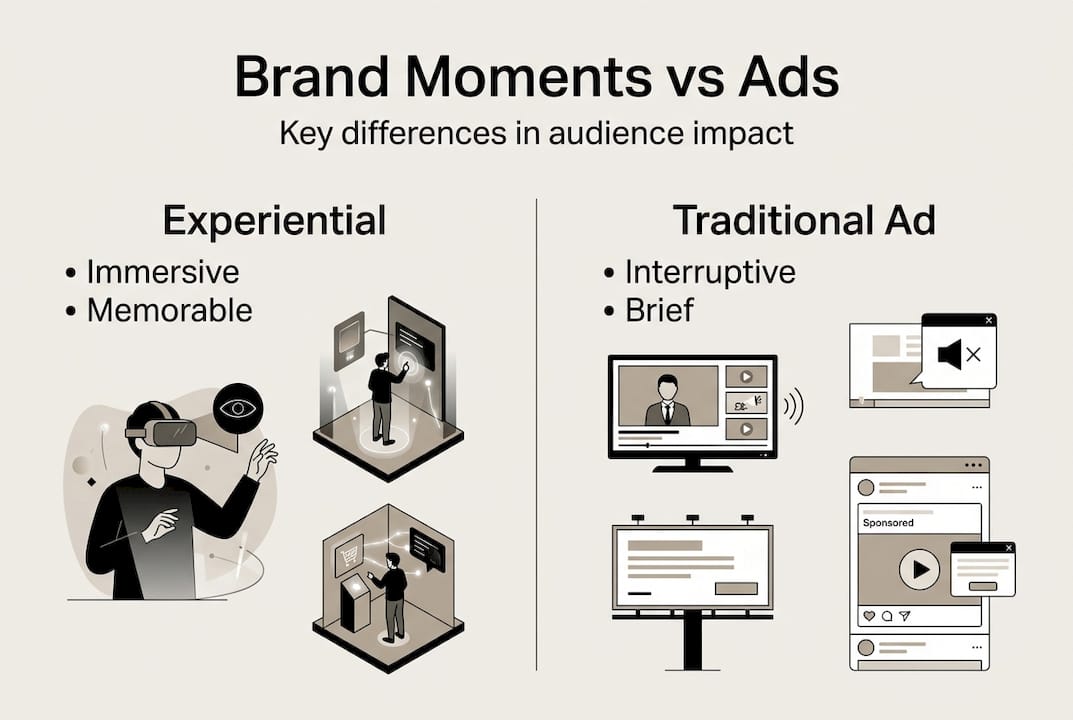
The mistake many marketing leaders make is measuring brand moments the same way they measure paid media. Impressions. CPM. Click-through rates. These metrics were built for interruptive advertising. They are a poor fit for experiences that operate on a fundamentally different mechanism. Vanity metrics alone are not enough; the metrics that matter are affinity and sales conversion, not surface-level engagement numbers.
Here's what premium brands consistently see when they execute brand moments with intention:
- Social amplification: A single well-designed activation generates thousands of organic posts. That UGC reaches audiences your paid media budget could never touch, and it arrives with social proof attached.
- Repeat purchase uplift: Customers who experience a brand moment show measurably higher repeat purchase rates. The emotional bond created in-person translates directly to loyalty behavior.
- Brand affinity scores: Post-event surveying regularly shows double-digit lifts in brand affinity among attendees versus control groups.
- Sales acceleration: Product launches structured around a brand moment consistently generate stronger week-one demand than equivalent launches supported only by digital advertising.
- Staff and partner alignment: Internal stakeholders who experience the moment firsthand become vocal advocates, extending the impact far beyond the consumer audience.
The social media engagement that follows a strong brand moment is not a bonus. It is part of the return. Organic reach compounds over days and weeks as content gets reshared, remixed, and referenced. That compounding effect is what separates brand moments from campaign spikes. For event staffing expertise that ensures every guest interaction reinforces the moment's emotional arc, the execution layer matters as much as the concept.
Smart brands also use event planning tips to structure the logistics that allow the creative vision to land without friction. A powerful concept derailed by poor execution is just an expensive disappointment.
Pitfalls: Authenticity, timing, and the dangers of cultural misalignment
For all the opportunity, there's risk. Here's what your peers often overlook.
Not every brand moment lands. Some backfire spectacularly, and the damage can outlast the campaign budget by years. The most common failure mode is not poor production quality. It's cultural misalignment. Brands that insert themselves into cultural moments they haven't earned the right to occupy face an audience that is increasingly sophisticated at detecting inauthenticity. Opportunistic cultural hijacking causes backlash; authentic fit and precise timing are what separate celebrated campaigns from cautionary tales.
Here are the top pitfalls premium brands must avoid:
- Cultural hijacking: Borrowing the energy of a cultural movement without genuine brand connection. Audiences recognize it immediately, and the backlash is swift.
- Timing errors: Launching a moment that conflicts with a news cycle, cultural event, or competitor activation. Timing is a strategic decision, not a logistics detail.
- Generic messaging: Producing a visually impressive experience with nothing distinctive to say. Spectacle without substance leaves no lasting brand memory.
- Ignoring the post-moment window: Failing to capture and amplify UGC in the 48 hours after an activation. This is when organic sharing peaks.
- Measuring the wrong outcomes: Tracking impressions instead of affinity and sales. Vanity numbers feel good and tell you very little.
Pro Tip: Before greenlighting any brand moment concept, run it through a three-question authenticity filter. Does this idea connect to something our brand has genuinely stood for? Would our existing customers recognize this as true to us? Could a skeptical journalist find a contradiction between this moment and our past behavior? If any answer is uncertain, the concept needs refinement before it goes anywhere near production.
"The brands that misstep don't always do so loudly. Sometimes the damage is quiet: a moment that felt hollow, a campaign that no one remembered."
Recovery from a misaligned moment is possible, but it requires speed, transparency, and a willingness to course-correct publicly. Ensuring brand authenticity from the concept stage is always more efficient than managing reputation risk after the fact.
Brand moments: What most leaders miss (and what actually works)
Here's a candid perspective on how top brands actually win with memorable experiences.
The brands we see chasing viral moments are often the ones that never quite get there. Virality is an outcome, not a strategy. When a premium brand optimizes for shareability over substance, it produces content that gets likes from the wrong people and ignored by the right ones.
What actually works is harder to sell in a planning meeting, because it sounds less exciting. Internal alignment. A narrative that closes cleanly. An experience designed around how memory works, not how social feeds work. The brands we've seen drive genuine revenue from brand moments, including clients in automotive, luxury goods, and retail, share one trait: they knew exactly what they wanted the guest to feel at the end, and they built everything backward from that feeling.
A data-led brand moment strategy is not a constraint on creativity. It is the foundation that makes creativity accountable. The uncomfortable truth is that most brand moments fail not because the budget was too small or the concept too ordinary, but because the brief never defined what success would feel like for the person standing inside the experience.
Take your brand moments further with King Sixteen
Inspired to craft lasting brand moments? Here's how King Sixteen can empower your next strategic move.
At King Sixteen, we design and execute brand moments that are built to last beyond the activation. From concept to fabrication to on-site execution, we manage every element so your team can focus on strategy, not logistics. Our clients come to us because they need experiences that perform, not just impress.
If you're ready to move beyond campaign spikes and build something your audience will remember for years, we're ready to help you build it. Elevate your brand experience with a team that has delivered for Porsche, Audi, Ray-Ban, and Churchill Downs. Discover unique brand experiences that convert attention into genuine, lasting affinity.
Frequently asked questions
What is a brand moment in marketing?
A brand moment is a carefully crafted experience where consumers emotionally connect with a brand, leaving a strong and lasting memory. The most effective ones drive peak memory encoding when the experience resolves with a clear brand cue.
How do brand moments differ from traditional ads?
Brand moments engage audiences through context and multisensory experiences rather than interrupting them. Traditional ads interrupt; experiences pull audiences in willingly, producing stronger recall and organic content amplification.
What risks do brands face when creating brand moments?
The primary risks are misalignment causing backlash through cultural hijacking, poor timing, and generic messaging leading to irrelevance. Inauthentic execution can damage brand equity faster than any campaign can build it.
How do you measure the ROI of a brand moment?
True ROI comes from tracking revenue impact, repeat purchase behavior, and brand affinity scores alongside organic reach. Brands should measure beyond vanity impressions to capture the full strategic value of the experience.