Planning a company retreat sounds straightforward until you're three months out and still debating objectives, juggling vendor quotes, and fielding questions about dietary restrictions from 60 employees. A skilled company retreat event planner does more than book a nice venue. The role connects organizational strategy to lived experience, turning a few days away from the office into something that genuinely shifts how teams work together. This guide walks you through every stage of the process, from goal setting through post-retreat follow-up, so your investment delivers results you can measure.
Table of Contents
- Key takeaways
- What a company retreat event planner actually does
- Planning timelines and budgets that hold up
- Venue selection and logistics that actually work
- Building an agenda that creates space for real connection
- Turning retreat insights into lasting organizational change
- My honest take on what makes retreats actually work
- Let Kingsixteen handle the complexity
- FAQ
Key takeaways
| Point | Details |
|---|---|
| Start with clear objectives | Define specific, measurable goals before any venue search or activity planning begins. |
| Plan well in advance | Most retreats require 6 to 12 months of lead time to secure the right venue and vendors. |
| Design the agenda intentionally | Balance structured sessions with unstructured time to avoid over-scheduling and maximize connection. |
| Assign an onsite logistics lead | One dedicated point person on the ground keeps execution smooth while organizers stay present. |
| Build in follow-up before you leave | Schedule accountability check-ins and assign action item owners before the retreat ends. |
What a company retreat event planner actually does
Most corporate leaders approach retreat planning as a logistics exercise. Book a venue, schedule some team activities, arrange meals, done. But the most impactful retreats are designed around outcomes, and the difference between a forgettable trip and a genuinely productive offsite comes down to intentional planning at every stage.
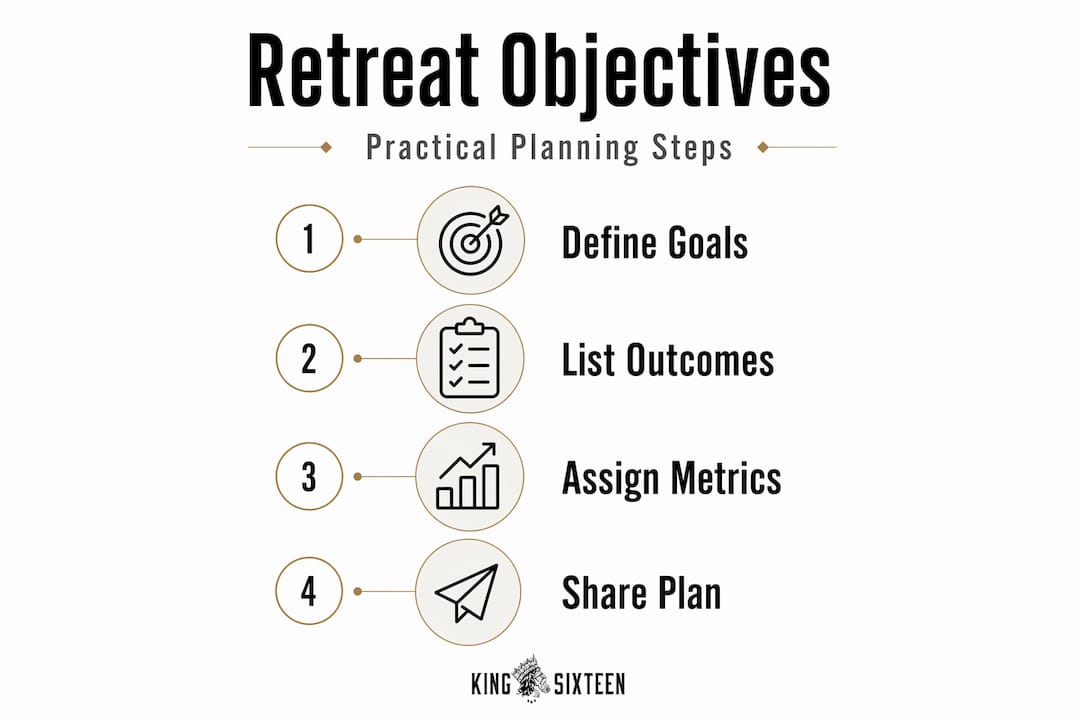
A corporate retreat planner's first job is helping you define what success looks like. Before any venue is considered, you need clarity on what the retreat is meant to accomplish. Common objectives include:
- Team cohesion: Strengthening relationships across departments or between remote employees who rarely share physical space
- Strategic alignment: Getting leadership teams on the same page about priorities for the year ahead
- Culture reinforcement: Embedding company values through shared experience rather than slide decks
- Innovation and problem-solving: Creating space for creative thinking outside the pressure of day-to-day operations
Each of these objectives shapes every downstream decision. A retreat focused on innovation needs breakout spaces and time for divergent thinking. A culture-building retreat for a hybrid team needs programming that creates equal access to shared experiences. In-person gatherings build social capital, including the trust and informal norms that make distributed teams actually function, and that fact alone makes the objective-setting conversation worth slowing down for.
Pro Tip: Write your retreat objectives as measurable outcomes, not feelings. "Increase cross-functional trust" is vague. "Schedule 20 cross-functional project introductions during the retreat" gives you something to track.

Planning timelines and budgets that hold up
One of the most consistent mistakes in corporate retreat management is starting too late. The ideal planning window is 6 to 12 months in advance, with a minimum of 3 months for groups under 100 people. Destination retreats and larger groups need the full 6 to 9 months simply to secure venues with the right capacity and availability.
Budget planning deserves the same discipline. Corporate retreat costs typically run $500 to $1,000 per person for local or smaller events, and $3,000 to $4,000 per person for multi-day international retreats. A standard daily budget benchmark lands at $300 to $500 per person per day. Neither number is a surprise once you account for venue, travel, accommodations, food, facilitators, and activities, but leadership teams consistently underestimate total cost when they only price the venue.
A standard milestone framework for retreat planning looks like this:
- 90 days out: Finalize objectives and success metrics, establish total budget, begin venue search, identify key facilitators or speakers
- 60 days out: Confirm venue and accommodations, book travel, finalize vendor contracts, send save-the-dates to attendees
- 30 days out: Lock the agenda, distribute pre-retreat communications, confirm dietary and accessibility needs, brief the onsite logistics team
- One week out: Final headcount confirmation, run-of-show walkthrough, contingency check for weather or travel disruptions
Booking travel later than 45 days out drives up costs and limits options significantly. Getting travel locked in the 60-day window is not optional for groups flying to a destination, it is a direct cost-control measure.
Pro Tip: Build a 10 to 15 percent contingency line into your budget from day one. Unexpected costs are not exceptions in retreat planning. They are the rule.
Venue selection and logistics that actually work
The venue does more than provide a backdrop. It shapes the energy of the retreat. A conference room at a suburban hotel sends a very different signal than a working ranch in the Hill Country or a boutique hotel in a walkable city. Your choice of space communicates what kind of experience you intend this to be.
When evaluating venues as an offsite meeting planner, weigh these factors together rather than separately:
- Capacity and configuration: Can the space support both full-group sessions and breakout formats without feeling cramped or awkwardly spread out?
- Ambiance and separation from routine: Does the venue feel distinct enough from the office environment to shift mindsets?
- Accessibility: Can your full team reasonably get there, including team members with mobility needs or those traveling from different cities?
- Technology and AV: Does the venue support your technical requirements, or will you be shipping in your own infrastructure?
- Built-in amenities: Outdoor spaces, wellness facilities, and casual gathering areas support the unstructured time that makes retreats work
The logistics layer underneath venue selection is where retreats either stay on track or quietly fall apart. Travel coordination, room assignments, dietary accommodations, agenda technology, and contingency planning all require ownership. Assigning one dedicated onsite point person to manage logistics allows everyone else, including the organizer, to fully participate rather than spend the retreat playing coordinator. This is especially true for multi-day events where the run-of-show changes daily.
For teams exploring private event logistics, the level of detail required for a 50-person offsite and a 200-person corporate retreat are very different animals, and that gap is where professional retreat planning services earn their keep.
Building an agenda that creates space for real connection
Here is a counterintuitive truth about retreat agendas: the most valuable moments are often the ones you do not schedule. Over-scheduling is the most common agenda design mistake, and it costs you the spontaneous conversations, informal problem-solving sessions, and personal connections that are the whole point of getting people in the same place.
A strong agenda as a team building event coordinator blends structured programming with genuine breathing room. That means:
- Morning sessions for focused work, strategic discussion, or facilitated workshops when energy is high
- Mid-day transitions with enough buffer that meals become social time rather than rushed fuel stops
- Afternoon slots reserved for experiential activities or breakout groups, where the agenda can flex based on group energy
- Evening programming that is optional or lightly structured, so attendees have real choices about how they spend their time
Retreats designed as culture-building events need embedded rituals: a nightly reflection, a shared meal format, a team activity that becomes a reference point people talk about afterward. For hybrid teams especially, these rituals do the heavy lifting that weekly video calls cannot. They create shared memory, and shared memory is the raw material of team identity.
Wellness integration is worth taking seriously too. A 20-minute morning walk option, access to a fitness facility, or a structured mindfulness session gives people tools to show up at their best during the substantive programming.
Turning retreat insights into lasting organizational change
The work does not end when the last session wraps. Post-retreat evaporation is a real pattern: teams return energized, insights dissolve into inbox backlogs within two weeks, and six months later the retreat feels like a pleasant memory with no measurable outcome. Preventing that pattern requires structure built before the retreat even ends.
Here is a practical follow-up process for corporate retreat planning that protects the investment:
- Close with action items, not summaries: Before the final session ends, document specific decisions, assign owners, and attach deadlines. Avoid generic "key themes" wrap-ups that sound meaningful but drive nothing.
- Send a retreat summary within 48 hours: A concise written recap with commitments, owners, and timelines gives everyone a shared reference point and signals that leadership takes the outcomes seriously.
- Schedule a 30-day check-in before people leave: Put a follow-up meeting on the calendar while you are still in the room. Teams that schedule accountability before returning to work are far more likely to follow through.
- Conduct a 90-day review: Measure progress against the success metrics you defined in the objective-setting stage. This is where the retreat becomes a strategic investment, not just a line item.
- Gather attendee feedback within one week: A short survey captures impressions while they are fresh and generates data to improve the next retreat.
The organizations that get the most value from retreats are the ones that treat follow-up as part of the event design, not an afterthought. Human connection built during the retreat reduces trust barriers and eases collaboration when people return to their daily work, but only if the structural follow-up exists to channel that energy.
My honest take on what makes retreats actually work
I've seen retreats done beautifully and retreats done expensively with almost nothing to show for it. The single clearest predictor of outcome is whether leadership can articulate, in one sentence, what success looks like before the planning starts. Not "we want people to feel more connected." Something specific. The teams that arrive with clarity leave with results.
What I've also found is that the onsite logistics lead is the most consistently undervalued hire in retreat planning. When the organizer is simultaneously running the agenda, managing vendor questions, and checking room assignments, they are not present for the conversations that matter. That role needs to be someone else's job entirely.
The other pattern I keep seeing is retreat agendas that are packed because leadership is afraid of silence. Free time feels unproductive on paper. In practice, it is often where the most important conversations happen. A 45-minute block labeled "unstructured exploration" is not wasted. It is where your senior engineer and your head of product finally talk about the thing they have been avoiding for six months.
For hybrid and distributed teams, retreats carry more weight than most leaders realize. The social capital built in person takes months to develop through video calls alone. Getting people in a room together, intentionally, with good programming and real breathing room, is one of the highest-leverage investments a leadership team can make.
— Tyler
Let Kingsixteen handle the complexity

Planning a retreat that actually delivers on its promise takes more than a venue and a catered lunch. Kingsixteen specializes in full-scale corporate experiences that combine strategic design with flawless execution. From venue sourcing and agenda design to onsite logistics and post-event reporting, our team manages every moving part through a trusted vendor network built over years of working with brands like Porsche, Audi, and Ray-Ban. You focus on your people. We handle everything else. Professional planning services often offset their fees through vendor relationships and cost savings that internal teams cannot access on their own. Reach out to explore corporate retreat options and see what a professionally managed retreat looks like from start to finish.
FAQ
How far in advance should you hire a retreat planner?
For most corporate retreats, start the planning process 6 to 12 months out. Groups under 100 people can work with a 3-month minimum, but destination retreats require more lead time for venue availability and travel coordination.
What does a company retreat event planner typically cost?
Fees vary based on scope, but professional planners frequently offset their cost through vendor relationships and bulk pricing. Overall retreat budgets typically run $500 to $1,000 per person for domestic events and $3,000 to $4,000 per person for international or multi-day experiences.
How do you measure the success of a corporate retreat?
Define success metrics before the retreat, not after. Track outcomes like cross-functional project starts, decision implementation rates, and employee engagement scores in the 30 to 90 days following the event.
What is the biggest mistake in corporate retreat planning?
Over-scheduling the agenda is the most common error. Leaving intentional unstructured time increases psychological safety, drives organic connection, and ultimately produces better outcomes than back-to-back programming.
Do you need a dedicated onsite coordinator for a retreat?
Yes. Assigning one person specifically to logistics on the day allows organizers and leadership to fully participate. When the planner is also managing vendor questions and room assignments, the event experience suffers for everyone.