Your brand's reputation at a product launch or major activation can hinge entirely on the people holding it together on the ground. One misplaced brand ambassador, an understaffed registration desk during peak arrival, or a demo specialist who can't answer product questions confidently can unravel months of planning in minutes. For marketing executives managing high-value experiential programs, staffing isn't a logistical afterthought. It's a strategic lever. This guide walks you through a systematic, field-tested event staffing process from initial role mapping to post-event analysis so you can execute with precision and protect the brand experience your audience expects.
Table of Contents
- Establishing event staffing requirements
- Calculating optimal headcount and scheduling
- Selecting and training staff for brand impact
- Managing execution: Avoiding common pitfalls and last-minute disasters
- Reviewing results: Post-event staffing analysis for continuous improvement
- Why most event staffing processes break—and how top brands get it right
- Elevate your brand with expert event staffing solutions
- Frequently asked questions
Key Takeaways
| Point | Details |
|---|---|
| Define roles early | Clearly outline all staffing roles and requirements before event scheduling. |
| Calculate and staff for peaks | Determine headcount needs for high-traffic periods and use surge ratios when necessary. |
| Prioritize brand training | Invest in brand immersion and situational training to maximize staff impact. |
| Plan contingencies | Prepare backup staff for breaks, emergencies, and peak crowd moments. |
| Analyze and improve | Post-event data analysis drives smarter staffing and higher ROI for future activations. |
Establishing event staffing requirements
Once you understand the high stakes of staffing, your first priority is ensuring every role and requirement is clearly mapped. This foundational step is where most brands either get it right or plant the seeds for day-of chaos.
The event staffing guide framework begins with a full role inventory. For experiential and brand-driven events, core roles typically include:
- Brand ambassadors who engage guests, communicate messaging, and represent the brand's personality
- Greeters who manage first impressions at entry points and create the emotional tone guests carry into the experience
- Supervisors who oversee zone operations, manage staff issues, and serve as the link between the event leadership and the floor team
- Demo specialists with specific product or technical knowledge who guide guests through hands-on interactions
- AV technicians who maintain equipment, troubleshoot live issues, and keep presentations running without interruption
- Security personnel who protect guests, manage crowd flow, and handle access control
- Floaters who cover breaks, support high-traffic zones, and provide backup wherever pressure builds
Standard staffing ratios give you a reliable starting baseline: waitstaff at 1 per 12 guests, bartenders at 1 per 50, supervisors and hosts at 1 per 75, and AV or cleaning staff at 1 per 100. For experiential activations, these numbers shift significantly because the nature of brand-driven engagement is more interactive, more demanding, and higher stakes.
| Role | Standard ratio | Experiential adjustment | Specialized need |
|---|---|---|---|
| Greeters | 1:75 | 1:40 | Brand tone training |
| Brand ambassadors | N/A | 1:20 | Script + product fluency |
| Demo specialists | N/A | 1:15 | Technical certification |
| AV technicians | 1:100 | 1:50 | Live event troubleshooting |
| Supervisors | 1:75 | 1:30 | Crisis response training |
| Security | 1:75 | 1:75 | Access control protocols |
The event branding essentials behind each role matter as much as the headcount. A greeter at a luxury automotive activation isn't simply directing parking. They're setting a tone, speaking to your brand's values, and making an attendee feel like they arrived somewhere worth being.
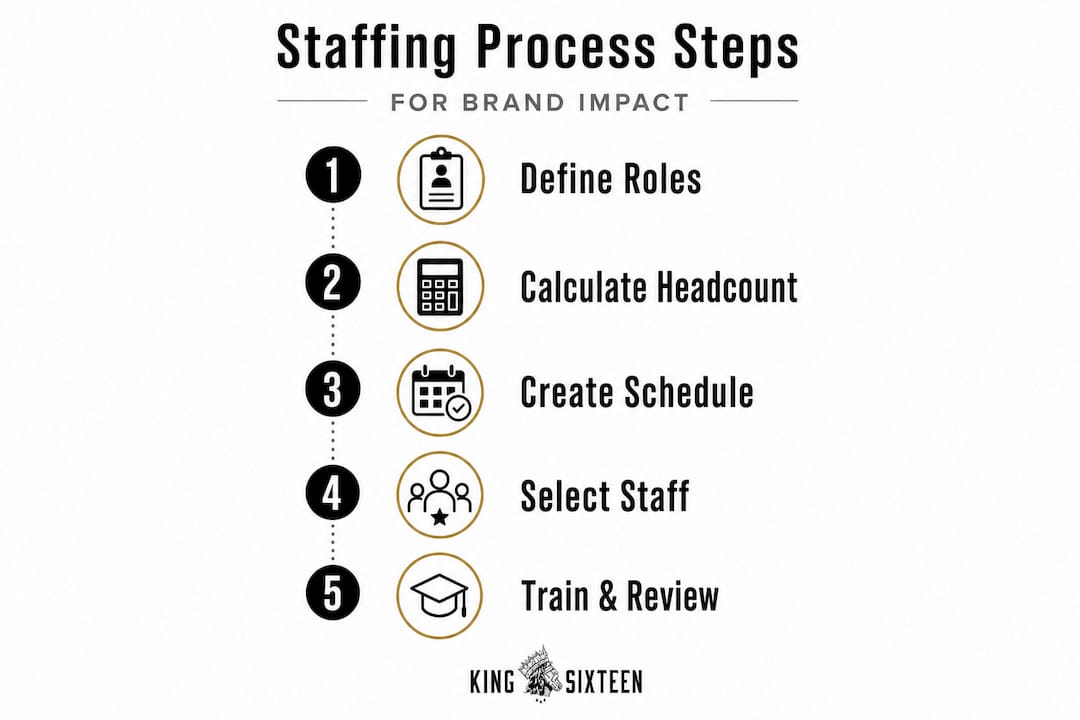
The staffing plan process involves defining roles, calculating headcount based on peak moments and ratios, scheduling shifts with overlaps, assigning zones, training staff on brand and scripts, and building contingencies including the 15-30-60 backup rule. That rule specifies 15% backup for critical roles, 30% for high-risk shifts, and 60% reserve for peak moments. Build it into your plan before you need it.
Pro Tip: Always designate floater positions explicitly in your staffing plan. Floaters are not extras. They are the buffer that keeps your event from collapsing during break rotations and unexpected surges. Budget for them, train them, and schedule them intentionally.
Calculating optimal headcount and scheduling
With your ideal roles outlined, it's time to determine exactly how many people you need, when, and where.

Headcount calculation is not a flat formula. It's a layered process that accounts for venue size, function type, time-of-day demand curves, and the intensity of the attendee experience you're delivering.
Here's a step-by-step approach:
- Map your venue zones. Divide the venue into functional areas: entry, registration, main experience floor, demo zones, catering, VIP, and exit. Each zone has its own traffic pattern and staffing logic.
- Estimate peak occupancy per zone. Use event registration data, past event benchmarks, or venue capacity percentages to estimate how many guests will be in each zone at peak times.
- Apply role-specific ratios. For conference staffing, use 1 registration staff per 150 attendees at baseline and 1 per 75 during surge periods. Add 1 session monitor per breakout room and 1 usher per 250 seats. Plan 1 floater for every 10 staff members scheduled.
- Layer in trade show or activation requirements. For booth-based events, trade show staffing benchmarks recommend 1 staff per 50 square feet, with dedicated greeters, qualifiers, and demo specialists. During peak footfall, push toward a 1:4 staff-to-visitor ratio to maintain quality engagement and avoid bottlenecks.
- Build your shift schedule with overlaps. Never schedule hard handoffs. Build 15 to 30 minute overlaps between shifts so incoming staff can be briefed and outgoing staff can close out their zone properly.
| Metric | Standard event | High-impact experiential |
|---|---|---|
| Registration staffing | 1:150 guests (1:75 surge) | 1:75 guests (1:40 surge) |
| Floor engagement | 1:50 attendees | 1:20 attendees |
| Demo or activation | 1:30 guests | 1:10 guests |
| Floater reserve | 1:15 staff | 1:10 staff |
| Supervisor coverage | 1:75 staff | 1:30 staff |
Critical warning: Skipping floater and captain roles is one of the most expensive staffing decisions you can make. When a front-line team member steps away for a break and there's no coverage, you lose engagement momentum, create service gaps, and expose your brand to guest frustration at the exact moments your team should be operating at full capacity. The captain role in particular is essential. Without a designated team leader on the floor, confusion multiplies quickly and decision-making stalls. Budget for these roles without exception.
For trade show staffing strategies and conference staffing best practices, surge planning is equally important. Identify your two or three highest-risk time windows, such as opening rush, keynote transitions, and end-of-day crowd builds, and staff those windows at your peak ratio, not your baseline.
Selecting and training staff for brand impact
After you've quantified your staff needs, focus shifts to finding and preparing talent who'll bring your brand to life.
Vetting should evaluate two things equally: relevant event experience and personal attitude. Technical competency matters, but a candidate who genuinely connects with people and represents your brand's energy is worth far more than someone with an impressive resume who goes through the motions. For luxury and experiential contexts, this distinction is everything.
The onboarding process for a high-impact event should include immersion in your brand's values, not just a briefing on logistics. Staff should understand what your brand stands for, how it speaks, what it avoids, and what emotional experience you're engineering for the guest. This is especially critical for brands in the premium and lifestyle space where every interaction is part of the story.
Key training areas to cover:
- Product or experience knowledge: Staff should be able to answer questions confidently and accurately without referring to notes or appearing uncertain
- Brand scripting and tone: Provide approved language, key messages, and examples of off-brand language to avoid
- Guest engagement techniques: Train staff on how to initiate conversations, read guest body language, and transition from greeting to meaningful interaction
- Crisis and complaint response: Prepare staff for scenarios including unhappy guests, technical failures, and safety concerns with clear escalation steps
- Zone and rotation protocols: Make sure every staff member knows their zone, their shift, their supervisor, and their floater coverage before the event begins
Elite brands seek agencies with deep brand immersion training, crisis prevention protocols, and the confidence to offer strategic pushback rather than simply executing orders. The best event staffing partners challenge your thinking, identify gaps you haven't considered, and bring operational discipline that elevates the final product.
Budget realistically for quality. Event staffing costs typically run $28 to $60 per hour including base pay and premiums, with agency fees adding 18 to 25 percent on top. Training costs range from $50 to $150 per person, and equipment costs vary by role. Staffing 100 people for an 8-hour event can run approximately $36,000 in total. That number sounds significant until you compare it to the cost of a damaged brand impression in front of the wrong audience.
Reviewing your brand identity strategies during onboarding is not optional for premium activations. It's how you ensure that every person wearing your brand on the floor actually understands what that brand means.
Pro Tip: For luxury and experiential activations, replace generic staff briefings with what we call brand immersion sessions. Walk staff through the brand's visual world, play examples of the right tone, and role-play guest interactions before the event day. The investment in preparation pays off in the quality of every single guest touchpoint.
Managing execution: Avoiding common pitfalls and last-minute disasters
Even with smart planning, flawless execution on event day means staying vigilant against recurring mistakes.
The most damaging errors in live event staffing are almost entirely preventable. They're not caused by bad luck. They're caused by skipped steps and underestimated risks.
Common brand-damaging event mistakes that are entirely preventable: No floaters means coverage gaps during breaks. Understaffing peak windows leads to visible service failure. Missing team captains create confusion and slow decision-making when it matters most. Unbriefed or undertrained staff actively harm the brand by delivering inconsistent or off-message interactions. Each of these failures has a clear upstream cause and a straightforward solution. Plan for them before they plan for you.
Here's a last-minute readiness checklist to run through in the 24 hours before your event:
- Confirm all staff have received their zone assignments and shift schedules in writing
- Verify that every supervisor and captain knows their escalation contacts and decision authority
- Conduct a final headcount and identify any open positions that need emergency backfill
- Test all AV and technical equipment with the staff who will be operating it on site
- Brief all staff on the day's run-of-show, key moments, and guest flow expectations
- Confirm floater assignments and ensure they know every zone they may be called to cover
- Establish a group communication channel for real-time coordination during the event
For rapid-response scenarios during the live event, designate one supervisor as the operations lead with authority to redeploy staff across zones without going up the chain. This prevents the decision lag that turns a manageable situation into a visible problem.
Reviewing brand activation common mistakes before finalizing your plan is worth the time. Patterns repeat across events, and awareness of common campaign errors in execution helps your team anticipate rather than react.
Reviewing results: Post-event staffing analysis for continuous improvement
Once the event wraps up, your job shifts to validation and ongoing improvement.
The most sophisticated marketing teams treat every event as a data collection opportunity. Your staffing debrief is where operational intelligence gets built. Skip it, and you'll make the same miscalculations next time. Build the habit, and your events get measurably better with each execution.
Key metrics to capture include:
- Attendance vs. expectations: How did actual guest flow compare to your staffing model? Were any zones chronically over or understaffed?
- Staff utilization rates: Were floaters deployed heavily or barely used? This tells you whether your contingency ratio was calibrated correctly.
- Engagement outcomes: How many meaningful interactions occurred per brand ambassador? Did demo zones hit their conversion or interaction targets?
- No-show and late arrival rates: Track how many staff arrived late or didn't show. Use this data to refine your backup staffing model.
- Guest experience feedback: Survey or interview attendees and brand team members separately. Both perspectives reveal gaps the other group misses.
Post-event data analysis on attendance, engagement, and no-shows provides the foundation to refine future staffing models and improve productivity metrics over time.
Your post-mortem process should include:
- A structured debrief with event supervisors within 48 hours of the event
- A written summary of staffing gaps, coverage wins, and unexpected scenarios
- Updated role documentation and ratio benchmarks based on actual performance
- A revised contingency model if the 15-30-60 rule was tested and fell short
- Integration of all learnings into your master event playbook for future reference
Why most event staffing processes break—and how top brands get it right
Here's the uncomfortable reality: most brands don't fail at event staffing because they didn't plan. They fail because they planned for logistics and ignored strategy.
The staffing plan becomes a spreadsheet exercise rather than a brand exercise. Roles get filled, ratios get met, and the team shows up on time. But no one on the floor genuinely understands the experience they're supposed to create, and guests feel the difference immediately. They can't explain it, but they sense that something is missing.
Experiential marketing reveals a compelling dynamic: internal sales teams are most effective when protected for deep conversations, while external greeters and qualifiers serve as filters who manage access and warm up prospects. The lesson isn't just about role segmentation. It's about strategic deployment. The best brands think about who should be doing what, and why, before they think about how many.
The other pattern we see consistently at King Sixteen is the cost of choosing vendors who operate as order-takers rather than strategic partners. When an agency simply executes what you request without ever pushing back, questioning your assumptions, or flagging risks, you lose the most valuable thing a great partner offers. Critical thinking applied before problems become visible is where real operational value lives. The brands that win at experiential events invest in partnerships that challenge them, not ones that simply agree.
Data changes the game too. Brands that track innovative marketing strategies tied to staffing performance, including engagement rates, zone utilization, and guest sentiment, build a compounding operational advantage. Each event informs the next one with real numbers rather than gut feelings. That shift from anecdotal to analytical is where experiential programs move from impressive to exceptional.
Elevate your brand with expert event staffing solutions
The framework in this guide gives you the tools to build a staffing process that actually performs under pressure. But the execution layer is where most marketing teams need a true partner, not just a vendor.
King Sixteen brings a turnkey approach to experiential staffing that covers everything from role definition and brand immersion training to on-site supervision and post-event analysis. Our experiential marketing services are built for brands that can't afford a generic experience, and our comprehensive event services model means you have one accountable team managing every moving part. Whether you're running a product launch, a multi-day conference, or a high-traffic brand activation, our private event solutions are designed to make your brand felt, not just seen. Let's build something iconic together.
Frequently asked questions
What is the 15-30-60 backup rule in event staffing?
The 15-30-60 rule involves preparing 15% backup for critical roles, 30% for high-risk shifts, and 60% reserve for peak moments, ensuring coverage for absences or emergencies.
How much does it cost to staff a large event?
Event staffing typically costs $28 to $60 per hour with added agency fees, training, and equipment; staffing 100 people for 8 hours is approximately $36,000 in total.
How do I calculate staff ratios for conferences and trade shows?
Use 1 registration staff per 150 attendees at baseline (1:75 at surge), then apply 1 booth staff per 50 sq ft for trade shows, scaling up during high-traffic periods.
What are the most common staffing mistakes at events?
Unfilled break coverage, missing captains, and insufficient brand training are the leading causes of execution failures that damage brand reputation during live events.
How do I use data to improve future event staffing?
Collect metrics on attendance, engagement, and staff utilization immediately after each event and integrate those findings into your staffing model before planning the next activation.