Luxury brands are losing ground in the one space that once felt untouchable: the minds of their best customers. Ultra-wealthy consumers have seen every billboard, scrolled past every digital ad, and ignored every mass-market campaign. The problem is not the quality of your creative. It is the channel itself. Static advertising was built for a mass audience, and your audience is anything but mass. The brands winning with affluent consumers right now are doing something fundamentally different. They are building moments that people feel, not just see.
Table of Contents
- Why luxury brands need more than traditional advertising
- The power of experiential marketing: Emotional connections and loyalty
- Crafting high-impact luxury experiences: Tactics that work
- Measuring experiential ROI: What luxury brands should track
- What most luxury marketers miss about experiential success
- Elevate your luxury brand through immersive experiences
- Frequently asked questions
Key Takeaways
| Point | Details |
|---|---|
| Emotional connections matter | Immersive experiences outperform traditional advertising by building real brand loyalty. |
| Proven ROI boost | Luxury brands see up to 10x higher ROI and a 25-34% average return with experiential marketing. |
| Exclusivity drives engagement | Invite-only, personalized events create memorable moments that affluent consumers deeply value. |
| Measurement is strategic | Effective tracking links immersive events directly to sales, repeat purchases, and customer lifetime value. |
Why luxury brands need more than traditional advertising
Television, print, and digital advertising share one fatal flaw for luxury brands: they ask nothing of the audience. A consumer can watch a sixty-second car commercial from a couch and feel zero connection to the brand. They are observers, not participants. For high net-worth individuals who already own multiple luxury items, seeing another polished product image produces very little psychological response.
This is where the concept of psychological ownership becomes critical. Psychological ownership means a person mentally "possesses" something before they buy it, or builds such a strong attachment to a brand that loyalty feels personal. You cannot manufacture that feeling through a static image or a clever slogan. It requires genuine interaction, physical presence, and sensory memory. When a guest touches the leather interior of a new vehicle at a private launch event, or holds a diamond necklace under perfectly designed lighting at a curated dinner, the brain registers ownership in a way no ad ever could.
"Experiential marketing creates emotional connections and psychological ownership superior to traditional advertising for ultra-wealthy consumers who already own luxury products."
Affluent audiences have also shifted what they expect from the brands they patronize. Access, surprise, and authentic connection are now table stakes for earning their attention. They do not want to be marketed to. They want to be invited in. Brands that recognize this distinction and build their strategies around unique luxury experiences are pulling ahead of competitors still chasing impressions and click-through rates.
Here is what affluent consumers are asking for from luxury brands today:
- Access: Behind-the-scenes moments, early product reveals, and founder conversations they cannot get anywhere else
- Surprise: Unexpected sensory details, personalized touches, and experiences that feel genuinely rare
- Authentic connection: Real interactions with brand representatives and other like-minded guests, not scripted sales pitches
- Meaning: Events tied to values, craftsmanship, heritage, or purpose that resonate beyond the transaction
With traditional channels falling short for elite consumers, what sets experiential marketing apart?
The power of experiential marketing: Emotional connections and loyalty
Experiential marketing works because it activates memory differently than passive advertising. When a person attends a well-designed brand event, multiple senses engage simultaneously. The brain encodes the memory with more depth, context, and emotion than it would assign to a thirty-second ad. That emotional encoding is what drives loyalty, and the data backs this up clearly.
Research shows that 91% of consumers report more positive brand feelings after attending experiential events, with 85% more likely to purchase as a direct result. Those are not marginal improvements. Those are transformational shifts in consumer sentiment. For luxury brands where a single sale can represent tens of thousands of dollars in revenue, even a modest improvement in conversion from event attendees can justify the investment many times over.
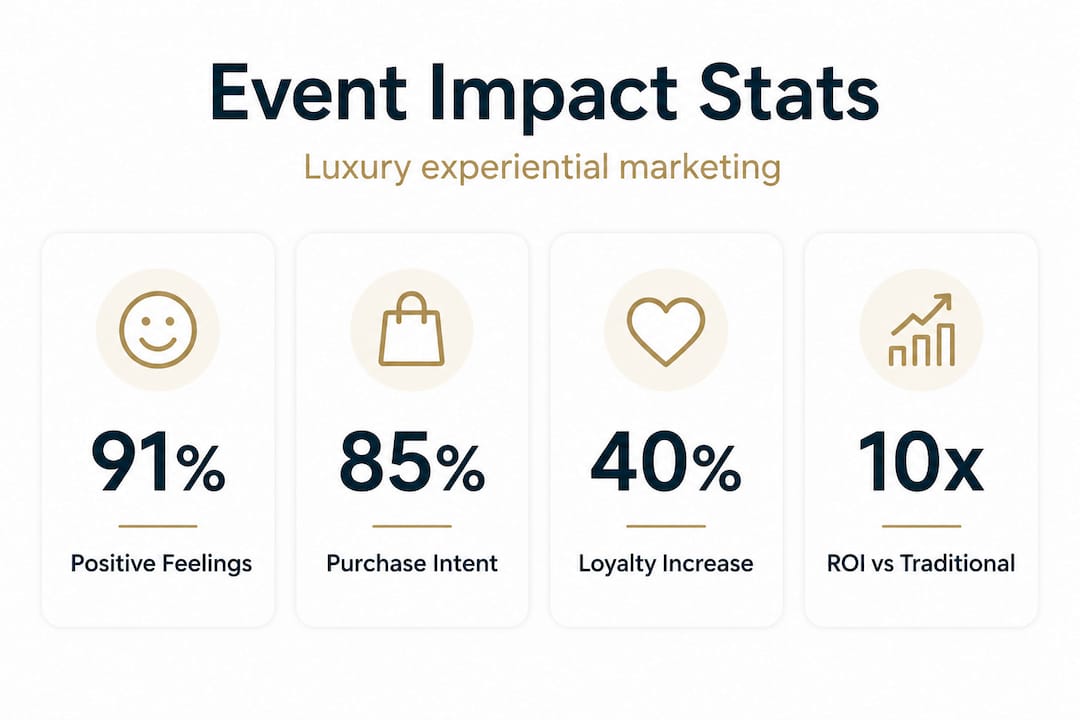
The loyalty numbers are equally compelling. 40% of customers report increased brand loyalty after experiential exposure, and 70% become repeat customers. When you consider the lifetime value of a loyal luxury consumer, those figures represent a compounding financial advantage over brands still relying on reach and frequency.
Here is a side-by-side view of how experiential marketing compares to traditional advertising across the metrics that matter most:
| Metric | Traditional advertising | Experiential marketing |
|---|---|---|
| Emotional engagement | Low to moderate | High |
| Brand sentiment lift | Gradual over time | Immediate and lasting |
| Purchase intent | 20-30% average | 85% after event attendance |
| Customer loyalty increase | Minimal | 40% increase reported |
| Repeat customer rate | Variable | 70% become repeat customers |
| ROI potential | Baseline | Up to 10x higher |
To understand how emotional engagement works in practice, consider a few specific mechanisms:
- Memory encoding: Physical presence at a brand event creates episodic memory, which is among the most durable forms of human memory. Guests recall not just the product but the feeling of being there.
- Social proof in real time: When guests see other high-caliber attendees valuing a brand experience, their own perception elevates. Exclusivity reinforces perceived value.
- Narrative participation: Attendees become part of the brand's story. They are not watching from a distance; they are characters in the experience itself.
- Post-event amplification: High-quality experiential moments generate organic social sharing, which extends reach beyond the room and into the brand's broader audience ecosystem.
The brands we work with that execute experiential well consistently report that memorable brand experiences produce advocates, not just customers. There is a meaningful difference between someone who bought your product and someone who attended your event and told three colleagues about it the following week.
Understanding why experiential marketing resonates is only the first step. Let's see how brands bring these strategies to life.
Crafting high-impact luxury experiences: Tactics that work
Knowing that experiential marketing works is the starting point. Knowing how to execute it at the standard luxury consumers expect is where most brands either succeed or fall short. The mechanics matter enormously, and cutting corners in a high-stakes environment is immediately visible to the guests you most want to impress.
Sensory immersion, exclusivity, and digital integration are the core mechanics that separate forgettable events from ones guests reference for years. Here is how each element works in practice:
- Sensory immersion: Every sense should be considered deliberately. The scent of a space, the texture of surfaces guests touch, the quality of sound, the visual composition of each environment area, and the caliber of food and beverage all contribute to an overall impression. When these elements align with your brand identity, the experience feels coherent and intentional.
- Exclusivity through private event experiences: Invite-only formats are not just logistical decisions; they are brand signals. When guests receive a curated invitation and understand that not everyone was included, their perceived value of the experience rises before they even arrive. The guest list itself becomes a brand statement.
- Digital integration for amplification: Geo-targeted marketing before and during events allows brands to reach the right audience in the right location with precision. During the event, AR/VR components and social sharing prompts extend the experience well beyond the physical space. After the event, retargeting and follow-up sequences maintain the momentum.
- Simplicity in execution: This one surprises many clients. High net-worth guests respond well to frictionless experiences. Complicated check-in processes, crowded spaces, unclear flow, and disorganized logistics all undermine the luxury positioning. The best events feel effortless to the guest because every detail was planned thoroughly in advance.
| Tactic | Implementation approach | Guest impact |
|---|---|---|
| Sensory immersion | Curated scent, sound, lighting, food, texture | Deep emotional memory encoding |
| Invite-only exclusivity | Carefully curated guest list, personalized invites | Elevated perceived value before arrival |
| AR/VR integration through VR event solutions | Product demonstrations, virtual walkthroughs | Extended engagement and novelty |
| Geo-targeting | Location-based ads before and during events | Precise reach to the right attendees |
| Seamless execution | Pre-planned logistics, staffing, flow management | Trust in brand professionalism |
Pro Tip: Always establish clear attribution models before your event launches. Define exactly how you will connect event attendance to downstream revenue, whether that is tracking guest purchase behavior over 90 days post-event, monitoring referral patterns, or measuring changes in brand sentiment scores. Attribution is what transforms experiential from a "soft" investment into a strategic, defensible line item.
With the tactics defined, how can luxury marketers see if these experiences are driving real business value?
Measuring experiential ROI: What luxury brands should track
One of the most common concerns luxury marketing executives raise about experiential investment is measurement. How do you prove that a private dinner or a bespoke product launch delivered financial return? The answer lies in tracking the right KPIs and building your measurement infrastructure before the event happens, not after.
Here are the five most important metrics to monitor:
- Engagement rate: Track how deeply guests interact with your brand during the event. This includes time spent at specific brand activations, conversations with brand representatives, and participation in interactive elements.
- Brand sentiment shift: Survey attendees before and after the event, and track social mentions for sentiment changes. Net Promoter Score (NPS) measured immediately post-event and again sixty days later can reveal the durability of emotional impact.
- Repeat customer rate: As noted, 70% of experiential attendees become repeat customers. Tracking purchase behavior among event guests in the six to twelve months following is one of the most direct ways to quantify loyalty value.
- Sales impact and deal acceleration: For B2B luxury brands or high-consideration purchases, track how many event attendees moved through the purchase funnel faster than non-attendees. Experiential often shortens sales cycles significantly.
- Customer lifetime value (LTV) shift: Compare the long-term purchasing patterns of experiential attendees versus customers acquired through traditional channels. This metric often reveals the most compelling financial argument for experiential investment.
The financial case for this approach is already documented. Experiential events yield 10x higher ROI than traditional channels for luxury brands, with a 25-34% average ROI reported across sectors. Those figures reflect events that were strategically planned and rigorously measured.
Understanding impactful event data before you execute gives you the benchmarks to set realistic expectations and report confidently to stakeholders. Knowing what good looks like is half the battle.
Pro Tip: Integrate digital touchpoints throughout the guest journey. QR codes at physical installations, personalized follow-up emails referencing specific event moments, and post-event retargeting ads all generate behavioral data you can use to track conversion. The physical experience opens the door; the digital thread helps you measure who walked through it. A detailed event execution guide can help your team build this tracking into your run-of-show from the start.
Measurement is essential, but perspective from real implementation highlights what works and what does not.
What most luxury marketers miss about experiential success
Here is the uncomfortable truth we have seen play out more times than we can count: the brands that spend the most on spectacle are often the ones that leave guests feeling the least connected. There is a common instinct in luxury marketing to equate scale with impact. Bigger venue, more elaborate staging, longer production list. But discerning consumers see through that immediately.
Authenticity is not a trend. For ultra-wealthy audiences, it is the filter through which every experience gets evaluated. When an event feels designed to impress rather than designed to connect, guests register the difference. The carefully placed brand logos, the over-rehearsed talking points from the sales team, the obviously forced "surprise" moment at the end of the evening. None of that lands. It reads as insecurity, not confidence.
The experiences that generate the most genuine loyalty are often the smallest and most considered. A dinner with twelve guests and genuine access to a brand founder. A private preview where guests are asked for their real opinions and those opinions are visibly respected. A moment of craft or process revealed candidly, without the polish of a marketing presentation. These are the events guests remember and describe to others.
We also see brands make the mistake of treating experiential as a one-time campaign rather than a strategic discipline. A single event, no matter how well executed, has a ceiling. The brands that compound value over time are the ones building a rolling calendar of experiential strategy insights and touchpoints, creating a rhythm of access and surprise that deepens the relationship with their best customers year over year.
The contrarian view worth considering: if your event could work just as well for a different luxury brand with minor aesthetic changes, it is not differentiated enough. Truly effective luxury experiences are so specific to the brand's identity that guests would know whose event it was even if the logo were removed from the room.
Elevate your luxury brand through immersive experiences
If this article has surfaced a gap between where your current strategy sits and where it needs to go, the good news is that the path forward is clearer than most executives expect.
King Sixteen builds exactly the kind of experiences this article describes, from concept to execution, with zero margin for error. We handle design, fabrication, staffing, digital integration, and logistics through a turnkey model that removes the coordination burden from your team entirely. Whether you are looking to launch an experiential campaign around a new product or create a series of private luxury events for your best clients, we bring the strategic clarity and production discipline that luxury brands require. Let's build something your guests will still be talking about next year.
Frequently asked questions
What is experiential marketing in the context of luxury brands?
Experiential marketing uses immersive events and carefully designed environments to create emotional connections and psychological ownership that no static advertising format can replicate for ultra-wealthy consumers. It places the guest inside the brand story rather than showing it to them from a distance.
How does experiential marketing improve brand loyalty for luxury products?
Direct event attendance creates measurable loyalty shifts, with 40% of customers reporting increased brand loyalty and 70% returning as repeat customers. For luxury brands where lifetime customer value is high, those numbers represent a significant long-term revenue advantage.
What is the ROI for experiential marketing in luxury sectors?
Luxury brands investing in well-executed experiential programs can expect 10x higher ROI than traditional channels, with an average reported ROI of 25-34% across sectors. Measurement infrastructure built before the event determines how accurately you can capture and report that return.
What are the key elements of a successful luxury experiential event?
The most effective luxury events combine sensory immersion, invite-only exclusivity, seamless execution, and digital integration for post-event amplification. Attribution models linking event attendance to downstream sales and lifetime value are what separate strategic experiential programs from one-off brand moments.