
A product launch without a clear plan is one of the most expensive mistakes a brand can make. Resources get stretched, messaging falls apart, and the window of market opportunity closes fast. The difference between a launch that generates real demand and one that quietly fizzles comes down to discipline, structure, and the right framework applied at the right time. This article walks you through the proven strategies that marketing executives and brand leaders use to execute launches that move the needle, from phased planning and tiered resource allocation to pre-launch enablement and post-launch optimization that keeps momentum alive.
Table of Contents
- Understand the three-phase launch process
- Tier launches for maximum impact
- Master pre-launch planning and sales enablement
- Optimize and sustain post-launch results
- The real difference: What executives overlook about launches
- Take your next product launch further
- Frequently asked questions
Key Takeaways
| Point | Details |
|---|---|
| Structured launch phases | Break launches into planning, execution, and optimization for predictable results. |
| Tier your launch efforts | Classifying into major or minor launches helps direct resources efficiently and boost ROI. |
| Front-load sales enablement | Strengthen sales teams early to avoid common launch pitfalls and drive adoption. |
| Leverage post-launch data | Continuous optimization after launch secures lasting impact and informs future campaigns. |
Understand the three-phase launch process
Every successful product launch operates inside a structured sequence. Without that structure, even well-funded campaigns collapse under the weight of competing priorities, last-minute changes, and poor communication. Successful product launches follow a structured three-phase process: pre-launch planning (8-12 weeks), launch execution, and post-launch optimization (4-12 weeks). Understanding what belongs in each phase, and respecting the timeline, is what separates brands that build momentum from those chasing it.
The planning phase is where strategy gets built. This is the time to define your target audience, develop your core messaging, align internal stakeholders, and finalize go-to-market (GTM) tactics. GTM refers to the full plan for reaching your market with the right offer at the right moment. Skipping or rushing this phase is like building a house without a blueprint. You might get walls up, but they won't hold under pressure.
Execution is where the plan meets reality. This phase covers the actual launch event or campaign rollout, press and media outreach, sales activation, and customer-facing communications. Speed and precision both matter here. A delay in one team's deliverable can ripple through the entire timeline.
Post-launch optimization is where most brands underinvest. This phase, which typically runs 4-12 weeks after launch, focuses on analyzing results, responding to feedback, adjusting messaging, and reinforcing sales momentum. Brands that treat launch day as the finish line consistently leave value on the table.
Here is a quick reference for how the phases typically break down:
| Phase | Typical duration | Key deliverables |
|---|---|---|
| Pre-launch planning | 8-12 weeks | Strategy, messaging, enablement assets, QA |
| Launch execution | 1-4 weeks | Live event, media outreach, sales activation |
| Post-launch optimization | 4-12 weeks | Feedback analysis, messaging refinement, ROI tracking |
The McKinsey product strategy framework reinforces this sequencing, emphasizing that market timing and disciplined phase management are critical variables in launch success. Brands that build phase milestones into their project management tools, with clear owners for each deliverable, reduce execution errors significantly.
For brands in the automotive sector, auto launch strategies demand even tighter phase control because of the complexity of dealer networks, media embargoes, and live event logistics. And across industries, the best experiential marketing approaches integrate all three phases into one cohesive narrative, so the pre-launch buzz, the launch event itself, and the follow-up engagement all feel like chapters in the same story.
The key takeaways for phase management:
- Assign a single owner to each phase to prevent accountability gaps
- Set hard deadlines for phase transitions, not moving targets
- Build a shared launch brief that all teams reference throughout
- Treat post-launch as a campaign in itself, not an afterthought
Tier launches for maximum impact
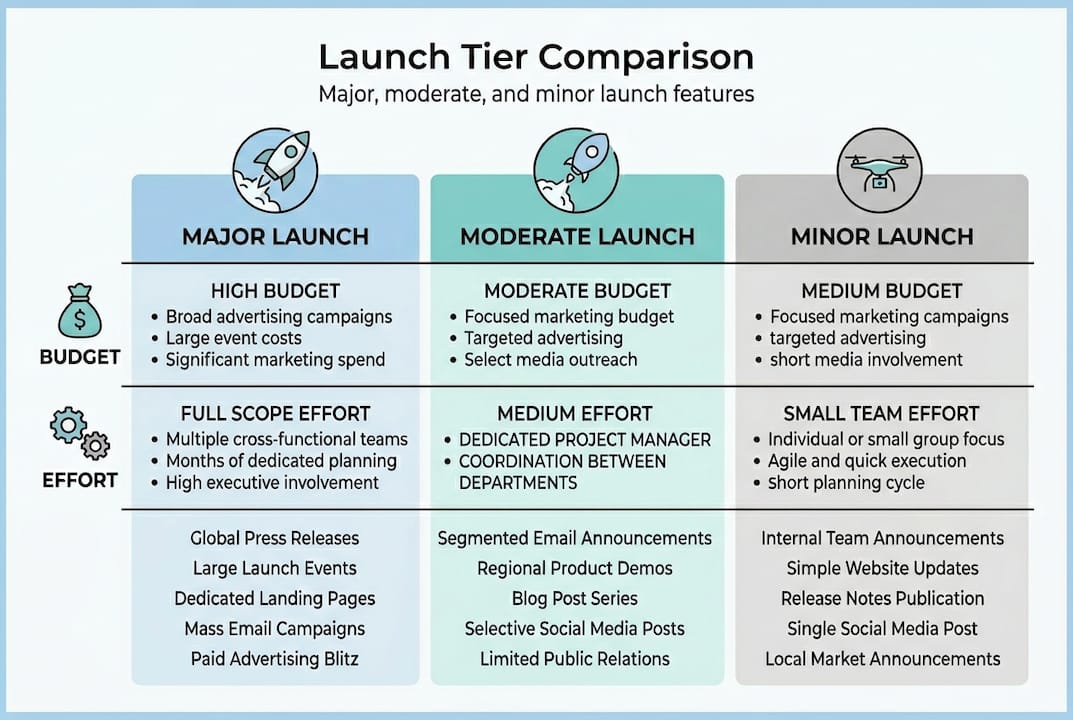
Not every product deserves the same level of effort. That might sound obvious, but many organizations default to treating every release like it is a flagship moment, spreading resources thin and diluting the impact of their most important launches. Classify launches into tiers such as Tier 1 major, Tier 2 moderate, and Tier 3 minor to allocate appropriate resources and GTM effort.
A Tier 1 launch is your flagship moment. This is a new product entering a new category, a major platform update that changes how customers interact with your brand, or a market expansion that signals a significant strategic shift. Tier 1 launches get the full treatment: dedicated campaign budgets, immersive launch events, PR outreach, executive involvement, and cross-functional alignment.

A Tier 2 launch is meaningful but more contained. Think a new product variant, an upgraded feature set, or a regional market entry. Tier 2 launches benefit from structured campaigns and solid sales enablement, but they don't require the same resource intensity as a Tier 1 activation.
Tier 3 launches are tactical updates. A bug fix, a minor feature release, a localization update. These rarely need more than an internal announcement and updated documentation.
Here is how the tiers compare across key dimensions:
| Dimension | Tier 1 (major) | Tier 2 (moderate) | Tier 3 (minor) |
|---|---|---|---|
| Budget | High | Moderate | Low |
| Event or activation | Full-scale immersive event | Focused event or webinar | Email or internal comms |
| PR and media outreach | Broad media push | Targeted trade press | Minimal or none |
| Sales enablement | Full kit and training | Updated collateral | Brief product note |
| Timeline | 8-12 weeks pre-launch | 4-8 weeks pre-launch | 1-2 weeks pre-launch |
The real discipline is in the classification decision. Many teams over-classify launches because product managers naturally feel that their release is Tier 1 worthy. Leadership needs to make this call objectively, based on market impact potential, strategic priority, and available resources.
Research on retail launch leadership shows that store managers and field teams perform significantly better when they understand the tier and scope of what they are activating. Clarity at the top translates directly to execution quality at the front line.
Exploring marketing services for launch can help your team determine what level of external production support each tier actually requires. For brands activating at trade show marketing events, tier classification also determines booth size, staffing levels, and the depth of the experience you build for attendees.
Pro Tip: If you find yourself trying to apply Tier 1 tactics to a Tier 3 release because of internal pressure, push back with data. Show leadership what that resource spend would accomplish if redirected to your next genuine Tier 1 moment.
Additional benefits of rigorous tier classification:
- Prevents budget fatigue across the launch calendar
- Keeps your sales team focused on the releases that matter most
- Creates internal credibility when you do go all-in on a Tier 1 moment
- Helps agencies and vendors plan capacity effectively across the year
Master pre-launch planning and sales enablement
The decisions you make in the eight to twelve weeks before launch day determine everything that follows. Pre-launch is not just about building hype. It is about making sure your product is ready, your team is aligned, and your sales organization can actually sell what you are about to release.
Here is a structured approach to pre-launch planning:
-
Lock your launch brief early. A structured launch brief is the single document that prevents scope creep. It should include the launch date, target audience, key messages, tier classification, budget, channel plan, and owner for each workstream. Front-loading sales enablement and using field-first announcements prevents the chaotic information cascade that kills launch momentum.
-
Run exhaustive QA, but know when to stop. Quality assurance (QA) is non-negotiable, but it can also become a trap. Teams that chase perfection indefinitely delay launches past the point of market relevance. Balance exhaustive QA with scope control by setting clear entry and exit criteria for each QA cycle.
-
Use a beta launch to stress-test before you scale. A soft or beta launch with a small user group allows you to catch real-world issues before they become public problems. Twenty to fifty users is enough to surface the most critical edge cases without overwhelming your support team.
-
Build your sales enablement kit before the announcement goes out. Sales reps should never learn about a launch from the press. Build your enablement assets first: battle cards, demo scripts, objection-handling guides, and competitive positioning documents.
-
Communicate field-first. Your internal teams and channel partners need to hear about the launch before external audiences. This builds confidence, reduces confusion, and gives field teams time to prepare their own talking points.
"Front-loading sales enablement, using field-first announcements, and maintaining a structured launch brief are the internal practices that separate clean launches from chaotic ones." This is the operational discipline that most organizations know they need but consistently underinvest in.
Your event staffing guide decisions also belong in this phase. If your launch involves a live activation, staffing decisions made six weeks out are dramatically better than those made six days out. And for brands using geo frame marketing to build pre-launch awareness in specific geographic markets, the targeting strategy needs to be built and tested during this window, not after.
Pro Tip: Create a "known limitations" document before launch day. List every issue your QA team identified that will not be fixed before release, with a workaround or timeline for resolution. Share this internally so your sales and support teams are never caught off guard.
Optimize and sustain post-launch results
Launch day is not the finish line. It is the starting line for a new phase of work that will determine whether your launch delivers lasting value or just a brief spike in attention. Post-launch optimization runs 4-12 weeks and demands the same strategic focus as your pre-launch planning.
The brands that sustain post-launch momentum do a few things consistently well:
-
Gather structured feedback immediately. Within the first two weeks of launch, collect feedback from customers, sales reps, channel partners, and anyone who interacted with the product or the launch experience. Use surveys, calls, and direct outreach. Do not rely on anecdotal reports.
-
Analyze your event data with intention. If your launch included a live activation, the data captured during that event is a goldmine. Foot traffic patterns, dwell time, lead capture rates, and session engagement all tell you something about what resonated and what did not.
-
Optimize your messaging based on real responses. The positioning you built in pre-launch was your best hypothesis. Now you have real market data. Use it. Adjust your core messages to reflect what customers are actually responding to.
-
Sustain momentum through social media promotion. A single launch announcement is never enough. Build a content calendar that extends launch messaging for at least six to eight weeks post-launch. Customer stories, product demonstrations, behind-the-scenes content, and expert commentary all keep the conversation alive.
-
Use event data insights to refine future campaigns. Every data point from your launch event is an asset. Which activations generated the most engagement? Which messages prompted the most questions? Which audiences stayed longest? These insights should directly inform your next launch strategy.
Pro Tip: Build a post-launch feedback loop with your sales team that runs on a two-week cadence for the first eight weeks. Short, structured check-ins catch scope creep early and keep leadership informed without creating reporting fatigue.
Concrete post-launch optimization priorities to act on immediately:
- Identify your top three performing channels and double down on them
- Resolve any product or experience issues surfaced during beta and communicate fixes publicly
- Celebrate wins with your internal team to sustain energy and morale
- Begin documenting lessons learned for your next launch cycle
The real difference: What executives overlook about launches
Here is what we have seen consistently across launches with brands like Porsche, Ray-Ban, and Fossil: the teams that execute the most memorable launches are not the ones with the biggest budgets. They are the ones with the most disciplined frameworks.
The instinct at the executive level is often to go bigger. More spectacle, more channels, more noise. But a dramatic, one-time announcement without a structured follow-through almost always underperforms a phased, methodical approach executed with precision.
The uncomfortable truth is that most launches fail not from lack of creativity but from lack of accountability. Scope creep sneaks in during pre-launch. Sales enablement gets deprioritized in favor of external marketing. Post-launch optimization gets cut when the next initiative demands attention.
The brands that consistently win with launches treat them as full programs, not single events. The auto launch solutions we have built for automotive brands work precisely because every phase has an owner, every deliverable has a deadline, and the post-launch learning feeds directly into the next campaign. That kind of structured discipline is not glamorous. But it is what makes brands felt, not just seen.
Take your next product launch further
A strong launch strategy deserves an equally strong execution partner. At King Sixteen, we build experiential marketing services that bring your launch framework to life, from immersive environments and custom fabrications to full-scale live events that generate real data and lasting brand impressions.
If you are ready to move from strategy to execution, our event management solutions cover everything: venue, staffing, AV, fabrication, catering, and digital integration, all under one roof. We work with brands that need things done right, fast, and without margin for error. If that sounds like your next launch, we would love to talk. Visit King Sixteen to explore what a turnkey launch partnership looks like in practice.
Frequently asked questions
How long should each phase of a product launch take?
Pre-launch planning takes 8-12 weeks and post-launch optimization typically runs 4-12 weeks, depending on product complexity and market scope.
What is a "Tier 1" product launch?
A Tier 1 launch is a major product introduction requiring the highest resource investment, broadest GTM effort, and full cross-functional alignment across marketing, sales, and leadership.
How can I test my product before full launch?
Run a soft or beta launch with 20-50 users to surface critical issues, document known limitations, and validate your support team's readiness before scaling to the full market.
What's the biggest mistake companies make in launches?
Allowing scope creep and failing to front-load sales enablement are the two most common reasons launches underperform, leaving field teams unprepared and messaging inconsistent at the moment of market entry.
How do I measure post-launch success?
Track engagement rates, pipeline velocity, customer feedback, and event data insights across the first 8-12 weeks, then use those findings to optimize messaging and inform your next launch cycle.