Feedback is defined as the structured collection of attendee, vendor, and staff input that drives every meaningful improvement in event marketing strategy. The role of feedback in event marketing goes far beyond a post-event survey. It is a continuous decision-making tool that shapes agenda design, messaging, and audience targeting before, during, and after every event. Tools like SurveyMonkey, Typeform, and Google Forms have made collection easier, but the real advantage belongs to teams that build feedback into their entire event lifecycle. Organizations with structured feedback loops grow attendance 25% faster than those using ad-hoc methods. That single statistic defines the gap between events that compound in value and events that plateau.
How does feedback shape attendee satisfaction and loyalty?
Attendee satisfaction is not a feeling. It is a measurable outcome tied directly to whether you acted on what people told you. 78% of festival-goers say they are likely to return to a future event where their feedback was valued and acted upon. Flip that around: 70% are less likely to return if their feedback is ignored. Those two numbers represent the full range of your loyalty outcome, and feedback is the lever.

The connection between specific improvements and measurable results is direct. One documented example shows that fixing long bar lines after attendee complaints increased satisfaction scores by 15% and drove stronger early-bird ticket sales for the next event. That is not a coincidence. Attendees who see their input reflected in a better experience become advocates, not just repeat buyers.
Several feedback-driven improvements consistently move the needle on loyalty:
- Wait time reduction: Adding staff to high-traffic areas based on survey data cuts frustration before it becomes a social media complaint.
- Content relevance: Session ratings from tools like Typeform reveal which speakers and topics earned attention and which lost the room.
- Logistics clarity: Feedback on signage, parking, and registration flow catches operational friction that internal teams often miss entirely.
- Catering and amenities: Food and beverage complaints are among the most common post-event survey responses and among the easiest to fix.
Social listening during events functions as live feedback. Monitoring hashtags and mentions in real time lets your team address concerns before they escalate. A negative post about a broken AV setup, caught and resolved within 20 minutes, becomes a positive story about a responsive team.
Pro Tip: Set up a dedicated event hashtag and assign one team member to monitor it throughout the event day. Real-time social listening catches problems that post-event surveys never will.
What are the best practices for collecting event feedback?
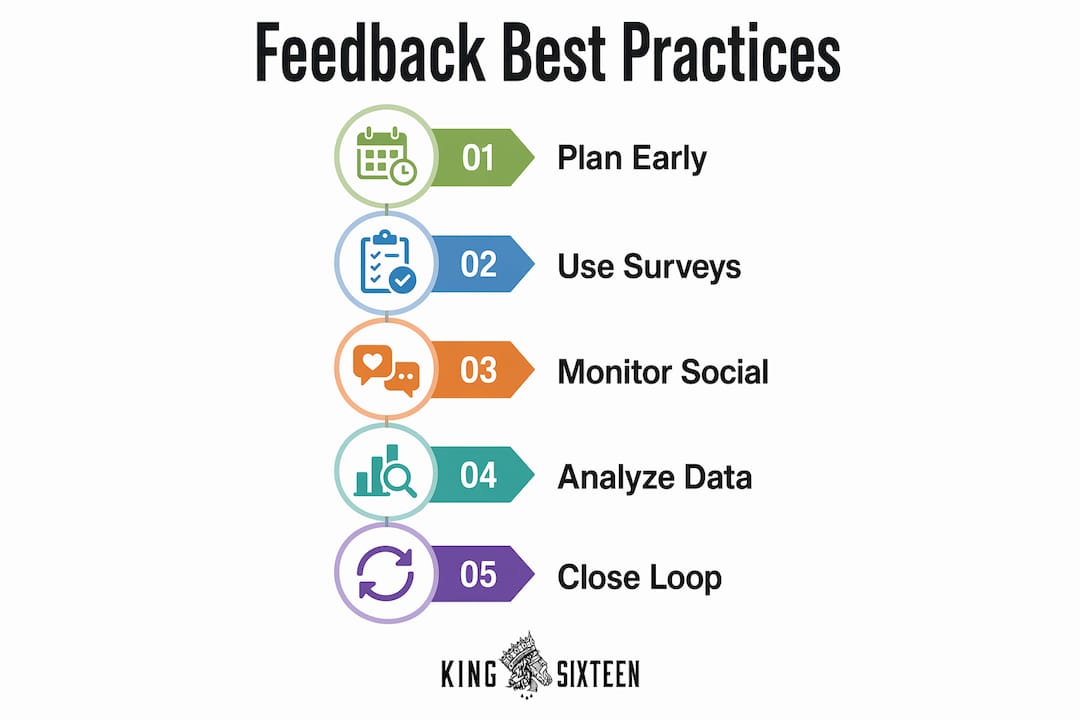
Collecting feedback well is a discipline, not an afterthought. The quality of your data depends entirely on how, when, and through what channel you ask. Follow this sequence to build a feedback collection process that consistently produces usable insights.
- Design surveys with 5–7 focused questions. Mixing rating scales and open text gives you quantifiable data alongside qualitative context. Rating scales let you track trends over time. Open text reveals the "why" behind the numbers.
- Send within 24–48 hours post-event. Response rates and detail quality drop sharply after 48 hours. The experience is still fresh, and attendees are more likely to give specific, useful answers.
- Use multiple channels. Email remains the highest-response channel for post-event surveys. QR codes placed at exits or on printed materials capture responses on-site. Social media polls work well for quick sentiment checks.
- Incentivize participation. Discount codes for future events, exclusive content access, or entry into a prize drawing increase completion rates without compromising response quality.
- Personalize your outreach. A survey email addressed by name and referencing the specific session or experience the attendee joined converts at a higher rate than a generic blast.
- Run a hot debrief immediately after the event closes. A hot debrief captures high-energy, in-the-moment insights from your internal team before memory fades. This is separate from attendee surveys and equally valuable.
The difference between ad-hoc feedback and a structured continuous feedback loop is compounding value. Ad-hoc surveys give you a snapshot. A structured loop, where questions are consistent across events and data is tracked over time, gives you a trend line. Trend lines tell you whether you are improving, plateauing, or declining. That is the information that drives real event marketing strategies.
Pro Tip: Use Typeform for attendee-facing surveys because its conversational format increases completion rates. Use a shared Google Form internally for your hot debrief so all team members contribute simultaneously.
How should feedback drive your event marketing strategy?
Feedback is a continuous decision input that shapes agenda design, messaging, and targeting, not just a post-event report card. Marketing teams that treat it as strategic intelligence rather than a satisfaction metric gain a compounding advantage over time.
The most direct application is audience segmentation. Behavioral data from event apps, combined with survey responses, tells you which attendee segments engaged most deeply. You can then target those profiles in pre-event campaigns for future editions, improving registration conversion rates before you spend a dollar on broad awareness.
"Feedback should be viewed as evidence for professional practice, not just finding mistakes. Embedding evaluation in project plans creates continuous improvement cultures." — Obsidian PR
Closing the feedback loop is where most marketing teams leave value on the table. Transparently communicating what changed based on attendee input builds trust and directly increases ticket demand for future events. A simple post-event email that says "You told us the networking sessions were too short, so we doubled them for next year" converts a survey respondent into a loyal advocate. That message also functions as marketing content, showing prospective attendees that your brand listens.
Here is how feedback integrates across the full event marketing cycle:
| Stage | Feedback Application | Marketing Outcome |
|---|---|---|
| Pre-event | Audience surveys on topic preferences | Sharper agenda and speaker selection |
| During event | Social listening and live polls | Real-time experience adjustments |
| Post-event (24–48 hrs) | Attendee satisfaction surveys | Identify top performers and pain points |
| Post-event (30 days) | Net Promoter Score follow-up | Measure advocacy and referral potential |
| Planning next event | Trend analysis across multiple events | Smarter targeting and budget allocation |
Sentiment analysis from social listening also feeds directly into your content strategy. Positive mentions of specific speakers or activations become testimonial content. Negative patterns around logistics become internal improvement priorities. Both outputs serve your event data strategy and reduce guesswork in planning.
Attendees vs. vendors vs. staff vs. speakers: who gives the best feedback?
No single stakeholder group gives you the complete picture. Vendors, staff, and speakers reveal operational issues and revenue opportunities that attendee surveys miss entirely. Each group sees a different layer of your event, and each layer matters.
| Feedback Source | Primary Focus | Unique Insight |
|---|---|---|
| Attendees | Experience and engagement quality | Satisfaction, loyalty intent, content relevance |
| Vendors | Logistics, setup, and revenue flow | Operational friction, missed upsell opportunities |
| Internal staff | Execution and coordination | Bottlenecks, communication gaps, resource gaps |
| Speakers | Content delivery and audience response | Session pacing, audience engagement, topic fit |
Attendees tell you how the event felt. Vendors tell you how it ran. Staff tell you where the cracks were. Speakers tell you whether the content landed. You need all four perspectives to make decisions with confidence.
Gathering multi-stakeholder feedback requires different approaches for each group. Attendees respond well to short digital surveys sent by email or QR code. Vendors and speakers respond better to a brief structured conversation or a 5-question email within 48 hours. Internal staff benefit most from the hot debrief format, where the whole team debriefs together immediately after the event closes while details are still sharp.
Weighting this feedback correctly matters. Attendee satisfaction scores carry the most weight for marketing decisions. Vendor and staff input carries the most weight for operational decisions. Speaker feedback shapes content strategy for future editions. Treat each source as a distinct data stream, not a single blended score.
Key takeaways
Structured, continuous feedback loops are the single most reliable driver of attendance growth, attendee loyalty, and event marketing performance.
| Point | Details |
|---|---|
| Feedback drives loyalty | 78% of attendees return when feedback is acted on; 70% do not return when it is ignored. |
| Timing determines quality | Send surveys within 24–48 hours post-event to capture the most accurate and detailed responses. |
| Multi-stakeholder input is required | Attendees, vendors, staff, and speakers each reveal blind spots the others cannot see. |
| Closing the loop builds trust | Communicating what changed based on feedback converts surveys into brand advocacy tools. |
| Structured loops outperform ad-hoc | Organizations with continuous feedback systems grow attendance 25% faster than those without. |
Feedback culture is the real competitive advantage
Most event teams I have worked with treat feedback as a final deliverable. They send a survey, compile a report, and file it. The next event starts from scratch. That pattern is the single biggest missed opportunity in event marketing.
The teams that consistently produce better events treat feedback as the first input for the next event, not the last output of the current one. They run a hot debrief the night the event closes. They send surveys within 24 hours. They analyze the data before the post-mortem meeting. By the time they sit down to plan the next edition, they already know what to fix, what to keep, and what to amplify.
Social listening as a live feedback tool is still underused by most marketing teams. Brands that monitor event hashtags in real time and respond publicly to attendee posts build a visible culture of responsiveness. That visibility is marketing in itself.
The cultural shift I push for with every client is simple: feedback is evidence, not criticism. When your team internalizes that framing, the defensiveness disappears and the improvement accelerates. Transparent communication about changes made from attendee input is also one of the most underrated brand-building moves available to event marketers. It costs almost nothing and signals that your brand takes its audience seriously.
Build the feedback loop into your event plan from day one. Not as a checkbox. As a system.
— Tyler
How Kingsixteen builds feedback into every event
At Kingsixteen, we design events that generate data, not just moments. Every activation we produce for brands like Porsche, Audi, and Ray-Ban is built with measurable attendee engagement in mind, because the insights from one event should directly shape the next one.
Our experiential marketing services include structured feedback integration as part of the full event lifecycle. From live social listening during activations to post-event debrief frameworks, we give your team the tools to turn attendee input into strategic decisions. If you are ready to produce events that improve with every edition, connect with our team and let us show you what a feedback-driven event strategy looks like in practice.
FAQ
What is the role of feedback in event marketing?
Feedback is a continuous decision-making input that shapes event agenda, messaging, attendee experience, and marketing strategy before, during, and after every event. It is not a post-event formality but a core tool for driving measurable improvement.
How does feedback affect attendee loyalty?
78% of attendees are likely to return to events where their feedback was acted upon, while 70% are less likely to return when it is ignored. Acting on feedback is the most direct lever for repeat attendance.
When should you collect event feedback?
Send attendee surveys within 24–48 hours post-event for the highest response rates and most accurate data. Run an internal hot debrief immediately after the event closes to capture operational insights before they fade.
What tools work best for collecting event feedback?
Typeform, SurveyMonkey, and Google Forms are the most widely used tools for post-event surveys. Each supports rating scales and open-text questions, which together produce the most complete and usable feedback data.
Why should you collect feedback from vendors and speakers, not just attendees?
Vendors and speakers surface operational bottlenecks and content delivery insights that attendee surveys never capture. Multi-stakeholder feedback gives you a complete picture of what worked and what needs to change before your next event.