Luxury brands pour significant resources into maintaining their prestige, yet many find their brand presence plateauing despite record investments in campaigns and events. The market is saturated with high-end competitors all fighting for the same affluent consumer's attention, and traditional advertising alone no longer moves the needle the way it once did. The shift happening right now is from impression-based marketing to experience-driven engagement, where every brand touchpoint becomes a deliberate moment of connection. This guide walks you through the strategic tools, frameworks, and execution tactics that help luxury marketers move from generating awareness to creating lasting, measurable impact.
Table of Contents
- Assess your current brand presence and establish clear goals
- Curate exclusive experiences that reflect your brand's DNA
- Integrate technology to amplify engagement and measurement
- Avoid common pitfalls: Alienation, trend-chasing, and shallow engagement
- A seasoned perspective: What luxury marketers often overlook
- Partnering for transformation: Elevate your luxury brand presence with expert guidance
- Frequently asked questions
Key Takeaways
| Point | Details |
|---|---|
| Start with clear metrics | Defining concrete engagement and attribution goals ensures experiential strategies move the needle. |
| Curate memorable brand moments | Signature experiences should align with brand history while embracing cultural relevance. |
| Balance exclusivity and inclusion | Mastering both aspiration and belonging fosters deeper loyalty and retention. |
| Leverage technology for impact | Integrated platforms drive engagement and provide real data to prove ROI. |
| Avoid generational pitfalls | Over-relying on exclusivity risks alienating new audiences; blend tradition with curiosity for success. |
Assess your current brand presence and establish clear goals
To begin elevating your brand, it's essential to know your starting point and define what success will look like.
The most common mistake luxury marketers make is launching experiential initiatives without a clear baseline. You can't measure elevation if you don't know where you stood before. Start with a thorough audit of your current brand touchpoints: retail environments, event presence, digital engagement, press coverage, and customer feedback. Map out where your brand shows up, how consistently it communicates your core values, and where the experience falls short of your positioning.
Once you've completed the audit, you need to define what meaningful success looks like for your brand. Generic metrics like impressions or social reach don't tell the whole story. Instead, focus on KPIs that connect directly to business outcomes. Measuring event engagement through robust event data tools gives you visibility into what's actually working. According to experiential marketing research on ultra-high-net-worth consumers, brands should measure via attribution to purchases, engagement lift, repeat visits, and average order value (AOV), shifting from "vibes" to real clienteling platforms that capture behavioral data.
Cultural resonance matters as much as raw reach in luxury marketing. A smaller, deeply engaged audience that aligns with your brand values is worth far more than a massive but disconnected one. Define what cultural relevance means for your specific brand, whether that's leadership in sustainability, artisan craftsmanship, or access to rare experiences.
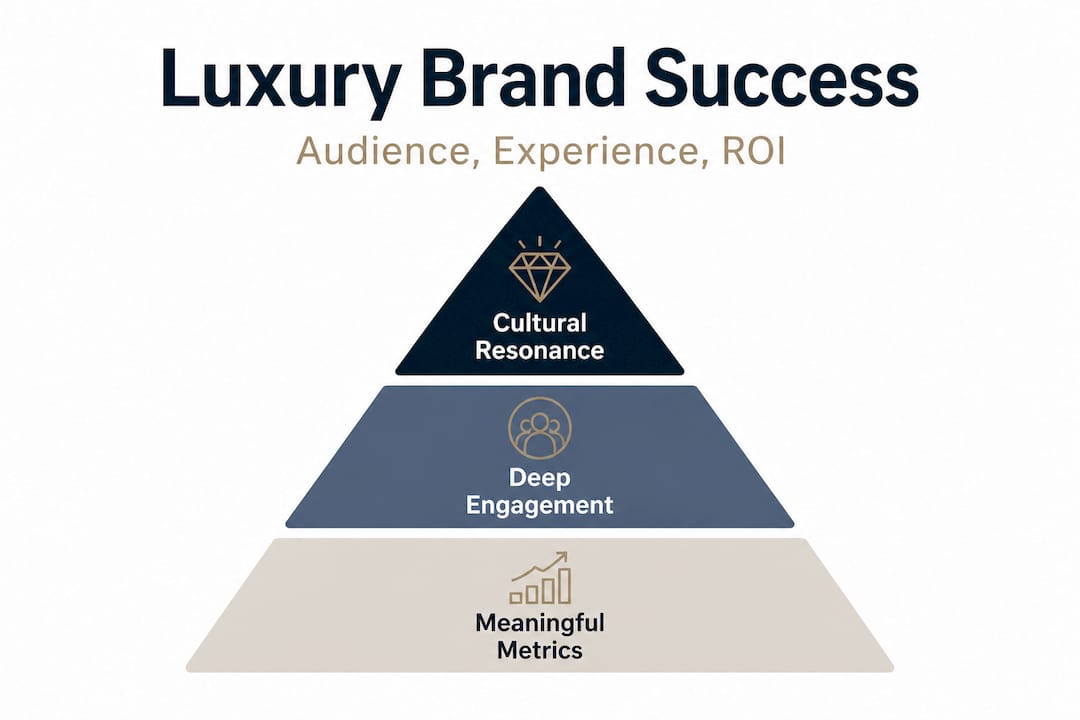
Here's a quick overview of tracking tools and what each measures:
| Tool | What it measures | Best for |
|---|---|---|
| Clienteling platforms | Purchase attribution, loyalty signals | Post-event follow-up |
| RFID event tracking | Foot traffic, dwell time, booth engagement | In-person activations |
| Social listening tools | Brand sentiment, cultural reach | Ongoing brand audits |
| CRM integration | Repeat visits, AOV, lifetime value | Long-term retention |
| Geo-framing analytics | Location-based engagement | Events and pop-ups |
Key KPIs worth prioritizing at this stage include:
- Purchase attribution: How many attendees or engagement touchpoints convert to actual sales within a defined window
- Engagement lift: The measurable increase in interaction across platforms following an event or activation
- Repeat visit rate: How often engaged customers return, a direct signal of brand loyalty
- Average order value: Whether experiential investment is correlating with higher-value purchases
- Social media presence growth: Follower quality and interaction rate post-activation
Getting clear on these numbers before you execute any activation positions you to prove ROI confidently, both internally and to stakeholders.
Curate exclusive experiences that reflect your brand's DNA
Once your goals are clear, it's time to design experiences that truly reflect your brand essence and value proposition.
Not all exclusivity is created equal. Luxury brands often default to one of two strategic postures: the scarcity model or the inclusion model. Both are legitimate, but each requires a deliberate design philosophy behind it. Balancing scarcity with cultural relevance and avoiding trend-chasing is critical to preserving long-term brand status. The brands that stumble are those that borrow exclusivity tactics from competitors without rooting them in their own brand story.
The contrast between Hermès and Chanel illustrates this beautifully. Hermès leans into scarcity through waitlists and controlled product drops to manufacture aspiration, while Chanel builds belonging through recognition and inclusion, making loyal customers feel seen and valued. Neither approach is wrong. The question is which one serves your brand DNA.
Here's a comparison of how these two models play out in experiential strategy:
| Approach | Core mechanic | Experience design | Risk |
|---|---|---|---|
| Scarcity (Hermès model) | Waitlists, limited access, controlled drops | Private viewings, invitation-only events | Can feel cold or inaccessible |
| Inclusion (Chanel model) | Recognition, personalization, community | Member events, curated customer journeys | Can dilute perceived exclusivity |
To create an immersive experience rooted in your brand DNA, follow this process:
- Define your brand's experiential signature. What feeling should someone walk away with? Awe, belonging, discovery, empowerment? Name it and build toward it.
- Identify your brand's heritage assets. Craftsmanship stories, founding histories, iconic design codes. These become the experiential content.
- Choose a format that matches your audience's expectations. A salon-style private dinner communicates differently than a large-scale installation. Both can work; the choice signals something.
- Design sensory touchpoints intentionally. Sound, scent, lighting, and texture all reinforce or undermine brand positioning. Treat them as brand elements, not afterthoughts.
- Layer in moments of personalization. Monogramming, name recognition, or curated product recommendations create the "felt, not just seen" effect that defines elite brand experiences.
- Build in social shareability without compromising intimacy. Subtle, photogenic moments that guests want to capture organically extend your reach without cheapening the experience.
Explore what innovative event marketing looks like when these principles are applied at scale. The execution will vary by brand, but the underlying discipline remains the same.
Pro Tip: Resist the pull of trending aesthetics. Neon installations and immersive "infinity rooms" cycle in and out of fashion quickly. Curate your experiences around what your brand has always stood for, and let that timeless foundation anchor every creative decision you make.
Integrate technology to amplify engagement and measurement
Creating experiences is only half the battle; amplifying impact requires the right technological backbone for both engagement and measurement.
The luxury experiential space has evolved dramatically. It's no longer enough to host a beautiful event and hope the right conversations happen afterward. You need a technology layer that captures what happened, who responded, and what those responses mean for your brand's future investment decisions. Brands that have shifted to clienteling platforms are seeing measurable gains in engagement lift, repeat visits, and AOV because the data tells them exactly where to invest next.
Real-time feedback tools let you course-correct during an activation, not just after it. Imagine a product launch where guest engagement with specific display zones is tracked in real time, allowing your team to redirect traffic, increase staffing in high-interest areas, or adjust programming on the fly. That level of responsiveness isn't just operationally smart. It directly improves the guest experience.
Here are the must-have technologies for luxury experiential marketing in 2026:
- RFID wristbands or badges: Track foot traffic flow, dwell time at specific installations, and session attendance with precision
- Clienteling platforms: Connect event behavior to CRM records, enabling post-event personalized outreach and purchase attribution
- Mobile event apps: Deliver personalized schedules, product information, and exclusive content to guests in real time
- Geo-framing analytics: Capture and analyze location-based data to understand how audiences engage within and around your event footprint
- Real-time sentiment tools: Monitor social conversations and in-app feedback during the event to gauge emotional resonance
- Data capture at touchpoints: Integrate registration data, purchase behavior, and post-event surveys into a unified analytics view
The goal of this tech stack isn't to make your event feel like a trade show. It's to make every guest interaction smarter, while keeping the experience itself feeling effortlessly elevated. The data runs in the background. The guest feels nothing but the experience.
One practical approach is to partner with a production team that already has these integrations built into their event infrastructure. That way, you're not assembling a patchwork of vendors under pressure. You're working with a system that has been stress-tested at scale.
Avoid common pitfalls: Alienation, trend-chasing, and shallow engagement
Mastery isn't just about innovative execution. Successful luxury marketers anticipate and avoid the pitfalls that erode long-term brand value.
One of the most pressing challenges right now is staying relevant to Gen Z without alienating your core audience. Pure exclusivity risks alienating Gen Z consumers, who are drawn to brands that blend depth, cultural curiosity, and earned intimacy rather than gatekeeping alone. The brands winning with younger affluent audiences are those that offer access to knowledge, craft, and culture, not just access to a product.
"Luxury brands that double down on exclusivity without cultural substance will find themselves presiding over an aging, shrinking audience. The next generation of luxury consumers wants to feel invited into something meaningful, not simply blocked from something expensive."
This tension between aspiration and accessibility is where many brands stumble. They either tighten the velvet rope so much that they lose cultural relevance, or they overcorrect and dilute what made them special. Neither extreme serves you well.
Here are the most common mistakes luxury brands make in experiential marketing, along with how to avoid each one:
- Chasing aesthetic trends: Incorporating trendy design elements without connecting them to brand values creates cognitive dissonance. Guests feel the inauthenticity even if they can't name it. Root every design decision in your brand heritage.
- Measuring the wrong things: Optimizing for Instagram impressions instead of purchase attribution or repeat engagement gives you a distorted picture of success. Use the KPI framework outlined in section two and hold to it.
- Over-investing in one-time spectacle: A single flashy activation without a follow-up strategy leaves engagement on the table. Build post-event touchpoints that sustain the momentum.
- Ignoring the in-between moments: The experience doesn't start when guests arrive and end when they leave. How you communicate before the event and follow up after it shapes the total brand impression.
- Losing sight of brand identity under production pressure: When timelines compress and budgets tighten, creative compromises happen. Protect your non-negotiables by defining them in writing before production begins.
Pro Tip: Build a cultural resonance checkpoint into your event planning process. Before any activation goes into production, run the concept through a small group of brand advocates and target-audience representatives. Ask them what the experience says about the brand. Their answers will tell you whether you're on strategy or drifting.
A seasoned perspective: What luxury marketers often overlook
The most sophisticated experiential strategies we see succeed aren't the ones with the biggest budgets. They're the ones where the brand had the courage to make a clear choice about who they are and refused to compromise it under pressure.
Here's the uncomfortable truth we've observed working with brands like Porsche, Audi, and the Natural Diamonds Council: over-indexing on either scarcity or inclusivity leads to diminishing returns. Brands that chase exclusivity for its own sake eventually feel hollow. Brands that chase belonging without a strong identity behind it feel generic. The brands that break through are those that treat cultural curiosity as a loyalty driver.
What does that mean in practice? It means your audience wants to learn something, feel something, and discover something they didn't know before they walked into your activation. That sense of earned discovery, whether it's understanding the provenance of a material, witnessing a craft process, or accessing a conversation that isn't available anywhere else, is what creates genuine loyalty. It's not the scarcity or the prestige. It's the depth.
The other thing most luxury marketers underestimate is the feedback loop. Your activations are generating data about what resonates and what falls flat. That data is more valuable than any focus group. But only if you're structured to collect it, interpret it, and feed it back into the next initiative. Rethinking event strategies through a feedback-driven lens is how you turn a one-time activation into a compounding brand asset.
Our challenge to you: design your next activation with a hybrid model in mind. Create depth and discovery for your core audience, while leaving intentional openings that allow culturally aligned newcomers to find their way in. Then measure both groups separately, and let the data tell you where your next investment should go.
Partnering for transformation: Elevate your luxury brand presence with expert guidance
The strategic frameworks in this guide are only as powerful as the team behind their execution. Knowing what to do and having the infrastructure to do it flawlessly are two different things, and the gap between them is where most brand presence initiatives lose momentum.
At King Sixteen, we bring every element of luxury experiential strategy under one roof. From concept development and custom fabrication to real-time data capture and post-event analytics, our turnkey model means you never have to manage a fragmented vendor chain under deadline pressure. We've elevated brand experiences for clients across automotive, fashion, jewelry, and lifestyle sectors, with the same commitment to precision and brand fidelity every time. If you're ready to move from awareness to impact, explore our full range of event services for luxury brands and let's build something that lasts.
Frequently asked questions
What are the best metrics to measure luxury brand presence improvement?
Attribution to purchases, engagement lift, repeat visits, and average order value (AOV) are the key metrics for evaluating brand presence gains, because they connect experiential investment directly to business outcomes.
How do exclusivity and inclusion impact loyalty in luxury marketing?
Both models drive loyalty through different mechanisms: Hermès-style scarcity cultivates aspiration and desire, while Chanel's inclusion approach creates a sense of community, recognition, and belonging that keeps loyal customers deeply connected.
How can luxury brands stay relevant to Gen Z audiences?
Blending cultural depth with curiosity-driven access helps brands avoid the trap of alienating Gen Z consumers through pure gatekeeping, since younger affluent audiences respond to brands that offer earned intimacy and genuine discovery.
What technologies most effectively enhance experiential luxury marketing?
Clienteling platforms, RFID, geo-framing, and real-time data capture tools deliver the deepest engagement insights and the clearest path to measuring ROI across luxury activations.
Recommended
- King Sixteen | Discover Unique Experiences — Get Started
- Experiential Marketing | Elevate Your Brand Experience - Act Now — King Sixteen
- Innovative event marketing strategies to maximize brand impact
- Auto Launch | Elevate Car Launches Today — King Sixteen
- Interactive Branding in Dubai: Strategies That Build Loyalty | Almost Impossible | Journal | Almost Impossible