
Onsite event logistics is the coordination of every physical and operational element that makes an event actually run: who arrives when, where power gets routed, how attendees move through registration without a long queue, and what happens when the badge printer goes down at 8:05 AM. It's distinct from event planning in the broader sense. Event planning defines the why and the what; logistics defines the how, the when, and the where everything physically comes together. Neglecting that distinction is one of the most common reasons events fail operationally, even when the programming is excellent.
The core elements you need to manage on event day include:
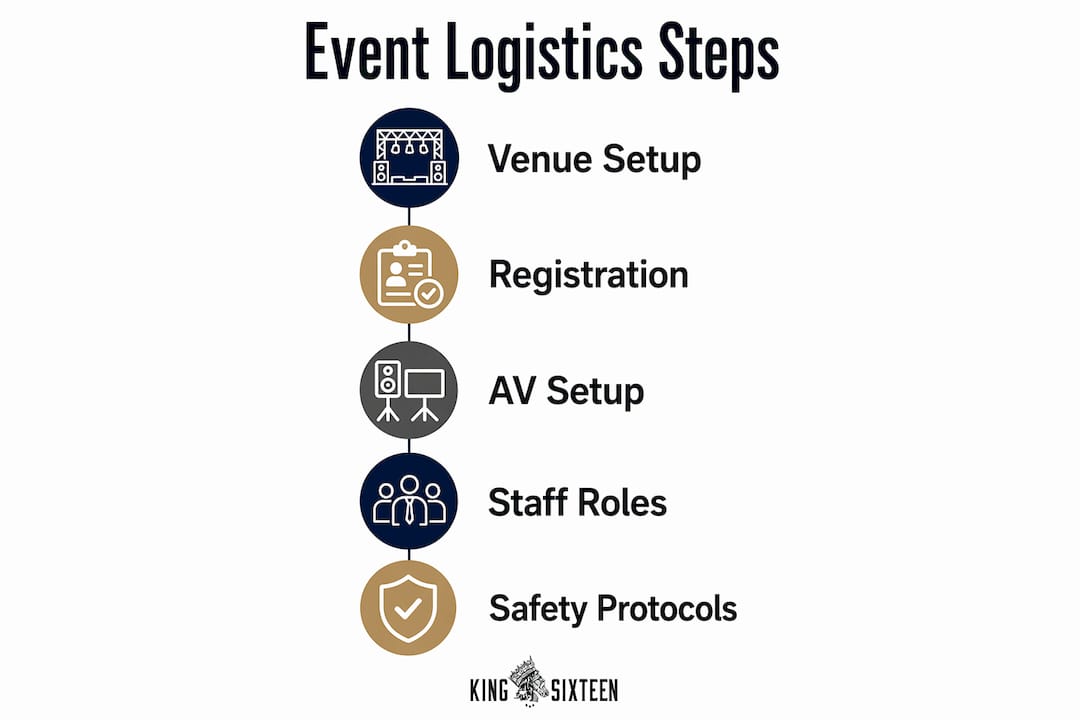
- Venue and space management: layouts, access points, and power distribution plans
- Registration and check-in: lane configuration, badge printing, and walk-up handling
- AV and technology: setup sequencing, technical rehearsals, and live support coverage
- Staffing and team roles: logistics lead assignment, vendor coordination, and staff positioning
- Signage and wayfinding: directional signage, setup schedules, and teardown sequencing
- Transportation and parking: vendor arrival windows, load-in coordination, and attendee parking flow
- Emergency and safety protocols: evacuation plans, first aid stations, and fire code compliance
- Communication systems: pre-event, day-of, and urgent escalation channels
- Supply and vendor management: arrival sequencing and dependency mapping to prevent conflicts
Poor logistics doesn't just create inconvenience. It creates safety risks, fires up attendee frustration, and puts your client relationship on the line. Getting this right starts well before event day, and it requires both a clear operational plan and the agility to adapt when reality diverges from it.
What does effective onsite event logistics management actually cover?
Every experienced planner knows the feeling: the event looks perfect on paper, and then load-in day arrives. Effective onsite event management requires you to think in systems, not just tasks. Each component below connects to the others, and a failure in one area cascades quickly.
Venue and space management
Your venue is the physical constraint everything else works around. Before any vendor sets foot inside, you need a detailed floor plan that accounts for power drops, emergency exits, AV cable runs, and service corridors. Confirm load-in access points with the venue operations team, and map out which areas are available during which time windows. Overlapping access creates bottlenecks that cost you hours.

Registration and check-in
Registration is the first physical experience your attendees have, and it sets the tone for everything that follows; managing it effectively starts with this detailed marketing automation checklist designed specifically for SMB events. Self-service kiosks with QR code scanning require zero staff time per attendee, compared to several minutes per walk-up registration at a staffed station. A well-configured registration area can process roughly 1,000 attendees per hour, though actual throughput depends on staff competency and venue layout. Plan your station count around your peak entry window, not your total attendance.

AV and technology setup
AV failures are the most visible logistics breakdown at any event. Schedule a full technical rehearsal the evening before or the morning of, with every piece of equipment live and every operator present. Build in backup equipment for projectors, microphones, and streaming encoders. Your AV lead should have a direct communication line to the logistics lead throughout the event, not just during setup.
Staffing and team roles
Every logistics operation needs a designated lead whose only job on event day is keeping the physical event running. This person does not handle client relations, does not manage the program, and does not get pulled into speaker green room issues. Their focus is operational: vendor arrivals, setup progress, issue escalation, and real-time adjustments. For staffing your onsite team, assign each role with a specific area of responsibility and a clear escalation path.
Signage, transportation, and emergency protocols
Directional signage reduces attendee confusion and cuts the volume of staff questions by a wide margin. Place signs at every decision point: building entrances, elevator banks, hallway intersections, and session room doors. For transportation, coordinate vendor arrival windows and attendee parking in advance with the venue. Emergency protocols require written evacuation plans, posted first aid station locations, and at least one staff member per zone trained in basic emergency response.
How should you approach pre-event onsite preparations?
Logistics planning quality is largely determined in the first few weeks after venue confirmation, not in the final sprint before event day. Starting weeks out gives you the runway to resolve venue constraints, build vendor sequences, and rehearse contingencies before they become day-of emergencies.
Here's a preparation timeline that works for most mid-to-large events:
- 10–12 weeks out: Confirm venue access hours, loading dock availability, and power capacity; identify service routes and corridor restrictions
- 8–10 weeks out: Develop vendor arrival sequences with staggered arrival windows to prevent load-in conflicts at shared docks
- 6–8 weeks out: Confirm all power requirements and equipment needs with venue engineering; identify gaps and rental needs
- 4–6 weeks out: Assign logistics lead and define escalation protocols; distribute load-in contact sheets to all vendors and internal teams
- 2–4 weeks out: Conduct technology rehearsals, including registration hardware, AV systems, and communication tools; run contingency scenarios
- 1–2 weeks out: Finalize parking and transportation logistics for vendors and attendees; confirm all vendor arrival confirmations
- 48–72 hours out: Distribute final run-of-show and logistics brief to all staff; confirm backup equipment inventory
Pre-event coordination checklist:
- Venue floor plan with power drops, AV positions, and emergency exits marked
- Vendor arrival schedule with staggered windows and contact names
- Load-in contact sheet distributed to all parties
- Technology rehearsal completed and issues documented
- Backup equipment inventory confirmed
- Staff assignments and escalation paths communicated in writing
- Parking and transportation plan shared with venue and vendors
- Emergency response plan reviewed with all zone leads
One detail planners often overlook: map your service routes before your vendors do. Walking the loading dock to the ballroom with a tape measure and a stopwatch tells you whether a 10-foot truss section can actually make that turn. Discovering it can't at 6 AM on setup day is a very different problem.
What does a typical onsite event day workflow look like?
A well-run event day follows a clear sequence, and deviations from that sequence compound quickly. The general flow looks like this:
- Early vendor arrival several hours before doors open: Power and AV teams arrive first to establish infrastructure; staging and furniture follow once power is confirmed live
- Mid-setup phase a few hours before doors: Catering setup, signage installation, and registration area build-out; all teams working in their designated zones simultaneously
- Final checks about an hour before doors: Full walkthrough by logistics lead; registration hardware tested live; AV and lighting cues confirmed; staff briefed at their stations
- Doors open: Registration lanes active with three distinct configurations: self-service kiosk, staffed walk-up, and a dedicated reprint/issue resolution station
- Active event period: Real-time check-in velocity monitoring with staff reassignment as needed; session capacity tracked via live dashboards to prevent overcrowding and fire code violations
- Contingency triggers: Pre-defined protocols for network outages, printer failures, and session room overflows, with named staff responsible for each scenario
- Teardown and load-out: Reverse setup sequence; AV and power last out; venue walkthrough completed before any vendor departs
The three-lane registration model deserves specific attention. Most bottlenecks happen when a single line handles both fast self-service check-ins and slower issue resolution cases. Separating those flows keeps your throughput high and prevents one frustrated attendee from slowing down 30 others behind them.
Pro Tip: Assign one staff member exclusively to the issue resolution lane during peak entry. That person handles badge reprints, name corrections, and walk-up registrations without touching the main check-in flow. It's a small staffing investment that protects your overall throughput.
Real-time capacity monitoring matters most in breakout sessions and smaller rooms. Live scan data lets you redirect attendees to overflow areas before a room hits its fire marshal limit, not after. A centralized dashboard visible to the logistics lead and room monitors gives you the situational awareness to act in time.
What are the most common onsite logistics challenges, and how do you prevent them?
Most onsite failures are predictable. The planners who avoid them aren't necessarily more experienced; they've just rehearsed the failure scenarios before they happened.
Common challenges:
- Vendor arrival conflicts: Two vendors competing for the same loading dock at the same time, causing cascading setup delays
- Technology failures: AV dropout, badge printer jams, or Wi-Fi congestion during peak registration
- Registration bottlenecks: Insufficient stations for peak entry volume, or a single-lane setup that mixes fast and slow check-in types
- Session overcrowding: Rooms filling past capacity without a redirection protocol in place, creating fire code exposure
- Communication breakdowns: Staff operating without a shared channel, leading to duplicated effort or missed escalations
Best practices that prevent these failures:
- Use staggered arrival windows of 30–60 minutes per vendor group to absorb variability at shared docks
- Conduct a full operational rehearsal with your logistics team 24–48 hours before the event, walking through each failure scenario by role
- Monitor check-in velocity in real time and pre-authorize staff reassignment when a lane falls behind
- Maintain offline backup capabilities for registration: printed lists, manual badge stock, and a clear protocol for when the system goes down
- Assign a logistics lead with no other day-of responsibilities, as noted in the event logistics planning guide
- Keep backup AV equipment on-site and tested, not in a storage room three floors away
Pro Tip: Run a tabletop scenario exercise with your full logistics team two weeks before the event. Walk through "the badge printer fails at 9 AM" and "the main session room hits capacity at 10:15 AM" out loud, by role. Teams that rehearse these scenarios resolve them in under three minutes on event day. Teams that haven't can take 20.
The difference between a recoverable problem and a visible failure usually comes down to whether someone already knew their role in the response. Preparation at that level doesn't happen through better documentation alone. It happens through rehearsal.
How should you budget and allocate resources for onsite logistics?
Logistics costs are frequently buried inside vendor line items, which makes them invisible until something goes wrong. Scheduling logistics costs separately gives you a clearer picture and surfaces hidden expenses like power generators, refrigerated trucks, and equipment rentals that often get misattributed to catering or AV budgets. Logistics typically accounts for a significant portion of total event costs, with the range depending on event complexity, venue type, and the distance vendors travel.
Core logistics budget line items to plan explicitly:
- Power infrastructure: generator rental, power distribution, and electrician fees if venue power is insufficient
- Transportation: vendor shuttle coordination, attendee parking management, and load-in equipment like forklifts or freight elevators
- Registration hardware: kiosk rentals, badge printers, and backup units
- Communication systems: two-way radio rental or app licenses for day-of coordination
- Staffing for logistics roles: logistics lead, zone monitors, and issue resolution staff, separate from program or hospitality staff
- Contingency reserve: a dedicated fund for last-minute equipment rentals, emergency repairs, or unplanned vendor needs
Beyond the line items, think about the balance between fixed contracts and contingency resources. Locking every vendor into a fixed scope limits your flexibility when the event grows or the venue throws a constraint at you two weeks out. Build at least one or two vendor relationships on a day-rate or on-call basis so you have a lever to pull without renegotiating a full contract under pressure.
For end-to-end event planning, the logistics budget should be built alongside the overall event budget from the start, not added as a line item after everything else is scoped. Planners who treat logistics as an afterthought consistently underestimate it.
Expert perspective: mental preparation and operational rehearsal
The planners who execute the cleanest events aren't always the ones with the most detailed run-of-show documents. They're the ones who've already solved the problems in their heads before event day arrives.
Mentally rehearsing real-time scenarios prepares coordinators to resolve registration bottlenecks, equipment failures, and capacity issues more effectively than those who rely on plans alone. The plan tells you what should happen. The rehearsal tells you what to do when it doesn't.
Here's how that preparation translates into practice:
- Assign a dedicated logistics lead whose only job is day-of operations. No client calls, no program management, no green room duties.
- Run scenario-based rehearsals with your full team, covering the three most likely failure points for your specific event: registration, AV, and capacity.
- Build role-specific response cards for each team member, so every person knows exactly what to do when a specific trigger occurs, without needing to escalate first.
- Establish a single communication channel for logistics escalations, separate from general staff channels, so urgent issues surface immediately.
- Conduct a pre-event walkthrough with the logistics lead and venue operations contact together, walking every zone, confirming every contingency resource location.
- Debrief in real time during the event, not just at the end. A 10-minute check-in between the logistics lead and zone monitors at the 90-minute mark catches problems before they compound.
The mental model that works best is treating your event like a live production, not a project plan. Projects tolerate delays. Live productions don't. When you build your team's preparation around that reality, the operational agility follows naturally. For high-stakes activations where the margin for error is genuinely zero, working with a production partner who brings experiential marketing expertise and a tested vendor network changes the risk profile entirely.
Sustainability and waste management also belong in the operational rehearsal conversation. Designate waste stations in your floor plan, assign staff to monitor them during teardown, and confirm your venue's recycling and composting protocols in advance. Events that handle waste poorly create post-event problems with venues and clients alike.
Ready to execute your next event without the guesswork?

Kingsixteen handles the full operational picture for brands that can't afford a visible failure. From venue logistics and AV production to staffing, vendor coordination, and real-time day-of management, we bring the systems and the team that make complex events run cleanly. If you're planning a product launch, conference, or large-scale activation and want a production partner who's already solved the problems you haven't encountered yet, let's talk.
Key Takeaways
Effective onsite event logistics requires a dedicated logistics lead, rehearsed contingency protocols, and a budget that treats logistics costs as a separate, explicitly planned line item from the start.
| Point | Details |
|---|---|
| Start planning early | Logistics quality is largely determined in the first weeks after venue confirmation, not in the final sprint. |
| Stagger vendor arrivals | Use 30–60 minute arrival windows per vendor group to prevent load-in conflicts at shared docks. |
| Separate registration lanes | Three lanes (self-service, staffed walk-up, issue resolution) protect throughput during peak entry. |
| Budget logistics explicitly | Logistics generally accounts for between 10 and 20 percent of total event costs, varying by complexity and venue; track it separately to surface hidden expenses. |
| Rehearse failure scenarios | Teams that walk through specific failure scenarios by role resolve them far faster on event day. |