An event attendee experience guide is a strategic framework that optimizes every interaction an attendee has with an event, from registration and arrival through sessions and post-event engagement, to maximize satisfaction, engagement, and return intent. In the industry, this practice falls under guest experience management, a discipline that treats the attendee journey as a continuous, multi-touch process rather than a series of isolated tasks. The attendee journey begins with the purchase confirmation email and extends days after the event through follow-up communications that directly influence loyalty and return attendance. For event planners and marketing professionals running immersive conferences, product launches, or brand activations, mastering this journey is the difference between an event people attend once and one they return to every year. This guide covers every phase, with tools, tactics, and metrics to execute each one.
How to design the pre-event attendee experience for engagement
The pre-event phase is where most planners lose ground they never recover. Attendees form their first impressions during registration, and those impressions set the emotional tone for everything that follows. Registration data capture is a strategic design decision, not an administrative one. The questions you ask at sign-up determine what personalization you can deliver across every downstream touchpoint, from session recommendations to catering preferences to targeted communications.
Personalization is an end-to-end strategy that tailors communications and content across every touchpoint rather than a single welcome email with the attendee's first name. Bizzabo defines it as integrated personalization from the first email through the final post-event follow-up. That means segmenting your audience by role, interest, or attendance tier at registration and building communication flows that reflect those segments from day one.
Here are the pre-event tactics that consistently move the needle:
- Segment at registration. Capture role, industry, and session interest during sign-up. Use that data to send targeted pre-event content, not a single blast to your full list.
- Announce your event app 48 to 72 hours before the event. Early app adoption maximizes pre-arrival engagement and gives attendees time to build their personal agendas before they walk through the door.
- Build an accessible registration process. Under the Americans with Disabilities Act, accessible seating must be sold through the same channels and under the same conditions as general tickets, with no requirement for disability proof. Apply that same principle to your entire registration flow.
- Send pre-event content that earns attention. Speaker previews, venue maps, parking instructions, and curated session guides reduce day-of friction and build anticipation simultaneously.
- Use email and app push notifications together. Email drives initial awareness; push notifications drive last-minute action. Neither channel alone covers the full pre-event window.
Pro Tip: Build your registration form in two layers. Collect the minimum required fields at sign-up to reduce drop-off, then send a short preference survey 72 hours later to capture the personalization data you actually need. Completion rates on follow-up surveys consistently outperform long registration forms.
What are the best check-in strategies for a smooth entry?
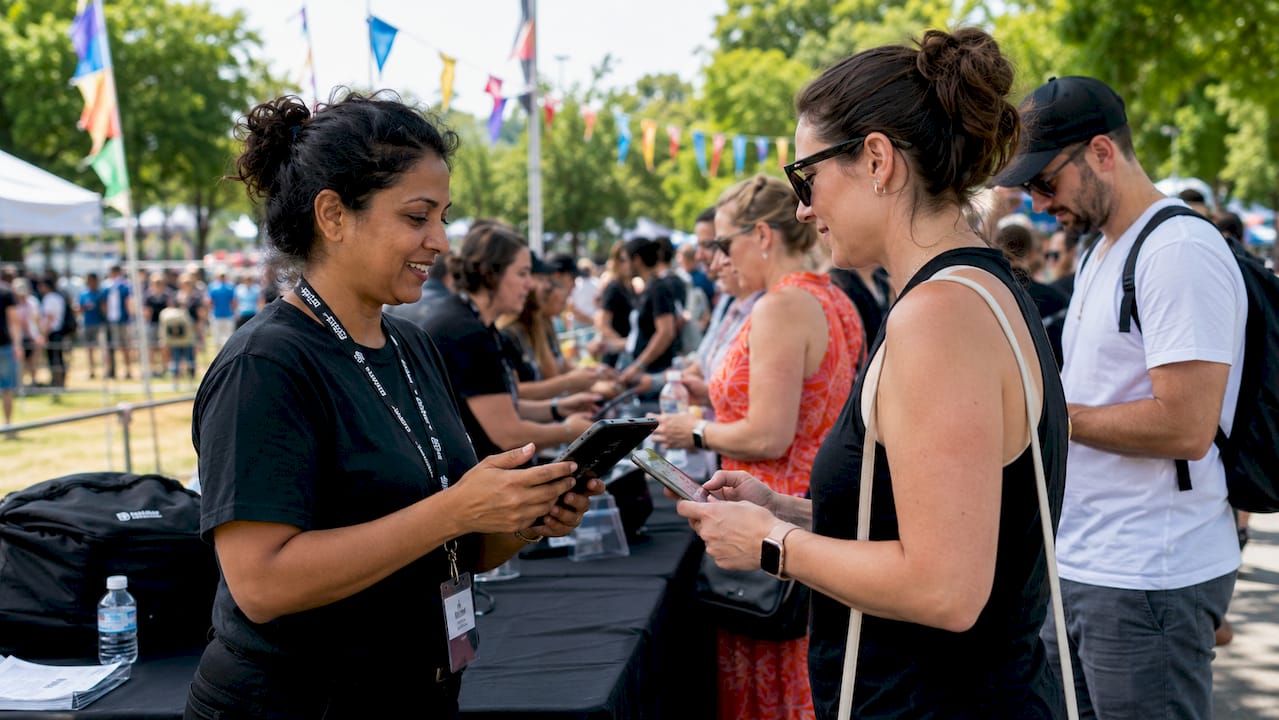
Check-in is the first physical touchpoint of your event, and it carries disproportionate weight. A 10-minute wait at the door can undo weeks of pre-event communication. The operational decisions you make about queue design, technology, and staff training determine whether attendees arrive energized or already frustrated.
Multiple short, independent queue lines reduce anxiety and prevent complete queue collapse if one lane stalls. A single massive line creates the perception of disaster even when actual wait times are manageable. Splitting access into four or five independent validation lanes keeps visible progress constant and gives attendees a sense of control over their wait.
- Use digital wallet tickets. Apple Wallet and Google Wallet passes scan faster than PDFs and eliminate the "I can't find my email" problem at the gate.
- Deploy offline-capable check-in technology. Offline-first check-in systems that sync on reconnect prevent downtime during network outages. Never assume venue Wi-Fi will hold under the load of 500 simultaneous device connections.
- Post clear visual guidance from the parking lot forward. Signage that guides attendees from arrival to their lane removes the cognitive load of figuring out where to go, which reduces perceived wait time.
- Train staff for rapid problem resolution. Every check-in lane needs one person with override authority who can resolve ticket issues in under 60 seconds without pulling a manager.
- Run a regression test before the event. Validate QR and NFC scanning workflows offline and under load conditions. Beta testing with a small group 48 hours before the event catches failures you cannot afford to discover on the day.
Pro Tip: Station a roving staff member with a tablet at the back of your longest queue. They can pre-scan tickets while attendees wait, cutting effective processing time in half before people even reach the main gate.
How to deliver an engaging and memorable on-site experience
The on-site experience is where your event either becomes a story attendees tell or a day they forget. Content quality matters, but memorable experiences are engineered micro-moments. Emotional peaks, smooth transitions, and the final departure moment shape lasting impressions far more than the scheduled agenda alone.
Here is how to build an on-site experience that attendees remember and talk about:
- Design emotional peaks deliberately. Map your run-of-show and identify three to five moments intended to create a strong emotional response: a surprise speaker reveal, a product demo that stops the room, a networking activation that sparks genuine conversation. These peaks are the moments attendees photograph and share.
- Use interactive technology to hold attention. Real-time polls via tools like Slido or Mentimeter, AR activations, and live Q&A features transform passive audiences into active participants. Passive attendance is forgettable; active participation is not.
- Personalize the agenda through your event app. Let attendees build custom schedules, receive session reminders, and get real-time updates on room changes. Real-time app engagement and behavioral data also inform live operational decisions, such as opening overflow rooms or adjusting session timing based on actual attendance patterns.
- Design for inclusivity at the venue level. Accessible seating, captioning, quiet rooms, and gender-neutral restrooms are not optional additions. They are baseline requirements for any event that claims to serve a diverse professional audience.
- Manage navigation proactively. Place staff at every decision point in the venue, not just at the entrance. Attendees who get lost or confused disengage quickly, and that disengagement is almost impossible to reverse mid-event.
"Guests remember engineered micro-moments such as emotional peaks and friction resolutions more than just the scheduled content, so design for these moments." — Onstage Entertainment
The physical environment carries as much weight as the programming. Lighting, sound, spatial flow, and branded touchpoints all contribute to how attendees feel in the space. At Kingsixteen, we treat environment design as a storytelling tool. The room should communicate the brand's identity before a single speaker takes the stage. For more on how event branding shapes the full attendee experience, the principles apply directly to on-site environment decisions.
How to use post-event feedback to improve future events

Post-event follow-up is where most planners leave the most value on the table. The data you collect in the 24 hours after your event is more accurate and more emotionally resonant than anything you gather a week later. Post-event surveys sent within 24 hours achieve the highest response rates and the most detailed feedback. Response rates decline sharply after 48 hours as emotional memory fades and inboxes fill up.
The three metrics every event planner should track are CSAT, NPS, and CES. These KPIs provide actionable insight into content quality, navigation, support effectiveness, and overall event enjoyment. Each one measures a different dimension of the attendee experience.
| Metric | What it measures | How to use it |
|---|---|---|
| CSAT (Customer Satisfaction Score) | Overall satisfaction with specific touchpoints | Identify which sessions, venues, or services underperformed |
| NPS (Net Promoter Score) | Likelihood to recommend the event | Gauge overall advocacy and predict return attendance |
| CES (Customer Effort Score) | Ease of key interactions like check-in and navigation | Pinpoint operational friction points to fix before the next event |
Segment your feedback by attendee type. A first-time attendee and a returning VIP have fundamentally different experiences, and averaging their scores together masks the insights you need. Build separate survey flows or filter responses by registration segment to get data you can actually act on.
- Send a pulse survey at the end of each day for multi-day events. Daily check-ins capture session-specific feedback while it is still fresh, and a final follow-up captures the overall arc.
- Close the loop with attendees. Send a post-event communication that acknowledges their feedback and outlines what you are changing as a result. This practice builds trust and increases the likelihood of return attendance.
- Integrate app behavioral data with survey responses. Session attendance rates, feature usage, and networking connections from your event app tell you what attendees actually did, not just what they say they did. For a deeper look at event data strategy, combining behavioral and survey data produces the most complete picture of attendee experience.
Pro Tip: Use a tool like Formbricks or Typeform to build a two-question pulse survey for day-of delivery. Keep it under 90 seconds to complete. Short surveys sent immediately after a session capture specific, accurate feedback that longer post-event surveys cannot replicate.
Key takeaways
A great event attendee experience requires deliberate design at every phase, from registration data capture through post-event feedback loops, with technology reliability and personalization as the connective tissue throughout.
| Point | Details |
|---|---|
| Start personalization at registration | Capture high-leverage data at sign-up to enable tailored communications and agendas throughout the event. |
| Launch your app 48 to 72 hours early | Early app adoption drives pre-arrival engagement and improves on-site usage and navigation. |
| Design check-in with multiple lanes | Independent queue lines prevent bottlenecks and reduce perceived wait time anxiety at entry. |
| Engineer emotional peaks on-site | Plan three to five deliberate high-impact moments that attendees will remember and share beyond the event. |
| Send feedback surveys within 24 hours | Early outreach captures accurate emotional memory and produces higher response rates for CSAT, NPS, and CES. |
What I've learned from building attendee journeys that actually work
After producing events for brands like Porsche, Audi, and Churchill Downs, I can tell you that the gap between a good event and a great one almost never comes down to the keynote speaker or the venue. It comes down to the 40 decisions that happen between the moment someone registers and the moment they walk out the door.
The planners who struggle most are the ones who treat personalization as a feature they will add later. They build the logistics first and then try to layer in the attendee experience on top. That approach produces events that run on time but feel generic. The planners who consistently get it right build the attendee journey first and let the logistics serve it.
Technology is the other place where I see well-intentioned plans fall apart. Deploying a new check-in system or event app without offline-first architecture and a full regression test is a gamble you will lose eventually. Venue Wi-Fi fails. Cellular networks get saturated. The events that hold together under those conditions are the ones where someone made the unglamorous decision to test every failure scenario before the event went live.
The metric I care about most is not NPS or CSAT in isolation. It is whether the data from those surveys actually changes something in the next event. Feedback loops only create value if someone is accountable for closing them. Build that accountability into your post-event process before the event happens, not after you read the results.
— Tyler
Build experiences that attendees remember with Kingsixteen
Kingsixteen designs and executes immersive events and brand activations for high-value clients who need every detail executed without margin for error. From conference production and environment design to custom fabrication and digital integration, our turnkey model covers the full attendee journey from first impression to final follow-up. If you are ready to move beyond logistics and build an experience that drives real engagement and return intent, our experiential marketing services are built for exactly that. For events that require a fully managed production with personalized guest experience at the center, explore our event services or contact us directly to discuss your next activation.
FAQ
What is event guest experience management?
Event guest experience management is the practice of designing and overseeing every attendee interaction across the full event lifecycle, from registration through post-event follow-up, to maximize satisfaction and return intent. It treats the attendee journey as a continuous process rather than a series of disconnected tasks.
When should post-event surveys be sent?
Post-event surveys should be sent within 24 hours of the event's conclusion. Response rates and feedback accuracy decline sharply after 48 hours as emotional memory fades.
What metrics measure attendee experience effectively?
The three core metrics are CSAT, NPS, and CES. CSAT measures satisfaction with specific touchpoints, NPS measures likelihood to recommend the event, and CES measures the ease of key interactions like check-in and navigation.
How early should you announce an event mobile app?
Announce your event app 48 to 72 hours before the event. This window gives attendees enough time to download, explore, and build their personal agendas before arriving, which drives higher on-site adoption and engagement.
How do you reduce check-in wait times at large events?
Use multiple independent queue lanes rather than a single line, deploy digital wallet tickets for faster scanning, and run offline-capable check-in technology that does not depend on stable venue Wi-Fi. Staff each lane with someone authorized to resolve ticket issues immediately.