
End-to-end event planning is the process of managing every phase of an event lifecycle, from initial concept and goal setting through post-event evaluation and ROI reporting. The industry term for this discipline is event management, which extends well beyond traditional event planning by incorporating production oversight, vendor coordination, data analysis, and attendee experience design. Event management covers the full lifecycle as a strategic discipline, not just a logistical checklist. For corporate decision-makers and professional planners, understanding this distinction is the difference between an event that runs and an event that delivers. Tools like Guidebook, Agenday, and Planning Pod have made the full-service coordination model more accessible, but the framework behind it remains the same: own every phase or risk losing control of the outcome.
What are the essential phases of end-to-end event planning?
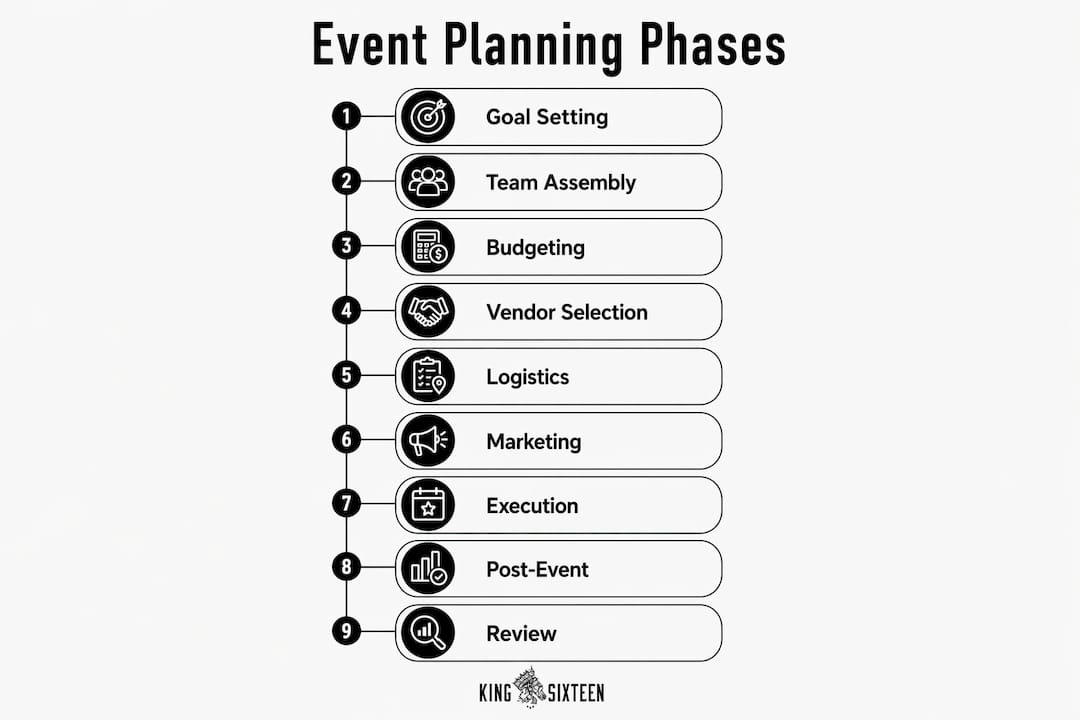
End-to-end event management follows a 9-step lifecycle from concept to evaluation. Each phase builds on the last, and skipping one creates compounding problems downstream. Here is how professional planners structure the process.
-
Goal definition. Set measurable outcomes before anything else. Are you generating leads, launching a product, or building brand awareness? Your goals determine every decision that follows, from venue size to speaker selection.
-
Team assembly. Assign clear ownership for each workstream: production, marketing, logistics, and onsite operations. Ambiguous roles are the first cause of dropped tasks in complex events.
-
Budget creation. Build a line-item budget that accounts for AV, catering, venue, staffing, fabrication, and contingency. Leave at least 10–15% unallocated for last-minute changes.
-
Venue sourcing. Match the venue to your audience size and brand positioning. A product launch for Porsche requires a different environment than a 500-person industry summit.
-
Agenda planning. Structure the run-of-show around attendee energy, not just content volume. The strongest conferences front-load high-value sessions and build in deliberate networking time.
-
Marketing and registration. Drive attendance through targeted outreach, landing pages, and email sequences. Your event marketing strategy should start at least eight weeks before the event date.
-
Vendor coordination. Confirm contracts, delivery schedules, and technical requirements with every vendor. This is where most coordination gaps appear, especially when AV and logistics teams operate independently.
-
Onsite operations. Execute the run-of-show with a dedicated production manager holding a single master document. Deviations from the plan get resolved in real time, not after the fact.
-
Post-event analysis. Measure against your original goals. Collect attendee feedback, review registration and engagement data, and document what worked for the next event.
Pro Tip: Assign one person as the single point of contact for all vendor communications during the final 72 hours before the event. This eliminates the version-control problems that cause schedule drift on event day.
Which digital tools help manage the full event lifecycle?

The right software turns a chaotic multi-vendor operation into a coordinated production. The wrong tools, or too many disconnected ones, create the exact fragmentation they were meant to prevent.
A single "source of truth" dashboard that syncs schedules, registration data, and vendor instructions is the most effective way to prevent data fragmentation. When front-of-house staff and production teams work from different versions of the same document, cues get missed and agendas drift. Centralized platforms eliminate that risk.
| Tool | Best Use Case | Key Feature | Pricing |
|---|---|---|---|
| Planning Pod | Corporate event logistics | Centralized task and vendor management | Paid tiers; contact for quote |
| Guidebook | Conference attendee apps | Mobile agenda and engagement tools | Paid tiers; contact for quote |
| Agenday | Real-time schedule sync | Single-dashboard data coordination | Contact for pricing |
| Cvent | Large-scale registration | End-to-end registration and reporting | Enterprise pricing |
Each tool solves a different problem. Planning Pod works best for teams managing multiple simultaneous workstreams. Guidebook excels at the attendee-facing experience, giving conference guests a mobile app with live schedule updates. Agenday focuses on the backend, keeping production and logistics teams synchronized. Cvent handles large-scale registration and post-event reporting for enterprise clients.
AV and lighting management should not live in a separate system from your event schedule. Integrating AV and logistics under one management system reduces communication friction and keeps show flow intact. When your lighting cues, speaker transitions, and catering timing all reference the same master document, the event runs as designed.
Pro Tip: Before committing to any platform, map your existing workflow first. The best tool is the one your team will actually use consistently, not the one with the most features.
How does full-service event coordination differ from basic planning?
Traditional event planning focuses on pre-event logistics: booking the venue, confirming catering, and building the agenda. Full-service event coordination, or comprehensive event management, goes further by holding production accountability through execution and post-event wrap-up.
The clearest distinction is who owns the day-of operation. In a traditional model, the planner hands off to a venue coordinator and multiple vendors, each managing their own scope. In a full-service model, a dedicated production manager oversees every element from a single command position. Full-service companies bridge planning and production to guarantee show flow and attendee experience alignment. That single point of accountability eliminates the finger-pointing that happens when AV, catering, and logistics teams each blame the others for a missed cue.
The service tier you need depends on event complexity:
- Coordination only. Covers vendor management, timeline creation, and day-of oversight. Base coordination services start around $1,750 for limited scopes.
- Full production management. Includes AV direction, stage design, run-of-show management, and post-event reporting. Pricing scales with attendee count and technical complexity.
- Turnkey experiential production. Covers concept, fabrication, staffing, AV, catering, and digital integration under one agency. Best suited for brand activations, product launches, and large-scale conferences with 500 or more attendees.
The pricing gap between coordination-only and full production management is real, but so is the risk gap. For high-stakes corporate events, the cost of a failed execution far exceeds the premium for full-service oversight.
What are the most common challenges in end-to-end event management?
Even well-planned events fail at the execution layer. The causes are predictable, and so are the solutions.
Data fragmentation is the most frequent failure point in high-stakes events. When your registration platform, production schedule, and vendor briefing documents are not synchronized, teams operate on different assumptions. The result is inconsistent agendas, missed cues, and attendees who experience a different event than the one you designed.
The most common challenges professional planners face include:
- Vendor coordination gaps. Multiple vendors with separate contacts and no shared timeline create communication dead zones. Assign one master document and one point of contact.
- Schedule drift. Small delays compound. A 10-minute speaker overrun can push catering, AV transitions, and the entire afternoon agenda off track. Build buffer time into every major transition.
- Scope creep. Clients add requests after contracts are signed. Define a formal change-order process before the event enters production.
- Attendee experience inconsistency. Front-of-house staff and production teams working from different information deliver a disjointed experience. Unified briefings solve this.
- Post-event data gaps. Without a structured follow-up process, ROI measurement becomes guesswork. Build your reporting framework before the event, not after.
"The best events are intentional, not transactional. When you limit your client roster and give each event the focused attention it deserves, the quality of the outcome changes entirely." — Andrew Roby Events
That perspective reflects a real operational truth. Agencies that take on too many simultaneous events spread their attention thin. The events that stand out are the ones where every detail received deliberate thought, not just execution.
Contingency planning is non-negotiable for events above a certain complexity threshold. Have a backup AV vendor on call. Know your venue's weather contingency if any element is outdoors. Brief your production manager on the three most likely failure points and the response protocol for each.
Key Takeaways
Successful end-to-end event planning requires owning every phase of the lifecycle, from goal setting through post-event analysis, with integrated tools, clear accountability, and a single source of operational truth.
| Point | Details |
|---|---|
| Follow the 9-phase lifecycle | Structure every event from goal definition through ROI reporting to prevent gaps. |
| Centralize your data | Use one platform to sync schedules, vendor instructions, and registration to prevent drift. |
| Choose the right service tier | Match coordination, full production, or turnkey management to your event's complexity. |
| Integrate AV and logistics | Unified production management eliminates finger-pointing and protects show flow. |
| Plan for failure points | Identify the three most likely risks before the event and brief your team on each response. |
Why intentional events outperform transactional ones
The events I remember most, and the ones clients talk about long after the lights go down, share one quality: they were built around a clear purpose, not just a date on the calendar.
Most event failures I have seen do not happen because of bad vendors or tight budgets. They happen because the planning process was reactive. The team was solving problems as they appeared instead of designing the experience from the outcome backward. When you start with a measurable goal and build every phase to serve that goal, the event has direction. Attendees feel it. Sponsors notice it. The data confirms it.
The technology piece matters, but it is not the answer on its own. I have watched teams use every platform available and still deliver a fragmented experience because no one owned the integration layer. The tool is only as good as the discipline behind it. Assign ownership, centralize your data, and hold your production manager accountable to a single master document.
The agencies and planners who consistently deliver exceptional events also tend to limit how many they take on at once. That is not a capacity constraint. It is a quality decision. Focused attention produces better outcomes than distributed effort, and the best clients recognize that.
If you are a corporate decision-maker evaluating event partners, ask how many events they are running in the same month as yours. The answer tells you more than any portfolio deck.
— Tyler
How Kingsixteen handles full-service event production
Kingsixteen builds and executes events for brands that cannot afford a second-rate outcome. From product launches for Porsche and Audi to large-scale conference production, the team handles every layer of the event: concept, fabrication, AV, staffing, catering, and digital integration. That turnkey model means one point of accountability and no coordination gaps between vendors.
If you are planning a corporate event, brand activation, or conference and need a team that owns the entire process, Kingsixteen's full-service event management is built for exactly that. For brands focused on creating experiences that drive real engagement, explore Kingsixteen's experiential marketing services to see how production and brand strategy work together.
FAQ
What does end-to-end event planning include?
End-to-end event planning covers the full event lifecycle across nine phases: goal setting, team assembly, budgeting, venue sourcing, agenda planning, marketing, vendor coordination, onsite operations, and post-event analysis. It extends beyond traditional planning by including production oversight and ROI measurement.
How much does full-service event coordination cost?
Base coordination services start around $1,750 for limited scopes. Full production management for large conferences scales with attendee count and technical complexity, with enterprise-level events requiring custom pricing.
What is the difference between event planning and event management?
Event planning focuses primarily on pre-event logistics such as venue booking and agenda creation. Event management is a full lifecycle discipline that includes strategy, production oversight, real-time operations, and post-event evaluation.
Which software is best for managing event logistics?
Planning Pod works well for multi-workstream corporate events. Guidebook excels at attendee-facing mobile experiences. Agenday specializes in real-time schedule synchronization across production and logistics teams. The best choice depends on where your coordination gaps are.
How do you prevent schedule drift during a large event?
Use a single centralized document shared across all vendor and production teams, assign one point of contact for day-of communications, and build buffer time into every major transition. Fragmented communication is the primary cause of schedule drift in high-stakes events.