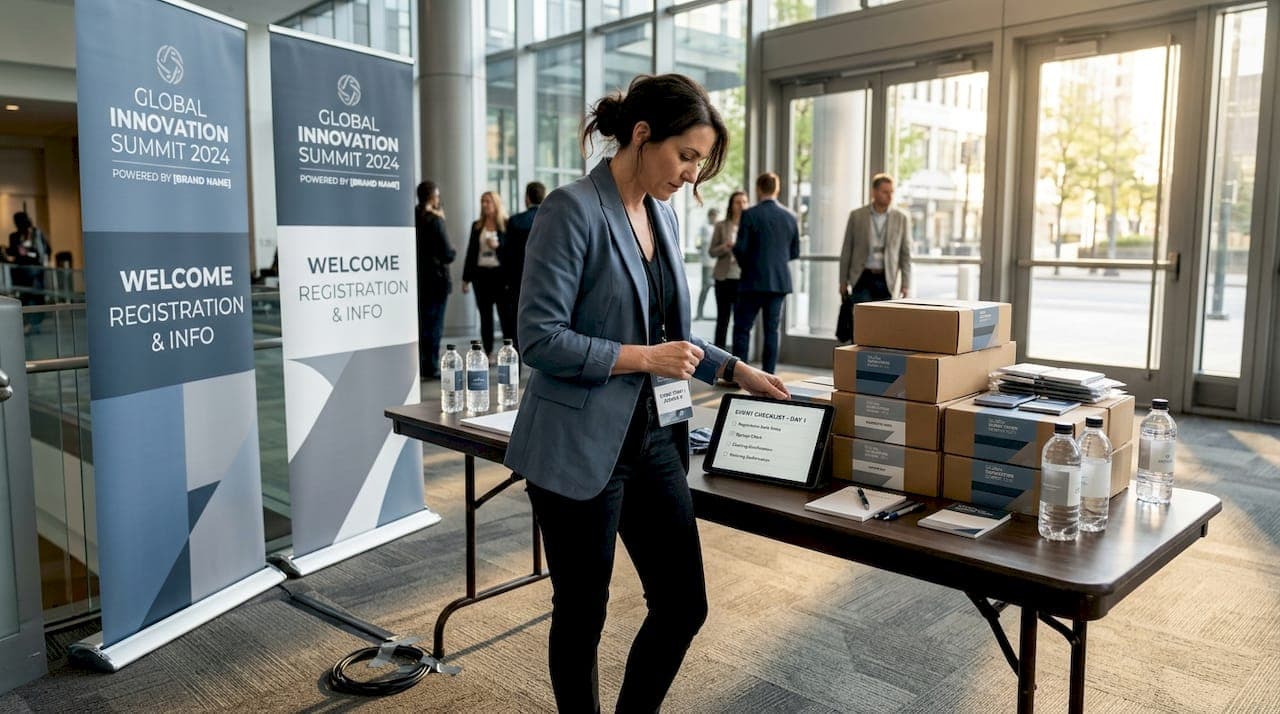
Live brand activations are one of the most powerful tools in a marketing executive's arsenal, yet most brands leave serious results on the table by treating them as one-off spectacles rather than strategic business assets. 61% of consumers are more inclined to purchase after attending a brand event, which means a well-executed activation isn't just a feel-good moment, it's a revenue driver. The challenge is in the execution: designing an experience that resonates emotionally, operates flawlessly, and generates measurable outcomes. This guide walks you through every stage, from foundational planning and team setup to live execution, troubleshooting, and performance analysis.
Table of Contents
- Essential elements of successful brand activations
- Step-by-step planning and execution framework
- Avoiding common pitfalls and maximizing engagement
- Measuring impact and optimizing results
- What most executives miss about experiential marketing in 2026
- Partner with experts for next-level brand activations
- Frequently asked questions
Key Takeaways
| Point | Details |
|---|---|
| Activations drive sales | Brand events significantly increase purchase intent and positive sentiment for high-value brands. |
| Strategic planning is essential | A structured process from prep to execution ensures measurable impact and avoids common mistakes. |
| Measure and refine | Tracking key metrics after your event enables continuous improvement and stronger ROI. |
| Expert support amplifies results | Partnering with experienced agencies and tech platforms brings expertise and scalability for standout activations. |
Essential elements of successful brand activations
Having established the impact, let's define what you need to get started. Before a single piece of custom fabrication is ordered or a venue is booked, you need to be crystal clear on three things: your objective, your audience, and your resources. Without this foundation, even the most visually spectacular activation can fall flat on business metrics.
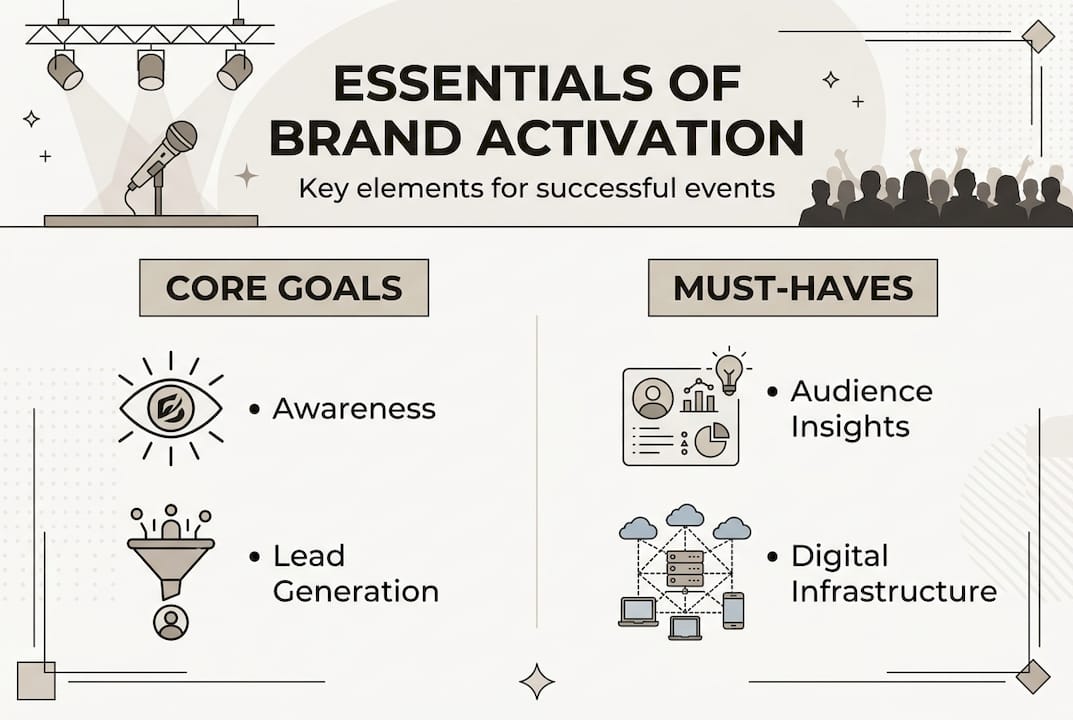
Start with your objectives. Brand activations typically serve one of three core goals: building awareness, generating qualified leads, or shifting sentiment. These aren't interchangeable. An awareness play at a cultural festival looks completely different from a high-touch lead-gen experience at an industry summit. Define yours early and let it drive every downstream decision, from the type of environment you build to the data you collect on the floor.
Audience analysis is non-negotiable. Dig into your target attendee's demographics, but go further into their behaviors, motivations, and what they care about when they're not thinking about your product. The most successful activations we've seen feel personally relevant to the people walking through them. That relevance isn't accidental; it's the result of deliberate research.

Experiential marketing essentials go beyond decor and logistics. You also need to account for your digital infrastructure: social integrations, QR-coded touchpoints, lead capture tools, and real-time data dashboards. The physical and digital experience need to operate as a single system, not two separate tracks.
Event services increasingly include technology components because attendees in 2026 expect seamless interaction between physical environments and digital engagement. Plan for both from day one.
Key requirements for a successful 2026 brand activation:
| Requirement | Details |
|---|---|
| Clear objective | Awareness, lead generation, or sentiment shift |
| Audience profile | Demographics, behavioral data, psychographic insights |
| Venue selection | Size, footfall, brand alignment, technical capabilities |
| Event technology | RFID, QR integrations, real-time data capture tools |
| Staffing plan | Brand ambassadors, tech support, logistics coordinators |
| Social integration | Hashtag strategy, content creation zones, influencer invites |
| Post-event analytics | CRM integration, feedback surveys, ROI reporting setup |
After live events, 91% of consumers feel more positive about brands. That's an extraordinary sentiment shift, and it tells you that the experience itself is doing the heavy lifting. But only if it's built correctly from the start.
Key resources to line up before activation day:
- A dedicated project lead who owns the full timeline and vendor relationships
- A fabrication partner capable of building on-brand physical environments, not just standard booths
- Audio-visual equipment that matches the scale and mood of the experience
- A staffing roster with clearly defined roles and proper brand training
- A social amplification plan that captures and distributes content in real time
Pro Tip: Select experiences that align with your brand's personality, not just your campaign theme. A luxury automotive brand hosting a high-adrenaline obstacle course might generate buzz, but it can undercut the aspirational positioning you've spent years building. Alignment between the experience and the brand identity is what makes activations resonate at a deeper level.
Step-by-step planning and execution framework
Once you have your essentials in place, it's time to map out your activation's execution. Planning without structure creates chaos on event day. Structure without flexibility creates rigidity when things inevitably shift. The goal is a framework that's detailed enough to keep everyone aligned but agile enough to adapt in real time.
The planning process from kickoff to wrap-up:
- Kickoff and briefing. Align your internal team and agency partners on objectives, budget parameters, timeline, and non-negotiables. Document everything.
- Concept development. Translate your brand story into an experiential concept. What should people feel when they walk in? What's the single strongest memory they'll take away?
- Venue scouting and contracting. Scout locations that support your concept, not just your headcount. Factor in natural light, load-in access, proximity to your target audience, and technical infrastructure.
- Fabrication and design build. Commission custom brand assets: installations, environments, display systems. Give your fabrication partner enough lead time; rushed builds show.
- Staffing recruitment and training. Hire your team early. Use a detailed event staffing guide to define roles clearly, train on brand voice and product knowledge, and run pre-event walkthroughs.
- Tech integration and testing. Test every digital touchpoint, including lead capture tools, AV systems, and social integrations, at least 48 hours before the event.
- Live execution and monitoring. Assign a real-time decision-maker on the floor. Issues will come up. That person needs authority to act.
- Wrap-up and data export. Pull all data before you break down the space. Leads, engagement metrics, photo content, and feedback forms should be collected and backed up immediately.
In-house vs. agency support:
| Factor | In-house team | Agency partner |
|---|---|---|
| Concept creativity | Strong brand knowledge, limited external perspective | Fresh creative with brand immersion process |
| Execution speed | Slower due to internal approvals and limited vendor network | Faster via established vendor relationships |
| Cost control | Direct oversight, potential for budget drift | Structured pricing with scope management |
| Scalability | Limited by headcount and internal bandwidth | Scales easily with project scope |
| Risk management | Higher exposure without event-specific experience | Agencies absorb and manage risk professionally |
For brands operating at the level of auto launch best practices, the agency model almost always outperforms in-house execution on complex activations. The vendor relationships, fabrication capabilities, and real-time problem-solving experience are simply hard to replicate internally.
The average ROI of brand activations runs between 3:1 and 5:1 when properly planned and measured. That number goes down fast when execution is inconsistent or when data capture is an afterthought.
Pro Tip: Build real-time analytics into your event from the start, not as a post-event add-on. Monitoring foot traffic patterns, dwell time at specific installations, and social mentions while the event is live gives you the ability to make smart, agile decisions, like redirecting staff, extending a popular activation, or pushing a social post at peak engagement.
Avoiding common pitfalls and maximizing engagement
Now, let's ensure your plan avoids the stumbling blocks and delivers lasting engagement. Even well-funded activations can underperform when execution breaks down in predictable ways. Most of the mistakes we see aren't creative failures; they're operational ones.
Top pitfalls to avoid:
- Neglecting data collection. If you're not capturing attendee information, behavior patterns, and engagement metrics, you're running a brand activation without a feedback loop. Every interaction is a data point. Don't waste it.
- Poor staff training. Brand ambassadors who can't speak confidently about your product or who break from the brand's tone of voice can undo thousands of dollars in design investment in a single conversation.
- Over-indexing on aesthetics. A beautiful space that doesn't guide attendees through a clear journey creates visual noise without emotional impact. Design for experience flow, not just Instagram moments.
- Weak social integration. If your event doesn't make it easy for attendees to share content, you're limiting your reach to the people in the room. In 2026, social amplification is a core activation mechanic, not an optional extra.
- Ignoring personalization. Generic experiences feel transactional. Attendees who feel personally seen and catered to are significantly more likely to convert and advocate.
Engagement boosters that consistently deliver:
- Live demonstrations that let attendees interact with the product directly, not just observe it
- Personalized giveaways tied to attendee data or choices made during the experience
- Exclusive content drops or early access rewards for event attendees only
- Interactive event tech tools like AR overlays, gamified touchpoints, and real-time leaderboards
- High-quality, shareable content capture zones with professional lighting and brand-consistent backdrops
"61% of consumers are more inclined to purchase after attending a brand event." EventTrack 2026
That lift is substantial. But the brands capturing it aren't relying on the event itself to do all the work. They're designing deliberate pathways from emotional engagement to commercial action: a QR code that leads to a personalized product page, a follow-up email sequence triggered by event check-in, or an exclusive offer available only to event attendees for 48 hours post-show.
Personalization is the variable that separates good events from great ones. When you use the data you collect during registration and on the event floor to tailor the experience in real time, such as routing VIP guests through a dedicated journey or serving content based on stated product preferences, you create moments that feel intentional and exclusive. Those moments drive the deepest brand memory.
Pro Tip: Even simple personalization tactics, like greeting returning customers by name or tailoring product demos based on pre-event survey responses, create a noticeably different emotional response. You don't need complex AI tools to start. Start with the data you already have.
Measuring impact and optimizing results
Finally, with your activation live, it's crucial to measure, analyze, and refine for lasting success. Many marketing teams celebrate a successful event day, then struggle to tell a clear ROI story to leadership two weeks later. The measurement plan needs to be built before the event, not assembled afterward from whatever data happens to be available.
Key performance metrics to track:
- Engagement rate. How many attendees actively participated vs. just observed? Track interaction at each touchpoint using tech integrations and staff tallies.
- Lead volume and quality. Total leads captured, and the percentage that fit your ideal customer profile. Quality matters more than volume here.
- Sentiment shift. Pre and post-event surveys or social listening tools can quantify how perceptions of your brand changed because of the experience.
- Conversion rate. What percentage of event leads moved into your sales pipeline or made a purchase within 30, 60, and 90 days?
- Social reach and earned media. Total impressions generated by attendee content, press coverage, and brand posts tied to the event.
- Net Promoter Score (NPS). Did attendees leave wanting to recommend your brand? A simple post-event NPS survey gives you a clean, comparable metric.
Tools and strategies that make measurement easier:
- CRM integrations that auto-tag leads generated at specific events for clean attribution
- RFID wristbands or badge scanners that track movement and dwell time throughout the venue
- Post-event email surveys sent within 24 hours while memories are fresh
- Social listening tools like Brandwatch or Sprout Social to track organic conversation volume and sentiment
- Real-time dashboards built by your event tech partner or internal analytics team
- Event data analytics platforms that consolidate data across physical and digital touchpoints into a single reporting view
Statistic to keep front of mind: The average ROI for brand activations lands between 3:1 and 5:1 when measurement systems are properly built and tracked.
Use that benchmark as your baseline target, and build your reporting structure to prove it. If your activation hits below 3:1, use the data to identify where drop-off occurred: was it in lead quality, follow-up speed, or conversion pathways? Each gap is a specific, fixable problem.
Your post-event debrief should be structured around three questions. What worked and why? What underperformed and where did the breakdown happen? And what would you change for the next activation to improve the ROI? When you apply measuring experiential marketing rigorously after every event, your activations compound in effectiveness over time. Each one teaches you something the next one benefits from.
What most executives miss about experiential marketing in 2026
Here's a perspective most planning guides won't share: the brands obsessing over digital metrics from their activations are often measuring the wrong things. Impressions, likes, and click-through rates matter, but they don't capture the most valuable thing a live event creates: experiential memory.
When a consumer walks through an environment your brand built specifically to move them, and they feel something real, that moment lives in their memory in a way no digital ad ever reaches. We've seen activations at King Sixteen generate disproportionate long-tail results, sales conversations that happen six months later, partnerships initiated by someone who attended a product launch, and brand advocates who emerged from a single event.
The uncomfortable truth is that the most impactful activations are often the hardest to attribute directly in a dashboard. The brands that win at experiential marketing are the ones willing to trust the strategy, build the measurement systems to capture what they can, and stay consistent in their commitment to creating genuine, felt experiences. Digital metrics tell you what happened. Experiential memory tells you what mattered.
Partner with experts for next-level brand activations
Planning an activation that drives real business outcomes takes more than a great concept. It takes experienced execution, a trusted vendor network, and the ability to move fast without sacrificing quality.
At King Sixteen, we build experiential marketing solutions that are designed from the ground up to perform, not just impress. Whether you're planning a precision auto launch activation, a multi-day conference, or a large-scale brand environment, our turnkey model handles concept, fabrication, staffing, AV, and logistics as one seamless operation. Explore our full range of event services and connect with our team to start building an activation that your audience will remember, and your leadership will respect.
Frequently asked questions
What is the average ROI for brand activations?
Brand activations typically deliver a 3:1 to 5:1 average return on investment when measurement systems are properly built and tracked from the start.
How much does consumer sentiment change after live events?
91% of consumers report feeling more positive about a brand after attending one of their live events, making activations one of the most effective sentiment-shifting tools available.
What are the biggest mistakes in brand activations?
The most common pitfalls are neglecting attendee data collection, inadequate staff training on brand voice and product knowledge, and failing to personalize the experience for different audience segments.
Which performance metrics should be tracked at brand events?
Track engagement rate, lead volume and quality, sentiment shift, conversion rates at 30 and 60 days post-event, social reach, and Net Promoter Score to build a complete picture of activation effectiveness.