Skilled conference event management is the difference between an event people tolerate and one they talk about for months. Yet most organizers treat it as a checklist exercise, coordinating rooms and catering and calling it done. The reality is that conferences today are complex productions with moving parts spanning security, AV, digital platforms, stakeholder expectations, and real-time decisions under pressure. This guide covers the full picture: from foundational planning through advanced technology and attendee engagement, so you can run events that actually deliver.
Table of Contents
- Key Takeaways
- Conference event management fundamentals
- Advanced security for large conferences
- Optimizing your AV production
- Leveraging technology for engagement and efficiency
- Maximizing attendee engagement and revenue
- My honest take on what actually separates good from great
- How Kingsixteen approaches full-service conference production
- FAQ
Key Takeaways
| Point | Details |
|---|---|
| Plan with clear objectives | Define what success looks like before booking a single vendor or setting a timeline. |
| Security requires layered strategy | Combine AI-powered monitoring, access control, and integrated communications to protect attendees. |
| AV quality shapes perception | Poor sound or visuals undermine even the strongest content and speaker lineup. |
| Technology drives engagement | Use conference platforms for registration, networking, and hybrid delivery to extend your reach. |
| Engagement and revenue connect | Interactive sessions and smart sponsorship integration directly impact your bottom line. |
Conference event management fundamentals
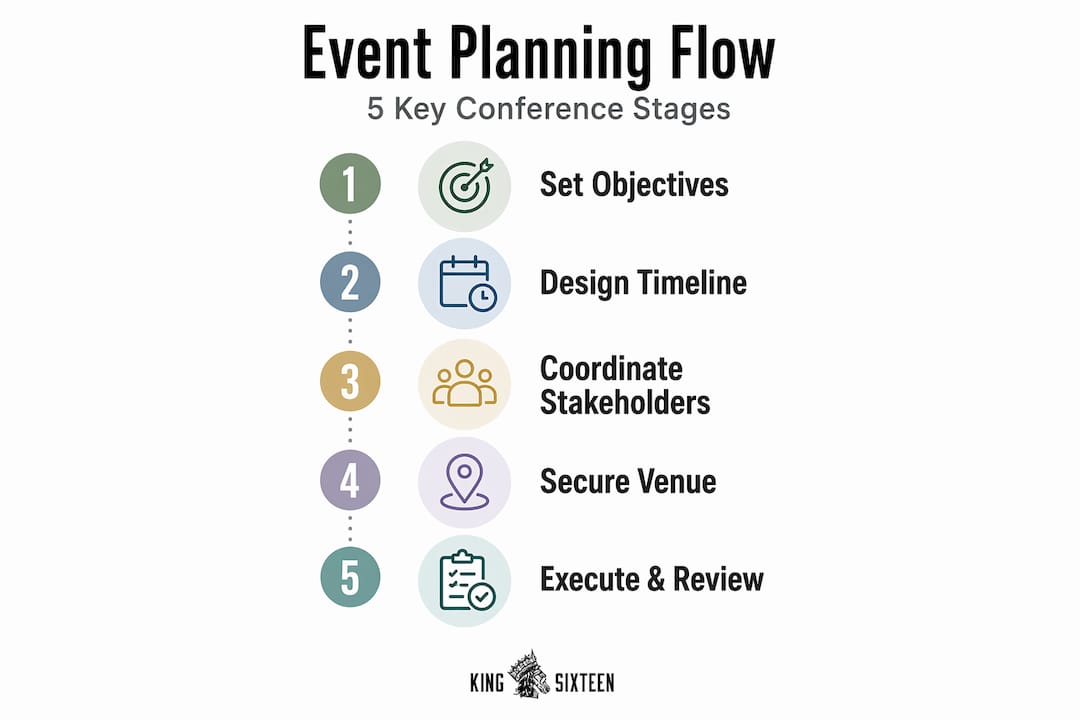
Every strong conference begins with a clearly defined objective. Not a vague goal like "bring the industry together," but a measurable outcome: generate 200 qualified leads, launch a product to 500 key accounts, or build visibility in a new market segment. That objective shapes every downstream decision, from venue capacity to session format to your marketing timeline.
Once you have your objective, build a phased timeline working backward from the event date. A multi-day conference typically requires 9 to 12 months of lead time. Break that into milestone phases: initial planning and stakeholder alignment, venue and vendor contracts, speaker recruitment, marketing and registration launch, attendee communications, and final production logistics. Missing a milestone in month three creates compounding pressure in month eleven.
Stakeholder coordination is where most conference plans quietly fall apart. You are managing sponsors expecting visibility, speakers expecting support, venues expecting compliance, and vendors expecting clear briefs. Build a shared communication cadence early, with weekly or bi-weekly check-ins tied to milestones rather than status updates for their own sake.
Budgeting frameworks are foundational to conference planning, directly impacting the event's scale, quality, and stakeholder satisfaction. Allocate budget across five core categories: venue, AV and production, staffing, marketing, and contingency. That last one is not optional. A 10% contingency reserve is the minimum for any event with more than 300 attendees.
When evaluating venues, go beyond aesthetics. Consider load-in logistics, union labor rules, rigging capacity for AV, breakout room availability, Wi-Fi infrastructure, and proximity to lodging for multi-day events. The most beautiful space can become a production nightmare if it does not support your technical requirements.
Pro Tip: Visit your venue shortlist on a day when another event is running. You will learn more about staff responsiveness, crowd flow, and facility limitations in one hour than in any site visit meeting.
Advanced security for large conferences
Security planning has outgrown the model of hiring a few guards and posting them at entry points. Today, effective event security requires a risk assessment before a single attendee registers. That means evaluating political and social context around your event dates, identifying venue-specific vulnerabilities, and planning for scenarios ranging from medical emergencies to unauthorized access.
Modern conferences now use AI-powered geo-based monitoring with real-time intelligence to detect and respond to risks including protests, cyber threats, and crowd anomalies. This is not reserved for government summits. Any conference drawing thousands of attendees from high-profile industries should incorporate real-time situational awareness tools.
Access control is your first physical line of defense. Here is a layered approach that works:
- Issue digital badges with QR codes tied to attendee profiles during registration.
- Set up security checkpoints at all entry points with crowd density monitoring.
- Run daily ID verification that matches physical identification to badge names.
- Assign different access tiers to general attendees, speakers, sponsors, and staff.
- Log all entries and exits in real time to identify anomalies quickly.
High-profile conferences are now seeing attendance reach 140% of prior years, which means daily ID check protocols matching badges to names have become a non-negotiable standard at the scale-up stage. That growth is good news for organizers and a genuine operational challenge for security teams that have not scaled their systems accordingly.
Integrated multi-channel communication systems using SMS, apps, and email with a central command center allow coordinated real-time response to security incidents. Your incident response is only as fast as your communication infrastructure. If a security issue requires immediate attendee notification, you need a system that can reach every registered attendee within two minutes, not two hours.
Cybersecurity belongs in your planning conversation as well. Conference registration systems collect payment data, personal information, and sometimes sensitive company data. Ensure your event registration software and Wi-Fi infrastructure are secured with enterprise-grade protocols.
Pro Tip: Conduct a tabletop exercise with your security team and venue management 30 days before the event. Walk through three scenarios: a medical emergency, an unauthorized access attempt, and a weather event requiring evacuation. You will expose gaps while you still have time to fix them.
Optimizing your AV production
Audio-visual production is the layer of conference event production that attendees feel before they consciously register it. Bad sound makes a great speaker seem unprepared. Poor lighting makes a high-budget stage look cheap. Getting AV right is not about spending more. It is about planning more thoroughly.
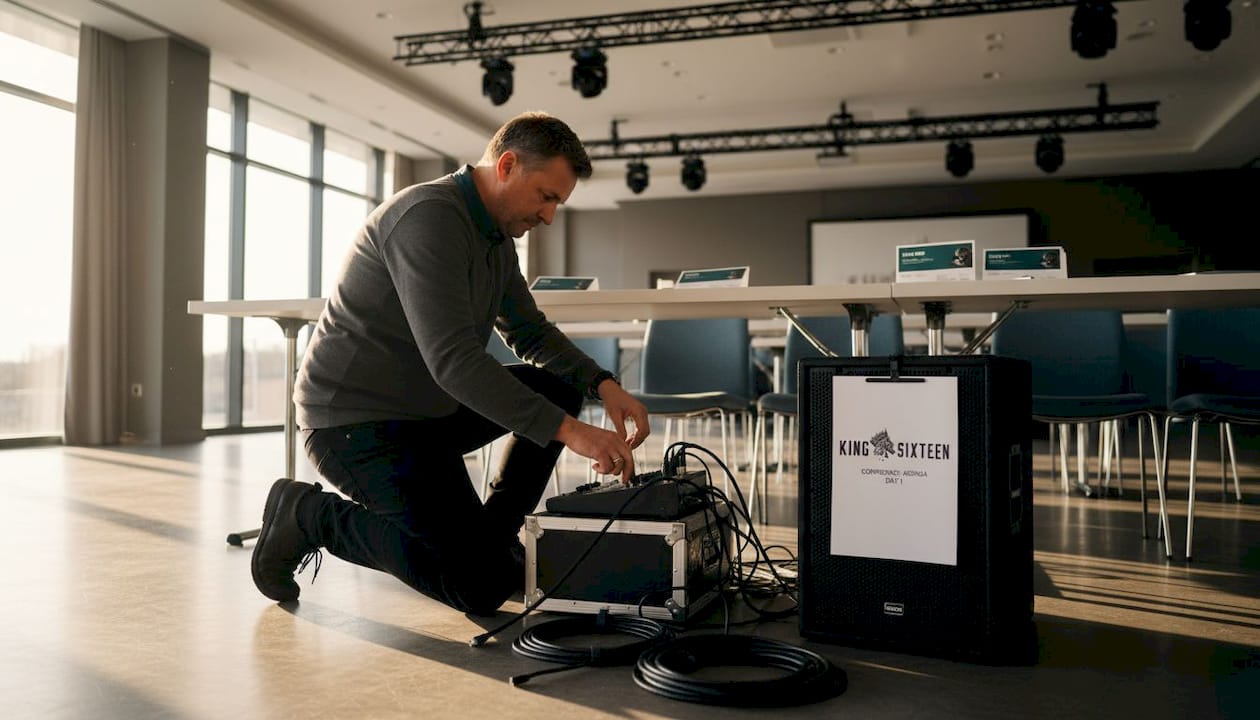
Start by aligning your AV plan to event purpose and room size. A 50-person workshop needs a completely different setup than a 2,000-person general session. Your sound system design should specify microphone types (lavalier, handheld, podium), their placement, and how they are mixed for both live room sound and broadcast feeds. These are not interchangeable decisions.
For visual displays, LED walls deliver higher brightness and better viewing angles than projection in most conference settings. Projection still works well for controlled-light environments and breakout rooms. For any main stage, add confidence monitors so speakers can view slides, notes, timers, and live cues without turning away from the audience. This single element dramatically improves speaker performance and audience engagement.
Lighting deserves its own brief. You need three layers: stage lighting that makes presenters look professional on camera, audience wash lighting that keeps energy up without washing out the screen, and broadcast-specific lighting that eliminates shadows and color inconsistencies for any streaming or recording.
Backup AV equipment and technical rehearsals are not optional safeguards. They are the production standard. Redundant microphones, backup laptops loaded with all presentations, and a detailed show flow with cue-by-cue documentation keep your team aligned when the unexpected happens.
Pro Tip: Require all speakers to submit presentation files 72 hours before the event in a standardized format. Load every deck the night before and run a full technical rehearsal with your AV team. Day-of surprises are almost always avoidable.
Leveraging technology for engagement and efficiency
The conference management platforms available today do far more than manage registration. All-in-one software handles registration, abstract submissions, speaker coordination, agenda building, and attendee engagement in one place, reducing the operational complexity that typically spreads across a dozen disconnected tools.
When evaluating platforms, compare across these core capability areas:
| Capability | What to look for |
|---|---|
| Registration and ticketing | Custom forms, payment processing, confirmation flows, capacity controls |
| Agenda and scheduling | Session builder, speaker profiles, personalized attendee schedules |
| Networking features | Matchmaking algorithms, meeting scheduling, community forums |
| Hybrid delivery | Live streaming, on-demand access, virtual attendee interaction tools |
| Data and analytics | Real-time dashboards, session attendance, engagement scores, ROI reporting |
For hybrid events specifically, platforms supporting live streaming and virtual networking with on-demand content access dramatically increase reach and overall engagement. A well-executed hybrid format can double your total audience without proportionally increasing your production costs.
Using event data analytics for post-event performance review closes the loop on whether your investment actually delivered. Track session attendance rates, networking tool engagement, app usage, sponsor booth visits, and overall satisfaction scores. These numbers tell you exactly what to improve and what to double down on next year.
Maximizing attendee engagement and revenue
Engagement and revenue are not separate priorities at a conference. They are the same ecosystem. Attendees who are genuinely engaged buy more, refer more, and return more. Here is how to build that environment intentionally:
- Design sessions with interaction built in. Replace 60-minute lectures with 40-minute presentations followed by structured Q&A or small group discussions. Passive audiences disengage within 20 minutes.
- Communicate before the event. A 3-touch pre-event email sequence covering logistics, session highlights, and networking tips increases attendance rates and day-one engagement.
- Integrate sponsors into the experience rather than siloing them in an exhibit hall. Sponsored breakout sessions, co-branded lounges, and sponsored networking tools generate more value for sponsors and more relevance for attendees.
- Use experiential elements to create memorable moments. Photo moments, interactive product demos, and curated networking experiences give attendees something to share and remember.
- Track your audience engagement strategies with specific metrics: session fill rates, app engagement, sponsor interaction rates, and net promoter score from post-event surveys.
For revenue specifically, think of your conference as a stadium. The ticket price covers the field. Sponsorship packages cover the premium suites. VIP upgrades, pre-conference workshops, and exclusive networking dinners cover the curated adventure orbiting the main event. Each tier serves a different buyer and a different price point.
Pro Tip: Open VIP and premium tier registration before general registration goes live. Scarcity and early access are powerful motivators, and early revenue improves your cashflow position heading into the final production sprint.
For a deeper look at turning conferences into profit centers, the proven revenue strategies at Kingsixteen cover exactly how to structure your pricing tiers and sponsorship packages for sustainable growth.
My honest take on what actually separates good from great
I have been around enough conferences to know that the difference between a good event and a genuinely great one is rarely the big things. It is rarely the venue or the keynote speaker. It is the 10-second microphone handoff that happens smoothly. It is the registration line that moves in under three minutes. It is the networking app that actually works on day one instead of day two.
What I have found is that most organizers spend 80% of their planning energy on things attendees will not remember and 20% on the things they will. The opening session experience, the speed of problem resolution, the quality of food during a long afternoon, the moment a speaker lands a genuinely surprising idea: those are the things people talk about afterward.
Technology gets underestimated in a particular way. Organizers often view it as a back-office function rather than an attendee-facing experience. But a conference app that helps someone schedule five meaningful meetings is a revenue driver for every sponsor and exhibitor in that room. The event marketing strategies that generate the most post-event buzz are almost always the ones that integrated technology into the experience itself rather than treating it as a separate track.
My honest advice: commit to one or two experiential risks per event. Something that has not been done at your conference before. The worst outcome is that it does not land perfectly. The best outcome is that it becomes the thing everyone remembers and your defining differentiator going forward.
— Tyler
How Kingsixteen approaches full-service conference production
When the stakes are high and the margin for error is zero, working with a production partner who has done this at scale changes everything. Kingsixteen specializes in end-to-end conference production for brands and organizations that need more than a vendor. They need a strategic partner who can own the entire experience from concept through execution.
From stage design and AV production to run-of-show, staffing, and digital integration, Kingsixteen brings the same approach to conferences that they bring to brand activations for clients like Porsche, Audi, and Churchill Downs. If you are planning a high-stakes conference and want a team that has seen every scenario, visit Kingsixteen's event services to explore what a full-service partnership looks like for your next event.
FAQ
What does conference event management include?
Conference event management covers every operational and creative element of running a conference: planning, budgeting, venue selection, AV production, security, attendee registration, speaker coordination, and post-event analysis. It is both a strategic and logistical discipline.
How far in advance should you start planning a conference?
Most conferences with 300 or more attendees require 9 to 12 months of lead time to secure venues, recruit speakers, build marketing momentum, and coordinate vendor contracts without compressing timelines.
What is the biggest AV mistake at conferences?
Skipping technical rehearsals is the most common and costly AV mistake. Running a full rehearsal with all speakers and presentation files loaded the night before eliminates the majority of day-of disruptions and technical failures.
How do hybrid conference platforms improve engagement?
Hybrid conference platforms support live streaming, virtual networking, and on-demand content, which extend reach and engagement beyond the physical room. Attendees who cannot travel can still participate, network, and access sessions in real time.
How should conferences handle access control and security?
Effective access control combines digital badge scanning with daily manual ID verification, tiered access levels for different attendee categories, and real-time crowd monitoring at entry points, supported by integrated communication systems for rapid incident response.