Corporate buyout events are far more than closing ceremonies for deal teams. For executives, they are high-stakes opportunities to define how your brand is perceived, how your teams cohere, and whether the strategic logic behind a transaction actually takes hold in the market. Whether you are orchestrating a management buyout, a full facility acquisition, or a private equity takeover, the events surrounding these moments shape narrative, culture, and market confidence in ways that spreadsheets simply cannot. This guide gives you the frameworks, best practices, and hard-won perspective to manage corporate buyout events with precision and brand intelligence.
Table of Contents
- Key takeaways
- What corporate buyout events actually involve
- Strategic objectives and challenges in buyout event management
- Planning and executing buyout events that actually work
- Turning buyout events into long-term brand assets
- Industry trends shaping buyout events in 2026 and beyond
- My honest take on where executives get this wrong
- How Kingsixteen can bring your buyout events to life
- FAQ
Key takeaways
| Point | Details |
|---|---|
| Buyout events shape brand perception | How you design and execute these events directly signals your strategic intent to stakeholders and competitors. |
| Early legal planning prevents delays | Negotiate liability and customization terms with venues before your timeline tightens to protect operational control. |
| Cultural integration is the hardest part | Financial planning alone does not deliver synergies. Culture alignment during and after events is where deals succeed or fail. |
| Measure brand impact, not just logistics | Track audience sentiment, media coverage, and post-event engagement to quantify the brand value of your buyout events. |
| Post-event follow-through closes the loop | The real work of brand and operational integration begins the day after your buyout event ends. |
What corporate buyout events actually involve
The term "corporate buyout event" covers more ground than most executives initially expect. At the broadest level, these are structured occasions tied directly to a corporate acquisition or takeover, designed to communicate the transaction's significance to a defined audience. That audience can be internal employees, external investors, media, or a combination of all three.
There are several distinct types worth understanding:
- Full facility buyouts involve reserving an entire venue exclusively for a company's event, giving organizers complete control over the environment, guest experience, and brand presentation. Event customization at this level enhances exclusivity and deepens stakeholder engagement in ways a shared space simply cannot match.
- Management buyout (MBO) events mark the transition of company ownership from an existing owner to an internal management team, typically requiring careful internal communication and investor alignment programming.
- Leveraged buyout (LBO) announcement events are public-facing or investor-facing, framing the financial rationale and future strategic direction of the newly structured entity. The Mister Car Wash $3.1 billion buyout, completed through a $900 million senior secured loan, required significant stakeholder communication as the company exited public markets entirely.
- Acquisition integration kickoff events serve as internal rallying moments, designed to align two previously separate workforces around shared culture, processes, and goals.
Each type carries distinct legal, logistical, and brand implications. Experienced planners recommend negotiating detailed liability and customization clauses early in the venue or vendor engagement to preserve your operational flexibility as the timeline evolves. This is not a detail to delegate late in the process.
Strategic objectives and challenges in buyout event management

Running a successful buyout event requires clarity on what you are actually trying to achieve. Most executives walk in focused on logistics. The ones who get the most out of these events walk in focused on outcomes.
The three core strategic objectives worth anchoring your planning around are:
- Brand positioning. The event is your first public statement about what the combined entity stands for. Every design choice, speaker selection, and venue decision communicates something. The Shein acquisition of Everlane is a sharp reminder of what happens when brand associations conflict. Everlane's core customers perceived the parent company's values as incompatible with their own, creating immediate loyalty risk that no press release could fully repair.
- Stakeholder communication. Investors, employees, and partners all need a clear, consistent narrative about why this transaction creates value and what changes to expect. Your event is the most powerful channel for delivering that message live and with conviction.
- Operational alignment. Especially for internal integration kickoffs, the event must create psychological buy-in, not just information transfer. This means designing experiences that give people a felt sense of where the organization is going.
The challenges are equally significant. Post-acquisition technology integration routinely underestimates cultural complexity, particularly when the acquired company operates with different workflows, tools, or organizational values. Add to that the logistical weight of coordinating across multiple business units, time zones, and legal jurisdictions, and the margin for error shrinks fast.
Pro Tip: Build a dedicated event integration lead into your deal team from day one. This person owns the bridge between transaction milestones and the event calendar, preventing the common problem of event planning starting too late to shape the narrative effectively.
IMAA experts consistently emphasize that today's volatile M&A climate demands executives shift focus from deal execution to rigorous post-merger integration. Your events are the human infrastructure of that integration.
Planning and executing buyout events that actually work
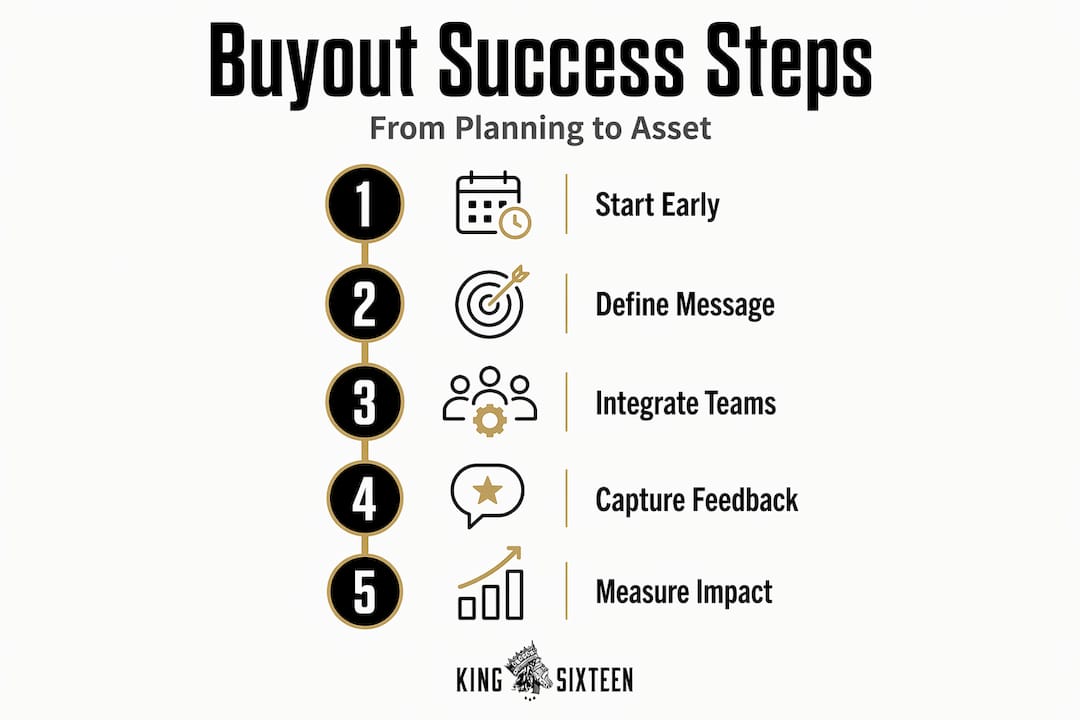
The difference between a forgettable buyout event and a genuinely effective one often comes down to how early and how deliberately the planning begins. Here is a framework that holds up across deal sizes and industries.
Start with the message, not the venue. Before you book a room, define the one thing every attendee should believe or feel when they leave. Build the program around that outcome. The venue, speakers, and design follow from that anchor.
Invest in experience design. A boardroom presentation can communicate facts. An immersive environment communicates identity. Companies that treat their event branding as a strategic asset, rather than a logistical afterthought, consistently generate stronger stakeholder alignment and media coverage.
Use this comparison to guide your decision-making on event format:
| Event format | Best for | Key advantage | Key risk |
|---|---|---|---|
| Full venue buyout | Investor and media events | Total brand control | Higher cost and longer lead time |
| Hosted conference session | M&A networking events | Built-in audience | Shared environment limits brand expression |
| Private integration summit | Internal alignment | Focused culture building | Lower external visibility |
| Hybrid event | Multi-stakeholder audiences | Broader reach | Diluted in-room experience if not produced well |
Negotiate contracts with precision. Pre-negotiated venue agreements that spell out customization rights, catering flexibility, exclusivity windows, and liability terms prevent the operational delays that derail even well-funded events.
- Confirm what A/V infrastructure is included versus contracted separately.
- Lock cancellation and force majeure terms before the deal announcement date is set.
- Designate a single point of contact on the vendor side who has authority to make real-time decisions.
- Build a 15 percent budget buffer for unforeseen requirements, especially if the deal timeline shifts.
Pro Tip: If your deal involves a public-to-private transition, work with legal counsel to determine what can and cannot be communicated at your event before the transaction closes. This single step prevents the kind of disclosure risk that turns a strategic event into a compliance problem.
Use technology deliberately. Real-time polling, event apps, and digital sentiment capture during merger and acquisition conferences give you data on how your message is landing while there is still time to adjust.
Turning buyout events into long-term brand assets
The event itself is only the beginning. What you do in the 30, 60, and 90 days afterward determines whether the brand positioning you established actually sticks.
The most effective post-buyout brand integration strategies share a few consistent characteristics:
- They assign clear ownership of the brand narrative to a specific executive, not a committee.
- They translate the event's visual and messaging language into internal communications, client-facing materials, and digital presence within weeks, not months.
- They measure outcomes across both brand and business dimensions.
On measurement, the following indicators give executives the clearest picture of event ROI:
| Metric | What it measures | Why it matters |
|---|---|---|
| Net Promoter Score shift | Internal or customer sentiment post-event | Indicates narrative effectiveness |
| Media coverage quality | Earned press tone and reach | Reflects external brand perception |
| Employee engagement score | Workforce alignment post-integration kickoff | Predicts cultural integration success |
| Partner inquiry volume | Business development interest post-announcement | Signals market confidence in the deal |
The AvalonBay and Equity Residential merger, valued at $69 billion and targeting $125 million in annual synergies, demonstrates the scale at which brand and operational integration must be managed simultaneously. At that level, every stakeholder touchpoint, including the events, carries measurable financial weight.
The brands that get lasting impact from buyout events treat them as the first chapter of an ongoing narrative, not as a one-time announcement. That means planning post-event content, alumni outreach, and follow-on engagement before the event even happens.
Industry trends shaping buyout events in 2026 and beyond
The environment around corporate buyout events is shifting in ways that matter to your planning.
Global demand for in-person M&A engagement is rising. The Capital Markets and M&A Forum in Kuala Lumpur now attracts over 500 executives from multiple continents in its fourth consecutive year, reflecting a meaningful appetite for direct, high-level business acquisition events that digital formats have failed to replicate. Relationship-building at this scale requires physical presence, and savvy organizations are designing their investor buyout meetings and corporate divestiture discussions with that in mind.
Technology integration is reshaping the experience layer. AI-driven personalization, real-time sentiment analysis, and data-rich environments are raising the bar for what attendees expect from buyout strategy workshops and corporate takeover seminars. Coupa's acquisition of Tonkean to accelerate autonomous workflow orchestration is one example of how technology-forward acquisitions demand events that match their ambition.
Geopolitical and regulatory complexity is also a factor. Cross-border transactions require event teams to account for compliance restrictions on communications, local labor regulations for production staff, and sensitivity around brand messaging in different markets.
"The companies winning in this environment are the ones treating buyout events not as obligatory milestones, but as strategic investments in the perception and culture of the combined entity."
Staying ahead means building your event strategy into the deal planning process from the outset, not as a late addition after the term sheet is signed.
My honest take on where executives get this wrong
I've watched a lot of corporate buyout events fall flat, and the pattern is almost always the same. The deal team works incredibly hard on the transaction itself, and then treats the surrounding events as administrative checkboxes. Someone books a hotel ballroom, someone else orders catering, and the result feels exactly as under-invested as it sounds.
What I've learned is that the event is where the deal becomes real for the people who have to live with it. Employees, partners, and investors don't read term sheets. They experience announcements, integration summits, and brand launches. If those moments feel generic or rushed, the conclusion they draw about the combined entity is equally generic.
The other thing I've seen consistently: organizations underestimate how much the internal event matters relative to the external one. Executives will spend three times the budget on an investor announcement and then hold a 45-minute all-hands call to introduce 2,000 employees to their new company. That imbalance is where cultural integration starts unraveling before it even begins.
My honest advice is to treat every buyout event on your calendar as a brand-building investment with measurable outcomes. Define what success looks like before you plan a single session. Then hold your team accountable to those outcomes the way you would any other strategic initiative. Unlocking brand experience at these moments is not a nice-to-have. It is where deals become organizations.
— Tyler
How Kingsixteen can bring your buyout events to life
When corporate buyout events need to land with precision and make a lasting impression, Kingsixteen builds the experience that makes that happen. We work with executives and senior marketing leaders who don't have time for vendors that need hand-holding. Our turnkey model covers everything from venue sourcing and immersive environment design to A/V, staffing, fabrication, and on-site execution.
Whether you need a high-production investor announcement, an internal integration summit that actually builds culture, or an exclusive private experience for key stakeholders, our private event services are purpose-built for high-stakes moments. We've delivered for Porsche, Audi, Ray-Ban, and the Natural Diamonds Council. We know what it takes to make a brand felt, not just seen. Explore our experiential marketing capabilities and let's build something worth remembering.
FAQ
What is a corporate buyout event?
A corporate buyout event is a structured occasion designed to communicate the significance of an acquisition or ownership transition to a specific audience, including investors, employees, or media. These events range from full venue buyouts to internal integration summits, each serving a distinct strategic purpose.
How do buyout events affect brand positioning?
Buyout events are one of the most direct ways a company signals its post-transaction identity to the market. Poor execution or misaligned messaging, as seen in the Shein and Everlane deal, can accelerate customer attrition and erode the brand equity the transaction was meant to protect.
When should buyout event planning begin?
Planning should begin as early as the deal timeline allows, ideally during the due diligence phase. Early planning gives you time to negotiate favorable venue terms, align legal communications restrictions, and build a message that reflects the actual strategic rationale of the transaction.
What metrics should executives use to measure buyout event success?
The strongest indicators include employee engagement scores, net promoter score shifts, earned media quality, and post-event partner or investor inquiry volume. These metrics connect event performance directly to the business and brand outcomes that justify the investment.
How are M&A networking events different from buyout announcement events?
M&A networking events like the Capital Markets and M&A Forum are industry gatherings designed to connect deal-makers and share market intelligence. Buyout announcement events are company-specific, purpose-built to communicate a specific transaction and shape perception of the resulting entity.