Brand experience is not a campaign. It's not a product launch activation or a well-designed booth at a trade show. When brand and customer experience work together, they can drive up to 3.5x higher revenue impact than either discipline can produce in isolation. Yet most established brands still treat experiential marketing as a series of disconnected moments rather than a compounding strategic system. This article breaks down exactly what strategic brand experience means, how to build the frameworks that sustain it, and how to measure outcomes with enough precision to justify every dollar invested.
Table of Contents
- Defining strategic brand experience: Beyond events and touchpoints
- The total experience mindset: Aligning brand and customer experience
- Frameworks and mechanics: Signature cues, non-negotiables, and stage-based measurement
- Measurement and benchmarks: How to evaluate brand experience impact
- Why most brands struggle with strategic experiential alignment
- Accelerate your brand experience with expert partners
- Frequently asked questions
Key Takeaways
| Point | Details |
|---|---|
| Total experience drives results | Integrating brand and customer experience creates up to 3.5x more revenue impact than working in silos. |
| Signature cues boost recognition | Translating brand intent into distinctive assets ensures consistent, immersive impact across touchpoints. |
| Measurement must go deeper | Stage-level metrics like asset recognition and NPS are far more actionable than basic awareness or sales spikes. |
| Operational discipline wins | Strategic experiential alignment requires relentless consistency and cross-functional teamwork, not just creative campaigns. |
| Expert partners accelerate growth | Leveraging experienced firms makes it easier to adopt advanced frameworks and deliver high-impact brand experiences. |
Defining strategic brand experience: Beyond events and touchpoints
Now that we've set the stage, let's clarify exactly what makes brand experience strategic. The word "strategic" does a lot of heavy lifting here, and it's worth being precise about it.
Strategic brand experience is the intentional design and consistent delivery of every interaction a customer or prospect has with your brand, across every touchpoint, at every stage of their relationship with you. It is not a one-time activation or a memorable ad. It is a holistic integration of physical environments, digital touchpoints, staff behavior, messaging, sensory cues, and post-interaction follow-through.

The most common misconception is that brand experience equals a spectacular event. A stunning product launch or an immersive pop-up does create value, and the experiential marketing impact of in-person activations is well-documented. But a single moment, no matter how compelling, fades without a connected system of touchpoints reinforcing it.
Think of it this way. A great experiential activation is a spark. Strategic brand experience is the infrastructure that turns that spark into a sustained flame.
Here's what separates a strategic brand experience from a standard campaign:
- Intentionality: Every touchpoint is designed with a clear role in the overall brand narrative, not created in isolation.
- Consistency: The same core brand signals appear whether a customer encounters your brand at a flagship event, on social media, or during a customer service call.
- Measurability: Outcomes are tracked at the journey stage level, not just at the campaign level.
- Cross-functional alignment: Marketing, product, sales, and operations all contribute to and uphold the experience standards.
- Long-term focus: The goal is to build cumulative brand equity, not just spike awareness.
"Brand experience is the sum of all interactions a customer has with a brand across the entire journey, and its power comes from consistency and alignment, not from any single event."
Understanding the full scope of brand engagement means recognizing that every interaction either reinforces or erodes the brand promise. There is no neutral ground.
The revenue data confirms it: brands that align brand experience and customer experience together outperform those that manage them separately by a significant margin. That is the business case for strategic integration.
The total experience mindset: Aligning brand and customer experience
With strategic brand experience defined, the next step is understanding how it intersects and compounds with customer experience (CX). These two disciplines are often managed by different teams with different budgets and different goals. That separation is expensive.
Brand experience (BX) shapes how people feel about your brand before, during, and between purchase decisions. Customer experience (CX) shapes how people feel about transacting with your brand. When these two work in sync, they reinforce each other at every stage of the customer journey. When they operate in silos, they create friction, confusion, and missed revenue opportunities.
Improving brand and customer experience together compounds revenue impact in ways that improving either one alone cannot replicate. This is the total experience mindset: treating BX and CX as mutually reinforcing pillars of a single integrated strategy.
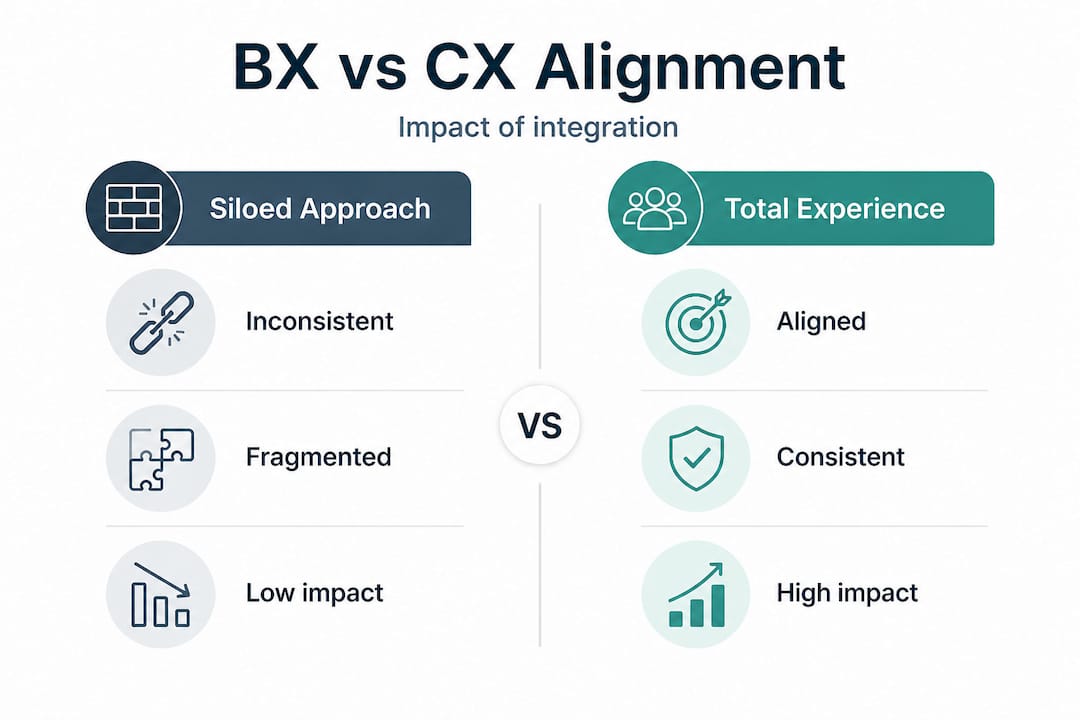
Here is a practical comparison of how siloed versus aligned experience management plays out:
| Dimension | Siloed BX and CX | Total experience alignment |
|---|---|---|
| Brand messaging | Controlled by marketing only | Consistent across all customer-facing teams |
| Event design | Focused on impressions | Designed to advance customer journey stages |
| Measurement | Campaign awareness metrics | Stage-level attribution and revenue linkage |
| Cross-team coordination | Rare, project-based | Ongoing, structured collaboration |
| Revenue impact | Moderate, inconsistent | Compounded, measurable, scalable |
For high-end experiential strategies, this alignment matters even more. Luxury and premium brands operate in environments where customer expectations are elevated and brand perception is fragile. A disconnect between how a brand presents itself at an immersive activation and how it handles post-event follow-up can undo weeks of positioning work.
Environmental branding is one of the most powerful areas where BX and CX converge. The physical spaces where customers encounter your brand, whether at a launch event, a showroom, or a conference, communicate brand values without a single word being spoken. When those spaces are designed with intentionality and aligned with the broader customer experience strategy, they become powerful conversion and retention tools.
Pro Tip: Map your full customer journey in detail, then identify every stage where brand experience and customer experience overlap. These overlapping zones are your highest-leverage opportunities for joint optimization. A prospect attending a product launch event is simultaneously experiencing your brand and your customer journey. Design for both, not just one.
Frameworks and mechanics: Signature cues, non-negotiables, and stage-based measurement
To bring the total experience mindset into reality, brands need operational frameworks and mechanics. Good intentions do not produce consistent brand experiences. Repeatable systems do.
The Brand Experience Wheel is one of the most practical frameworks available to brand strategists. It organizes the work of brand experience into three interconnected layers: positioning translation, touchpoint domain management, and stage-level measurement. Understanding each layer helps you build experiences that are both creatively powerful and operationally sound.
Positioning translation is the process of converting your brand's strategic position into tangible, observable cues that customers can actually feel. This produces two critical outputs:
- Signature cues: Unique assets, behaviors, sounds, visual elements, or interactions that reliably signal your brand's essence. Think of the specific typeface a luxury automaker uses, the way a hospitality brand trains its staff to greet guests, or the scent profile of a retail flagship. These cues are not accidental. They are engineered and protected.
- Non-negotiables: The minimum standards that must be present at every touchpoint, without exception. These are the floor, not the ceiling. Non-negotiables ensure that even an imperfect execution does not fall below the threshold of acceptable brand representation.
Touchpoint domain management means organizing your touchpoints into categories, such as physical environments, digital interactions, human touchpoints, and product experiences, and assigning clear ownership and standards for each. Brand environment design is one of the most visible and highest-impact domains for established brands.
Stage-based measurement is where most organizations fall short. Rather than measuring only at the campaign or annual level, strategic brand experience requires tracking metrics at each stage of the customer journey. Here is a practical reference for what to measure and when:
| Journey stage | Recommended metrics | Why it matters |
|---|---|---|
| Awareness | Distinctive asset recognition, unaided recall | Tests if your signature cues are landing |
| Consideration | Brand preference score, share of attention | Measures competitive positioning |
| Engagement | Event participation depth, content interaction | Indicates quality of in-person experience |
| Purchase | Conversion rate, time-to-first-value | Links experience to revenue directly |
| Loyalty | NPS, CSAT by stage, repeat engagement rate | Shows cumulative experience quality |
"Strategists translate brand positioning into signature cues and non-negotiables, then measure outcomes at each journey stage rather than relying solely on campaign-level awareness metrics."
The payoff of this level of discipline is significant. When you know which touchpoints are performing and which are creating friction, you can allocate resources with precision. You stop throwing budget at activations that look impressive but do not move the needle on the metrics that matter.
For a practical starting point, review our strategic brand impact guide and pair it with the brand activations step-by-step guide to translate these frameworks into execution-ready plans.
Measurement and benchmarks: How to evaluate brand experience impact
With frameworks in place, measurement is the next challenge for strategists focused on continuous improvement. The instinct to default to traditional metrics like impressions, reach, and post-event sales spikes is understandable. But those metrics tell you very little about whether your brand experience strategy is actually working.
Stage-level metrics provide far more nuanced and actionable insight than top-line campaign awareness numbers alone. Here is what a modern brand experience measurement stack looks like:
- Distinctive asset recognition: Can your target audience identify your brand from its visual, auditory, or sensory cues without seeing your name? This measures the effectiveness of your signature cues in the real world.
- NPS and CSAT by journey stage: Net Promoter Score (NPS) and Customer Satisfaction Score (CSAT) measured at specific touchpoints reveal where the experience is delighting customers and where it is falling apart, rather than averaging those signals into a single unhelpful number.
- Time-to-first-value: How quickly does a new customer or prospect reach the moment where they clearly understand and feel the brand promise? Shortening this window accelerates both conversion and loyalty.
- Attribution by experience type: Which specific brand experience formats, events, environments, digital touchpoints, are most closely correlated with downstream revenue? This requires connecting your experience data to your CRM and sales pipeline.
- Emotional engagement indicators: Survey-based tools, social sentiment analysis, and in-event behavioral signals can all provide proxies for emotional engagement when direct neurological measurement is not feasible.
On that last point, neurobranding tactics are gaining serious attention among brand strategists. Techniques that measure emotional arousal, attention intensity, and memory encoding during brand interactions offer a more direct window into experience quality than self-reported surveys. The caveat is real, though: these methods require rigorous internal validation before you build strategy around them.
Pro Tip: Before adopting any new measurement approach, whether it's a neurobranding tool, an AI sentiment platform, or a new attribution model, run a controlled internal experiment. Compare results from the new method against your existing baseline on a single event or campaign. Validate first, then scale. Faith-based measurement is how brands waste both budget and insight.
Strong brand engagement strategies always include a measurement plan built before the experience is designed, not bolted on afterward. If you cannot define success in advance, you will not recognize it when it happens.
Why most brands struggle with strategic experiential alignment
With credible frameworks and measurement covered, let's step back and examine why most organizations still miss the mark, and what actually works.
The honest answer is structural. Most brands are organized in ways that make holistic brand experience management nearly impossible. Marketing owns brand identity. Sales owns customer relationships. Operations owns the physical environments. Product owns the digital experience. Each team is doing its job well in isolation, but no single team is responsible for the cumulative experience a customer has across all of those domains.
The result is episodic brand experience: a spectacular product launch here, a strong conference presence there, but no connective tissue between them. Customers feel the inconsistency even when they cannot name it. That gap between what a brand promises and what it consistently delivers erodes trust over time.
Brand experience is cumulative, and real impact requires cross-functional alignment that most organizations have not built. The brands that consistently outperform on experience metrics have done the unglamorous work of creating shared standards, shared ownership, and shared accountability across teams.
Here is the uncomfortable truth we share with every client: creative novelty without operational discipline is expensive decoration. The most visually stunning activation loses its value if the follow-up email is generic, the sales team does not know what was promised at the event, or the next customer touchpoint feels like it came from a different brand entirely.
What actually works is prioritizing consistency over spectacle, at least until your operational foundation is solid. Luxury brand experiential leaders like Porsche and Audi do not succeed because they throw bigger parties. They succeed because every touchpoint, including the ones no one photographs, reinforces the same brand promise with the same level of care.
Build the connective tissue first. Then amplify with the moments that earn attention.
Accelerate your brand experience with expert partners
You now have the strategy. The frameworks are clear, the measurement approach is defined, and the common pitfalls are mapped. The next step is finding a partner who can execute at the level your brand demands.
King Sixteen specializes in building the kinds of immersive, intentional brand experiences that this article describes, from full-scale experiential marketing campaigns and product launches to private events that convert influence into revenue. We handle every dimension of execution through a trusted vendor network, so your team stays focused on strategy while we deliver the standard your brand requires. If you're ready to build brand experiences that compound over time rather than spike and fade, explore what our complete event services can deliver for your next activation.
Frequently asked questions
How does strategic brand experience differ from experiential marketing?
Strategic brand experience aligns brand intent across all touchpoints and journey stages, while experiential marketing typically focuses on creating memorable standalone events. One builds cumulative equity; the other creates moments.
What are signature cues in brand experience?
Signature cues are the unique sensory, visual, behavioral, or verbal assets that reliably signal your brand's essence at any touchpoint, from the way staff greets guests to the specific visual identity elements present in a physical environment.
How can brands measure the impact of experiential strategies?
Rather than relying on awareness spikes alone, brands should use stage-level metrics including distinctive asset recognition, NPS and CSAT measured at specific journey stages, and time-to-first-value to track experience quality with precision.
Is neurobranding effective for measuring brand experience?
Neurobranding tools offer promising insight into emotional engagement and memory encoding during brand interactions, but require validation through experimentation before brands should integrate them into their standard measurement practice.
Recommended
- Brand moments: Why experiential marketing outperforms ads
- Experiential marketing strategies for high-end brands
- Brand engagement explained: Strategies for experiential success
- Event brand identity: strategies for revenue-driving experiences
- Brand Memory: How Logo Projectors Increase Recognition and Sales – The Logo Light Store
- Top brand partnership examples that drive real results