Event staffing is one of the most underestimated levers in experiential marketing. Most brands focus their energy on venue selection, fabrication, and content, then treat staffing as a last-minute checkbox. That approach costs them more than they realize. The people representing your brand on the ground are not just logistics; they are the living, breathing expression of your campaign. Get them right, and every other element amplifies. Get them wrong, and even the most beautifully produced activation falls flat.
Table of Contents
- Defining event staffing: More than just manpower
- How event staffing drives campaign success
- Types of event staffing solutions: Agency vs. in-house
- Activating and managing event staff for brand impact
- Why typical event staffing approaches fall short—and how to fix them
- Partner with experts for event staffing success
- Frequently asked questions
Key Takeaways
| Point | Details |
|---|---|
| Event staffing is strategic | Strategic staffing transforms brand experiences and maximizes marketing ROI. |
| Agency vs. in-house options | Choose between agency or in-house staffing based on event scale, expertise, and campaign needs. |
| Effective activation process | Rigorous onboarding and training are essential to empowering impactful event staff. |
| Brand ambassadors drive success | Well-selected and trained staff serve as powerful extensions of your brand during activations. |
Defining event staffing: More than just manpower
Event staffing is the recruitment, training, and management of personnel specifically chosen to represent your brand and engage your guests during a campaign or activation. It sounds straightforward, but the scope is far wider than most marketing teams account for when they first start planning.
The roles within a strong event staffing strategy span a broad range of functions. Each role serves a distinct purpose in the overall guest experience, and they should work together like a well-rehearsed ensemble.
- Brand ambassadors: The frontline face of your campaign. They greet guests, communicate key brand messages, and create emotional moments.
- Experiential guides: Specialists who walk attendees through immersive environments, explaining product features or brand stories in a way that feels natural, not scripted.
- Hosts and event emcees: They set the tone, manage crowd flow, and keep energy high across multi-hour or multi-day programs.
- Technical support staff: Essential for activations with digital components, AR or VR elements, or complex AV setups that require on-site troubleshooting.
- Data capture specialists: Increasingly critical in 2026, these team members collect lead information and audience insights in real time, feeding post-event analytics.
"Event staff are the face and voice of your brand during activations."
This is not a metaphor. It is a strategic reality. As remote staffing benefits research confirms, partnering with event staffing agencies helps brands achieve their marketing objectives far more effectively than piecing together an ad hoc team.
The most important staffing decision you will make is alignment. Every staff member's personality, communication style, and personal energy should match your campaign's goals. A luxury automotive activation needs composed, knowledgeable staff who project confidence. A street-level sneaker launch needs enthusiastic, culturally connected ambassadors who feel authentic to that audience. One size does not fit all, and the brands that understand this gain a real competitive edge.
Pro Tip: Before hiring any event staff, write a "brand persona brief" that describes not just the job duties but the personality traits, vocabulary, and energy level that fit your activation. Share it with every recruiter and agency partner involved.
For a thorough look at building a staffing framework from the ground up, our event staffing guide walks through every stage of the process with actionable detail.
With clarity on what event staffing truly encompasses, let's explore its role in successful brand campaigns.
How event staffing drives campaign success
Well-trained event staff do three things that no installation, display, or digital touchpoint can replicate. They amplify your brand message through human conversation, they create emotional connections that stick long after the event ends, and they actively drive engagement that translates into measurable results.
Here are three specific ways that strong staffing directly drives campaign ROI:
- Quality interactions convert faster. A skilled brand ambassador who can read a guest, pivot their approach, and personalize the conversation creates a 1:1 connection that accelerates trust and purchase intent. That interaction is irreplaceable.
- Real-time data collection. Staff trained to capture lead information through natural conversation or digital tools give your team a warm lead list that a passive QR code never could. The quality of that data is exponentially higher.
- Lead nurturing begins on the floor. Great event staff do not just hand out samples and smile. They plant seeds for post-event follow-up by creating memorable moments and gathering context that your sales and marketing teams can use immediately.
| Factor | Agency event staffing | In-house event staffing |
|---|---|---|
| Scalability | High, flexible up or down fast | Low, limited by internal headcount |
| Brand knowledge | Trained but requires onboarding | Deep, already embedded |
| Specialization | Strong, role-specific talent pools | Variable, depends on team |
| Speed of deployment | Fast, especially through established agencies | Slower, requires internal planning |
| Cost model | Variable, often more efficient at scale | Fixed costs, less flexible |
| Geographic reach | Wide, national or global | Typically regional or single-market |
As brand ambassador impact research highlights, brand ambassadors play a decisive role in delivering brand messages at marketing events. The difference between a well-placed ambassador and a generic "staff member" is the difference between an attendee who remembers your brand the next morning and one who forgets the experience before they reach the parking lot.
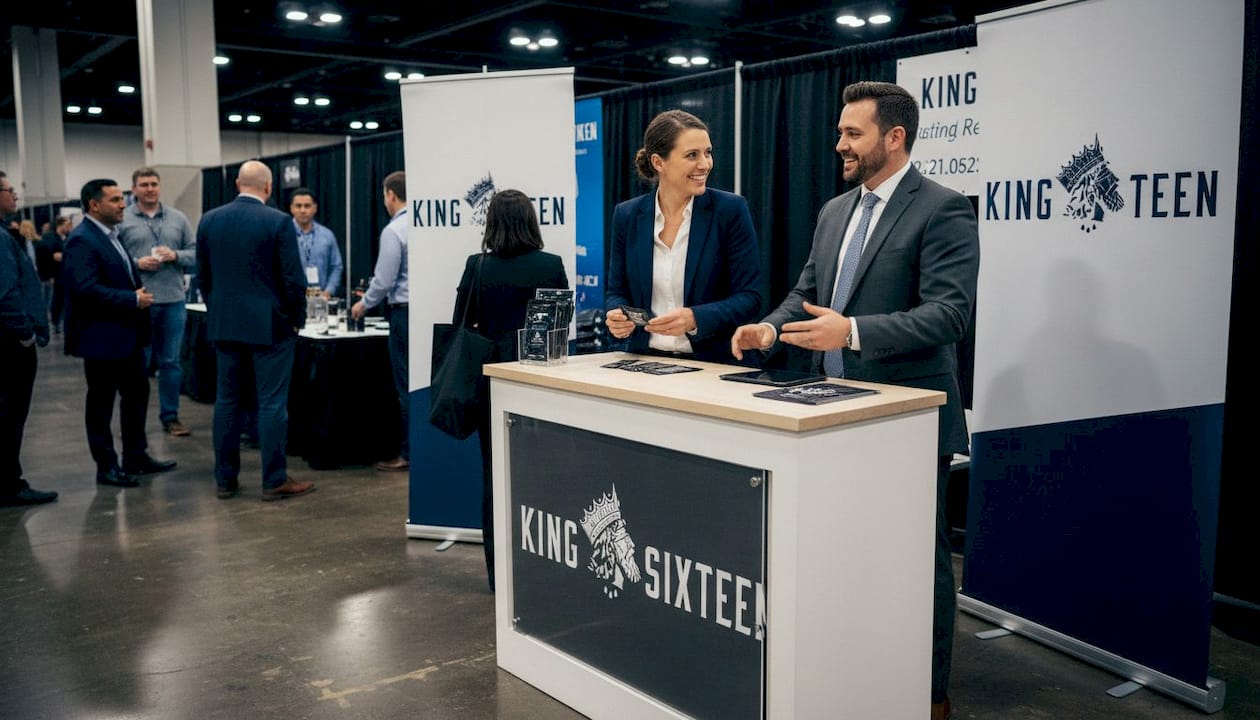
Strong event branding strategies and effective staffing are interconnected. Your visual brand sets the stage. Your staff bring it to life. Neither works as well without the other. When you integrate those two elements with the right event marketing strategies, the results become significantly more consistent and scalable.
Having seen the impact of staffing, let's examine the different models brands can use to scale effectively.
Types of event staffing solutions: Agency vs. in-house
Choosing the right staffing model is not simply a budget decision. It is a strategic one that should reflect your event's scale, your brand's complexity, and the level of specialization each activation demands.
Agency staffing is built for flexibility. An established staffing agency maintains talent pools across multiple markets, meaning you can scale from 10 to 100 staff across 5 cities with far less internal friction than an in-house approach would require. Agencies also bring recruiter expertise, pre-screened talent, and logistical infrastructure that most marketing teams simply do not have in-house.
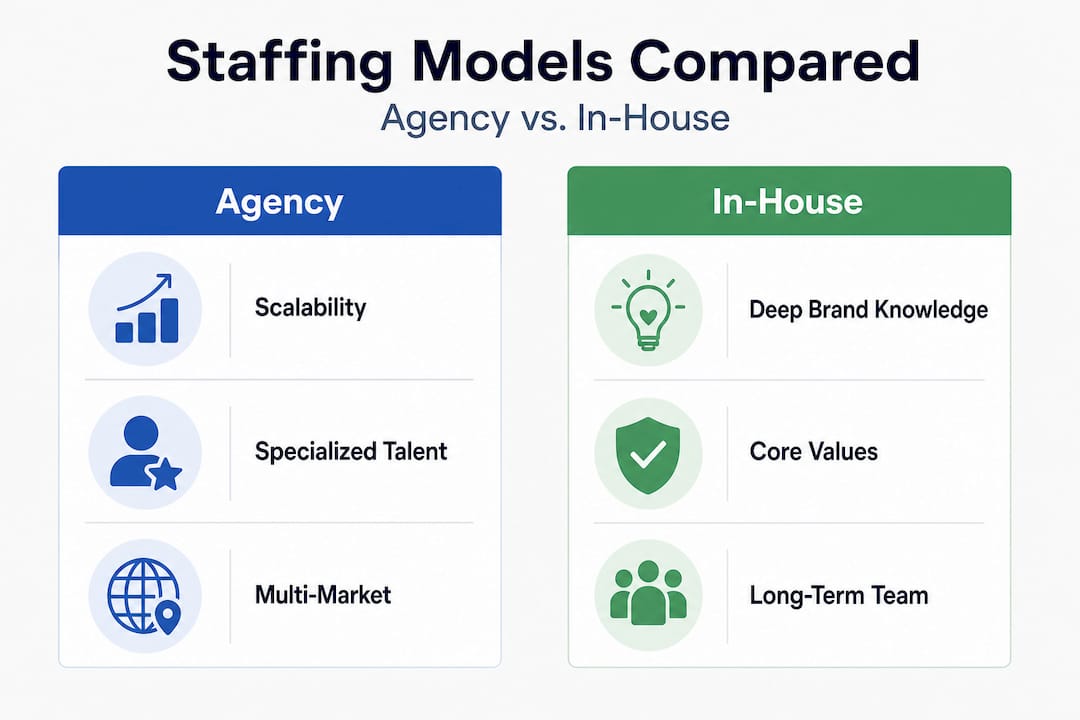
In-house staffing has its own strengths. Your internal team members know the brand deeply, understand company values without much briefing, and often bring an authenticity to their guest interactions that trained external staff take time to match. For smaller, high-touch activations where brand nuance matters intensely, in-house teams can be extremely effective.
The most sophisticated brands use a hybrid model, deploying key in-house staff in leadership and management roles while filling volume positions through agency partners. This captures the best of both approaches.
Here are the key factors to weigh when choosing your staffing model:
- Event scale: Large multi-city or multi-day activations almost always require agency support to meet headcount requirements without overwhelming internal resources.
- Budget structure: Agency staffing is typically variable cost, which is easier to manage for one-time events. In-house requires fixed investment regardless of event volume.
- Brand experience complexity: The more specialized the role (luxury hospitality, technical demo, VIP concierge), the more you benefit from an agency with pre-screened talent in those niches.
- Timeline: Short runway campaigns are almost impossible to staff in-house from scratch. Agencies with active talent rosters can mobilize quickly.
- Geographic reach: If your activation spans multiple markets simultaneously, agency partners with local talent networks are essential.
As trade show staff considerations research explains, recruiting and managing staff for marketing-focused events like trade shows and product launches requires structured planning and a clear understanding of the roles needed before the first hire is made.
You can explore our approach to trade show staffing to see how a turnkey model handles these variables efficiently.
Pro Tip: Build your agency relationships well before you need them. Agencies allocate their best talent to the clients they know and trust. If the first time you call is two weeks before a major launch, you may not get the A-team.
With the landscape mapped, your next challenge is activating and managing event staff for maximum brand impact.
Activating and managing event staff for brand impact
Recruiting the right staff is only half the job. The other half is how you deploy, train, and manage them in the days and hours leading up to and during your event. This is where most brands leave performance on the table.
Here is a step-by-step staffing activation process that we apply across large-scale campaigns:
- Planning: Define every staff role needed, the number of people per role, and the specific skills required. Build your staffing plan alongside your event production plan, not after it.
- Recruiting: Source candidates through your agency partners or internal database. Prioritize attitude and communication skills. Technical skills can be trained; personality cannot.
- Training: Run a formal briefing covering brand story, key messages, guest flow, FAQs, and escalation procedures. Use real scenarios so staff know how to respond when things go off-script.
- Pre-event rehearsal: Walk through the activation with all staff on site before doors open. Assign positions, practice interactions, and identify any gaps in coverage or communication.
- Monitoring: Have a designated on-site staffing manager who can observe, coach, and reassign in real time. Do not leave staff to manage themselves in a high-pressure environment.
- Debriefing: Immediately after the event, gather staff for a structured debrief. Capture what worked, what did not, and specific guest feedback they observed.
Best practices to sustain performance across multi-day or multi-city activations include:
- Consistent messaging: Every staff member should be able to deliver your core brand narrative in under 60 seconds, conversationally and without sounding robotic.
- Real-time feedback loops: Use messaging apps or walkie-talkies to keep the on-site manager connected to all staff. Quick corrections prevent small issues from becoming visible problems.
- Clear role ownership: Ambiguity creates gaps. Every staff member should know exactly what they are responsible for, and who to escalate to when something falls outside their role.
- Energy management: For multi-day events, rotate staff strategically to prevent fatigue from affecting guest interactions. Tired staff deliver flat experiences.
As guidance on event swag considerations confirms, partnering with event staffing agencies gives brands access to structured systems for achieving their marketing objectives, including staff management frameworks that scale across complex activations.
Post-event, invest in structured data analysis. Look at engagement metrics, lead capture volume, guest feedback scores, and any social media amplification attributed to staff interactions. These data points tell you exactly where your staffing strategy succeeded and where to improve next time. Your brand activation guide should always include a post-event review protocol.
Pro Tip: Record a short video debrief with your on-site staffing manager within 24 hours of the event closing. Verbal recaps capture nuances that written reports miss, and they are invaluable for training future teams.
Now let's bring together expert perspectives on what truly distinguishes impactful event staffing strategies.
Why typical event staffing approaches fall short—and how to fix them
Here is the uncomfortable truth we see again and again across the industry. Most brands treat event staffing like a procurement task. They set a headcount, get a quote, approve the budget, and assume the agency will handle the rest. Then they wonder why the activation felt generic or why guest engagement was lower than expected.
Staffing is not a line item. It is a strategic decision that sits right at the center of your brand experience. The people you put in front of your guests shape every impression your brand makes in that moment. That should carry the same weight as your creative brief or your fabrication budget.
"Your event staff should be your most valuable brand ambassadors, not just warm bodies."
Brands that invest in empowered, specialized teams consistently outperform those that treat staffing as interchangeable labor. We have seen this play out across activations ranging from intimate VIP product reveals to large-scale multi-day conferences. The variable that separates a forgettable event from one that generates months of earned media and strong pipeline is almost always the quality of the human interaction.
The fix is simpler than most brands expect. Start by treating your staffing brief with the same rigor you apply to your creative brief. Describe the brand personality, the guest journey, the specific moments where staff interaction matters most, and the outcomes you expect from those interactions. Then select your staff and agency partners based on their ability to deliver against that brief specifically.
Invest in pre-event training that goes beyond logistics. Teach your staff the brand story, the product's value proposition, and the emotional experience you want guests to walk away with. Give them permission to be human, to improvise, and to create genuine moments rather than following a rigid script.
Finally, measure what matters. Do not stop at headcount or hours worked. Track guest satisfaction scores, lead quality, and conversion rates that trace back to specific event interactions. That data will show you the ROI of great staffing and make the case for continued investment. Explore our thinking on high-end brand strategies to see how the most sophisticated brands approach this challenge.
Partner with experts for event staffing success
Understanding the strategic value of event staffing is one thing. Executing it at a high level, across complex activations with tight timelines, is another challenge entirely.
King Sixteen builds and manages event staffing as part of a fully integrated experiential model. Our approach connects staffing strategy with design, fabrication, production, and logistics through a single trusted framework, so nothing falls through the cracks. Whether you need experiential marketing services for a national product launch, full production through our event services, or specialized staff for private event staffing, we bring the infrastructure and experience to execute without margin for error. Reach out to our team and let's build your next activation around staff that make your brand unforgettable.
Frequently asked questions
What is event staffing in experiential marketing?
Event staffing involves recruiting and training personnel to represent your brand and drive guest engagement during campaigns. It is a strategic function, not just a logistics task.
How do I choose between agency and in-house event staffing?
Agency staffing works best for large, complex events that require scalability and specialized roles; in-house teams are ideal when brand familiarity and tight control matter most for smaller activations.
What roles do event staff play?
Event staff can serve as brand ambassadors, hosts, technical support, and experiential guides, with each role tailored to the specific goals and guest journey of the campaign.
How do you measure event staffing effectiveness?
Assess effectiveness through attendee satisfaction scores, engagement metrics, lead capture data, and post-event feedback that maps directly to campaign goals and revenue outcomes.