Most marketers treat product campaign fabrication as a production checkbox. You need a booth, a display, maybe a backdrop. Build it, ship it, done. That framing costs brands more than they realize. Real product campaign fabrication is the physical and spatial translation of your brand strategy. It's where your creative direction, audience psychology, and campaign goals converge into something people can touch, walk through, and remember. This guide unpacks how to plan, execute, and measure fabrication-led campaigns that don't just look good but actually drive outcomes.
Table of Contents
- Key takeaways
- What product campaign fabrication actually means
- Aligning strategy with fabrication decisions
- Creative and logistical realities of fabrication
- Measuring what fabrication actually delivers
- Emerging trends reshaping campaign fabrication
- My honest take on what actually works
- How King Sixteen brings fabrication strategy to life
- FAQ
Key takeaways
| Point | Details |
|---|---|
| Fabrication is strategy, not production | Physical environments should reflect campaign objectives, not just aesthetic preferences. |
| One objective drives focus | Campaigns with a single clear goal consistently outperform those trying to do everything at once. |
| AI accelerates planning | Using AI tools cuts launch planning from weeks to hours, freeing teams for high-judgment decisions. |
| Treat live events like theater | Scripted run-of-show and rehearsals are what separate smooth activations from expensive failures. |
| Measurement closes the loop | Linking fabrication touchpoints to KPIs and post-event follow-up turns impressions into revenue. |
What product campaign fabrication actually means
Custom fabrication in experiential marketing creates physical brand environments designed to drive deep consumer engagement and lasting impressions. That's the definition worth holding onto. It's not about building props. It's about constructing spaces and objects that make your brand story tangible.

The materials matter more than most teams acknowledge. Metal, wood, laminates, and tension fabric each carry a different sensory signal. A raw steel installation communicates something fundamentally different than a warm oak display, even if they're the same size and shape. When you choose materials carelessly, you undercut your brand positioning before anyone reads a single word of your copy.
The strongest fabrication work operates the way great brand storytelling does: every physical choice reinforces a narrative. Porsche doesn't display vehicles under fluorescent warehouse lighting. The angle, the platform, the perimeter materials, the ambient sound. All of it is fabricated to trigger a specific emotional state.
Here's what effective fabrication-led campaigns consistently get right:
- Materials chosen for sensory resonance, not just budget or logistics
- Spatial flow designed with intent, guiding visitors through a deliberate brand experience
- Scalable elements that can adapt to trade shows, retail, pop-ups, and media environments
- Integration with digital touchpoints including screens, sensors, or AR overlays that extend the physical space
Consider the Halo 3 campaign, where hand-crafted dioramas created cultural moments that invited emotional engagement rather than just promoting a product. The fabricated assets became the campaign. That's the standard worth chasing.
Pro Tip: Before your fabrication team touches a single material, write a one-paragraph "sensory brief." Describe how the finished environment should make someone feel, what they should notice first, and what they should remember a week later. Hand that to your fabricators alongside the design specs.
Aligning strategy with fabrication decisions
Most new product launch failures trace back to a single strategic error. Teams confuse demand creation with demand capture, and they build fabrication assets optimized for the wrong job. Demand capture says, "We know you want this, here's where to buy it." Demand creation says, "You didn't know you needed this until right now." Those two goals require completely different physical environments.
Getting the strategy right before fabrication begins means working through four decisions in order:
- Define one objective. The Rule of One in campaign design states that a single campaign must carry a single primary objective. Fabrication built to serve five goals serves none of them well.
- Identify the audience's decision-making context. Are they already comparison shopping, or are you introducing them to a category? Your spatial design should answer that question before your staff says a word.
- Map your channel to your fabrication format. A retail environment, a trade show floor, and a private product launch event all demand different fabrication approaches. The assets you build for one rarely translate directly to another.
- Determine what data you need the activation to generate. Dwell time, demo requests, social shares, lead captures. Build physical triggers for each data point you want.
"Campaigns tied to specific operational outcomes and role-specific messaging consistently outperform vague trend-focused marketing." Industrial marketing research reinforces this: precision in messaging and fabrication asset design is what separates campaigns that generate pipeline from campaigns that generate foot traffic.
On the planning side, AI tools now generate campaign phases, budget allocation models, and risk assessments in under 30 seconds, compressing what used to take two to four weeks into a one to two hour process. That's not a replacement for strategic judgment. It's a way to get faster to the decisions that actually require human expertise: positioning, tone, and which fabrication choices will resonate with your specific audience.
Creative and logistical realities of fabrication
Creativity without operational discipline produces beautiful concepts that fall apart on-site. The brands that consistently execute well treat large-scale activations like theater productions, with scripted run-of-show documents, surrogate walkthroughs, and escalation plans for when things go sideways.
Here's a practical checklist for managing the creative-to-production handoff:
- Design lock date: Establish a hard deadline after which no structural changes are accepted
- Material lead times: Map every fabricated component against its production and shipping timeline
- Tech rehearsal window: Block time on-site before doors open to test every interactive element under real conditions
- Contingency inventory: Maintain backup units for high-touch, high-failure-risk components
- Team role documentation: Every person on-site should know their specific responsibility during setup, live activation, and teardown
The coordination layer is where most campaigns bleed time and money. Design teams make decisions that affect fabrication timelines. Fabrication changes affect AV integration. AV requirements affect spatial layout. Managing these dependencies requires a single point of accountability, not a committee.
Pro Tip: Run a "surrogate walkthrough" 48 hours before your event. Have someone unfamiliar with the activation navigate the space and interact with every fabricated element. They will find every gap your team stopped noticing weeks ago.
Here's a comparison of fabrication approaches by event type to help you calibrate scope:
| Event type | Fabrication priority | Key design consideration |
|---|---|---|
| Trade show | Visual authority and density | Stand out in a visually noisy environment |
| Private product launch | Atmosphere and narrative immersion | Control every sensory detail |
| Retail activation | Conversion and dwell time | Guide visitors toward a specific action |
| Conference exhibit | Information delivery and credibility | Balance engagement with professional restraint |
Measuring what fabrication actually delivers
Fabrication without measurement is expensive decoration. The goal is to connect every physical element back to a business outcome, and that requires defining KPIs before your fabrication team finalizes a single design.
The metrics that matter most in experiential fabrication campaigns fall into three categories:
Engagement metrics measure how people interact with your physical environment. Dwell time per zone, demo request rate, and social content generated on-site all tell you whether the fabrication is doing its job of drawing and holding attention.
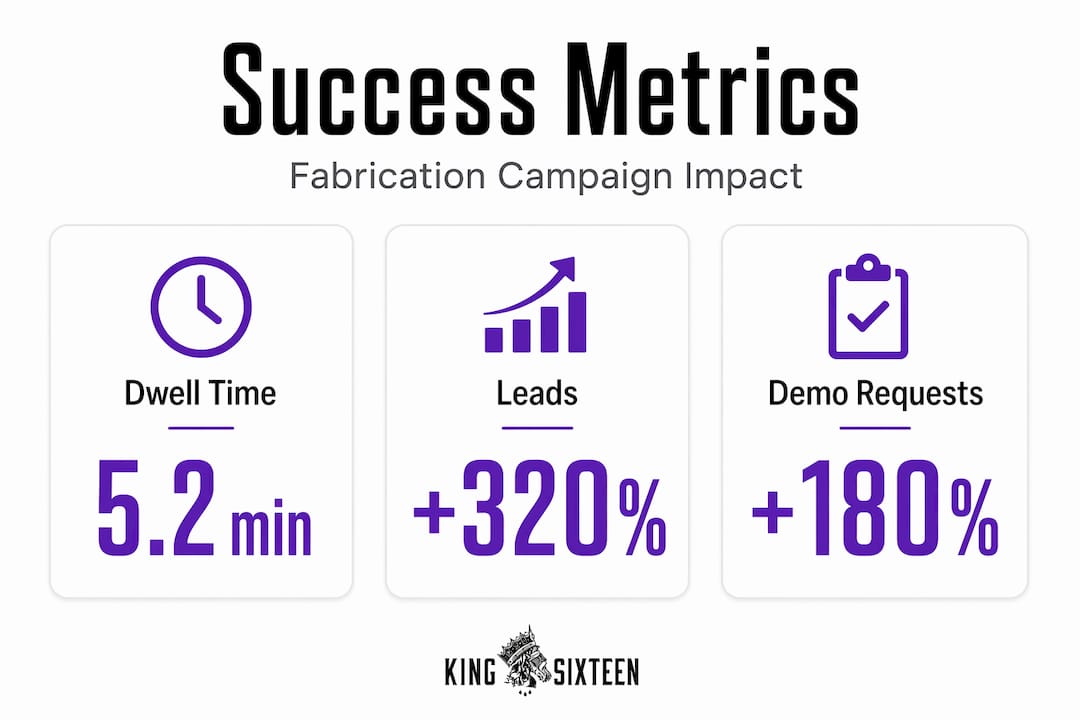
Conversion metrics track what happens after the activation. Lead volume, qualified opportunity rate, and post-event purchase intent surveys connect the physical experience to pipeline. Recurring, value-focused campaigns show engagement increases of 116% for products and 132% for associated newsletters when they prioritize consistent value over novelty. That data point matters for fabrication strategy: assets designed for reuse and iteration outperform one-time builds over a full campaign lifecycle.
Post-event follow-up is the step most teams underinvest in. Your sales team's ability to reference specific moments from the activation during follow-up calls depends on how well your fabrication created memorable, citable experiences. Building brand engagement strategies that extend beyond the event itself, through community content, digital recaps, and media assets captured during the activation, multiplies the return on your fabrication investment significantly.
Emerging trends reshaping campaign fabrication
The fabrication methods that worked in 2022 are already being outpaced. Here's where the field is moving:
- AI-assisted creative ideation: 67% of marketers in 2026 use AI to enhance content and multi-platform campaign strategy. That's now extending into fabrication planning, with AI generating material specifications, layout options, and cost scenarios at the brief stage.
- Sustainable materials: Brands are under increasing pressure to use eco-friendly materials in fabrication. Reclaimed wood, recycled aluminum, and modular components designed for disassembly and reuse are becoming standard expectations from high-end clients, not optional upgrades.
- AR and VR integration: Physical fabrication is increasingly designed as a frame for digital overlays. A wall isn't just a wall anymore. It's a trigger surface for an AR experience that exists only on your phone screen, extending the physical space far beyond its actual dimensions.
- Media franchise thinking: The most forward-thinking brands are treating campaign fabrication as the first chapter of a media property, not a standalone event. Assets get filmed, documented, and redistributed as content that lives long after the activation closes.
- Tighter agency-fabricator integration: The gap between creative agencies and fabrication vendors is closing. Brands that bring both into the room at the brief stage avoid the costly redesigns that happen when fabricators say "we can't build that" two weeks before the event.
My honest take on what actually works
I've seen more campaign fabrication budgets misallocated than I can count, and the pattern is almost always the same. The brand invests heavily in the visual centerpiece, the hero installation that photographs beautifully, and then under-resources every other touchpoint in the space. The result is a campaign that looks impressive in the recap deck and generates almost no qualified pipeline.
What actually works is designing fabrication from the conversion backward. Start with the question: what do I need someone to do in this space, and what physical environment makes that action feel natural? Then build toward that answer. The hero installation can still exist. It just has to earn its place in the conversion logic, not float above it as a vanity piece.
The other thing teams consistently underestimate is the post-event content value of well-designed fabrication. When you build a physical environment with photography, video, and social content in mind, you're not just producing an event. You're producing a catalog of brand assets that extend your product launch impact for months after the doors close. That math changes the ROI calculation entirely.
Multi-disciplinary coordination is what separates good activations from great ones. Design, fabrication, AV, staffing, and marketing strategy need to be in the same room from week one. The brands I've watched consistently win are the ones who treat fabrication as a strategic discipline, not a vendor category.
— Tyler
How King Sixteen brings fabrication strategy to life
At King Sixteen, we see product campaign fabrication as the physical proof of your brand's promise. Our team handles concept through execution, including custom fabrication of installations, environments, and set pieces, alongside full event production, AV, staffing, and digital integration. That turnkey model means your brand strategy doesn't get lost in translation between a dozen different vendors.
We've built experiential campaigns for Porsche, Audi, Ray-Ban, Fossil, and the Natural Diamonds Council, among others. Each project starts with your campaign objective, not a materials catalog. If you're planning a product launch, brand activation, or large-scale event and want fabrication that actually moves your audience, explore our experiential marketing services and see what purpose-built environments can do for your brand.
FAQ
What is product campaign fabrication?
Product campaign fabrication refers to the design and construction of physical brand environments, installations, and displays built to support a specific marketing campaign objective. It bridges creative strategy and physical production to create immersive consumer experiences.
How does fabrication differ from standard event production?
Standard event production focuses on logistics and infrastructure. Fabrication for marketing adds a strategic layer, building custom physical assets that express brand identity, guide audience behavior, and generate measurable engagement data.
How do you measure the ROI of fabrication-led campaigns?
Track dwell time, demo request rates, lead volume, and post-event purchase intent surveys. Recurring value-focused campaigns show engagement increases over 100% compared to one-off activations, making reusable fabrication assets a strong long-term investment.
Can AI tools improve fabrication campaign planning?
Yes. AI-powered planning tools can generate campaign phases, budget models, and risk assessments in under 30 seconds, reducing weeks of planning to a few hours. Human oversight remains critical for positioning and fabrication decisions.
How early should fabrication planning begin?
For large-scale activations, fabrication planning should begin at the same time as campaign strategy. Waiting until creative is finalized creates timeline pressure, limits material options, and eliminates opportunities to design fabrication assets with post-campaign content value in mind.