Live event branding is the strategic process of embedding a brand's identity, values, and personality into every aspect of a live experience to create meaningful audience connections that outlast the event itself. The importance of live event branding goes far beyond hanging a logo on a backdrop. When brands like Porsche, Ray-Ban, and Audi invest in fully realized event environments, they are not decorating a space. They are constructing a brand argument that attendees experience with every sense. Research confirms that events create high-stakes brand moments where perception forms through direct experience, accelerating awareness and conversion more efficiently than prolonged digital advertising.
Why live event branding builds trust and engagement
Consistent, multisensory branding across every event touchpoint is the mechanism that converts attendee attention into genuine brand trust. This is the industry term for what practitioners call experiential brand identity, and it operates very differently from static visual branding. When a brand controls the floor graphics, lighting gradients, ambient sound, wayfinding language, and staff behavior simultaneously, it signals a coherent brand promise that attendees absorb without consciously registering it.

Environmental storytelling with color-coded zones, lighting transitions, and directional signage reduces attendee confusion and promotes intuitive navigation. That reduction in friction is a direct trust signal. When people move through a space effortlessly, they associate that ease with the brand hosting them. The opposite is equally true. Confusion at registration, inconsistent signage fonts, or staff who cannot answer basic questions all erode the brand promise before the main program even begins.
The key brand trust drivers at live events include:
- Wayfinding and spatial clarity: Attendees should never feel lost. Every directional element is a brand touchpoint.
- Staff alignment: Uniforms, language, and behavior must reflect the brand's tone, not just its colors.
- Sensory consistency: Music tempo, lighting warmth, and scent (where applicable) should reinforce the emotional register of the brand.
- Registration and arrival experience: The first five minutes set the entire emotional frame for the event.
- Content and programming tone: Speaker selection, session titles, and presentation design all signal brand values.
Attendees remember how a brand made them feel in the context of the event, not just isolated branding assets. This means the emotional architecture of the space matters as much as the visual design.
Pro Tip: Before your event goes live, walk the entire attendee journey yourself, from the confirmation email through parking, registration, the main floor, breakout rooms, and the post-event follow-up. Document every moment where the brand experience has a gap. Those gaps are your highest-leverage repair opportunities.
How live events connect to your wider marketing ecosystem
Live events are not isolated moments. They are the highest-density nodes in a brand's broader content ecosystem, and treating them as standalone productions is one of the most common strategic errors in live event marketing strategies.
The most effective branding for events operates across four content pillars: anticipation, immersion, reflection, and education. Anticipation content builds familiarity before the event through teaser campaigns, speaker announcements, and pre-event social activation. Immersion content captures the live experience through photography, video, and real-time social posting. Reflection content extends the event's life through recaps, highlight reels, and attendee testimonials. Education content repurposes event insights into articles, reports, and webinars that serve audiences who were not present.
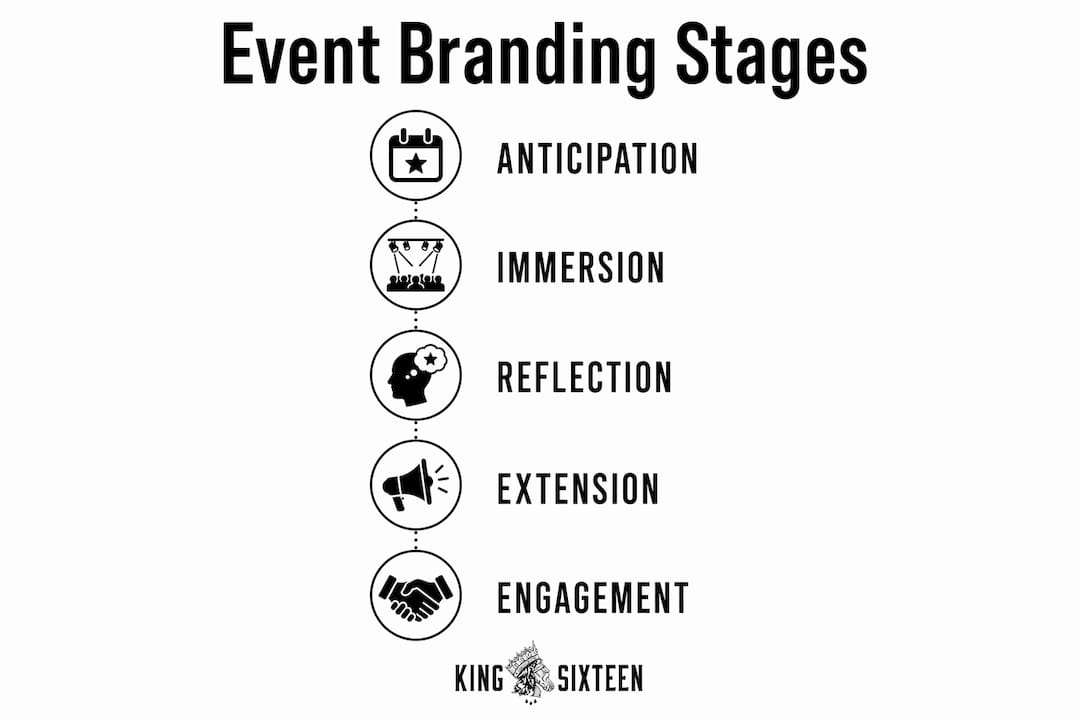
Radio builds familiarity early, digital and social content sustains momentum post-event, and combined channels boost brand recall and conversions. This multi-channel model transforms a single event day into weeks of brand-building content. The event becomes a content production engine, not just a gathering.
The table below illustrates the difference between single-touchpoint and ecosystem branding outcomes:
| Branding approach | Reach | Brand recall | Content output | Conversion window |
|---|---|---|---|---|
| Single touchpoint (event only) | Attendees only | Fades within 2 weeks | Minimal | Day of event |
| Ecosystem branding (multi-channel) | Attendees plus digital audience | Sustained over months | High volume, repurposable | Weeks to months post-event |
Approaching live events as flexible marketing platforms with integrated multi-channel activation creates sustained cultural relevance. Brands that understand this build equity with every event rather than starting from zero each time. For brand strategists, this means the planning conversation must include content strategy, social activation, and post-event distribution from day one, not as an afterthought.
For a deeper look at how digital and live channels work together, the event marketing integration guide at King Sixteen's blog is worth your time.
Common pitfalls that undermine live event branding
The most damaging branding failures at live events share a common root: treating event branding as décor rather than as an operational system. A logo on a step-and-repeat is not a brand experience. It is a photo opportunity. The distinction matters enormously.
Branding failures often stem from treating event branding as mere decoration instead of as a system affecting registration friction, wayfinding effectiveness, and staff behavior. When the operational layer of an event contradicts the brand's marketing promises, attendees notice. They may not articulate it, but the dissonance registers emotionally and damages trust.
The most common pitfalls brand strategists encounter include:
- Promise-experience gaps: The brand's marketing communicates luxury or exclusivity, but the event venue, catering, or registration process feels generic.
- Staff behavior misalignment: Team members who are unfamiliar with brand values or messaging undermine the experience at every interaction.
- Inconsistent visual language: Multiple vendors producing signage, presentations, and printed materials without a unified brand guide creates visual noise.
- Neglecting the digital-to-physical handoff: The online registration experience sets expectations that the physical event must meet or exceed.
- Ignoring post-event brand continuity: The experience ends abruptly with no follow-up content, leaving attendees with no channel to sustain their connection to the brand.
Gap moments where experience diverges from promises undermine brand perception more than missing logos. A missing logo is forgettable. A broken promise is not. The impact of branding on events is cumulative, built from dozens of small interactions that either reinforce or erode the brand's credibility.
Pro Tip: Shift your focus from grand gestures to micro-moments. The quality of the coffee, the clarity of the directional signage, and the warmth of the check-in staff collectively shape brand perception more than any single installation or keynote speaker.
Best practices for implementing effective live event branding
Executing effective branding for events requires a disciplined framework applied before, during, and after the event. The following steps represent the approach that consistently produces measurable outcomes for brand strategists working at scale.
-
Define your brand promise for this specific event. Not your general brand positioning. The specific emotional and functional promise this event makes to this audience. Write it in one sentence before any design work begins.
-
Map the full attendee journey. Start at the moment someone receives the invitation and end at the post-event email they receive three days later. Mapping the attendee journey identifies gap moments that can damage brand promise if left unaddressed. Document every touchpoint and assign a brand owner to each one.
-
Build a unified brand guide for the event. This document governs every vendor, designer, and staff member. It covers color values, typography, tone of voice, photography style, and spatial design principles. Without it, consistency is impossible at scale.
-
Design for flow and discovery. Well-orchestrated wayfinding and environmental storytelling are vital to brand integrity in a live setting. Design the physical space so attendees move through it in a sequence that mirrors the brand narrative you want to tell.
-
Activate content capture from the start. Assign a dedicated content team to document the event in real time. Capture attendee reactions, speaker moments, environmental details, and behind-the-scenes footage. This material feeds the reflection and education content pillars described earlier.
-
Measure recognition, engagement, and conversion separately. Tracking brand awareness lift, social engagement, attendee satisfaction, leads generated, and ongoing brand recall gives you a complete picture of event branding ROI. Each metric answers a different strategic question, so collapsing them into a single score obscures what actually worked.
For a practical framework on building event brand identity that drives revenue, King Sixteen's resource library covers the full spectrum from concept to measurement.
Key takeaways
Live event branding succeeds when it operates as a complete operational system, not a visual layer applied on top of logistics.
| Point | Details |
|---|---|
| Branding is operational, not decorative | Every touchpoint from registration to post-event follow-up must carry the brand promise. |
| Ecosystem thinking multiplies impact | Integrating anticipation, immersion, reflection, and education content extends event value for months. |
| Gap moments destroy trust faster than missing logos | Audit the full attendee journey to find and fix promise-experience disconnects before they happen. |
| Micro-moments outperform grand gestures | Consistent small interactions build deeper brand loyalty than any single high-budget installation. |
| Measurement requires three separate lenses | Track brand awareness lift, engagement, and conversion independently to understand what actually worked. |
Why live events are the most unforgiving brand medium
Live events are the only brand medium where you cannot edit after publishing. Every other channel, digital ads, social content, broadcast, gives you the ability to revise, retarget, or retract. A live event does not. The venue is the truth source for your brand's tone, and any confusion or inconsistency cannot be fully recovered by digital polish after the fact.
What I find most underappreciated is the emotional synchronization that happens in a room full of people sharing the same experience. Presence and shared attention in live experiences build deeper human connections than any digital format can replicate. That collective energy is the brand's most powerful asset at a live event, and it is also the most fragile. One broken promise, one confused attendee, one staff member who does not know the program, and the spell breaks.
The brands that get this right, the ones that build genuine advocacy through live events, are not the ones with the biggest budgets. They are the ones that treat brand consistency across all touchpoints as a non-negotiable operational standard, not a creative preference. They audit relentlessly, brief their teams thoroughly, and measure outcomes with the same rigor they apply to paid media.
My honest advice: stop optimizing for the hero moment and start optimizing for the attendee's worst moment. Fix the thing that breaks the experience, and the rest of the event will carry itself.
— Tyler
How King Sixteen builds live event branding that performs
King Sixteen designs and executes live event branding as a complete system, from spatial design and fabrication to content capture and post-event activation. If you are a brand strategist or marketing leader who needs an event environment that delivers on every promise your marketing makes, King Sixteen's experiential marketing services are built for exactly that. We have produced immersive brand experiences for Porsche, Audi, Ray-Ban, and Churchill Downs, handling every operational layer so the brand experience stays consistent from the first invitation to the final follow-up email. Explore our full event production capabilities or reach out directly to discuss your next activation.
FAQ
What is live event branding?
Live event branding is the practice of embedding a brand's identity, values, and personality into every element of a live experience, from spatial design and signage to staff behavior and post-event content. It operates as an operational system, not just a visual treatment.
Why does brand consistency matter at live events?
Trust in event branding is assembled from dozens of small, consistent micro-moments rather than a single large gesture. Inconsistencies between what the brand promises and what attendees experience erode trust faster than any missing visual element.
How do live events connect to digital marketing strategy?
Live events function as content production engines within a broader marketing ecosystem. Radio, social media, and digital channels extend the event's reach before, during, and after, sustaining brand recall and conversion opportunities well beyond the event date.
What are the most common live event branding mistakes?
The most damaging mistakes include treating branding as décor rather than an operational system, misaligning staff behavior with brand values, and failing to audit the full attendee journey for gap moments where the experience contradicts the brand's marketing promises.
How should you measure live event branding success?
Measure brand awareness lift, social engagement, attendee satisfaction, leads generated, and ongoing brand recall as separate metrics. Each answers a different strategic question, and combining them into a single score obscures which elements of the event branding actually drove outcomes.