Digital integration at events is defined as the coordinated connection of multiple technology platforms, data streams, and operational tools into a single, unified ecosystem that functions in real time. When your ticketing platform, CRM, mobile app, and onsite access control all speak the same language, you stop managing chaos and start managing outcomes. Event planners now manage 20 times more data than just a few years ago, yet most still operate fragmented tech stacks that turn that data into noise rather than intelligence. The role of digital integration at events has shifted from a nice-to-have feature to the operational backbone of every high-performing event program.
How does digital integration enhance event operations and data management?
Fragmented tech stacks are the single biggest threat to operational efficiency at live events. When your registration platform doesn't talk to your CRM, and your onsite check-in tool doesn't sync with your lead capture system, your team spends the event reconciling spreadsheets instead of making decisions. Full integration enables real-time sync between registration, CRM, and onsite tools, eliminating manual data reconciliation and accelerating pipeline attribution. That means your sales team knows who walked through the door before the keynote ends.
The most common inefficiencies in disconnected event stacks include:
- Duplicate data entry across ticketing, badge printing, and CRM systems, which introduces errors and slows staff response times
- Delayed reporting that forces post-event analysis instead of real-time course corrections during the program
- Siloed attendee records that prevent personalized communications from reaching the right people at the right moment
- Vendor misalignment where tools from different providers use incompatible data formats, requiring custom workarounds that break under pressure
A connected event tech ecosystem prevents the data silos that cause duplicated efforts and errors, improving both operational efficiency and attendee experience simultaneously. Think of it as the difference between a relay race where runners pass a baton cleanly versus one where each runner stops to hand-write a note about their leg of the race.
Pro Tip: Assign a dedicated integration lead before your event goes live. This person owns the health of your entire tech stack, monitors sync errors, and serves as the single point of contact between vendors. Without this role, critical failures during live execution often go unnoticed until the damage is done.

In what ways does digital integration improve attendee experience and personalization?
Connected data transforms attendees from anonymous ticket holders into known individuals with preferences, histories, and real-time behaviors your team can act on. A unified attendee profile pulls together ticketing data, app usage, session check-ins, payment history, and communication preferences into a single record. That record powers every personalized touchpoint from the moment someone registers to the follow-up email they receive three days after the event ends.
Here is how a well-integrated system improves the attendee journey at each stage:
- Pre-event: Personalized session recommendations and agenda builders based on registration data and stated interests, delivered through a branded event app like Cvent, Whova, or Bizzabo
- Arrival: Contactless check-in using QR codes or NFC badges that pull directly from the registration database, eliminating lines and repeated identity verification
- During the event: Real-time push notifications alerting attendees to schedule changes, nearby exhibitors matching their profile, or networking matches based on shared interests
- Post-event: Automated follow-up sequences triggered by specific session attendance or booth visits, sent through integrated marketing platforms like HubSpot or Marketo
"The true power of integration lies not only in connectivity but in linking attendee actions to CRM records, converting isolated moments into strategic long-term assets." — Bizzabo
The reduction of friction points matters as much as the personalization itself. When attendees don't have to log in three separate times, re-enter their dietary preferences, or wait in a badge pickup line, their perception of the entire event improves. Satisfaction and engagement are directly tied to how effortless the experience feels, and effortlessness is an engineering problem that integration solves.
What is the role of digital integration in linking events with marketing and sales pipelines?
Events generate intent signals that no other marketing channel can replicate. When an attendee spends 40 minutes at a product demo booth, attends two sessions on a specific topic, and downloads a whitepaper from the event app, that behavioral data tells your sales team exactly where that person sits in the buying journey. Integrated systems enable real-time session engagement tracking that correlates strongly with buyer intent and pipeline qualification. Without integration, that intelligence evaporates the moment the event ends.
| Data point | Fragmented stack outcome | Integrated stack outcome |
|---|---|---|
| Session attendance | Captured in event app, never reaches CRM | Synced to CRM contact record in real time |
| Booth visit duration | Logged manually by staff, inconsistent | Tracked via badge scan and added to lead score |
| App engagement | Siloed in app analytics, not actionable | Feeds marketing automation for follow-up triggers |
| Payment and upgrade history | Stored in ticketing platform only | Merged into unified attendee profile for sales context |
Fragmented event data captured across disconnected systems limits quick action, reduces data standardization, and weakens marketing and sales impact. The bi-directional data flow between your event platform and tools like Salesforce or HubSpot means sales reps walk into post-event calls with context-rich lead profiles rather than a badge scan and a business card. For brands like Porsche or Audi running high-stakes product launches, that difference is measured in closed deals, not just impressions.
Pro Tip: Build your event data strategy before you select your vendors. Define which data points matter to your sales and marketing teams, then work backward to identify which platforms must integrate to capture and deliver those signals.
How do event planners successfully implement digital integration strategies?
Successful implementation starts with a blueprint, not a vendor catalog. Before you evaluate a single platform, map every data exchange point your event requires: what information needs to move, between which systems, at what frequency, and in what format. This approach is formalized as an Integration Requirements Matrix, and it prevents the most common implementation failure, which is discovering incompatibilities two weeks before your event goes live.
Key principles for a successful implementation include:
- API-first vendor selection: Prioritize API-first vendors to minimize long-term integration complexity and technical debt. A vendor without a documented API is a dead end in a connected ecosystem.
- Real-time vs. batch syncing: Not all data needs to move instantly. Access control and check-in data require instantaneous sync. End-of-day lead exports to your CRM can run as batch processes without impacting operations. Categorizing data this way reduces system load and prevents bottlenecks.
- Middleware consideration: When two platforms lack a native integration, middleware tools like Zapier or MuleSoft can bridge the gap. Use them deliberately, not as a default fix for poor vendor selection.
- Centralized monitoring: Centralized dashboards aggregating registrations, sales, and engagement data in real time give your operations team a live command center view. Without this visibility, you are flying blind during the most critical hours of your event.
- Thorough pre-event testing: Test integrations thoroughly, including API sandbox calls, error handling, rate limits, and failure scenarios. A sync error that takes down your check-in system during peak arrival is not a technical problem. It is a brand problem.
Human coordination is the layer most planners underestimate. Technology does not manage itself during a live event. Assign clear roles, establish communication protocols between vendor contacts, and run a full dress rehearsal with every integrated system active. The integration lead role is not optional. It is the difference between a smooth execution and a crisis you are managing in real time.
What emerging trends define the future of digital integration at events?
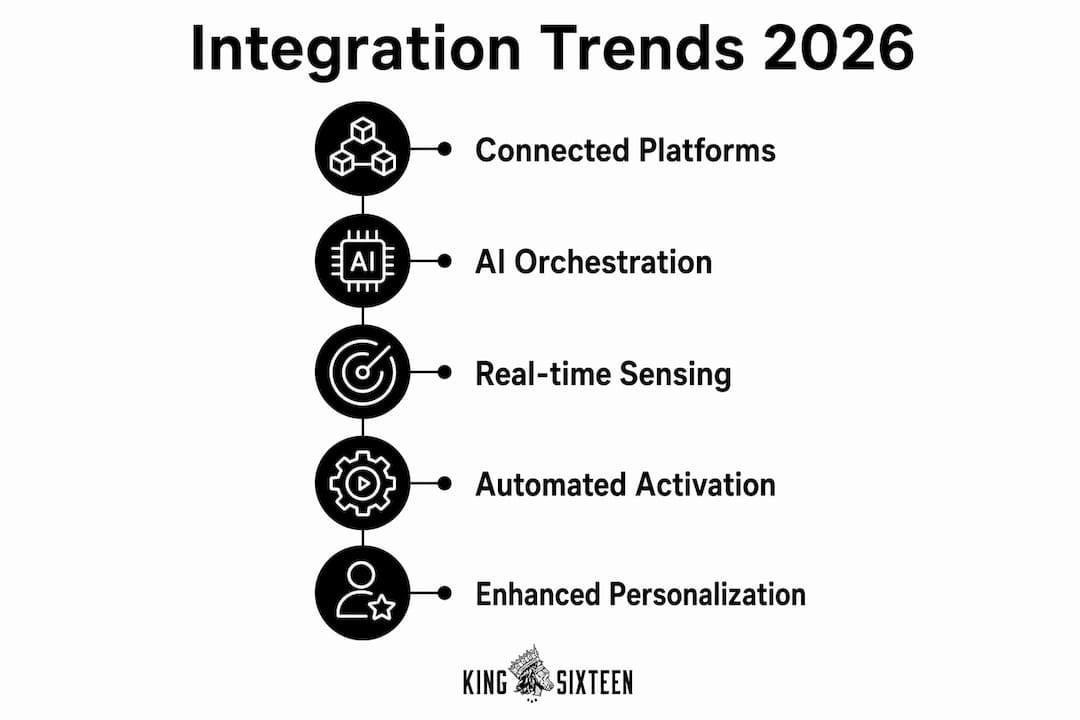
The next evolution of digital integration moves beyond connectivity into intelligence. AI-powered event orchestration uses real-time sensing, decisioning, and actuation cycles to dynamically manage logistics and engagement during live events. Rather than a planner reviewing dashboards and making manual adjustments, an orchestration layer monitors every data stream simultaneously and triggers interventions automatically.
| Capability | Traditional integration | AI-powered orchestration |
|---|---|---|
| Crowd management | Manual staff observation | Real-time sensor data triggers automated rerouting alerts |
| Session adjustments | Scheduled in advance | Dynamic capacity reallocation based on live attendance signals |
| Attendee engagement | Pre-programmed push notifications | Personalized "next best action" recommendations in real time |
| Post-event follow-up | Batch email sequences | Triggered within minutes of specific attendee behaviors |
This shift represents a fundamental change in how planners think about their role. Integration has evolved from software connectivity to AI-powered orchestration that enables real-time "next best action" recommendations during events. The planner's job becomes less about managing individual tools and more about setting the strategic parameters that the system executes against. For brands running innovative event marketing strategies, this creates a competitive advantage that compounds with every event in the portfolio.
Key takeaways
Digital integration at events is the operational foundation that converts fragmented tools and data into measurable engagement, sales intelligence, and attendee experiences that brands can actually build on.
| Point | Details |
|---|---|
| Define your data flows first | Map every data exchange point before selecting vendors to avoid costly incompatibilities. |
| API-first vendor selection | Choose platforms with documented APIs to reduce technical debt and future integration barriers. |
| Real-time sync where it counts | Prioritize instantaneous sync for access control; use batch processing for non-critical data like end-of-day lead exports. |
| Integration drives sales pipeline | Bi-directional data flows between event platforms and CRMs like Salesforce convert attendee behavior into qualified leads. |
| AI orchestration is the next frontier | Real-time sensing and decisioning loops are replacing manual monitoring as the standard for high-performance event execution. |
Why I think most planners are still underestimating integration
I have watched brands invest six figures in experiential production and then lose half the value because their tech stack was a collection of unconnected tools. The physical environment was flawless. The data was a disaster. No one could tell you which attendees were sales-qualified, which sessions drove the most engagement, or whether the VIP experience actually moved the needle on pipeline.
The honest truth is that modern event tech stacks in 2026 demand interoperability, automation, and measurable intelligence as baseline requirements, not premium features. If you are still treating integration as a line item to cut when budgets get tight, you are not just losing efficiency. You are losing the entire business case for the event itself.
The planners who get this right are not necessarily the ones with the biggest budgets. They are the ones who treat their tech stack as a system, assign ownership to it, and test it like their reputation depends on it. Because it does. Start with your Integration Requirements Matrix, select vendors who can prove their API documentation, and build your conference event management approach around data outcomes, not just production aesthetics. The technology exists to make every event smarter than the last one. Use it.
— Tyler
How King Sixteen builds events that actually work end to end
At King Sixteen, we design and execute events where the physical experience and the digital infrastructure are built together from day one. Our clients, including Porsche, Ray-Ban, and Churchill Downs, do not have the margin for a beautiful activation that generates no usable data. Our turnkey model covers everything from AV and fabrication to vendor coordination and digital integration, so your event tech ecosystem functions as a single system rather than a collection of competing tools. If you are ready to build experiences that generate real outcomes, explore our experiential marketing services or see how we approach full event production from concept through execution.
FAQ
What is digital event integration?
Digital event integration is the process of connecting multiple event technology platforms, including ticketing, CRM, mobile apps, and onsite tools, into a unified system that shares data in real time. The goal is to eliminate manual reconciliation and create a single source of truth for attendee and operational data.
Why does digital integration matter for event ROI?
Integrated systems convert attendee behavior into sales intelligence by syncing session engagement, booth visits, and app interactions directly to CRM records. This gives sales teams context-rich lead profiles that accelerate pipeline qualification and post-event follow-up.
What is an Integration Requirements Matrix?
An Integration Requirements Matrix is a planning document that specifies every data exchange point between your event platforms, including what data moves, between which systems, at what frequency, and in what format. It is the foundational blueprint for avoiding vendor incompatibilities before your event goes live.
How does AI change digital integration at events?
AI-powered orchestration adds a decisioning layer on top of connected platforms, using real-time sensing and actuation cycles to trigger automated interventions like crowd rerouting, session adjustments, and personalized attendee recommendations without requiring manual input from planners.
What is the biggest implementation mistake event planners make?
The most common mistake is selecting vendors before defining data requirements, which leads to incompatible systems and last-minute workarounds. Planners should also assign a dedicated integration lead to monitor system health during live execution, as undetected sync errors can compromise the entire event operation.