Attendee engagement is defined as the creation of personalized, shareable experiences that move participants from passive observers to active advocates before, during, and after your event. The most effective ways to engage event attendees operate across three phases: pre-event community building, onsite interactive moments, and post-event follow-up that sustains momentum. Brands like Porsche, Ray-Ban, and Fossil have proven that event engagement tactics built around tangible artifacts, such as branded LinkedIn share cards, personalized QR code activations, and session pre-selection portals, consistently outperform passive programming.
1. Ways to engage event attendees before they arrive
Pre-event engagement is not a warm-up act. It is the foundation that determines show-up rates, onsite participation, and post-event advocacy. The tactics you deploy in the weeks before your event set the tone for everything that follows.
Start with your confirmation email. Confirmation emails achieve open rates above 80%, making them the highest-leverage touchpoint in your entire communications calendar. Embedding a low-friction share ask, such as a one-click LinkedIn post or a pre-written tweet, in that email generates 3–5x higher attendee advocacy than requests sent later in the cycle. That single tactic compounds your reach before you spend a dollar on paid promotion.
Session pre-selection is equally powerful. Allowing attendees to choose their session schedule correlates with a 15–25% higher show-up rate for those specific sessions. When attendees commit to a schedule, they commit to the event itself.
- Launch a private Slack or LinkedIn group 4–6 weeks before the event to build community early
- Send personalized welcome messages with VIP content previews to registered attendees
- Use session pre-selection portals to let attendees build their own agenda
- Embed a branded share card in the confirmation email for one-tap social sharing
Pro Tip: Write the social share copy for your attendees. Pre-populated text with your event hashtag removes all friction and dramatically increases the number of people who actually post.
2. Branded share cards and social amplification onsite
True engagement produces tangible shareable artifacts, not just feelings of participation. The most effective onsite tactic for social amplification is the branded share card pushed immediately after a session ends.
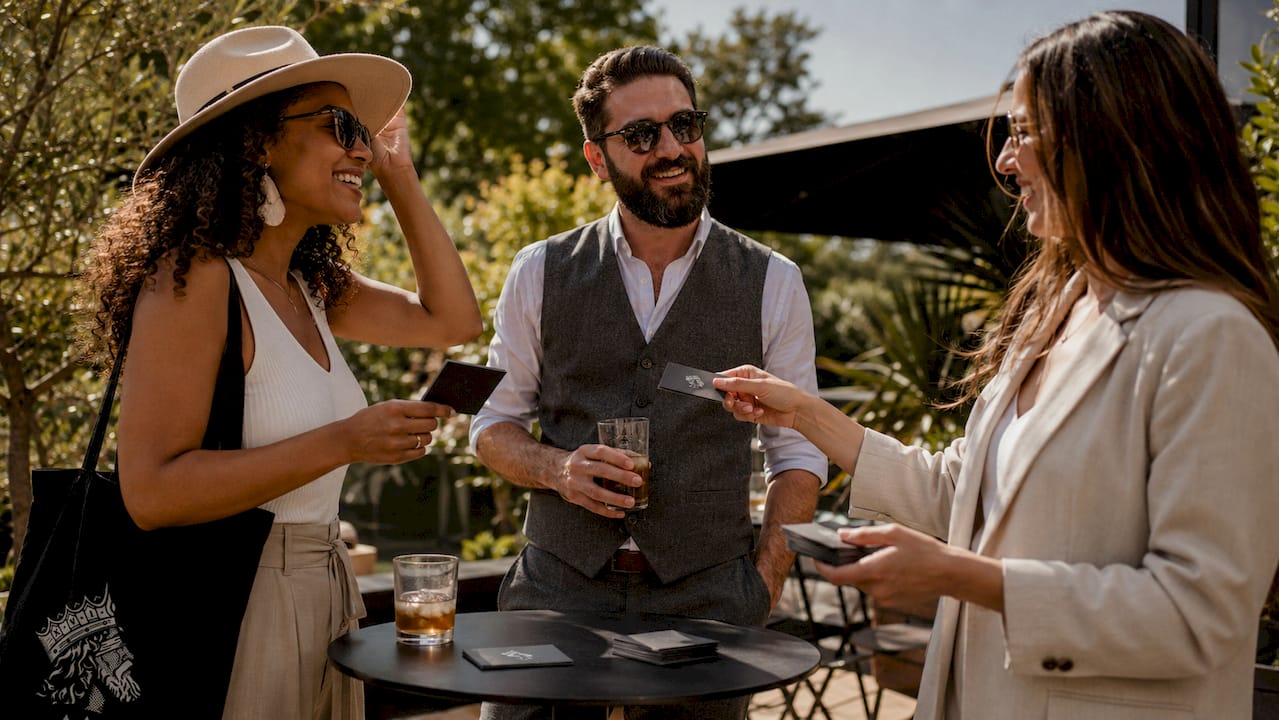
Pre-built LinkedIn share cards with one-tap sharing generate 5–10x higher conversion for social shares than generic prompts like "share your experience." The timing matters as much as the format. Pushing a share card within minutes of a session ending, while the content is still fresh, captures peak emotional engagement. A 31.9% share-to-registration conversion rate is achievable when the card is timed correctly post-session.
Generic social asks fail because they require attendees to create content from scratch. Branded share cards solve that problem by doing the creative work in advance. Your attendees become distribution channels without feeling like they are doing marketing work.
| Tactic | Effort Required | Social Impact |
|---|---|---|
| Generic "share this event" prompt | Low | Low |
| Pre-built branded share card | Low | 5–10x higher conversion |
| Post-session personalized card | Low | 31.9% share-to-registration rate |
| Manual social post ask | High | Inconsistent |
Pro Tip: Design share cards for each session topic, not just the event overall. Attendees are far more likely to share content tied to a specific talk they found valuable.
3. QR code activations that deliver personalized outcomes
Replace generic booth visits with QR code experiences that give attendees something personal in return. A QR code that delivers a generic PDF is a missed opportunity. A QR code that delivers an AI-powered product recommendation, a personalized discount code, or a custom photo is a reason to stop and engage.
The key distinction is the output. Personalized QR activations work because they trade a moment of attention for something the attendee actually wants to keep or share. That exchange creates a memory tied to your brand, not just a transaction. For brands like Audi or the Natural Diamonds Council, that moment of personalization is the difference between a forgettable booth and a talked-about experience.
Build the activation around a clear value exchange. The attendee scans, they receive something specific and useful, and the path to sharing that outcome is built into the flow.
4. Gamification and live leaderboards
Gamification converts passive attendees into active participants by introducing competition, progress, and reward. Scavenger hunts, trivia contests, and live leaderboards are not novelties. They are proven mechanics for driving foot traffic, extending dwell time, and creating organic conversation between attendees who would otherwise never interact.
Live leaderboards displayed on screens throughout the venue create ambient social pressure that keeps participation rates high throughout the day. Attendees check their ranking, recruit colleagues to join, and return to activities they might have skipped. The event attendee experience improves measurably when attendees have a reason to move through the space with purpose rather than drift.
Keep the game mechanics simple and the prizes visible. Complexity kills participation. A clear leaderboard with a desirable prize drives more engagement than an elaborate points system that requires a tutorial to understand.
5. Photo activations with instant AI-powered retrieval
Professional event photos delivered instantly via facial recognition or QR code spark immediate social sharing and buzz that generic photo booths cannot match. The friction of waiting days for event photos kills the social moment entirely. Instant retrieval solves that problem.
Facial recognition photo delivery works by scanning attendees as they enter and automatically matching them to every photo taken throughout the event. Attendees receive a gallery of their own images within minutes. That personal gallery is far more likely to be shared than a generic event photo album. The result is a wave of authentic, attendee-generated content that extends your event's reach across social platforms.
QR code retrieval is a lower-tech alternative that delivers similar results. Attendees scan at a photo station and receive their images immediately via text or email, ready to post.
6. Turning dead time into prime engagement moments
Waiting in line is the most wasted real estate at any event. Dead time converted into high-value activations significantly improves the overall attendee experience and creates additional touchpoints for brand interaction. A professional headshot booth placed near a registration line transforms a frustrating wait into a benefit attendees actively seek out.
Avatar booths, interactive brand installations, and live polling stations all work on the same principle. The attendee is already standing still. Give them something worth doing. Waiting time activations are among the highest-ROI investments in your event program because the infrastructure cost is low and the engagement density is high.
The headshot booth is particularly effective for professional conferences. Attendees leave with a usable LinkedIn photo, which means they associate your brand with a tangible career benefit long after the event ends.
7. Technology tools that reduce friction and increase participation
The biggest mistake in event technology is asking attendees to download a new app. App adoption rates at events are notoriously low, and a tool no one uses delivers zero engagement. Digital wallet passes via Apple Wallet or Google Wallet solve this problem by pushing real-time notifications through software attendees already have on their phones.
Digital wallet passes enable flash giveaways, session reminders, and last-minute schedule changes without requiring any new downloads. The notification appears on the lock screen like a boarding pass update. Adoption is near-universal because the barrier to entry is a single tap during registration.
- Use Apple Wallet and Google Wallet passes for real-time session reminders and flash offers
- Deploy live social walls that display attendee posts in real time to encourage participation
- Integrate QR codes into every physical touchpoint for instant personalized outcomes
- Use event portals for session scheduling and personalized agendas before and during the event
| Technology | Adoption Barrier | Best Use Case |
|---|---|---|
| Standalone event app | High (download required) | Large multi-day conferences |
| Digital wallet pass | Low (one tap) | Real-time notifications, flash giveaways |
| QR code activation | None | Personalized outcomes, photo retrieval |
| Live social wall | None | Ambient engagement, UGC amplification |
8. Post-event follow-up that converts attendees into advocates
Post-event engagement is where most planners leave money on the table. Sending a personalized follow-up email within 72 hours, with resources tied to the specific sessions an attendee joined, boosts next-event registration 2–3x higher than a generic recap email. That difference compounds over multiple event cycles into a significantly larger returning audience.
Segment your follow-up by behavior, not just by registration tier. An attendee who joined three sessions on product marketing deserves a different email than one who spent most of their time at networking events. Personalized post-event outreach signals that you were paying attention, which builds the kind of loyalty that drives repeat attendance.
Collect testimonials within 72 hours while the experience is still vivid. Feature those testimonials in your next event's promotional materials. Social proof from real attendees consistently outperforms brand-generated copy.
- Send session-specific resource emails within 72 hours of the event closing
- Collect video or written testimonials before attendees fully decompress
- Promote user-generated content from the event gallery with embedded polls and feedback prompts
- Nurture the pre-event community you built on Slack or LinkedIn to maintain ongoing relationships
9. Segmenting and rewarding your top attendees
The top 10% of attendees drive 80% of social shares from any given event. Treating that group the same as every other attendee is a strategic error. Identifying and engaging your most active participants separately converts casual enthusiasm into sustained advocacy that carries into your next event cycle.
Exclusive briefings, early access to next year's agenda, and private networking sessions with speakers are all low-cost ways to reward high-engagement attendees. The signal you send is that their participation was noticed and valued. Segmenting top attendees post-event and providing them exclusive content or access converts a one-time advocate into a long-term brand ambassador.
Track engagement signals throughout the event: session attendance, social shares, QR code interactions, and leaderboard participation. Use that data to build your advocate segment before the event even closes.
Key takeaways
The most effective event engagement strategy produces shareable artifacts at every phase, pre-event, onsite, and post-event, and segments top attendees for sustained advocacy.
| Point | Details |
|---|---|
| Start engagement before the event | Embed share asks in confirmation emails to generate 3–5x higher advocacy lift. |
| Build for shareable artifacts | Every tactic should produce something attendees want to keep or post. |
| Convert dead time into activation | Headshot booths and interactive installations turn waiting into brand touchpoints. |
| Use digital wallets over apps | Apple and Google Wallet passes remove adoption friction for real-time notifications. |
| Segment your top 10% post-event | The top 10% drive 80% of social shares; reward them with exclusive access and content. |
Why I think most event engagement advice misses the point
Most articles on how to create event engagement focus on tactics in isolation. Run a poll. Set up a photo booth. Send a follow-up email. That advice is not wrong, but it treats engagement as a checklist rather than a system.
What I have seen work, across events for brands like Churchill Downs and Fossil, is a different frame entirely. Every tactic should answer one question: what does the attendee walk away with? Not a feeling. Not a memory. A thing. A photo, a share card, a personalized recommendation, a LinkedIn post they are proud of. When every touchpoint in your event produces a tangible output, the engagement compounds. Each artifact your attendees share extends your event's reach to audiences you never paid to reach.
The second mistake I see constantly is vague engagement asks. Explicit engagement instructions integrated into the event journey drive dramatically higher participation than passive prompts. "Post a photo" gets ignored. "Scan this QR code to get your professional headshot, then share it with #YourEventHashtag for a chance to win" gets results. The specificity is the strategy.
The future of event engagement strategies is not more technology. It is smarter use of the technology attendees already carry. Digital wallets, facial recognition photo delivery, and pre-built social share cards all work because they meet attendees where they already are. The brands that win at events in 2026 are the ones that make participation feel effortless and the output feel personal.
— Tyler
Take your event engagement further with Kingsixteen
Kingsixteen designs and executes immersive brand experiences that turn events into revenue-generating moments. From custom fabricated installations to full-scale conference production, every element is built to produce the kind of attendee engagement that extends well beyond the event day itself.
If you are planning a product launch, conference, or brand activation and want an experience your attendees will actually share, Kingsixteen handles everything from concept to execution. Explore our experiential marketing services to see how we build environments that make brands unforgettable. Your next event deserves more than a venue and a stage.
FAQ
What is attendee engagement in event planning?
Attendee engagement is the active participation of guests before, during, and after an event through personalized, interactive experiences. The most effective engagement produces shareable artifacts that extend the event's reach beyond the venue.
Why does event engagement matter for ROI?
Engaged attendees share more, return more, and advocate for your brand longer. Personalized post-event emails sent within 72 hours boost next-event registration 2–3x compared to generic follow-ups.
What are the best interactive event ideas for onsite engagement?
Branded share cards, QR code personalization stations, live leaderboards, and instant photo retrieval via facial recognition consistently outperform passive programming for onsite participation.
How do I measure event engagement effectively?
Track session attendance rates, social share volume, QR code scan counts, and post-event email open rates. Segmenting your top 10% of sharers gives you the clearest signal of true advocacy.
What technology works best for event attendee engagement?
Digital wallet passes via Apple Wallet and Google Wallet outperform standalone event apps because they require no download. They enable real-time session reminders, flash giveaways, and schedule updates with near-universal adoption.