
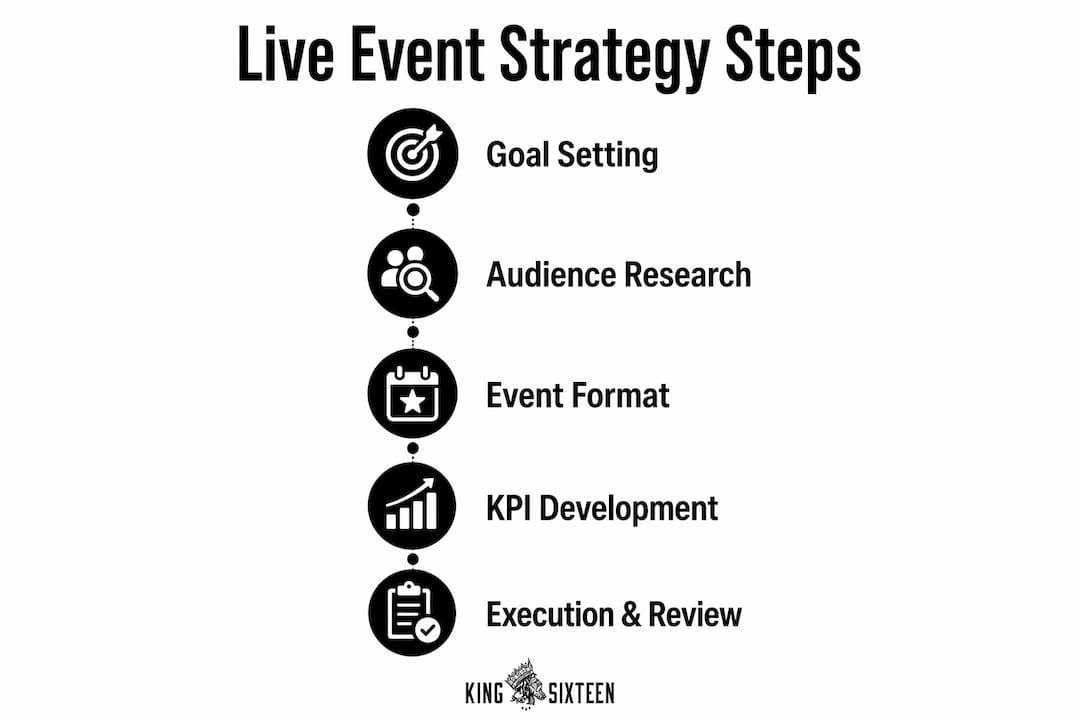
Live event strategy is a data-driven, intentional, and measurable plan that aligns organizational goals with event experiences to drive brand engagement and business outcomes. Where basic event planning focuses on logistics, strategy connects every decision to a defined objective. It covers goal identification, KPI selection, audience targeting, technology integration, and post-event analysis. Platforms like Bizzabo and tools like Guidebook have made it easier to build this kind of structured approach. The result is an event program that does more than fill a room. It generates data, builds brand equity, and produces outcomes you can measure.
What are the essential components of a live event strategy?
A strong live event strategy starts with clear goals and works outward from there. Without defined objectives, every other decision becomes guesswork. According to Bizzabo, a complete strategy includes goal identification, KPI selection, brand journey mapping, strategic partnerships, and post-event pivoting. Each component serves a specific function in the overall plan.
The core components of any effective live event strategy include:
- Goal identification: Define what success looks like before you book a venue. Is the goal lead generation, brand awareness, product education, or customer retention?
- KPI selection: Tie every goal to a measurable metric. Attendance numbers, engagement scores, lead volume, and post-event survey results all qualify.
- Audience segmentation: Know who you are targeting and why. Segmenting by industry, role, or buying stage lets you tailor content and experience to the right people.
- Technology stack: Choose platforms that support registration, engagement, and data collection. Bizzabo, Guidebook, and similar tools handle different parts of this stack.
- Brand journey mapping: Plan the attendee experience from first email to post-event follow-up. Every touchpoint should reinforce the same brand message.
- Strategic partnerships and sponsorships: Align with partners whose audiences overlap with yours. This extends reach and adds credibility.
- Post-event analysis: Review what worked and what did not. Use data to adjust your approach for the next event.
Pro Tip: Build your KPIs before you finalize your event format. The format should serve the goal, not the other way around.
How does live event strategy differ from event planning and management?
Live event strategy, live event planning, and live event management are three distinct disciplines that work best when treated as a unified system. Guidebook defines event planning as pre-event logistics and event management as the full lifecycle from concept through post-event analysis. Strategy sits above both. It sets the direction that planning and management execute against.
Here is how the three disciplines connect in sequence:
- Strategy: Defines the why. What business outcome does this event serve? Who needs to attend? What does success look like in measurable terms?
- Planning: Defines the what and when. Venue selection, vendor contracts, run-of-show documents, speaker schedules, and attendee communications all live here.
- Management: Defines the how, in real time. On-site coordination, technical execution, staff deployment, and contingency response all fall under management.
The most common failure point is treating these as separate workstreams. When the strategy team hands off to the planning team without shared context, you get events that are logistically sound but strategically hollow. A product launch that runs on time but fails to generate qualified leads is a planning success and a strategy failure.
Pro Tip: Schedule a strategy alignment meeting at the start of every planning phase. Bring both your marketing lead and your logistics lead into the same room. Misalignment at this stage costs far more to fix later.
A run of show is the internal operational backbone that controls timing, staff assignments, technical cues, and contingency plans. It is not the attendee schedule. It is the command document your team uses to execute the event behind the scenes. When strategy, planning, and management share a single run-of-show document, execution tightens considerably.
What are best practices for implementing a successful live event strategy?
The most reliable framework for live event execution is a phased planning approach. Planning events 6 to 18 months in advance raises success rates by up to 40%, and detailed timelines achieve 95% on-time execution compared to 70% for ad hoc plans. That gap is not a coincidence. It reflects the compounding value of early decisions.
| Planning Phase | Timeline | Key Activities |
|---|---|---|
| Early stage | 6–18 months out | Goal setting, venue selection, budget allocation, speaker outreach |
| Mid stage | 3–6 months out | Marketing launch, registration open, vendor contracts finalized |
| Final stage | 0–3 months out | Run-of-show creation, rehearsals, attendee communications, contingency planning |
Within each phase, ownership matters as much as timing. Assigning a dedicated timeline manager reduces event-day stress by 65% and improves the team's ability to make real-time adjustments without disrupting the attendee experience. This person monitors the run-of-show and decides whether to absorb delays or compress future segments.
Additional best practices that consistently separate strong events from average ones:
- Protect anchor moments. Keynote speeches, main entertainment, and product reveal moments are non-negotiable. Build buffer time around them so delays elsewhere do not cascade into your highest-value segments.
- Use technology to communicate, not just to impress. Mobile apps, live polling tools, and real-time messaging platforms keep attendees oriented and staff coordinated.
- Collect data continuously. Registration data, session attendance, app engagement, and post-event surveys each tell a different part of the story. Use event data collection to build a complete picture.
- Balance experience with feasibility. Immersive brand environments create stronger impressions, but only if they are executed cleanly. An ambitious installation that malfunctions on day one damages the brand more than a simpler setup done well.
How can live event strategy maximize brand engagement and business outcomes?
Modern live events prioritize immersive, multi-sensory experiences to create lasting emotional connections that go beyond traditional information delivery. This is the core principle behind experiential marketing. Brands like Porsche, Audi, and Ray-Ban invest in live environments precisely because physical presence creates a depth of brand connection that digital channels cannot replicate.
The tactics that drive measurable engagement include:
- Mobile event apps and gamification: Branded in-app experiences increase attendee interaction and extend brand touchpoints throughout the event day.
- Live polling and social media integration: Real-time participation tools keep attendees active rather than passive. Social sharing extends your reach beyond the room.
- Personalized follow-up using event data: Segment your post-event outreach based on session attendance, app behavior, and survey responses. Generic follow-up wastes the data you collected.
- Aligned content and brand messaging: Every session, environment, and piece of collateral should reinforce the same core message. Inconsistency dilutes impact.
- Experiential marketing tactics: Custom fabrication, immersive environments, and sensory design create moments that attendees remember and share.
The KPIs that matter most for brand engagement are attendance rate, session engagement scores, lead volume, social mentions, and post-event brand sentiment. Tracking all five gives you a complete view of both reach and depth. Reach tells you how many people showed up. Depth tells you whether the experience actually moved them.
What challenges arise in live event strategy and how do you overcome them?
Every live event carries execution risk. The difference between a team that handles it well and one that does not comes down to preparation and role clarity. Common challenges include timing fatigue, last-minute changes, communication gaps between teams, and technology inconsistency across platforms.
The most effective ways to reduce these risks:
- Designate a single decision-maker for event day. When something goes wrong, one person needs the authority to call the adjustment. Committees slow response time.
- Use a centralized communication platform. Slack channels, group texts, or dedicated event apps keep your team aligned without requiring everyone to be in the same room.
- Build contingency plans into the run-of-show. Identify your three most likely failure points in advance and write a response for each one. This is not pessimism. It is preparation.
- Audit your technology stack before the event. Test every integration, every screen, and every audio feed in the actual venue. Problems discovered during rehearsal cost minutes. Problems discovered during the keynote cost credibility.
- Measure intangible outcomes deliberately. Brand affinity and emotional connection are real outcomes, but they require qualitative tools. Post-event interviews, NPS scores, and social sentiment analysis all capture what attendance numbers miss.
Pro Tip: Send a one-page brief to every team member the morning of the event. Include the run-of-show summary, key contacts, and the top three priorities for the day. It takes 10 minutes to prepare and eliminates a significant share of on-site confusion.
Key Takeaways
A successful live event strategy requires aligned goals, phased planning, clear ownership, and continuous data collection to deliver measurable brand and business outcomes.
| Point | Details |
|---|---|
| Define goals before format | Set KPIs and objectives first; let them determine the event type and structure. |
| Plan 6–18 months in advance | Early planning raises success rates and achieves significantly higher on-time execution. |
| Unify strategy, planning, and management | Treating all three as one discipline produces better ROI and fewer execution failures. |
| Assign a timeline manager | One dedicated role on event day reduces stress and protects the attendee experience. |
| Measure both reach and depth | Track attendance and engagement scores together to capture the full impact of your event. |
The thing most marketers get wrong about live event strategy
Most marketing teams treat live events as a production problem. They focus on the venue, the AV, the catering, and the run-of-show. Those things matter. But the real work happens six months before the event, in a room where someone asks: what do we actually need this event to do for the business?
I have seen brands spend significant budgets on beautiful environments that generated almost no qualified pipeline. The events looked great on Instagram. The post-event reports were thin. The reason was always the same: the strategy conversation never happened. The team jumped straight to execution.
The counterintuitive truth is that the most impactful events are often the most constrained ones. When you have a clear goal, a defined audience, and a specific outcome you are chasing, every creative and logistical decision becomes easier. You stop asking "what would be cool?" and start asking "what would move this specific person to take this specific action?"
Technology is the other area where I see teams overcomplicate things. Mobile apps, live polling, and social integrations are genuinely useful. But they work only when they serve the attendee experience, not when they are added to justify a line item. The best use of event marketing technology is invisible. Attendees should feel more connected, not more managed.
Start your strategy early. Revisit your goals at every phase transition. And measure things that actually reflect business impact, not just things that are easy to count.
— Tyler
How Kingsixteen brings live event strategy to life
Kingsixteen works with brands that need more than a well-run event. They need an experience that generates demand, captures data, and extends the brand well past the closing session.
From full-scale experiential marketing campaigns to end-to-end conference production, Kingsixteen handles design, fabrication, AV, staffing, logistics, and digital integration through a single turnkey model. Clients like Porsche, Audi, and Churchill Downs trust this approach because it removes the coordination burden and delivers a consistent brand experience at every touchpoint. If you are building a live event strategy and need a production partner who understands both the creative and the commercial side, Kingsixteen is worth a conversation.
FAQ
What is live event strategy in marketing?
Live event strategy is a data-driven plan that aligns marketing goals with event experiences, covering objectives, audience targeting, technology, and post-event measurement. It transforms events from operational tasks into measurable marketing initiatives.
How does live event strategy differ from event planning?
Event planning covers pre-event logistics. Live event strategy sets the business objectives and KPIs that planning and management execute against. Strategy defines the why; planning defines the what and when.
How far in advance should you plan a live event?
Planning 6 to 18 months in advance raises success rates significantly and supports 95% on-time execution compared to 70% for ad hoc approaches. Earlier planning also improves vendor selection and budget control.
What KPIs should you track for live event strategy?
The most useful KPIs are attendance rate, session engagement scores, lead volume, social mentions, and post-event brand sentiment. Tracking all five captures both the reach and the depth of your event's impact.
What is a run of show and why does it matter?
A run of show is the internal command document that controls timing, staff assignments, technical cues, and contingency plans during a live event. It differs from the attendee schedule by focusing entirely on how the event is executed behind the scenes.