An iconic brand is defined as a cultural myth that resolves real identity tensions in society, not simply a recognizable logo or a catchy tagline. Understanding why create iconic brands matters is the central question every serious brand strategist must answer before allocating a single dollar of budget. Brands that achieve this status generate measurable advantages: consistent brand presentation increases revenue by 23% and reduces customer acquisition costs. That figure reflects something deeper than design consistency. It reflects the compounding power of a singular idea held with conviction over time. Kingsixteen has seen this principle play out across activations for Porsche, Audi, Ray-Ban, and Fossil. The brands that endure are the ones built on meaning, not momentum.
How do iconic brands build cultural resonance and emotional connection?
Iconic brands earn their status by functioning as narrative resolutions for real societal tensions. Marketing scholar Douglas Holt developed the cultural branding framework to explain this phenomenon. His core argument: iconic brands act as myths that give consumers a way to resolve identity anxieties they cannot resolve on their own.
Think about what that means in practice. A brand does not just sell a product. It offers a story that places the consumer inside a larger cultural narrative. When that story addresses something people genuinely feel, the brand becomes a reference point. Customers stop being buyers and start being believers.
"Iconic brands provide a lens through which consumers make sense of their world and desires by resolving cultural tensions."
This is why emotional connection drives retention far more reliably than price or features. A 5% improvement in customer retention can increase profit margins by 25%–95%. That range is wide, but the direction is unambiguous. Emotional loyalty compounds.
The practical implications for brand strategists are clear:
- Identify the cultural tension your brand resolves. Not a product problem. A human one. What anxiety, aspiration, or identity conflict does your brand address?
- Build a consistent narrative around that resolution. Every campaign, product launch, and event should reinforce the same core story.
- Engage communities as co-authors. Iconic brands are co-authored by customers and society. Community participation strengthens brand legitimacy over time.
- Measure emotional connection, not just awareness. Net Promoter Score, repeat purchase rate, and brand advocacy metrics reveal whether your narrative is landing.
Cultural resonance is not a soft metric. It is the foundation that makes every other brand investment more effective. When your audience feels your brand understands them, brand storytelling stops being marketing and starts being meaning.
What role does consistency and clarity play in building iconic brands?

Clarity is the operating system of an iconic brand. Without a single, clear idea at the center, every campaign pulls in a slightly different direction. Over time, that drift erodes recognition and trust.
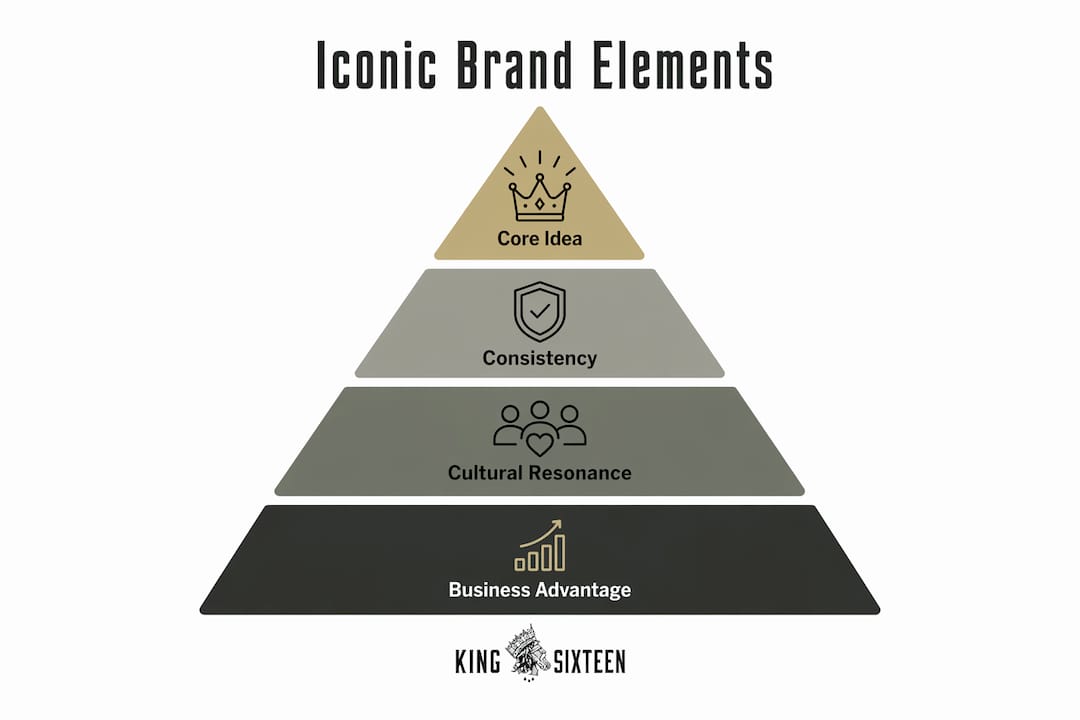
Iconicity is a byproduct of holding a single idea with conviction and consistency, not the result of campaigns or rebrands. That is a direct challenge to how most marketing teams operate. The instinct is to refresh, pivot, and respond to trends. The discipline required for iconic status runs in the opposite direction.
The financial case for consistency is concrete:
- Revenue growth. Consistent brand presentation across platforms increases revenue by 23%. The mechanism is simple: recognition reduces friction in the purchase decision.
- Enterprise valuation. Brand equity accounts for 30%–70% of total enterprise value for strong brands. That is not a marketing metric. That is a balance sheet metric.
- Lower acquisition costs. When a brand is instantly recognizable, paid media works harder. Organic word-of-mouth accelerates. The cost to acquire each new customer drops.
- Pricing power. Brand equity builds meaning that creates preference and supports premium pricing, breaking through growth ceilings that commoditized brands cannot escape.
Stat to anchor: Strong brands outperform the general stock market by 73% over 20 years. That performance gap is the return on narrative discipline.
The risk of inconsistency is equally measurable. Diluted brand narratives confuse consumers, weaken recall, and force brands to compete on price. Once a brand loses its singular identity, rebuilding it costs multiples of what maintaining it would have required. Consistency is not a creative constraint. It is a financial strategy. Brands that understand this treat brand consistency as a core business function, not a design preference.
What practical strategies help build and sustain iconic brand identity?
Building an iconic brand is less about campaigns and more about excavation. The most durable brand identities are not invented. They are uncovered. Effective brand management starts by excavating the founder's DNA to build a narrative system that the entire organization can execute consistently.
Here is how that process works in practice:
- Start with the origin story. What problem did the founder set out to solve? What belief drove the first product decision? That original conviction is usually the brand's most authentic asset.
- Align product, visual identity, and messaging with one core idea. Every touchpoint should express the same truth. When a customer sees your packaging, attends your event, or reads your copy, the experience should feel like one coherent voice.
- Apply the permission-to-change model. Iconic brands earn permission to change carefully, balancing innovation with core meaning. You can evolve the expression of your idea. You cannot abandon the idea itself without paying a steep price in consumer trust.
- Participate in culture, not just commerce. Sponsor the right events. Partner with the right voices. Show up in the cultural moments that matter to your audience. Brands that only appear in paid media channels never achieve the depth of cultural embedding that iconic status requires.
- Measure narrative drift regularly. Run brand perception audits at least annually. Ask whether your audience can articulate what your brand stands for in one sentence. If they cannot, your messaging has drifted.
Pro Tip: Before your next campaign brief, write a single sentence that captures your brand's core idea. If your team cannot agree on that sentence, the campaign will not build iconicity. Resolve the sentence first.
The permission-to-change model deserves special attention. Brands like Porsche have introduced electric vehicles without abandoning their performance identity. The product changed. The promise did not. That is the model. Innovation is allowed when it serves the core idea. Innovation that contradicts the core idea is brand dilution wearing the costume of progress.
What business benefits and competitive advantages do iconic brands provide?
Iconic brands create a defensive moat that commoditized brands cannot replicate. The moat is not built from patents or distribution. It is built from meaning. And meaning, once established, is extraordinarily difficult for competitors to copy.
| Business Benefit | What It Means in Practice |
|---|---|
| Market outperformance | Strong brands outperform the stock market by 73% over 20 years |
| Higher profit margins | A 5% retention gain can increase margins by 25%–95% |
| Premium pricing power | Brand equity supports higher prices without volume loss |
| Lower marketing costs | Consistent narrative makes each campaign more effective over time |
| Talent attraction | Top candidates choose brands with clear identity and cultural weight |
The talent dimension is underappreciated. Iconic brands attract people who want to be part of something larger than a job description. That reduces recruiting costs and improves retention at every level of the organization.
"Brand efforts compound. Consistent narrative performance makes marketing and recruitment exponentially cheaper over time."
The impact of strong branding on customer retention is equally direct. When customers feel a genuine emotional connection to a brand, they return without being prompted. They refer without being incentivized. They defend the brand in public conversations. That behavior is the output of iconic status, and it is worth far more than any single campaign can generate. Brands that increase customer retention through emotional loyalty consistently outperform those that rely on promotional pricing to drive repeat purchase.
Key Takeaways
Iconic brands are built by holding a single, culturally resonant idea with consistency and discipline over time, not by executing louder campaigns.
| Point | Details |
|---|---|
| Cultural resonance drives loyalty | Brands that resolve real identity tensions earn emotional loyalty that compounds into profit margin gains. |
| Consistency is a financial strategy | Consistent brand presentation increases revenue by 23% and accounts for up to 70% of enterprise value. |
| Excavate before you build | The strongest brand identities are uncovered from founder DNA, not invented by marketing teams. |
| Earn permission to change | Iconic brands can evolve their expression but must protect their core idea to maintain consumer trust. |
| Meaning creates a competitive moat | Strong brands outperform the market by 73% over 20 years because meaning cannot be commoditized. |
The discipline nobody talks about
After working with brands across automotive, luxury, and lifestyle categories, the pattern is consistent. The brands that achieve iconic status are not the ones with the biggest budgets or the most creative agencies. They are the ones with the most disciplined leadership.
Iconicity is earned through repetition, not revelation. The brands that try to manufacture it with a single bold campaign almost always fall short. They get attention. They do not get meaning. And attention without meaning fades the moment the next campaign launches.
The digital age has made this harder, not easier. The pressure to respond to every cultural moment, every platform shift, and every competitor move pulls brand teams away from the singular idea that actually builds equity. I have watched brands with genuinely powerful origin stories abandon them in pursuit of relevance. The result is always the same: they become louder and less memorable at the same time.
The uncomfortable truth is that building an iconic brand requires saying no more than yes. No to the trend that does not fit your core idea. No to the partnership that dilutes your positioning. No to the rebrand that solves a short-term perception problem by creating a long-term identity crisis. The brands that endure are the ones where leadership treats the core narrative as non-negotiable. Everything else is negotiable.
— Tyler
How Kingsixteen builds iconic brand experiences
Knowing what makes a brand iconic is one thing. Executing it in the physical world is another. Kingsixteen specializes in experiential marketing that translates brand identity into immersive, in-person moments that audiences feel long after the event ends.
From product launches for Porsche and Audi to activations for Ray-Ban and the Natural Diamonds Council, Kingsixteen handles concept, fabrication, staffing, AV, and logistics through a single turnkey model. The result is a brand experience that is consistent, culturally resonant, and built to generate real business outcomes. If your brand is ready to move from visible to unforgettable, explore what we build and reach out to start the conversation.
FAQ
What makes a brand truly iconic?
An iconic brand holds a single, culturally resonant idea with consistency over time, functioning as a narrative resolution for real identity tensions in society. Iconicity is earned through disciplined execution, not manufactured by campaigns.
Why does brand consistency matter so much?
Consistent brand presentation increases revenue by 23% and can account for 30%–70% of total enterprise value. Consistency reduces consumer friction, lowers acquisition costs, and compounds brand equity over time.
How do iconic brands affect customer retention?
A 5% improvement in customer retention can increase profit margins by 25%–95%. Iconic brands drive this through emotional loyalty, which keeps customers returning without reliance on promotional pricing.
What is the permission-to-change model for brands?
The permission-to-change model holds that iconic brands can evolve their product or expression only when the change serves their core idea. Brands that abandon their core narrative to chase trends lose consumer trust and brand equity.
How long does it take to build an iconic brand?
Iconic status is a long-term obligation with no fixed timeline. It emerges when a singular idea is held with conviction long enough that the market organizes itself around it, typically measured in years and decades, not quarters.