Most marketing professionals assume that a well-designed booth or a polished retail display will do the job. Then they watch competitors with custom marketing display builds stop foot traffic cold while their generic setup blends into the background. The difference is rarely budget. It's strategy, specificity, and execution. This guide walks you through the formats, materials, build process, and best practices that separate displays people remember from displays people walk past. Whether you're preparing for a major trade show or refreshing your retail presence, what follows will change how you think about physical brand environments.
Table of Contents
- Key takeaways
- Types of custom marketing display builds
- The build process from concept to installation
- Custom vs. modular vs. rental: making the right call
- Best practices for maximizing display impact
- My honest take on custom display investment
- How Kingsixteen builds displays that make brands felt
- FAQ
Key takeaways
| Point | Details |
|---|---|
| Material drives cost and timeline | Corrugated units cost $3–$15 each with fast turnaround; acrylic runs $15–$120 with longer production windows. |
| Custom builds protect brand control | Off-the-shelf alternatives force compromise on aesthetics, durability, and long-term brand consistency. |
| Process discipline prevents waste | A structured build process from discovery through installation prevents costly last-minute changes. |
| Lighting and interactivity multiply impact | Integrating LED, digital screens, and tactile elements transforms passive displays into audience experiences. |
| Transit packaging is not an afterthought | How a display ships is as critical as how it looks. Poor packaging destroys finished work before anyone sees it. |
Types of custom marketing display builds
When you say "custom display," you're actually describing a broad family of physical structures that serve very different functions. Getting clear on the categories is the first step to making a smart investment.
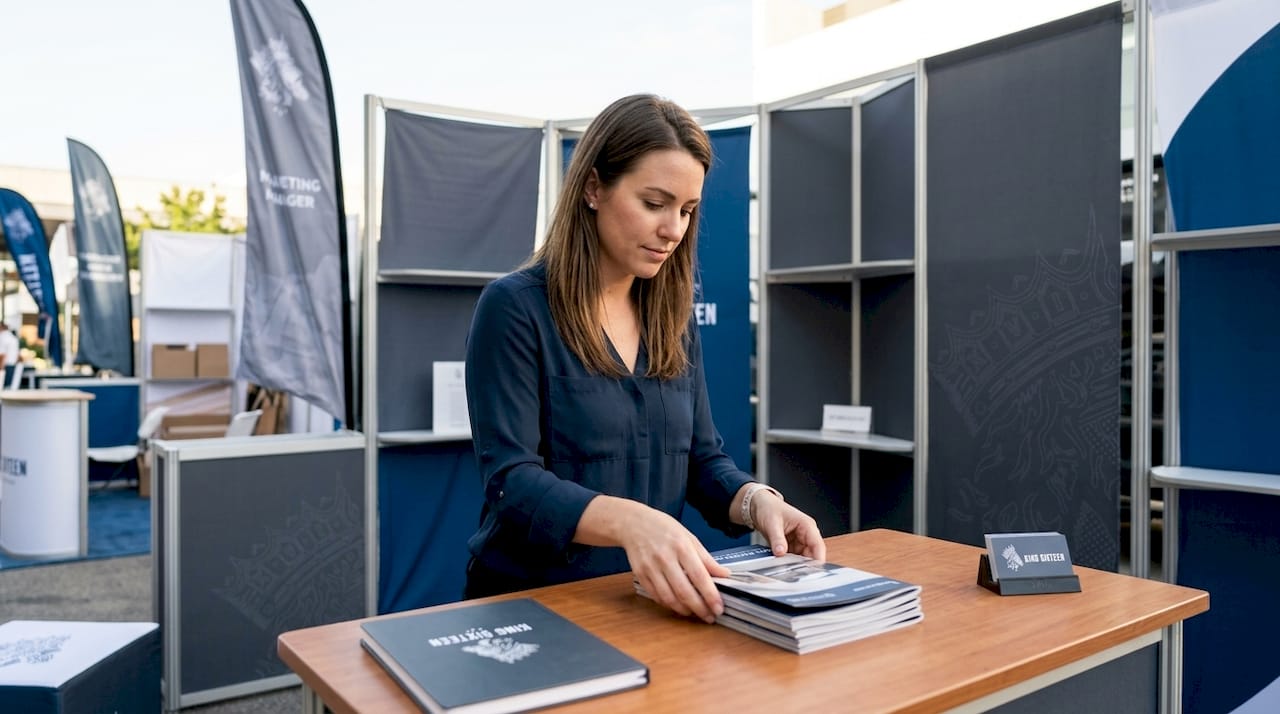
The three most common contexts are trade show booths and exhibits, retail point-of-purchase (POP) and point-of-sale (POS) displays, and experiential or event installations. Trade show builds tend to be larger, more architectural, and engineered for repeated setup and teardown. Retail displays are designed for high-volume production, planogram compliance, and product visibility at shelf. Experiential installations are one-of-a-kind environments built to create a specific emotional and sensory reaction.
Common materials and their real trade-offs
Material selection determines everything from unit cost to campaign longevity. Here's how the main options stack up:
- Corrugated cardboard: The most accessible entry point. Units cost $3–$15 with minimum order quantities starting at 500 and total production timelines as short as 10–15 days. Best for short-term promotions and seasonal campaigns.
- Acrylic: Premium appearance, strong product visibility, and real durability. Pricing ranges from $15–$120 per unit with MOQs as low as 50 units. Production runs 15–20 days, plus ocean freight time if sourced internationally.
- Metal and wood: Used in permanent or semi-permanent retail fixtures and trade show builds requiring structural integrity and a high-end feel. Higher upfront cost, but longevity justifies the spend for brands running multiple shows per year.
- Silicone Edge Graphics (SEG) fabric: Increasingly popular for trade show and event backdrops. Dye sublimation printing produces vibrant, durable color embedded directly into the fabric, and graphics can be updated without replacing the entire frame structure.
| Material | Cost Range (per unit) | Typical Lifespan | Best For |
|---|---|---|---|
| Corrugated | $3–$15 | 1–3 months | Short-term retail promos |
| Acrylic | $15–$120 | 1–3 years | Ongoing POP, cosmetics, CPG |
| Metal/Wood | Varies widely | 3–10+ years | Permanent fixtures, trade shows |
| SEG Fabric | Varies by sq ft | 2–5 years | Backdrops, events, trade shows |
Selecting the right format is not just about aesthetics. Think about how many times the display will be used, how far it will ship, and who will set it up. A stunning acrylic tower that requires specialized assembly is a liability at a regional road show. A corrugated counter display that collapses after two weeks costs more than it saves.
The build process from concept to installation
The most expensive mistake in custom marketing display builds is treating fabrication like a purchase order rather than a production process. Successful exhibit fabrication moves through distinct phases, and skipping any of them introduces real risk.
-
Discovery and brief development. Before a single design is sketched, you need clarity on campaign goals, the environment the display will live in, your audience's behavior in that space, and the logistical constraints (shipping, storage, setup crew). A well-written brief saves weeks of revision later.
-
Concept design and rendering. This is where creative and structural thinking happen simultaneously. Good designers are also thinking about load-bearing requirements, component breakdown, and how the display photographs while they work on visual impact. Expect multiple rounds of feedback here.
-
Engineering and structural planning. Once a concept is approved, engineers develop detailed plans that account for material tolerances, weight distribution, and hardware. High-stakes fabrication requires design, engineering, and build teams working in close coordination to catch problems before materials are cut.
-
Fabrication and quality control. This is where in-house capability makes a measurable difference. Vendors who handle fabrication under one roof can iterate quickly, catch defects early, and meet tighter deadlines. Shops that outsource fabrication add time and communication risk.
-
Transit packaging design. Transit packing is as critical as the display itself. Corner protection, custom foam inserts, robust cartons, and palletization are not optional considerations. A display that arrives damaged destroys the entire investment.
-
Installation, on-site adjustments, and dismantle. Even the best-engineered display needs a competent installation team. Build in time for on-site adjustments. Plan dismantle logistics with the same care as setup.
Pro Tip: Request a full physical sample or prototype before approving mass production. A 3D rendering shows you form. A physical prototype shows you whether the assembly experience is reasonable for the people who will actually set it up.
Custom vs. modular vs. rental: making the right call
Not every situation calls for a fully custom build. The question isn't whether custom is better in theory. It's whether it's right for your specific program.
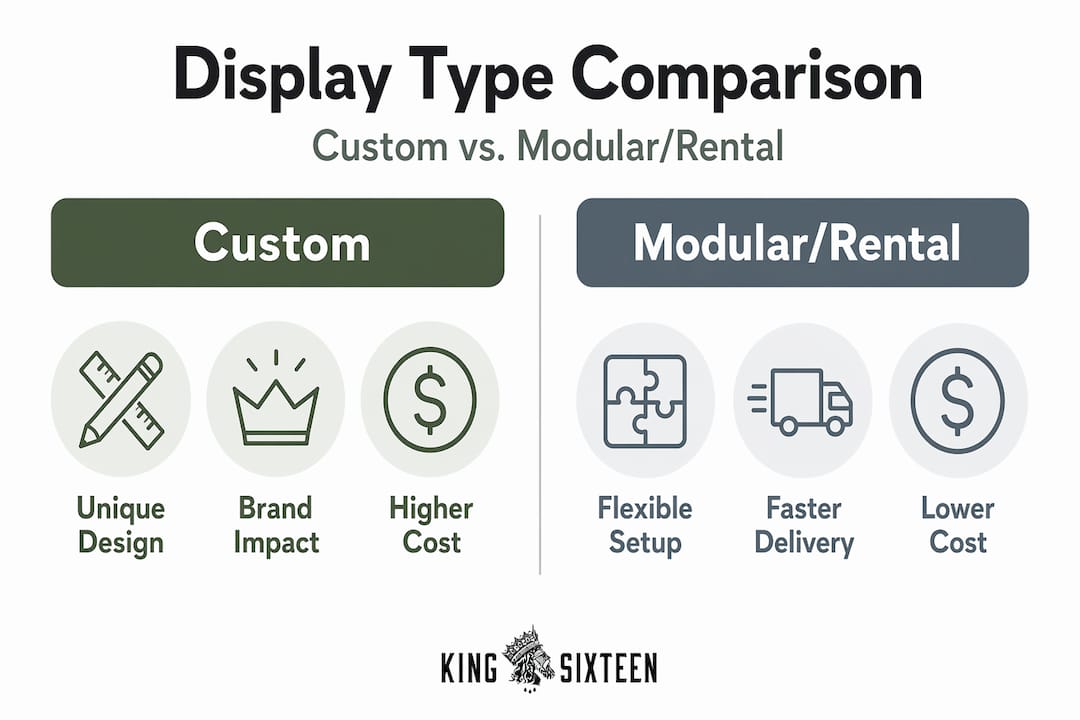
Custom displays deliver superior brand control, structural durability, and the kind of visual authority that modular systems simply cannot replicate. They are the right answer for brands with stable programs, frequent show schedules, or permanent retail environments where consistency and quality directly affect how customers perceive the product.
Modular and rental displays make sense in different scenarios:
- Testing new markets. Before committing fabrication budget to a format or geographic region, modular rental lets you gauge performance without long-term risk.
- Seasonal or one-time events. If a display will be used once and retired, a custom build rarely pencils out financially.
- Supplementing primary custom builds. Many brands use a custom hero display at their primary booth and rent supplemental structures for ancillary activations around the same event.
The trade-off worth understanding is this: modular systems give you flexibility but take away exclusivity. Your booth can look like your competitors' booth. Custom builds are purpose-built for your brand, your campaign, and your audience. When luxury brand presence is part of what you're selling, a modular rental sends the wrong signal.
Understanding MOQ tiers is also critical here. Brands sometimes choose a more expensive material per unit because their volume is too low to hit minimum orders at the lower price point. Always model your actual program volume before locking in a material decision.
Best practices for maximizing display impact
Getting a display fabricated is only half the challenge. How you design, specify, and manage it determines whether it earns its cost.
-
Integrate lighting from the start, not as an add-on. Acrylic displays with integrated LED options, including edge-lit and backlit configurations, draw attention in crowded retail and event environments in ways that static displays cannot. Specify lighting in the initial design so it's built into the structure, not taped on later.
-
Design for the assembly experience. Strong structural design accounts for correct shelf spans, load planning, and clear assembly instructions. A display that takes 45 minutes to set up in a retail stockroom will be set up incorrectly or not at all. Simplicity in assembly is a competitive advantage.
-
Build interactivity with purpose. QR codes, NFC touchpoints, digital screens, and product demonstration areas all extend the display's function beyond visual impact. The best interactive marketing setups are ones where the interaction serves the customer's curiosity, not just the brand's desire to look tech-forward.
-
Use environment data to inform placement and design. Shopper traffic patterns, dwell time research, and planogram guidelines are all inputs that should shape how a retail display is sized, positioned, and oriented. A display designed in isolation from how people actually move through the space will underperform.
-
Think about sustainability as a design constraint. Modular components that can be updated rather than replaced, recyclable materials, and reduced packaging waste are not just good for the environment. They reduce program costs over time and align with the values of an increasing number of purchasing decision-makers.
Pro Tip: If your display will travel to multiple events, invest in a logistics and storage protocol at the same time you invest in fabrication. Knowing exactly how each piece packs, labels, and stores will save you thousands in replacement and repair costs over a multi-show season.
Tying event brand identity back to the physical display environment is where most programs leave measurable impact on the table. The display should not be a standalone asset. It should feel like a physical extension of every other brand touchpoint.
My honest take on custom display investment
I've seen brands spend significant money on custom display builds and walk away underwhelmed, and in most of those cases the problem wasn't the build. It was the brief. The display was technically excellent but strategically disconnected from what the brand actually needed to communicate in that specific space, to that specific audience, at that specific moment.
What I've learned is that the brands who get the most out of custom builds treat the display as a strategic asset from day one, not a production task. They come to the table with clear answers to hard questions: What behavior do we want this display to drive? What does success look like on day one versus month six? Who is actually setting this up and does that person have the tools and instructions they need?
The ROI argument for custom over generic gets stronger the more often you use the display. A well-built custom exhibit that runs for three trade shows per year pays back its premium within a season, especially when you factor in the brand perception gap between a purposefully designed environment and a generic pop-up. The brands I admire most in this space treat fabrication the same way they treat media spend: with clear objectives, measurement criteria, and a bias toward quality over shortcuts.
My one contrarian point is this: don't overcomplicate interactivity. I've seen displays with elaborate digital integrations that no one used because the interaction required too much effort from the audience. The best displays are often ones that do one or two things exceptionally well, not ten things adequately.
— Tyler
How Kingsixteen builds displays that make brands felt
At Kingsixteen, custom fabrication is not a line item we hand off. It's a core part of how we build immersive brand experiences that move people and drive measurable outcomes. We work with brands like Porsche, Audi, and Ray-Ban precisely because they understand that the physical environment is a brand statement, and that statement needs to be right the first time.
We handle the full scope: concept and design, structural engineering, fabrication, logistics, installation, and on-site execution. If your current program relies on a patchwork of vendors with no single point of accountability, you already know how much time and money that costs. Our trade show and event services are built around a turnkey model that replaces that friction with clarity, speed, and standards your brand can trust. Talk to us about what you're building next.
FAQ
What are the main types of custom marketing display builds?
The three primary categories are trade show exhibits, retail POP and POS displays, and experiential event installations. Each serves a different function and is built from different materials based on lifespan, environment, and campaign goals.
How long does it take to fabricate a custom display?
Lead times vary by material. Corrugated displays can be completed in 10–15 days total, while acrylic builds typically require 15–20 days of fabrication plus additional time for shipping if sourced internationally.
When does a custom build make more sense than a rental or modular display?
Custom builds are worth the investment for brands with stable, recurring programs, frequent trade show schedules, or permanent retail environments. Custom displays deliver better brand control and durability compared to rental or modular options, which are better suited for one-time or test-market situations.
How do I protect my display investment during shipping?
Transit packaging is a design problem, not a logistics afterthought. Specify corner protection, custom foam inserts, and reinforced cartons during the fabrication phase. Proper palletization and packaging are just as critical to program success as the display itself.
Can custom displays include digital and interactive elements?
Yes. Options include integrated LED lighting, UV-printed and backlit acrylic panels, digital screens, QR codes, and NFC touchpoints. The key is specifying these elements during initial design so they are structurally integrated rather than added after fabrication.