An event production workflow is the master coordination system that connects every phase of your event, from the first planning meeting to the post-event debrief, ensuring every team member, vendor, and deliverable moves in the right direction at the right time. Without a defined workflow, even well-funded events collapse under the weight of miscommunication, missed cues, and reactive decision-making. The most effective live event production workflows integrate a run of show document, a risk management plan, and a clear command structure into a single operating system. This guide breaks down each phase, the tools that hold them together, and the discipline required to execute without margin for error.
What are the essential phases of an event production workflow?
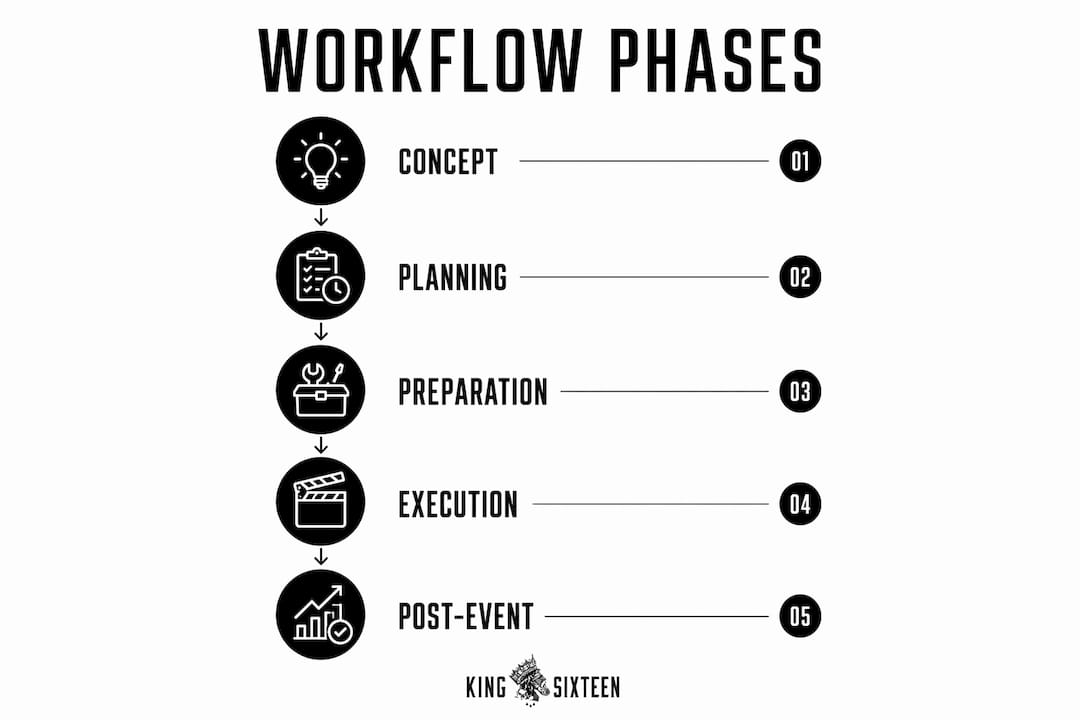
The event production workflow follows five core phases: Concept, Planning, Preparation, Execution, and Post-Event. Each phase has distinct deliverables, and the output of one feeds directly into the next. Skipping or compressing any phase is the fastest path to an event that looks improvised.
Here is the step-by-step breakdown every production team should follow:
- Concept phase — Define the event's purpose, audience, format, and success metrics. Align stakeholders on goals before any budget is committed.
- Planning phase — Build the master production schedule, confirm the venue, lock in key vendors, and draft the initial run of show. Assign department leads and establish communication channels.
- Preparation phase — Finalize all logistics, complete technical rehearsals, and distribute role-specific briefing documents. Conduct vendor confirmation checkpoints at 14 days and 48 hours prior to the event.
- Execution phase — Activate the run of show as the live command document. A single show caller coordinates all departments in real time, calling cues and managing changes through a headset communication loop.
- Post-event phase — Complete a structured debrief within 48 hours. A post-event debrief covers attendance, NPS, budget variance, vendor performance, and a start/stop/continue analysis to prevent relearning lessons the hard way.
The table below shows how each phase differs in focus, typical duration, and primary output.
| Phase | Focus | Typical Duration | Primary Output |
|---|---|---|---|
| Concept | Strategy and alignment | 1 to 4 weeks | Event brief and success metrics |
| Planning | Structure and logistics | 4 to 12 weeks | Master schedule, vendor contracts, initial run of show |
| Preparation | Rehearsal and confirmation | 2 to 4 weeks | Final run of show, briefing documents, risk register |
| Execution | Live coordination | Event day(s) | Delivered event, real-time change log |
| Post-Event | Review and improvement | 48 to 72 hours | Debrief report, vendor scorecards, action items |
The phases interlink through shared documents and communication protocols. A change made in the planning phase, such as a venue shift, must cascade through the risk register, the run of show, and every vendor contract simultaneously. Teams that treat these documents as separate files instead of a connected system are the ones who discover conflicts on event day.
How to build a run of show as your production control center
A run of show is not a schedule. It is the source of truth on event day, assigning clear ownership to every segment, flagging dependencies between departments, and mapping communication so nothing falls through the gaps. The distinction matters because a schedule tells you when. A run of show tells you who does what, in what order, and what breaks if they don't.
The core components of a production-grade run of show include:
| Component | Function |
|---|---|
| Timeline | Minute-by-minute sequence of all segments and cues |
| Ownership column | Named individual responsible for each segment |
| Dependencies | Flags which segments cannot start until a prior action is complete |
| Status column | Live tracking of confirmed, in-progress, and completed items |
| Communication mapping | Specifies which department head receives each cue call |
One of the most overlooked elements is buffer time. Scheduled buffer time of 15 minutes after rehearsal or 10 minutes after panels is not padding. It is insurance against the small delays that cascade into major disruptions when no slack exists in the timeline. A 5-minute AV check that runs long becomes a 25-minute problem if the next three segments have no buffer.
Role-filtered views are equally important for large productions. Your lighting director does not need to see catering cues, and your stage manager does not need to track sponsor activations. Distributing a single unfiltered document to 15 people creates noise and increases the chance that someone misses their actual cue.
Pro Tip: Lock the run of show to a single editor 24 hours before the event. All change requests must route through the lead producer for approval before any edit is made. This prevents the version-control chaos that comes from multiple people updating the same document in real time.
Treating the run of show as a live coordination system rather than static paperwork is the single biggest behavioral shift that separates professional productions from amateur ones. Tools like Airtable, Notion, or dedicated event management platforms allow real-time edits with version history, so every change is traceable and reversible.
What risk management strategies integrate best with your production workflow?
Risk management and contingency planning are not the same thing. A contingency plan is reactive. A risk management plan is an ongoing operational playbook that uses likelihood-impact matrices to prioritize threats and assigns named response owners before the event begins. The difference is the difference between scrambling and executing.
Build your risk register during the planning phase and update it at four critical milestones: three months out, one month out, one week out, and day-of. Each update should reflect new vendor confirmations, venue walkthroughs, and any changes to the production scope. Vendor confirmation checkpoints at 14 days and 48 hours prior are non-negotiable for high-stakes productions.
Common risk categories every event team should address include:
- Vendor failure — Identify backup suppliers for AV, catering, and transportation. Confirm contracts include cancellation and substitution clauses.
- Weather and venue — For outdoor or hybrid events, define the trigger conditions that activate your indoor contingency plan and the decision deadline for making that call.
- Budget overrun — Assign a budget owner with authority to approve unplanned spend up to a defined threshold without requiring full stakeholder sign-off.
- Health and safety — Confirm medical coverage, emergency exit protocols, and crowd management procedures with venue staff at least one week out.
- Technology failure — Maintain backup devices, offline copies of all key documents, and a secondary communication channel if primary headsets fail.
Pro Tip: Schedule a 20-minute risk review at each planning milestone with department leads present. Use a simple red/amber/green status system for each risk category. This keeps the register active rather than a document that gets filed and forgotten.
Platforms like Abastio centralize budgets, vendor data, and event specifications so your mitigation plans connect to real operational data rather than assumptions. Accessible risk plans that live alongside your run of show, rather than in a separate folder, are the ones that actually get used under pressure.
How to coordinate live event execution within your production workflow
Live event execution is where your workflow either holds or breaks. The coordination model that works at scale, from a 200-person corporate summit to a 20,000-person concert, relies on a single headset-based command role. At major productions, the production manager maintains a continuous communication loop with all department heads, while the stage manager coordinates artist or speaker movements and timing. Every cue call flows through one voice.
This command structure prevents the most common live-event failure mode: two department heads making conflicting decisions simultaneously because no one has clear authority. When lighting, audio, and video each receive cues from different sources, transitions fall apart. One caller, one loop, one source of truth.
Clear role separation across producer, stage manager, AV lead, and department coordinators prevents task overlap and ensures every person on the floor knows exactly who to report to when something changes. For event staffing, this means briefing every team member on their specific role, their escalation contact, and the communication channel they are responsible for monitoring.
Predefined responses to common live-event issues are what separate reactive teams from resilient ones:
- Speaker no-show or delay — Activate the designated MC holding script and notify the show caller immediately. Do not announce the delay until a revised timeline is confirmed.
- AV failure mid-segment — The AV lead calls the issue to the show caller, who pauses the program with a pre-scripted audience hold. The backup system activates within 90 seconds.
- Crowd flow bottleneck — The floor coordinator radios the venue operations lead, who redirects staff to secondary entry points. The show caller holds the next segment start by the buffer time already built into the run of show.
- Unplanned schedule change — All changes route through multi-stage approval before the run of show is updated. The show caller announces the revised cue only after confirmation from the lead producer.
Real-time tracking tools, whether a shared Airtable view, a production app, or a physical status board visible to department leads, give your command team situational awareness without requiring constant radio check-ins. The goal is proactive visibility, not reactive firefighting.
Key takeaways
A disciplined event production workflow, anchored by a dynamic run of show, a live risk register, and a single command voice, is the defining factor between events that deliver and events that disappoint.
| Point | Details |
|---|---|
| Five-phase structure | Map your workflow across Concept, Planning, Preparation, Execution, and Post-Event for full lifecycle control. |
| Run of show as command center | Assign ownership, dependencies, and buffer time to every segment, and lock edits to a single lead 24 hours out. |
| Risk register with milestones | Update your risk plan at four checkpoints and assign named response owners to every risk category. |
| Single command voice | Route all live cues and changes through one show caller to prevent conflicting decisions during execution. |
| Post-event debrief within 48 hours | Capture attendance, NPS, budget variance, and vendor performance before institutional memory fades. |
What I've learned about workflow discipline after years on the floor
The most common mistake I see from experienced teams is treating the run of show as a planning artifact rather than a live operating system. They build a beautiful document in the weeks before the event, then abandon it the moment something changes on the floor. Someone updates their own copy. Someone else makes a verbal agreement with a vendor. By the time the show caller calls the first cue, three versions of the truth are circulating.
The fix is not better software. It is a cultural shift toward workflow discipline. That means a single editor, a defined approval path for every change, and a pre-event briefing that explicitly tells every department lead: if it is not in the run of show, it does not happen. That sounds rigid, but it is actually what creates the freedom to adapt. When your baseline is locked and trusted, deviations are visible and manageable. When your baseline is fluid, every deviation is invisible until it becomes a crisis.
The other thing I push hard on is the debrief. Most teams do a 30-minute verbal recap and call it done. The teams that consistently improve are the ones who complete a structured written debrief within 48 hours, while the details are still sharp. Attendance numbers, budget variance, vendor performance scores, and a clear start/stop/continue list. That document becomes the foundation for the next event's planning phase, and it is the fastest way to build institutional knowledge that does not walk out the door when a team member leaves.
Balancing detailed planning with adaptability is not a contradiction. It is the whole point. The more precisely you plan, the more confidently you can improvise when the unexpected arrives.
— Tyler
How King Sixteen supports your event production from concept to execution
King Sixteen builds and executes the kind of events where nothing is left to chance. From the initial concept through live execution, our team manages every layer of the production workflow, including run of show development, vendor coordination, AV and staging, risk planning, and on-site command. We have produced events for Porsche, Audi, Ray-Ban, and Churchill Downs, and we bring that same level of operational discipline to every project we take on.
If you are responsible for a high-stakes event and need a production partner who treats your brand with the same precision you do, explore our experiential marketing services or get in touch to talk through your next production. We handle the complexity so you can focus on the outcome.
FAQ
What is an event production workflow?
An event production workflow is the structured coordination system that organizes every phase of an event, from concept and planning through live execution and post-event review. It connects the run of show, risk management plan, team roles, and communication protocols into a single operating framework.
What should a run of show include?
A run of show should include a minute-by-minute timeline, named ownership for each segment, dependency flags, a live status column, and communication mapping for each department. Buffer time of 10 to 15 minutes between major segments prevents small delays from cascading.
How do you manage risk in a live event production workflow?
Build a risk register during the planning phase and update it at four milestones: three months, one month, one week, and day-of. Assign a named response owner to each risk category and confirm vendor backup options at least 14 days before the event.
Who is responsible for calling cues during live event execution?
A single show caller, typically the production manager or stage manager, is responsible for calling all cues through a headset communication loop with all department heads. Routing cue calls through one voice prevents conflicting decisions and keeps transitions clean.
When should a post-event debrief happen?
A post-event debrief should be completed within 48 hours of the event closing. It should cover attendance, NPS scores, budget variance, vendor performance, and a start/stop/continue analysis to capture lessons while they are still fresh.