Event space branding is defined as the strategic integration of visual identity, environmental design, and spatial planning to create a cohesive brand experience that attendees feel from the moment they arrive. It goes well beyond hanging a logo on a wall. When you know how to brand event spaces effectively, every surface, sign, and lighting choice communicates your brand's personality and builds recognition. This guide covers the core components, from typography and color systems to wayfinding and post-event analysis, giving marketing professionals and event planners a practical framework to execute with confidence.
How to brand event spaces: the essential elements
Effective event branding integrates visual identity elements, textual elements, and event-planning elements to create cohesive brand messaging before, during, and after the event. Think of these components as the building blocks of your brand's physical presence. Get them right and the space tells your story without a single word of explanation.
The core visual and textual elements you need to define before any production begins:
- Logo placement: Your logo should appear at entry points, stage backdrops, and key photo moments. Avoid overuse. Saturation dilutes impact.
- Color palette: Select two to three primary brand colors and apply them consistently across printed materials, digital displays, and lighting. Color is one of the fastest ways to cue brand recognition.
- Typography: Limit your type system to three typefaces maximum. Shopify's 2025 guidance specifically recommends this to avoid visual confusion across marketing materials.
- Marketing copy and hashtags: Every headline, caption, and on-site phrase should reinforce your brand voice. A single event hashtag, used consistently on signage and digital screens, extends your brand reach beyond the room.
- Signage types: Entry arches, pull-up banners, directional signs, and digital displays each serve a distinct role. Platforms like Eventbrite and Whova support digital ticketing and app-based wayfinding that extend your signage system into attendees' phones.
Pro Tip: Build a one-page brand brief before production starts. It should include your approved colors, fonts, logo files, and approved copy phrases. Share it with every vendor. This single document prevents the most common branding breakdowns.
How to design a visually cohesive branded environment
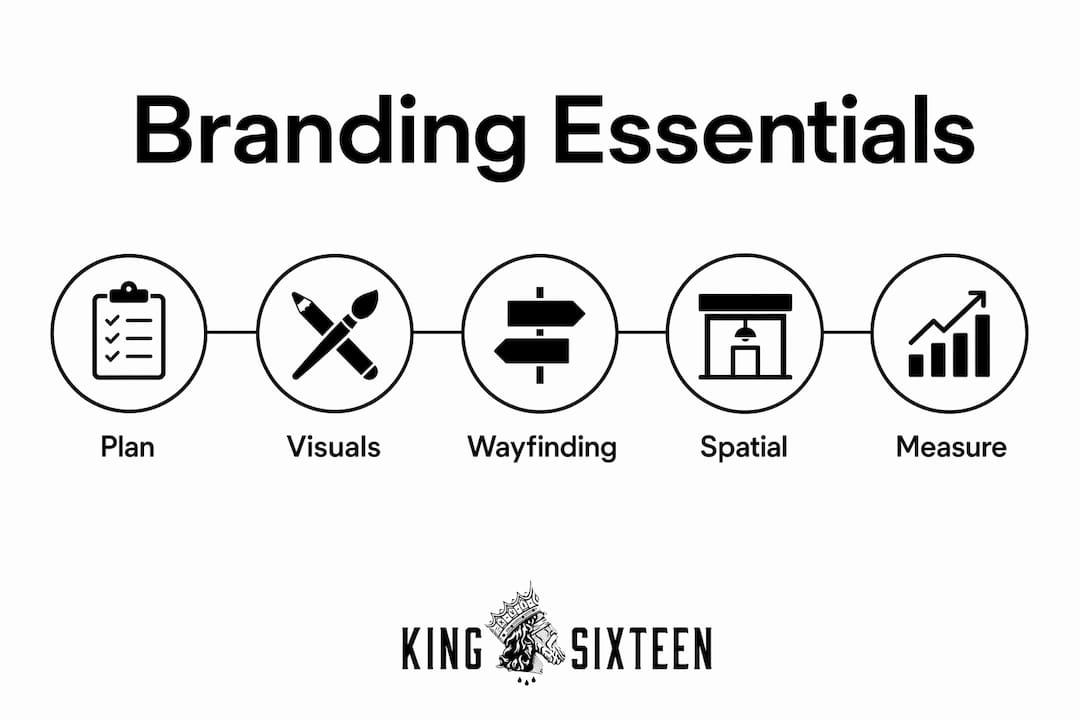
Branding event spaces is more than decoration. It is about inducing emotional and cognitive experiences that resonate with attendees long after they leave. The physical environment is your most powerful medium, and every design decision either reinforces or undermines the brand story you are trying to tell.
Here is a practical sequence for designing a cohesive branded environment:
- Align lighting with brand tone. Color-washed event lighting transforms a neutral venue into a branded space in minutes. A tech brand might use cool blue washes; a luxury product launch might favor warm amber. The color temperature you choose sets the emotional register for everything else.
- Select branded furniture intentionally. Lounge seating, bar counters, and breakout room furniture should match your brand's aesthetic. A mismatched chair in a VIP lounge breaks the visual system you have built everywhere else.
- Use LED walls and digital backgrounds for dynamic content. Static backdrops are a missed opportunity. LED walls allow you to cycle branded content, product visuals, and live social feeds, keeping the environment active and on-brand throughout the event.
- Extend branding beyond the stage. Registration desks, hallways, lounges, and restroom corridors are all brand touchpoints. Most planners focus 80% of their branding budget on the main stage and ignore the spaces where attendees spend significant time.
- Design for post-event content. A well-designed branded environment supports lasting brand perception and improves the quality of livestream and post-event marketing content. Every photo and video clip captured at the event becomes a brand asset.
"The best branded environments don't announce themselves. Attendees absorb the brand through the sum of every detail, not through any single element." — Moonlight Studios, Chicago
This principle is why modular stage setups matter. A modular system lets you reconfigure the physical space for different sessions or formats while keeping the visual identity intact. Consistency across configurations is what separates a polished production from a patchwork one.
What makes wayfinding a branding opportunity?
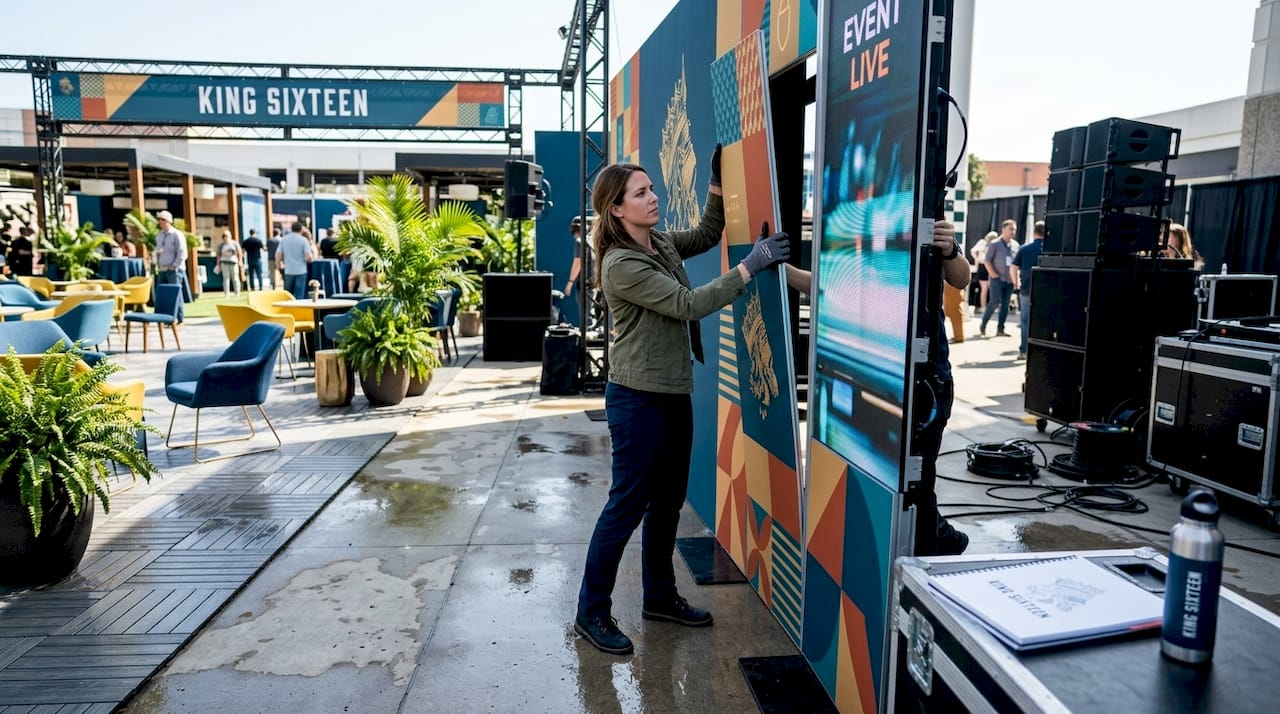
Wayfinding is both a functional necessity and a brand experience opportunity, starting the attendee journey with clarity and emotional engagement. Most planners treat signage as a logistical afterthought. The brands that get it right treat every directional sign as a brand touchpoint.
| Signage type | Primary function | Branding opportunity |
|---|---|---|
| Entry arch or gateway | First impression, crowd flow | Logo, brand color, emotional welcome |
| Directional banners | Navigation between zones | Consistent typography, brand voice in copy |
| Digital display kiosks | Real-time information | Dynamic branded content, social feeds |
| ADA-compliant floor signs | Accessibility and safety | Brand color integration without clutter |
| Sponsor integration panels | Revenue and partnership | Curated placement that avoids visual noise |
The Richland Chamber recommends conducting a sightline inventory to identify the best visibility points and placing signage at key decision nodes. A decision node is any point where an attendee must choose a direction: a hallway junction, an elevator bank, a registration queue. These are the highest-value locations for signage, and they are rarely the cheapest print locations.
Typography and color contrast matter here as much as they do in your brand guidelines. Pointmedia advises using sans-serif fonts with strong spacing for legibility, and testing signage before installation to confirm readability at distance. Your brand colors should maintain sufficient contrast to support accessibility without overpowering the navigational message.
Creating a "signage family" solves the consistency problem at scale. A signage family is a set of templates with consistent typography, spacing, and visual language that applies across every sign type in your event. According to digitalart.biz, treating venue branding as a modular system with these assets prevents a disconnected feel and simplifies production across multiple events or event formats.
Pro Tip: Map your venue floor plan and mark every decision node before you order a single sign. Place your highest-impact signage at those nodes first, then fill in secondary locations with remaining budget. This approach maximizes brand recall per dollar spent.
How spatial planning amplifies your brand message
Integrating planning and structure with branding ensures the event environment communicates a consistent message, improving attendee understanding and engagement. The layout of your space is not a neutral backdrop. It is an active part of your brand communication.
Spatial organization decisions that directly affect brand impact:
- Booth and activation placement: Position high-visibility brand activations along the primary attendee flow path. Attendees who pass your most immersive brand moment early in the event carry that impression through every subsequent interaction.
- Stage and seating configuration: The relationship between stage and audience affects perceived brand authority. A raised stage with branded LED backdrop signals a premium, high-production brand. Flat floor configurations with circular seating signal community and collaboration.
- Flexible venue features: Tagvenue notes that showcasing layout flexibility and AV technology boosts event space appeal to different planner segments. Venues that adapt to diverse formats give brands more tools to shape the attendee experience.
- Crowd flow and dwell time: Design your floor plan to slow attendees down in brand-rich zones and move them efficiently through logistical areas. Dwell time in a branded lounge or activation space increases brand exposure without requiring additional spend.
- Event planning software: Tools like Cvent, Bizzabo, and Social Tables help coordinate brand assets, floor plans, and logistics in one system. When your spatial plan and your brand assets live in the same workflow, execution gaps shrink significantly.
Post-event surveys are the mechanism that closes the loop between spatial planning and brand effectiveness. Gather attendee feedback on which areas felt most engaging, which felt confusing, and which brand moments stood out. That data directly informs your next floor plan.
How to measure whether your event branding actually worked
Post-event surveys should be focused on clear objectives, with minimal questions to maximize response rates and generate insights about branding effectiveness. Measurement is where most event branding programs fall short. You cannot improve what you do not track.
A practical measurement sequence:
- Set branding-specific survey objectives before the event. Define what success looks like. Is it brand recall? Emotional connection? Sponsor visibility? Your survey questions must map directly to these goals.
- Keep surveys short and focused. Spotler recommends linking every question to the event's main objectives. A five-question survey with one open-ended prompt consistently outperforms a twenty-question form in response rate and data quality.
- Use Net Promoter Score as a baseline. NPS gives you a single, comparable number across events. A rising NPS over multiple events signals that your branding and experience improvements are working.
- Analyze qualitative feedback for specific brand moments. Open-ended responses reveal which physical elements attendees noticed and remembered. If three respondents independently mention the entry arch, that element is earning its budget. If no one mentions your LED wall, reconsider the investment.
- Feed findings back into your brand brief. Survey data should update your brand brief for the next event. This creates a feedback loop where each event builds on the last, and your event brand identity compounds in strength over time.
Platforms like SurveyMonkey, Typeform, and Qualtrics all integrate with major event management systems, making post-event data collection a standard part of your production workflow rather than an afterthought.
Key takeaways
Effective event space branding requires a unified system of visual identity, environmental design, wayfinding, and spatial planning, measured and refined through attendee feedback after every event.
| Point | Details |
|---|---|
| Build a brand brief first | Document approved colors, fonts, logo files, and copy phrases before any vendor engagement. |
| Extend branding beyond the stage | Apply visual identity to lounges, hallways, and registration areas, not just the main stage. |
| Treat wayfinding as a brand touchpoint | Place signage at decision nodes using a consistent signage family for maximum recall. |
| Align spatial layout with brand goals | Use floor plan design to increase dwell time in brand-rich zones and guide attendee flow. |
| Measure with focused post-event surveys | Use NPS and qualitative feedback tied to branding objectives to improve each successive event. |
What I've learned from branding spaces that actually stick
The biggest mistake I see teams make is treating event branding as a production task rather than a strategic one. They hand a logo file to a fabricator and call it done. The result is a space that looks branded but doesn't feel like anything in particular.
The events that leave a lasting impression are the ones where the branding decisions were made before the venue was booked. Color palette, spatial flow, signage placement, and lighting tone were all defined at the strategy stage, not improvised on-site. That sequence matters more than budget.
I've also seen teams underestimate the power of the environmental branding in transitional spaces. The hallway between sessions, the line at registration, the path to the restroom. These moments are uncontested. No one is competing for attendee attention in a corridor. A well-placed, well-designed sign in that space lands harder than a crowded main stage backdrop.
The other lesson is that collaboration between branding, design, and event operations teams is not optional. When those three functions work in silos, you get a beautiful brand brief that never makes it to the floor, or a perfectly executed floor plan that looks nothing like the brand. The best results come from a shared production document that every team works from simultaneously.
Iterate after every event. The brands that show up to their fifth event with the same branding system they used at their first are leaving recognition equity on the table. Attendee feedback is the most direct signal you have. Use it.
— Tyler
How King Sixteen transforms event spaces into brand experiences
If you are ready to move from brand guidelines to a fully realized event environment, King Sixteen builds the physical and experiential infrastructure that makes brands unforgettable. From custom fabrication and stage design to full venue transformation and staffing, the team handles every production layer so your brand shows up exactly as intended.
King Sixteen has executed immersive brand environments for Porsche, Audi, Ray-Ban, and Churchill Downs, among others. Whether you need a product launch that generates demand or a conference environment that communicates authority from the first step inside, the experiential marketing services at King Sixteen are built for brands that cannot afford to get it wrong. Explore what a fully branded event environment looks like when every detail is designed with intent.
FAQ
What does it mean to brand an event space?
Branding an event space means integrating visual identity elements, including logos, color palettes, typography, lighting, and signage, into the physical environment so attendees experience the brand throughout the event, not just at specific moments.
How many typefaces should you use in event branding?
Limit your event branding to three typefaces maximum. Shopify's 2025 guidance confirms that exceeding this number creates visual confusion across printed materials, digital displays, and signage.
Where should event wayfinding signage be placed?
Place wayfinding signage at decision nodes, the points where attendees must choose a direction, rather than at the cheapest print locations. A sightline inventory of the venue identifies these high-impact positions before production begins.
How do you measure event branding effectiveness?
Use post-event surveys tied to specific branding objectives, including Net Promoter Score and open-ended questions, to evaluate which brand elements attendees noticed and remembered. Keep surveys to five questions or fewer to maximize response rates and data quality.
What is a signage family in event branding?
A signage family is a set of templates with consistent typography, spacing, and visual language applied across every sign type at an event. It prevents brand fragmentation and simplifies production, especially across multiple events or venues.