Unforgettable events are defined by the emotional and sensory experiences they create, not by their size or budget. Analysis of over 6,500 events confirms that the most memorable gatherings share one trait: they foster genuine human connection through designed moments of interaction and discovery. Knowing how to create unforgettable events means understanding how memory actually works, then building your program around those principles. This guide gives event planners and brand managers a practical, evidence-based framework for designing experiences that audiences carry with them long after the lights go down.
What key emotional and sensory elements make events unforgettable?
Memory is not a recording device. The brain stores experiences selectively, and emotional tagging drives what gets saved. Moments that trigger surprise, pride, or curiosity become long-term memories. Moments that feel routine get discarded. This is the foundational principle behind every memorable event design decision you will make.
Multi-sensory engagement is the most reliable way to deepen that emotional tagging. Incorporating sight, sound, scent, and texture creates neurological imprints that visual-only experiences simply cannot match. A product launch that smells like the brand, sounds intentional, and offers something tactile to touch will outperform a visually polished event that engages only the eyes. Sensory layering is not a luxury. It is a memory strategy.

The peak-end rule adds another layer of precision to event design. Research shows the highest emotional moment and the final minutes of an event disproportionately shape how attendees remember the entire experience. A mediocre middle can be forgiven. A weak ending cannot. Design your closing sequence with the same care you give your opening.
Planned anomalies are one of the most underused tools in event planning. Human brains pause at unexpected elements like unusual textures, surprising scents, or dramatic changes in scale. That pause forces deeper cognitive processing, which strengthens memory encoding. A single well-placed surprise, a performer appearing from an unexpected location, a scent that shifts as guests move through a space, can anchor the entire event in attendee memory.
Key sensory and emotional levers to build into your event design:
- Surprise moments: Unannounced performances, unexpected gifts, or sudden environmental shifts
- Pride triggers: Public recognition, achievement moments, or exclusive access that makes attendees feel chosen
- Curiosity hooks: Teaser installations, mystery elements, or discovery-based navigation through the space
- Scent design: Signature fragrances tied to the brand or theme, deployed at entry and peak moments
- Sound architecture: Music that shifts tempo and mood to guide the emotional arc of the program
Pro Tip: Map your event's emotional arc before you finalize the run-of-show. Identify where energy will peak, where it will dip, and place your biggest sensory surprise within 15 minutes of the closing sequence.
How do you tailor event experiences to your specific audience?
Audience research is not optional. It is the foundation of every design decision that follows. Knowing your attendees' preferences, motivations, and cultural context determines which emotional triggers will land and which will fall flat. A product launch for Porsche buyers requires a completely different sensory vocabulary than a summit for nonprofit leaders, even if both events share the same venue.
Personalization starts before the event day. Sending personalized previews and visual agendas before the event primes attendees' brains for deeper engagement when they arrive. This is not just good hospitality. It is neuroscience. When attendees know what to expect at a high level, they arrive oriented and ready to engage rather than spending the first hour getting their bearings.
A practical audience-first planning sequence looks like this:
- Define your audience segments. Identify two or three distinct attendee profiles based on role, motivation, and familiarity with your brand.
- Map their emotional expectations. What do they want to feel at this event? Inspired? Exclusive? Part of a community? Let that answer drive your theme.
- Design touchpoints for each segment. VIP guests may need a private arrival experience. First-time attendees may need a guided discovery moment early in the program.
- Align your event identity with their world. Decor, language, music, and catering should all feel native to your audience, not generic.
- Build in participation opportunities. Audience engagement strategies that give attendees agency, such as interactive stations, live polls, or co-creation moments, increase both satisfaction and memory retention.
The goal is to make every attendee feel the event was designed specifically for them. That feeling of personal relevance is what separates a good event from one people talk about for years.
What are the practical steps to design and execute a memorable event?
Execution is where strategy either holds or falls apart. The following framework covers the full arc from conception to post-event, with the specific decisions that determine whether your event becomes a reference point or a footnote.
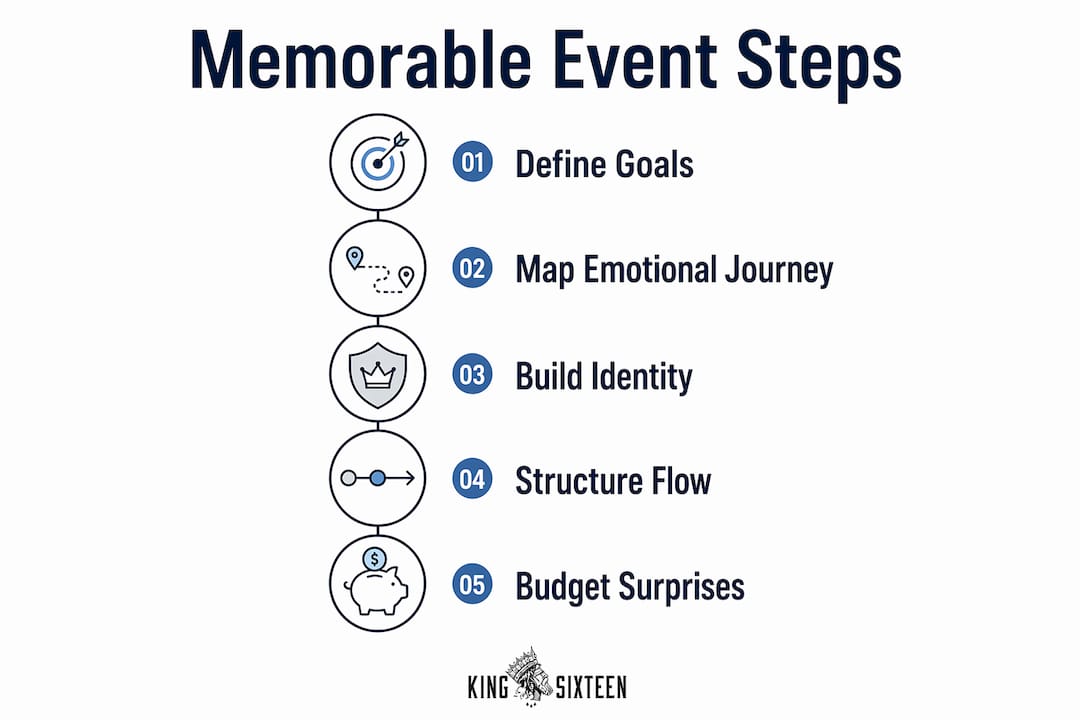
Define goals and map the emotional journey
Start with a clear, measurable outcome. "Create brand awareness" is not a goal. "Generate 500 qualified leads and a 40% increase in brand recall among attendees" is a goal. Once you have your outcome, map the emotional journey you want attendees to experience: anticipation before arrival, discovery in the first 20 minutes, immersion during the core program, and a peak moment near the close.
Build a cohesive event identity
Your theme, branding, decor, and communications should all speak the same visual and tonal language. Branding event spaces consistently across every touchpoint, from the invitation to the exit signage, reinforces the emotional narrative and makes the experience feel intentional rather than assembled. Inconsistency breaks immersion.
Structure the event flow deliberately
Arrival sets the tone. Discovery moments in the first 20 minutes determine whether attendees lean in or check out. Participation opportunities in the middle sustain energy. The finale must deliver the emotional peak. Interactive experiences shift attendees from passive watchers to active participants, which is the single most reliable driver of deep memory formation.
Budget for surprises
Reserve 10–15% of your total budget as a contingency for last-minute enhancements. This is not a safety net for mistakes. It is a deliberate fund for high-impact, low-cost surprises that rescue energy dips or amplify peak moments. A surprise performer, a personalized gift at the table, or an unexpected sensory shift can change the entire emotional trajectory of an event.
| Planning phase | Key action | Memorability impact |
|---|---|---|
| Pre-event | Send personalized previews and visual agendas | Primes attendee engagement before arrival |
| Arrival | Design a sensory-rich entry experience | Sets emotional tone and first impression |
| Core program | Build participation and discovery moments | Drives active engagement and memory encoding |
| Finale | Engineer a deliberate emotional peak | Shapes how the entire event is remembered |
| Post-event | Follow up with personalized content | Sustains connection and extends brand recall |
Pro Tip: The post-event phase is where most planners lose ground. A personalized follow-up message, a highlight reel, or an exclusive piece of content sent within 48 hours of the event keeps the emotional connection alive and reinforces memory.
How do innovative technologies and techniques amplify event impact?
Technology is a multiplier, not a replacement for good design. The most effective tools are those that deepen human connection rather than substitute for it. Used well, they extend the reach and emotional resonance of every moment you have designed.
- Interactive installations: Physical and digital installations that respond to attendee input create agency and curiosity. A touchscreen wall that builds a collective visual from attendee responses, or a fabricated environment that changes based on movement, turns passive guests into co-creators.
- Sound design: Ambient music is not background noise. A deliberate sound program that shifts tempo and mood at key moments in the run-of-show guides the emotional arc without a single word of instruction. Brands like Porsche and Audi use sound as a core brand asset. Your event should too.
- Augmented reality and thematic venue transformation: AR overlays and physical set transformations can transport attendees into a brand world that would be impossible to build at full scale. The key is integration. The technology must serve the story, not distract from it.
- Social sharing activations: Design at least one moment that attendees will want to photograph and share. A striking installation, a branded photo moment, or a visually unexpected environment extends your event's reach far beyond the room. Storytelling-driven brand moments that feel authentic generate organic sharing at a rate that paid media cannot replicate.
- Engagement data: Track participation rates, dwell time at activations, and social mentions in real time. This data tells you which moments are landing and which are losing the room, so you can adjust on the fly and refine your approach for future events.
The brands that consistently produce high-impact event experiences treat technology as one layer in a multi-sensory design system, not the centerpiece of it.
Key Takeaways
Unforgettable events require deliberate emotional design, multi-sensory engagement, and a closing sequence engineered to leave a lasting peak impression.
| Point | Details |
|---|---|
| Emotional tagging drives memory | Design moments that trigger surprise, pride, or curiosity to move experiences into long-term memory. |
| Multi-sensory design outperforms visual-only | Layer scent, sound, and texture alongside visuals to create deeper neurological imprints. |
| The finale shapes the whole event | Apply the peak-end rule and engineer a deliberate emotional high point near the close. |
| Audience research precedes all design | Know your attendees' motivations and cultural context before committing to a theme or format. |
| Budget 10–15% for surprises | Reserve a contingency fund for high-impact, low-cost moments that rescue energy dips or amplify peaks. |
What I've learned from designing events that people actually remember
Most event planners spend 80% of their energy on logistics and 20% on experience design. The ratio should be closer to the reverse. Logistics are the floor. Experience design is the ceiling. And the ceiling is what people remember.
The shift that changed how I think about events came from asking one question differently. Instead of "what will they watch?" I started asking "what will they do?" That reframe, moving attendees from audience to protagonist, changes every downstream decision. It changes the floor plan, the run-of-show, the catering format, and the technology choices. Participation and agency are not nice-to-haves. They are the mechanism through which memories form.
The other lesson I keep coming back to is that budget constraints are rarely the real problem. The real problem is creative timidity. Some of the most memorable moments I have seen at events cost almost nothing. A handwritten note at a seat. A performer who appears from inside the crowd. A scent that changes as guests move from one room to the next. These moments work because they are unexpected, not because they are expensive.
The planners who consistently produce events people talk about share one habit: they map the emotional arc first and fill in the logistics second. Start there, and the rest of the plan becomes much easier to build.
— Tyler
How Kingsixteen designs events that audiences never forget
Kingsixteen builds experiential marketing campaigns and live events for brands that need more than a well-run program. They need an experience that drives real outcomes: demand, data, and lasting brand recall. From product launches for Porsche and Audi to large-scale conference production and custom fabrication of brand environments, Kingsixteen handles every element of the experience under one roof.
If you are planning a product launch, brand activation, or private event and want it to land with the kind of impact that generates conversation long after the day itself, Kingsixteen brings the design thinking, production capability, and vendor network to make it happen. Reach out to discuss what your next event needs to become genuinely unforgettable.
FAQ
What makes an event truly unforgettable?
Unforgettable events create genuine human connection through designed moments of interaction, surprise, and emotional engagement. Analysis of over 6,500 events confirms that size and budget are far less important than deliberate experience design.
How does the peak-end rule apply to event planning?
The peak-end rule means that the highest emotional moment and the final minutes of your event shape how attendees remember the entire experience. Planners should engineer a deliberate emotional peak near the close rather than distributing energy evenly throughout the program.
How much budget should I reserve for surprises?
Reserve 10–15% of your total event budget as a contingency for last-minute, high-impact enhancements. These funds cover surprise entertainment, personalized guest touches, or sensory additions that rescue energy dips and amplify peak moments.
Why does multi-sensory design improve event memory?
Engaging sight, sound, scent, and texture together creates deeper neurological imprints than visual-only experiences. The brain encodes multi-sensory moments more strongly because each additional sense adds another retrieval pathway for the memory.
When should I start personalizing the attendee experience?
Personalization starts before the event day. Sending personalized previews and visual agendas primes attendees' brains for deeper engagement on arrival, so they spend less time orienting and more time participating from the moment they walk in.