Brands that rely on digital-only campaigns often believe they're winning the attention war. They're not. Brand recall reaches 65-80% at the 30-day mark for experiential events, compared to just 10-25% for digital-only campaigns. That gap isn't a minor edge, it's a fundamental difference in how people experience and remember a brand. This article breaks down exactly what an event environment is, how the best ones are built, what measurable impact they generate, and which strategies separate forgettable activations from ones that change how audiences feel about a brand permanently.
Table of Contents
- What is an event environment?
- Core mechanics of immersive environments
- The impact: Measurable results and crucial challenges
- Next-level strategies for luxury event environments
- What most event designers miss about immersive environments
- Bring your immersive event vision to life
- Frequently asked questions
Key Takeaways
| Point | Details |
|---|---|
| Immersive design matters | Engaging all senses and providing interactive brand spaces increases memorability and purchase intent. |
| Measure what counts | Event success goes beyond satisfaction—track engagement, shareability, and conversions for real ROI. |
| Personalization drives loyalty | Tailored experiences with site-specific and data-driven touches foster deeper brand relationships. |
| Plan emotional peaks | Intentionally design moments of joy and surprise to create lasting impressions and encourage repeat visits. |
What is an event environment?
Most marketing teams think about event environments as backdrop. Nice lighting, branded signage, maybe a photo opportunity. That framing misses the point entirely.
An event environment in experiential marketing is something more purposeful. As defined by leading practitioners, an event environment refers to the immersive physical and sensory space designed to engage attendees actively with the brand. It is not decor. It is a living, breathing extension of your brand strategy, built to generate emotion, behavior, and memory.
Here's what separates event environment design from traditional event planning:
- Traditional event planning focuses on logistics, timelines, vendor management, and basic guest experience. The space serves the event.
- Event environment design puts the brand narrative first. Every physical element, sensory cue, and attendee interaction is orchestrated to produce a specific feeling and response. The event serves the space.
For luxury and high-end brands, this distinction carries enormous weight. Your audience arrives with elevated expectations. They've experienced premium hotels, private clubs, and curated retail spaces. A generic activation won't register as sophisticated, it registers as careless.
Effective brand environment design for luxury brands requires a completely different toolbox:
- RFID-enabled personalized welcomes that greet guests by name or preference
- Site-specific builds that cannot be replicated or repurposed, creating genuine exclusivity
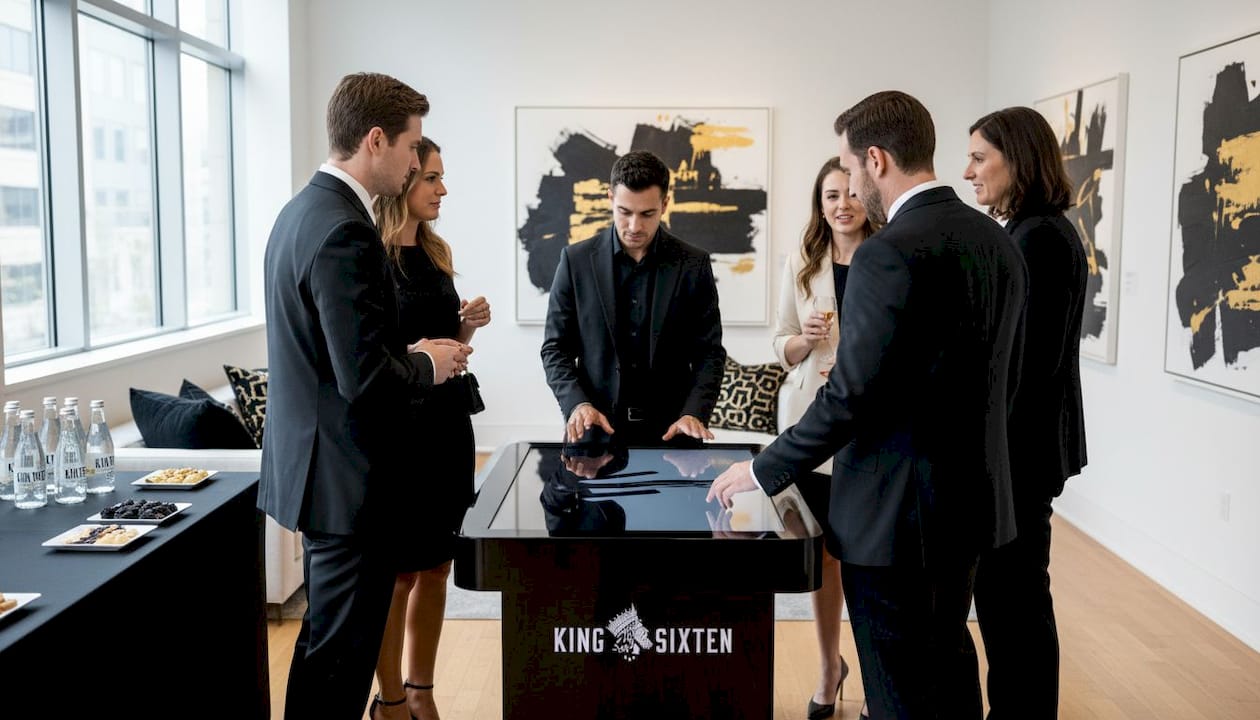
- Multi-sensory engagement that layers scent, sound, texture, and visual storytelling
- Interactive stations that give attendees a role to play, not just a room to walk through
"The event environment is not the stage for the brand, it is the brand. Every square foot is a media channel you control entirely."
When your environment is built this way, attendees don't observe your brand. They live inside it for a defined period of time, and that changes the depth of connection dramatically.
Core mechanics of immersive environments
With the definition in place, we can now break down how these environments are actually built and executed for edge-of-seat engagement.
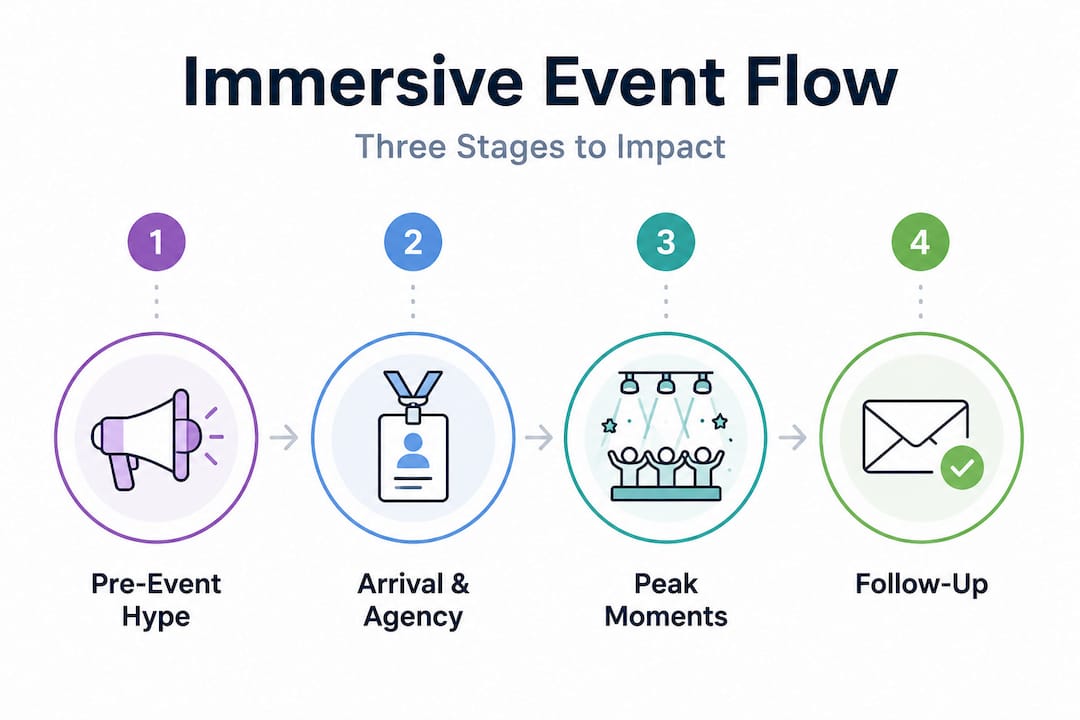
The mechanics of an immersive event environment operate across three distinct phases, and each one matters equally. Neglecting any phase creates a gap that disrupts the overall experience.
- Pre-event hype and setup: Teasers, waitlist messaging, and exclusive pre-event content build anticipation before anyone walks through the door. Queue entertainment, arrival rituals, and even the check-in experience set the emotional tone before the main activation begins.
- During-event pacing and transitions: The best environments use timed cues, lighting shifts, sound design changes, and physical transitions to move attendees emotionally from one state to another. This is what we call designing emotional "beats." Think of it like a film score: silence and noise, intimacy and spectacle, all sequenced deliberately.
- Post-event extension: Shareable moments, digital follow-up assets, personalized recap content, and social amplification tools extend the environment's impact well beyond the venue walls.
The mechanics also require giving attendees genuine agency. Choices create investment. When a guest at a product launch can select their own path through an environment, customize an element, or trigger a reveal, they become a participant rather than a spectator. That shift in role dramatically increases engagement depth and recall.
Experiential marketing mechanics involve pre-event hype through teasers and queue entertainment, pacing with timed cues and transitions, participant agency, and post-event extension via shareable moments. The brands that execute all three phases cohesively are the ones that dominate social feeds and post-event conversations.
| Phase | Tactic | Outcome |
|---|---|---|
| Pre-event | Teaser content, RSVP rituals, waitlist exclusivity | Elevated anticipation and qualified attendance |
| During-event | Timed transitions, sensory layering, participant choices | Deeper emotional connection and longer dwell time |
| Post-event | Shareable assets, personalized recaps, follow-up sequences | Extended reach, social amplification, conversion |
Effective immersive brand activations are built on this three-phase architecture. The tactics within each phase vary by brand and audience, but the structure never changes. You need all three working together to achieve strategic brand impact that justifies the investment.
Pro Tip: Queue entertainment and arrival design are the most underinvested phases in luxury activations. Your guest's mood when they enter determines everything. Design that moment with the same rigor you apply to the main experience.
The impact: Measurable results and crucial challenges
Understanding mechanics is vital, but what does success actually look like, and what are the classic challenges high-end brands face?
The business case for immersive event environments is not a matter of opinion at this point. Empirical benchmarks show average ROI of 200-600%, 61% of consumers more likely to purchase following an event, and brand recall reaching up to 80% after 30 days. Those numbers are hard to argue with when your alternative is a digital display ad with a 0.1% click-through rate.
But the data also reveals a tension worth naming directly. Some organizers prioritize attendee satisfaction, cited by 41.7% as their primary metric, over direct ROI, cited by only 18.5%. Even more telling: only 23% of organizers feel confident in their ability to measure ROI accurately. That confidence gap is where money gets left on the table.
Here's how the two primary strategic orientations compare:
| Strategy type | Primary focus | Strength | Weakness |
|---|---|---|---|
| Experience-first | Attendee satisfaction and emotional resonance | High recall, strong social sharing | Hard to quantify business impact |
| ROI-first | Conversion, lead capture, and revenue metrics | Clear measurement, strong business case | Can feel transactional or sterile |
The smartest luxury brands don't choose one over the other. They build environmental branding strategies that optimize for both, using emotional design to generate the experience and integrated technology to capture the data.
What marketers consistently underestimate is the "Engagement Trap." This is the scenario where your activation generates extraordinary buzz, high satisfaction scores, and beautiful content, but no measurable business outcome. Attendees loved it. Nobody bought anything. Nobody was captured in a CRM. No downstream conversion occurred. The experience was complete in itself rather than a catalyst for action.
The key measurement criteria for avoiding the Engagement Trap are:
- Dwell time: How long are attendees spending in specific zones? Longer dwell time correlates with higher purchase intent for audience engagement strategies.
- Shareability: Are organic social posts appearing, and what sentiment do they carry? This is earned media with a direct attribution source.
- Conversions: What actions are attendees taking post-event? Purchases, sign-ups, consultation requests, and referrals are all trackable outcomes tied to the experience.
When you measure these three things systematically, the 200-600% ROI benchmark becomes achievable rather than aspirational.
Next-level strategies for luxury event environments
After covering impact and challenges, let's focus on what truly elevates a luxury event environment from good to unforgettable.
For high-end brands, the bar is unambiguously higher. Your audience can smell generic from a hundred feet away. The strategies that consistently outperform for luxury activations share four qualities: deep personalization, genuine sustainability commitments, a designed emotional journey, and site-specific uniqueness. Luxury event environments should focus on hospitality-like personalization and sustainability to build loyalty, alongside integrated data capture for qualified leads.
Here's a practical checklist for luxury event environment design:
- Personalization: RFID badges that trigger customized content, staff briefed on individual guest preferences, personalized physical takeaways designed around each attendee's profile
- Sustainability: Material choices that communicate environmental responsibility without sacrificing visual impact; sourced locally where possible; build-to-last fabrication that reflects brand quality
- Emotional journey: Map the attendee arc from arrival to departure as a sequence of emotional states: curiosity, wonder, intimacy, pride, and desire
- Site-specificity: Choose venues and build environments that cannot exist anywhere else, because place creates a sense of occasion that a generic ballroom never will
On the technology side, the tools available now make measurement seamless without disrupting the guest experience. RFID tracking captures zone-level dwell data passively. QR codes embedded in physical brand elements connect the tactile to the digital instantly. Feedback loops built into interactive stations collect preference data that informs future campaigns.
State of Events 2026 research reinforces a critical design principle: design for emotional shifts such as joy and awe over factual content delivery, and add surprise elements and site-specific uniqueness to maximize memorability.
Pro Tip: Every luxury activation needs at least three distinct "emotional peaks" built into the flow. These are the moments guests photograph, describe to colleagues, and remember six months later. Design them intentionally rather than hoping they emerge naturally.
Tracking what matters means monitoring dwell time, QR scans, social amplification, and post-event conversions, using technology for seamless measurement without disrupting the guest experience.
Strong event staffing also plays an underappreciated role here. Staff who are trained not just on logistics but on brand story, guest engagement, and data capture protocols become multipliers for every other investment in the environment. A beautifully designed space staffed by disengaged or uninformed teams fails immediately. User engagement growth research confirms that human interaction quality significantly determines whether digital and physical touchpoints convert.
What most event designers miss about immersive environments
Let's step back and critically assess what high-achieving event architects consistently get wrong, and how you can sidestep mediocrity.
The conversation in our industry focuses heavily on visual impact. Renders are breathtaking. Mood boards are cinematic. Clients approve budgets based on how something looks in 3D. And then the event happens, and the experience feels hollow, because nobody engineered the human moments between the spectacular ones.
Here's the uncomfortable truth: most luxury activations are designed for photography, not for people. Every element is optimized for a 16:9 frame rather than a lived, embodied experience. The result is an event that generates beautiful content but shallow connection. Attendees photograph it, post it, and forget it within a week. The visual spectacle was complete, but no authentic two-way engagement occurred.
What actually drives memorability and loyalty in luxury audiences is the moment when the brand sees them. Not their demographic. Not their spending tier. Them, as individuals. A staff member who remembers a preference. A personalized element that reflects a previous interaction. A surprise that feels like it was designed specifically for that guest. These moments cost less than another lighting rig, and they generate more genuine loyalty than any installation.
We also need to call out the satisfaction-score obsession. Tracking satisfaction is not wrong, but optimizing for it as the primary metric produces safe, pleasant, forgettable experiences. Satisfaction peaks when you remove friction. Memorability peaks when you introduce the right amount of surprise, tension, and emotional contrast. Those are different design objectives, and confusing them is how you end up with an event that everyone "enjoyed" but nobody talks about.
The brands that consistently get event brand identity strategies right are the ones that treat emotional relevance as a non-negotiable design requirement. They ask: what is the specific emotional truth of this brand for this audience? And then they build an environment that expresses that truth through every touchpoint, not just the hero installation.
Don't copy trends. A trend that worked brilliantly for a consumer tech brand at a festival will land flat for a luxury automotive brand at a private dinner. Orchestrate emotion and relevance for your actual audience, and the environment will resonate far beyond the day itself.
Bring your immersive event vision to life
The principles outlined here aren't theoretical. They're the operating framework we use at King Sixteen every time we build an environment for a high-end brand. From RFID-enabled personalization to emotional journey mapping and post-event measurement, every decision connects back to one outcome: making your brand felt, not just seen.
If you're ready to take your activations beyond spectacle and into genuine strategic impact, our experiential marketing services are built exactly for that. For brands hosting more intimate, high-stakes moments, our private events expertise delivers the precision and exclusivity your audience expects. Let's build something worth remembering.
Frequently asked questions
What are the essential elements of a successful event environment?
Key elements include personalized brand touchpoints, multi-sensory design, clear attendee roles, and integrated technology for engagement and measurement. Successful event environments must engage all senses and offer interactive experiences to drive genuine connection.
How can you measure the ROI of an immersive event environment?
Track attendee dwell time, QR code scans, social media shares, and post-event conversions using integrated technology. Dwell time, QR, social, and conversion data together provide a complete picture of experiential ROI.
Why do some event environments fail to deliver business results?
Focusing only on excitement or satisfaction scores creates an Engagement Trap when delight is not tied to business metrics or measurement infrastructure. Experiences that prioritize satisfaction over revenue often lack the measurement frameworks needed to demonstrate or optimize ROI.
What role does personalization play in luxury event environments?
Personalization, such as RFID-triggered greetings and bespoke guest details, creates the feeling of individual recognition that builds loyalty in high-end audiences. Luxury event environments should prioritize hospitality-like personalization as a core differentiator rather than an optional upgrade.