Physical brand assets are the tangible expressions of a brand that consumers can hold, wear, use, and remember. They include packaging, signage, uniforms, business cards, branded merchandise, and built environments. Unlike digital content, which disappears with a scroll, these assets occupy real space in people's daily lives and keep working long after the initial exposure.
The strategic case for physical brand assets is grounded in how memory actually works. Physical objects activate sight, touch, and sometimes scent, creating more durable brand impressions than digital media alone. Research conducted by the Promotional Products Association International (PPAI) found that recall for branded merchandise exceeded 70%, with favorability scores even higher, driven by design quality and personal relevance. That kind of staying power is difficult to replicate through a paid social campaign.

The role of physical brand assets goes well beyond aesthetics. When designed with intention, they lower cost-per-impression over time, reinforce brand values at the moment of purchase, and create the kind of repeated exposure that builds genuine trust. For marketing and brand professionals, understanding how to deploy these assets purposefully is one of the highest-leverage decisions in a brand's toolkit.
Key physical brand assets include:
- Packaging: The primary physical touchpoint, shaping perception before a single word of copy is read
- Signage: Communicates brand presence and guides consumer behavior in physical spaces
- Uniforms and branded apparel: Ongoing brand media worn by employees in environments digital advertising never reaches
- Business cards and printed materials: Tangible proof of professionalism at critical relationship moments
- Promotional merchandise: Items consumers keep, use, and display, extending brand visibility into daily life
- Retail environments and event installations: Immersive spaces that make a brand felt, not just seen
What are physical brand assets and why do they matter strategically?
Physical brand assets are the tangible elements of a brand that customers and employees interact with in shared spaces. They are the things you can point to, ship, install, or print. That permanence is exactly what makes them so powerful at scale. Once produced, they are harder to modify than a digital file, which means the standards baked into them become the standard the brand holds in the world.

Their strategic value comes from persistence. A well-designed item creates repeated consumer exposure over time, increasing return on investment compared to transient digital ads. A Trader Joe's tote bag becomes a personal signal carried into grocery stores, gyms, and offices. A branded jacket worn weekly creates thousands of impressions in environments where no digital ad could ever appear. That kind of ambient, repeated visibility is what builds the familiarity that precedes trust.
Physical assets also sit closer to the moment of purchase than almost any other brand element. Packaging influences decisions within seconds, and a customer who holds a product has already crossed a threshold that a banner ad cannot reach. The physical touchpoint is where the brand becomes real.
Common types of physical brand assets you should know
Understanding the full range of physical brand assets helps you make deliberate choices about where to invest and why. Each category serves a distinct function in the brand ecosystem.
- Packaging anchors the entire physical brand system. Every other tangible asset inherits its material language and design logic from the packaging, creating unity across the brand's physical presence.
- Signage operates as a silent guide, directing attention and communicating brand values before any human interaction occurs. In retail and event environments, exterior displays and layout have a direct, measurable effect on shopping behavior.
- Uniforms and branded apparel are among the most underestimated brand assets. A well-designed jacket worn regularly creates thousands of repeated impressions and reinforces internal culture in ways that digital communication cannot replicate.
- Business cards and printed collateral carry weight at relationship-defining moments. The tactile quality of a card communicates positioning before the recipient reads a single word.
- Promotional merchandise works best when it is useful, durable, and designed with care. PPAI research shows that 89% of consumers say design is the most important factor in whether they keep a branded item, with quality materials valued by 68% of recipients.
- Retail environments and event installations are the most immersive category. Store layouts, lighting, product grouping, and custom fabrications shape how long customers stay and what they notice.
Pro Tip: When auditing your physical brand assets, map each category against the consumer journey. The goal is to identify which touchpoints are closest to a purchase decision and ensure those receive the most intentional design investment.
How physical brand assets shape brand identity and consumer decisions
Physical assets become part of consumers' personal space and routines in a way that digital content rarely does. More than half of consumers keep promotional items for sentimental reasons, according to PPAI research. They are not just holding onto something useful. They are holding onto a memory, a relationship, or an experience connected to the brand behind the item.
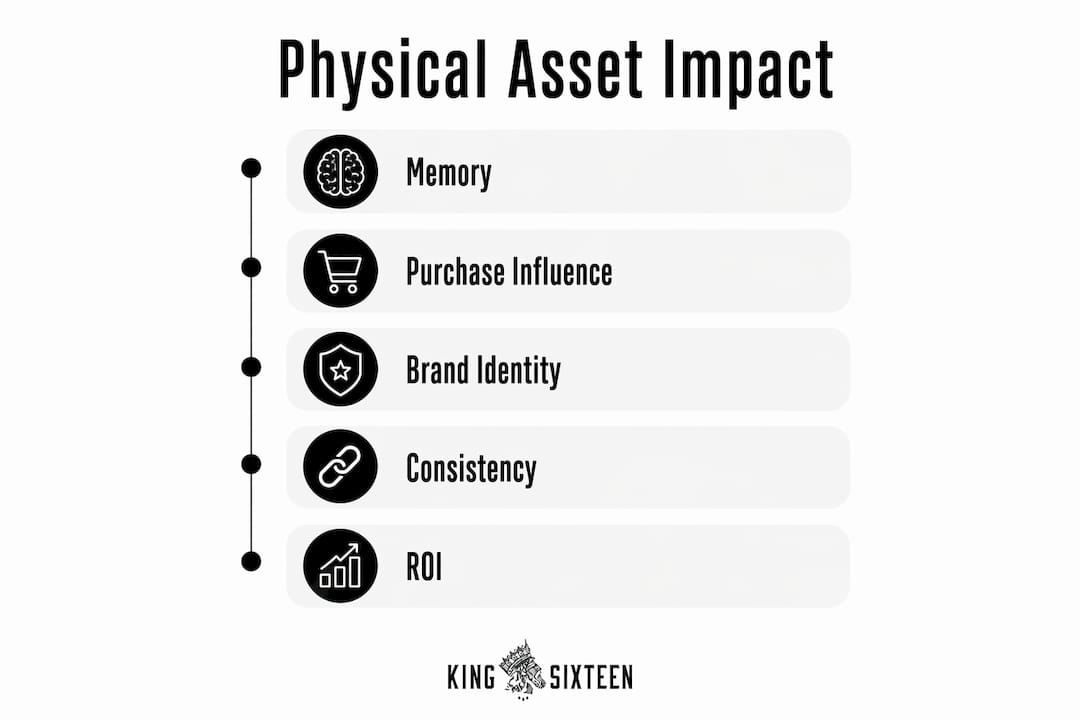
This behavioral pattern has direct implications for brand identity. When a consumer carries, wears, or displays a branded item, they are making a public statement about the brands they associate with. That visibility creates social proof at a scale that paid media cannot manufacture. Liquid Death, the canned water company, built an entire lifestyle identity around merchandise that generates revenue streams rivaling its beverage sales while transforming customers into visible advocates.
Packaging communicates silently but powerfully, influencing decisions within seconds and extending post-purchase brand engagement well past the checkout moment. Color triggers emotional response before any conscious evaluation. Material signals economic positioning before price is read. Typography carries personality before a single word is processed. These are not soft, intangible effects. Research published in Behavioral Sciences found that 73–85% of purchase decisions happen at the point of sale, where packaging is often the final nudge.
Pro Tip: Design physical assets as enduring brand extensions, not disposable giveaways. A poorly designed item can undermine brand perception just as quickly as a great one strengthens it. Prioritize quality and relevance over volume.
How to organize and manage physical brand assets for consistent brand presentation
Brand consistency across physical assets does not happen by accident. It requires systems, not just guidelines. The brands that maintain recognizable physical presence at scale treat their assets as a connected system with clear rules embedded directly into the design.
The most effective approach builds standards into production templates from the start. Embedding brand standards such as logo placement and color usage directly into templates reduces the need for costly approvals and prevents brand drift in distributed teams and franchises. When a franchisee or regional partner receives a vendor-ready file, the brand is protected without requiring oversight on every execution. Physical assets become silent managers in this environment, guiding behavior without meetings or training decks.
Common pitfalls to avoid:
- Treating physical assets as execution details rather than strategic decisions made early in campaign planning
- Lacking modular components, forcing teams to improvise and stretch layouts, swap colors, or adjust typography to "make it fit"
- Providing instructions without examples, leaving partners to interpret rather than replicate
- Ignoring regional variation, which causes brand fragmentation when organizations scale across locations
Strong physical brand systems share four traits: clear rules baked into design, modular components that adapt without breaking, documentation that shows examples rather than just instructions, and vendor-ready files that reduce interpretation errors. Treating physical assets as systems rather than one-off projects is what enables scalable brand consistency and operational clarity as organizations grow.
Pro Tip: Integrate physical asset management into brand operations from day one, not as an afterthought. Build brand consistency into your production files so the standard travels with the asset, not in a separate PDF that nobody reads.
How physical brand assets create memorable, shareable experiences
The most powerful physical brand assets do not just communicate. They create moments people want to share. Physical activations double as content engines, bridging real-world experiences with online engagement through QR codes, augmented reality, and social media. A brand that designs its physical presence with shareability in mind earns organic reach it never had to pay for.
According to Statista, global experiential marketing spend exceeded $128 billion in 2024, rising above pre-pandemic levels for the first time. That figure reflects a broad recognition that physical experiences deliver something digital cannot: the communal moment, the atmosphere, and the human connection that make brands feel real.
Physical activations feel inherently real, hard to fake or ignore. IRL experiences spark emotions, encourage social sharing, and create cultural moments, helping brands build deeper, more visceral connections. And they show up on our feeds and in our lives in a more meaningful way.
The transition from transactional to experiential use of physical branding is visible across every category. McDonald's adult Happy Meals generated enormous attention because the collectible figurines transformed a standard promotion into a physical experience consumers wanted to own, share, and display. The Stanley Quencher tumbler became a centerpiece of brand storytelling through collaborations and limited editions that made a functional product into a cultural artifact.
At Kingsixteen, this principle drives how we approach custom brand fabrication for clients like Porsche, Audi, and Ray-Ban. Physical installations and environments are designed not just to look impressive but to function as content generators, creating shareable moments that extend the campaign's reach far beyond the event itself. The physical asset is the starting point of a digital story.
Pro Tip: Design physical activations with a "dual impact" mindset. Ask how the asset performs in person and how it photographs or films. An installation that works in both dimensions earns media value that compounds well after the event ends.
How do you measure the effectiveness and ROI of physical brand assets?
Measuring the return on physical brand assets requires a different framework than digital attribution. Physical assets work more like outdoor advertising or environmental branding: their impact builds through repetition, familiarity, and trust rather than through instant clicks. Trying to measure them against short-term digital metrics misses how they actually create value.
The most practical measurement approach tracks impressions over the asset's useful life. A branded jacket worn twice a week in a city creates thousands of impressions per year at a fraction of the cost of a digital campaign reaching the same number of people. Packaging that photographs well and generates unboxing content on video platforms creates earned media the brand never paid for. These are real, trackable outcomes when the intent is defined upfront.
Behavioral signals offer another measurement layer. Tracking recipient behavior after a physical touchpoint, whether that is a purchase action, a referral, or a social share, connects the tangible asset to downstream revenue. QR codes, personalized landing pages, and branded hashtags on packaging create direct pathways from physical interaction to measurable digital engagement. The physical-to-digital bridge is where the most precise attribution lives.
Brand health metrics round out the picture. Recall rates, favorability scores, and net promoter scores measured among audiences who received physical assets versus those who did not reveal the long-term equity effect. PPAI's research methodology, which tracks recall and favorability for branded merchandise recipients, provides a replicable model for any brand willing to build measurement into its physical asset programs from the start.
Legal considerations and trademark protection for physical brand assets
Physical brand assets carry legal weight that digital assets often do not. A logo printed on packaging, embroidered on a uniform, or fabricated into a retail installation is a public representation of the brand's intellectual property. Protecting that property requires proactive trademark registration, not just good design.
In the United States, trademark registration with the United States Patent and Trademark Office (USPTO) gives a brand exclusive rights to use a mark in commerce for specific goods and services. Registration creates a public record, enables customs enforcement against counterfeit imports, and provides legal standing to pursue infringement claims. For physical brand assets, this means registering not just the wordmark but also distinctive logos, color combinations, and trade dress elements that consumers associate with the brand.
Trade dress protection is particularly relevant for physical assets. The distinctive shape of a Coca-Cola bottle, the color of a Tiffany box, and the layout of an Apple retail store have all received trade dress protection because they function as brand identifiers in the marketplace. Any physical element that consumers use to identify the source of a product can potentially qualify, provided it is distinctive and non-functional.
Practical steps for protecting physical brand assets include conducting a trademark clearance search before finalizing any new design, registering marks in all categories where the brand operates, monitoring the market for unauthorized use, and including clear intellectual property ownership clauses in contracts with fabricators, vendors, and partners. When a third party produces physical assets on your behalf, the contract should specify that all designs and tooling remain the brand's property. A step-by-step approach to brand activations should always include a legal review of any new physical asset before it goes into production.
Key Takeaways
Physical brand assets deliver their highest value when treated as a connected system designed for longevity, consistency, and sensory impact rather than as individual execution details.
| Point | Details |
|---|---|
| Memory through sensory engagement | Physical objects activate sight, touch, and scent, creating more durable brand impressions than digital media alone. |
| Recall exceeds 70% for merchandise | PPAI research found branded merchandise recall exceeded 70%, with favorability scores even higher among recipients. |
| 73–85% of decisions happen at point of sale | Packaging color, graphics, and layout directly influence purchase intent at the moment it matters most. |
| Systems prevent brand drift at scale | Embedding standards into production templates and vendor-ready files protects brand consistency without constant oversight. |
| Physical and digital work together | QR codes, AR features, and branded hashtags on physical assets create measurable pathways to digital engagement and attribution. |
Physical branding is having its moment, and it's not a coincidence
The brands winning in 2026 are not the ones with the biggest digital budgets. They are the ones that figured out something counterintuitive: as screens fill with AI-generated content, the things people can actually hold become more valuable, not less.
Physical branding is not rebounding because digital failed. Digital is more efficient than ever. But efficiency and memorability are not the same thing. A perfectly targeted ad disappears the moment the feed refreshes. A well-designed jacket, a thoughtfully packaged product, or a fabricated installation at a live event stays in someone's life. It keeps working. That persistence is what creates the kind of brand equity that survives a market cycle.
What I find most underappreciated in how brands approach physical assets is the timing problem. Physical elements consistently get added late in campaign development, treated as giveaways or event extras rather than as primary brand vehicles. By the time they are produced, they have no room to reinforce the central narrative. The brands that get this right, the ones that build physical assets into the campaign from the concept stage, consistently outperform on recall, loyalty, and earned media.
The shift from quantity to quality is also real and accelerating. Cheap promotional items no longer help a brand's image. Consumers have become pickier, and a poorly designed item can actively damage perception. The new standard is fewer, more meaningful physical assets that consumers genuinely want to keep. That is a harder brief to execute, but it is the right one.
For marketing professionals, the practical implication is straightforward. Treat your physical brand assets as a strategic channel with its own brief, its own measurement framework, and its own seat at the planning table. Design them to be useful, durable, and worth keeping. Build the bridge to digital into the asset itself. And invest in the fabrication quality that signals to consumers that a real organization, with real standards, stands behind the brand.
The brands that do this well do not just get remembered. They get carried into places no ad can follow.