Design in brand activations is defined as the strategic, sensory, and experience-driven process that transforms physical space into a business tool. The role of design in activations goes far beyond aesthetics. It determines whether attendees become passive observers or active participants who purchase, advocate, and return. Research confirms that 74% of event attendees say well-designed activations increase their likelihood to purchase or recommend a brand. That number tells you everything about where design sits in your marketing budget: not in the "nice to have" column, but in the revenue column. For marketing professionals and event planners working with high-value brands like Porsche, Ray-Ban, or Fossil, the difference between a forgettable activation and an iconic one almost always comes down to design.
What are the core design principles that drive successful activations?

Strategic design in activations operates on a fundamentally different logic than decoration. Decoration asks, "Does this look good?" Strategic design asks, "What do we want attendees to feel, do, and remember?" Those are different questions with very different answers.
The strongest activations are built around five interconnected principles:
- Spatial flow and guest movement: The physical path through your activation is a narrative. Guests should move from arrival through a sequence of brand moments, each building on the last. Porsche's product launch environments, for example, route guests past engineering displays before they reach the vehicle itself, building desire through context.
- Emotional arc: Every activation has a beginning, middle, and end. The arrival experience sets expectation. The core environment delivers the brand promise. The exit creates the memory. Collapsing any of these stages produces a flat experience.
- Multi-sensory environment: Lighting, sound, scent, and texture each carry brand meaning. A luxury fragrance brand that uses harsh fluorescent lighting has already failed, regardless of the product quality on display.
- Brand storytelling through installations: Physical installations are the most credible form of brand communication because they require real investment. A custom fabricated structure signals commitment in a way a digital ad never can.
- Participant agency over spectacle: Designing for participant agency means giving attendees choices, collaboration opportunities, and moments of reflection. Spectacle is passive. Agency creates memory.
Pro Tip: Design your activation so attendees can choose their own path through it. When people make choices inside your brand environment, they feel ownership over the experience. That ownership converts to advocacy far more reliably than any scripted walkthrough.
How does design influence measurable business outcomes?
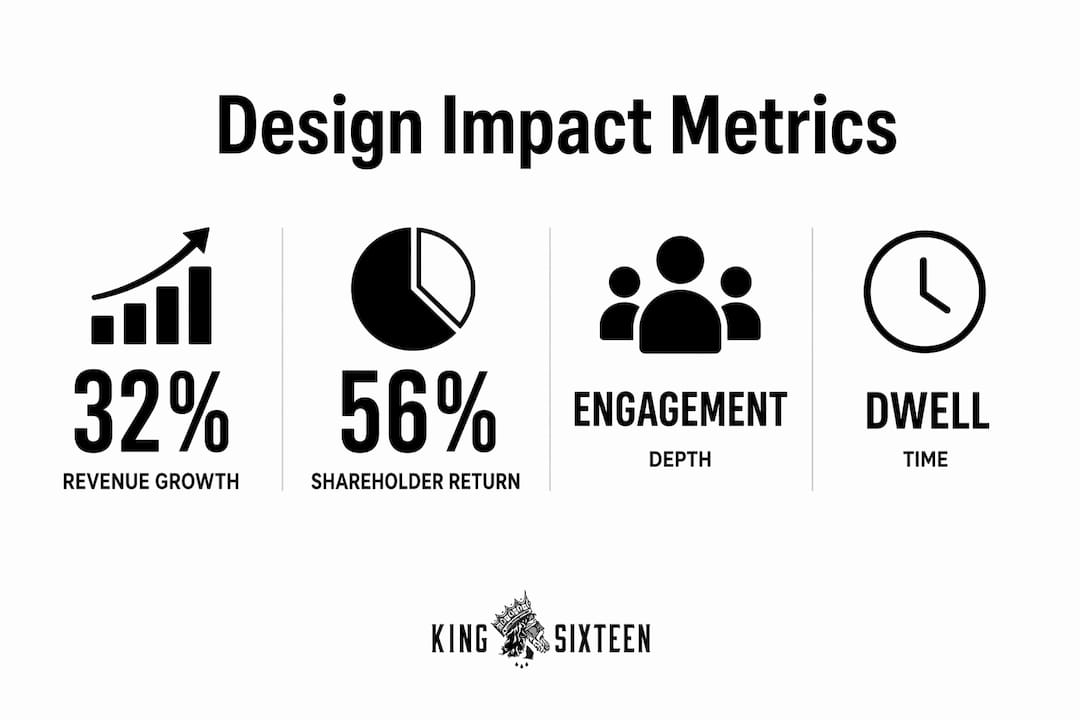
The business case for design investment is no longer theoretical. A five-year McKinsey study found that top quartile design performers grow revenue 32% faster and deliver shareholder returns 56% higher than their peers. That data covers product and service companies broadly, but the mechanism applies directly to brand activations: design quality signals brand quality, and brand quality drives purchase behavior.
"Good design is good business. It commands attention in an attention-scarce economy." — IMEX Event Design Report
The metrics that matter in activation design go beyond headcount. Engagement depth, dwell time, social sharing rate, and post-event brand recall are the numbers that connect design decisions to revenue outcomes. A well-designed activation at Churchill Downs, for instance, generates media coverage, social content, and word-of-mouth that extends the brand's reach long after the event closes.
| Design Quality Level | Revenue Growth Impact | Shareholder Return Impact |
|---|---|---|
| Top quartile performers | 32% faster growth | 56% higher returns |
| Standard performers | Baseline | Baseline |
| Poor design execution | Brand dilution risk | Negative advocacy risk |
Human-centered design has become the primary differentiator in a crowded, AI-assisted event market. When every brand has access to the same digital tools, the physical experience becomes the competitive advantage. You can explore how these principles connect to experiential ROI metrics in more detail if you want to build the internal business case for design investment.
What common pitfalls undermine design effectiveness?
Most activation design failures are not creative failures. They are operational failures that show up late and cost twice as much to fix. Recognizing these pitfalls before you brief your design team saves budget and protects your brand vision.
- Treating design as creative-first. The most common mistake is starting with a visual concept before confirming venue logistics, load-in windows, electrical capacity, and ceiling heights. A stunning installation that cannot be built in the available time or powered by the available infrastructure is worthless.
- Compressing the discovery phase. Skipping strategic discovery to accelerate timelines is the single fastest route to budget overruns and build failures. Discovery defines the constraints that make creative work executable.
- Ignoring social media framing. Design elements that look spectacular in person but photograph poorly are a missed opportunity. Optimizing for mobile-first vertical formats means thinking about your activation through a camera lens from day one.
- Neglecting venue constraints. Operational failures in activation design consistently trace back to ignoring physical constraints early. Ceiling heights, floor load limits, and union labor rules are not afterthoughts. They are design parameters.
- Building for one use. Single-use custom builds are expensive and wasteful. Modular designs that can be reconfigured across multiple activations deliver far better return on fabrication investment.
Pro Tip: Specify modular assembly in your design brief from the start. Durable, modular designs reduce shipping damage, cut installation labor costs, and give you the flexibility to redeploy assets across multiple markets without rebuilding from scratch.
How does technology integration strengthen brand activations?
Technology in activation design works best when it serves the experience rather than defines it. The brands that get this right use technology to deepen participation, not to replace human connection with digital novelty.
The most effective technology integrations in 2026 activations include:
- LED walls and projection mapping: These tools transform architectural surfaces into dynamic brand canvases. Audi has used projection mapping on vehicle surfaces to demonstrate engineering precision in a way no static display can match.
- Interactive touchscreens and configurators: Product configurators at activations let attendees build their own version of a product, creating personal investment in the brand before they leave the space.
- AR overlays: Augmented reality layers add information or narrative to physical objects without replacing the tactile experience. Ray-Ban has used AR try-on experiences at retail activations to reduce purchase hesitation.
- RFID personalization: RFID wristbands or badges allow activations to personalize content, track engagement data, and create seamless transitions between activation zones. The Natural Diamonds Council has used RFID-enabled experiences to connect attendees with personalized product stories.
- Social sharing infrastructure: Dedicated photo moments, optimized for vertical mobile framing, are not optional extras. They are distribution channels. Designing for social sharing means your activation reaches audiences who were never in the room.
The structural constraint to keep in mind: technology requires power, data connectivity, and technical support. All three must be confirmed at the venue before any technology is specified in the design. A beautiful AR experience that crashes on the event floor because of insufficient bandwidth damages the brand more than no technology at all.
How should marketing professionals plan design strategies for activations?
Effective design strategy for activations follows a phased workflow that keeps creative ambition grounded in operational reality. The sequence matters as much as the individual steps.
The proven workflow runs from discovery through concept, engineering, fabrication, graphics production, quality assurance, and freight logistics. Each phase gates the next. You cannot engineer what has not been fully conceived, and you cannot fabricate what has not been engineered. Compressing any phase creates compounding problems downstream.
Discovery is the most underinvested phase in most activation programs. It defines your audience, your business objective, your venue constraints, and your measurement KPIs before a single design concept is sketched. Impactful brand activations consistently begin with a thorough discovery process that aligns the entire team around a shared definition of success.
| Planning Approach | Discovery Investment | Typical Outcome |
|---|---|---|
| Operational-first | High: constraints defined before creative | On-budget, on-brand execution |
| Creative-first | Low: constraints discovered during build | Budget overruns, design compromises |
| Integrated partner model | Embedded: design and ops teams aligned | Fastest execution, lowest risk |
Working with an integrated activation partner, one who handles design, fabrication, logistics, and staffing under a single roof, eliminates the coordination gaps that cause most activation failures. When your design team and your build team are the same team, the translation between concept and execution is direct. You can also explore brand activation ideas that connect design choices to measurable engagement and ROI outcomes.
Key takeaways
Design in brand activations is the primary driver of audience engagement, purchase intent, and measurable business outcomes when it is treated as an operational discipline, not a creative afterthought.
| Point | Details |
|---|---|
| Design drives revenue | Top design performers grow revenue 32% faster and deliver 56% higher shareholder returns. |
| Participant agency beats spectacle | Activations that give attendees choices create stronger brand advocacy than passive experiences. |
| Discovery phase is non-negotiable | Compressing strategic discovery leads directly to budget overruns and build failures. |
| Technology serves experience | LED walls, AR, and RFID work best when they deepen participation, not replace human connection. |
| Modular design cuts total cost | Modular, durable builds reduce shipping damage and allow redeployment across multiple markets. |
Design is a business decision, not a creative one
I have watched brands spend six figures on activation builds that generated almost no measurable return, and I have seen relatively modest investments produce campaigns that ran for months across social media and trade press. The difference was never the budget. It was whether design was treated as a business decision from the first conversation.
The brands that get the most from their activations are the ones that brief their design teams with business objectives, not mood boards. They define what success looks like in numbers before they define what the space looks like in renderings. That discipline is harder than it sounds, especially when you are working with creative teams who are energized by visual possibility. But it is the only approach that consistently produces activations worth the investment.
The other thing I have learned is that human-centered design is not a trend. It is a return to what activations were always supposed to do: honor the people in the room by giving them something real. In a market flooded with AI-generated content and algorithmically optimized digital experiences, a physical environment that was clearly designed for the specific person standing in it is genuinely rare. That rarity is your competitive advantage. Use it.
— Tyler
How Kingsixteen brings strategic design to life
Kingsixteen builds brand activations for companies that cannot afford to get it wrong. From product launches for Porsche and Audi to immersive environments for Ray-Ban and the Natural Diamonds Council, the team brings design and operational discipline together under one roof.
Every engagement starts with discovery, moves through engineering and fabrication, and delivers a finished environment that performs on the event floor and across social media. If you are planning an activation and want design that connects directly to business outcomes, explore Kingsixteen's experiential marketing services to see how the process works. The brands that move first on strategic design are the ones that own their category.
FAQ
What is the role of design in brand activations?
Design in brand activations is the strategic process of shaping space, flow, and sensory experience to drive audience engagement and purchase intent. Research shows 74% of attendees say well-designed activations increase their likelihood to purchase or recommend a brand.
How does design affect activation ROI?
Design quality connects directly to revenue outcomes. Companies in the top quartile for design grow revenue 32% faster and deliver 56% higher shareholder returns than peers over a five-year period.
What is the biggest design mistake in activations?
The most damaging mistake is starting with creative concepts before confirming venue logistics and operational constraints. Compressing the discovery phase consistently produces budget overruns and build failures that compromise the final brand experience.
Why does participant agency matter in activation design?
Activations that give attendees choices and collaboration opportunities produce stronger brand recall and advocacy than passive spectacle. Participant agency transforms attendees from observers into brand advocates.
How should activations be designed for social media?
Design elements should be planned with mobile-first vertical framing in mind from the start. Optimizing for camera framing extends your activation's reach to audiences who were never physically present at the event.