High-value brands pour significant budgets into events every year, yet too many activations end with lukewarm applause and forgettable photo ops. The audience showed up, looked around, and moved on. That's not a creative failure. It's a strategic one. Immersive brand activations solve this problem by replacing passive observation with genuine participation, emotional resonance, and measurable outcomes. This guide breaks down exactly how to design, execute, and evaluate activations that move people, not just impress them.
Table of Contents
- What makes an activation truly immersive?
- Preparation: Core elements and requirements for immersive activations
- Execution: How to design and deliver immersive brand activations
- Verification: Measuring impact and optimizing future brand activations
- Perspective: What most brands get wrong, and how to ensure real immersion
- Partner with experts to elevate your immersive brand activations
- Frequently asked questions
Key Takeaways
| Point | Details |
|---|---|
| Immersive means participatory | The most effective brand activations create emotional resonance and invite genuine audience involvement. |
| Preparation drives success | Securing the right resources, insights, and team alignment is critical before activation. |
| Execution hinges on relevance | Story-driven, sensory-rich experiences that align with your brand deliver the deepest engagement. |
| Measurement fuels growth | Collecting and analyzing both quantitative and qualitative results ensures continual improvement in future activations. |
What makes an activation truly immersive?
The word "immersive" gets used loosely, so let's define it clearly. A truly immersive brand activation draws your audience into a structured experience where they feel, decide, and respond. They're not watching your brand story. They're living it.

This is fundamentally different from traditional event marketing, which focuses on structured visibility: branded signage, a booth, a product demo, and a handshake. There's nothing wrong with visibility, but visibility alone doesn't build loyalty. It rents attention. Strong brand environment design goes further by creating spatial and sensory contexts where audiences form genuine memories tied to your brand.
The distinction matters at a strategic level. As the conversation around experiential marketing continues to evolve, the clearest takeaway is that experiential marketing often functions as short-term attention rental, while experiential branding builds long-term relationships. Event marketing sits somewhere in between, prioritizing structured visibility without always committing to the emotional depth that drives advocacy.
Here's a quick comparison to frame your planning decisions:
| Approach | Primary goal | Audience role | Long-term impact |
|---|---|---|---|
| Traditional event marketing | Brand visibility | Passive observer | Limited recall |
| Experiential marketing | Short-term engagement | Participant | Moderate recall |
| Immersive brand activation | Emotional connection | Co-creator | High advocacy |
What separates the third column from the first two? Three things:
- Emotional resonance: The experience triggers a genuine feeling, whether that's wonder, pride, surprise, or belonging.
- Participation depth: Audiences make choices, move through curated spaces, and interact with the brand on their own terms.
- Relationship architecture: Every touchpoint is designed with long-term advocacy in mind, not just a single moment of impact.
"Experiences that integrate both traditional and immersive tactics consistently deliver the strongest, most lasting business results."
Building the right combination requires a clear understanding of your audience and your objectives before a single creative brief is written. Explore strategies for experiential success to sharpen your thinking before moving into the planning phase.
Preparation: Core elements and requirements for immersive activations
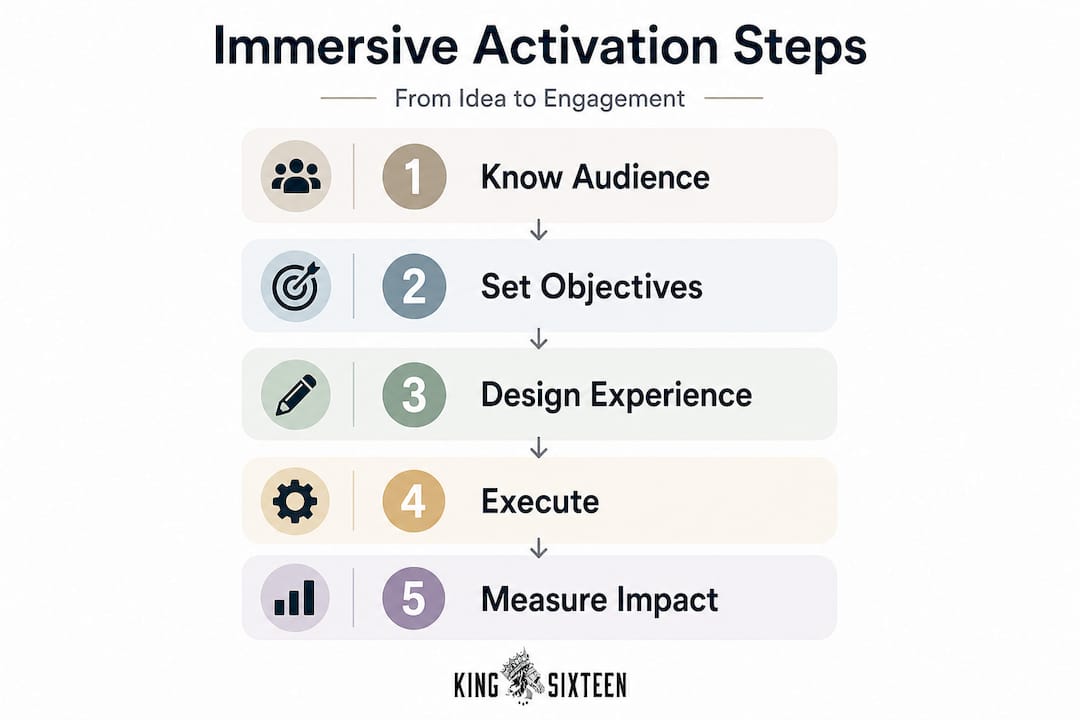
Before you brief a creative team or reserve a venue, you need a strong operational and strategic foundation. Skipping this step is the single most common reason activations miss their mark, even when the creative work is excellent.
Effective preparation comes down to five core requirements:
- Audience intelligence: Psychographic profiles, not just demographics. What does your audience value? What environments make them feel engaged? What would make them share the experience?
- Clear brand objectives: Are you launching a product, shifting perception, generating leads, or deepening loyalty? Each goal requires a different experiential architecture.
- Creative technology assessment: Which technologies genuinely serve the narrative, and which are just flashy additions? AR, RFID, gesture-based interaction, and spatial audio each have their place, but only when they serve a purpose.
- Skilled production team: You need people who can execute under pressure. That means experienced designers, fabricators, AV specialists, and on-the-ground logistics staff who understand high-stakes events.
- Adequate production resources: Budget, timeline, venue access, and vendor relationships all need to be locked before creative development advances too far.
As the research consistently shows, integrating traditional and experiential tactics delivers the strongest business results. That means your preparation budget should account for both the immersive elements and the supporting traditional channels, including paid media, PR, and post-event digital amplification.
| Budget category | Recommended allocation | Notes |
|---|---|---|
| Creative concept and design | 15-20% | Includes narrative development and spatial planning |
| Fabrication and build | 25-30% | Custom environments, displays, and set pieces |
| Technology and AV | 15-20% | Interactive elements, live streaming, analytics tools |
| Staffing and production | 15-20% | On-site team, logistics, and coordination |
| Traditional amplification | 10-15% | Pre-event and post-event media support |
| Contingency | 5-10% | Non-negotiable for large-scale activations |
Leadership alignment is equally critical. Your creative agency, marketing team, and senior stakeholders need to share the same definition of success before execution begins. Misaligned expectations at the top will cascade into inconsistent execution at every level. Use your step-by-step brand activation guide as an internal alignment tool to get everyone working from the same framework.
Pro Tip: Involve your legal and compliance teams during the planning phase, not as a final review before launch. Permitting, data collection consent, insurance requirements for custom installations, and local regulations can each introduce weeks of delay if they're addressed too late. Brands with strategies for high-end brands already baked into their process consistently get to market faster and with fewer costly last-minute pivots.
Execution: How to design and deliver immersive brand activations
This is where strategy becomes reality. Strong execution follows a clear sequence, and each step builds on the last. Skipping steps doesn't save time. It creates problems downstream that are exponentially harder to fix on-site.
-
Map the audience journey. Before you design a single element, map the full arc of your audience's experience from the moment they learn about the activation to the moment they leave and share it. Identify emotional peaks, decision points, and natural moments for brand interaction. Think of this as choreography, not logistics.
-
Design for multiple senses. The most memorable activations don't just look impressive. They sound, smell, and feel intentional. Spatial audio that shifts as guests move through zones. Textures and materials that reinforce brand personality. Temperature, lighting, and scent that create distinct emotional chapters within the experience. These details are the difference between a room people walk through and an environment people remember.
-
Select interactive technology with purpose. Choose technology that serves the narrative, not the other way around. RFID wristbands that personalize content as guests move through the space. Live data visualizations that reflect audience behavior in real time. Photo and video experiences designed for organic social sharing. Each technology layer should deepen participation, not distract from it.
-
Build a narrative arc. Every great immersive activation has a beginning, middle, and end. The opening creates curiosity and draws people in. The middle deepens engagement through interaction and discovery. The close delivers an emotional payoff and a clear brand message that sticks. Without this arc, even the most technically sophisticated activation feels like a collection of features rather than a story.
-
Execute live and extend digitally. The in-person moment is the core, but strategic ways to create impact extend well beyond the event itself. Plan your digital handover in advance: how will content captured at the activation flow into social channels, CRM systems, and post-event follow-up sequences? The experience should feel like it continues after people leave, not like it ended when the lights went down.
As immersive participation research confirms, emotional resonance drives long-term brand loyalty in ways that purely visual or informational experiences simply cannot. This isn't soft reasoning. It's a strategic reality that your activation architecture needs to respect.
Strong event branding strategies also ensure that every touchpoint, from the invitation to the exit experience, communicates a consistent brand identity. Consistency amplifies emotional impact because it signals confidence and intentionality to your audience.
Pro Tip: Set up a real-time analytics dashboard before the event goes live. Track dwell time in key zones, social sharing rates, and interactive engagement metrics as the activation unfolds. This gives your team the ability to adapt on the fly, whether that means redirecting foot traffic, adjusting pacing, or reinforcing underperforming moments. The brands that outperform expectations at live events are the ones making informed decisions in the moment, not just reviewing data the following week.
Verification: Measuring impact and optimizing future brand activations
The work doesn't end when the event closes. In fact, what you do with your data in the days and weeks after an activation determines whether you build on its success or repeat its mistakes.
Start with your primary KPIs. These should have been defined during preparation and tied directly to your brand objectives:
- Engagement time: How long did attendees spend in the activation? Longer dwell times in key zones indicate genuine interest and effective experience design.
- Sentiment scores: Real-time and post-event sentiment data from social monitoring, survey responses, and staff observations reveal how the experience actually felt to participants.
- Post-event advocacy: Track organic social mentions, media coverage, and referral behavior in the weeks following the activation. Advocacy is the clearest sign that your experience created genuine emotional connection.
- Conversion rates: Depending on your objectives, this might mean product purchases, event registrations, lead form completions, or partnership inquiries generated directly from the activation.
Qualitative feedback is equally important and often more revealing than quantitative data alone. Conduct structured debrief interviews with key attendees, partners, and staff. Look for language patterns, what people say when they describe the experience in their own words, because that language often reveals emotional outcomes that standard metrics miss.
Research consistently shows that long-term relationship building and emotional engagement are the most valuable outcomes to track from immersive activations. Don't let the pressure to report impressive short-term numbers push you away from measuring the deeper outcomes that actually determine long-term brand equity.
| Metric | Tool or method | Reporting cadence |
|---|---|---|
| Engagement time by zone | RFID or beacon tracking | Real-time and post-event |
| Sentiment score | Social listening, NPS surveys | Immediate post-event |
| Advocacy and sharing rate | Social monitoring, UTM tracking | Weekly for 4-6 weeks |
| Conversion rate | CRM integration, lead tracking | 30, 60, and 90 days post-event |
| Qualitative emotional impact | Structured interviews, focus groups | 2-4 weeks post-event |
For brands building lasting brand partnerships and advocacy, your activation data also informs partnership strategy. Knowing which audience segments responded most strongly, and why, shapes how you position collaborative activations in the future.
For your strategic brand experience to compound over time, you need a structured review cycle.
Pro Tip: Revisit your activation data quarterly, not just in the immediate post-event window. Patterns in advocacy, purchase behavior, and content engagement often emerge weeks or months later, and these patterns are your strongest signal for what to repeat, adjust, or reinvent in your next activation.
Perspective: What most brands get wrong, and how to ensure real immersion
Here's the uncomfortable truth that most agencies won't tell you: the majority of "immersive" activations aren't actually immersive. They're expensive.
There's a significant difference. Brands invest in projection-mapped walls, interactive LED tunnels, and AR mirrors, and then wonder why the emotional impact didn't match the production spend. The problem isn't the technology. The problem is that the technology was the strategy, not the tool.
True immersion comes from relevance, not spectacle. When Porsche unveils a new model in an environment designed to make you feel what it means to drive it, before you ever sit in the seat, that's immersion. When a luxury brand creates a space where guests genuinely discover something about themselves through the brand's lens, that's immersion. Technology can support both of those experiences. But it can't replace the human-centered storytelling that makes them work.
Research reinforces this clearly. Event marketing prioritizes structured visibility, whereas true immersive participation leads to emotional resonance and loyalty. The brands that win long-term are the ones who choose emotional resonance over visual complexity every single time.
We also see this play out in iteration. Brands that treat each activation as a learning opportunity, gathering qualitative feedback, testing new narrative approaches, and refining their experience architecture, consistently outperform brands that lock in a format and repeat it unchanged. Luxury brand engagement strategies built on iteration are almost always stronger in year three than in year one.
The lesson is simple: insist on emotional honesty in your creative process. Ask whether each element serves the audience's experience or just impresses a client review committee. The answer to that question will tell you everything you need to know about whether your activation will create advocates or just attendees.
Partner with experts to elevate your immersive brand activations
Building an activation that genuinely moves people requires more than a strong concept. It takes flawless execution, a trusted production network, and the experience to anticipate what can go wrong before it does.
At King Sixteen, we design and execute experiential brand activations for high-value brands that need to get it right. From concept through fabrication, staffing, AV, logistics, and digital integration, our turnkey model gives you a single, accountable partner for every layer of your activation. Whether you're planning a flagship product launch, a high-stakes conference, or a private event activation, we bring the creative depth and operational rigor that major brands require. Discover what's possible when your activation is built to be felt, not just seen.
Frequently asked questions
What is the main difference between experiential marketing and immersive brand activations?
Experiential marketing often focuses on short-term attention and single-event engagement, while immersive brand activations are designed to build lasting emotional connections through deep, participatory experiences that drive long-term brand loyalty.
How can I measure the success of an immersive brand activation?
Track engagement time, sentiment scores, organic advocacy rates, and conversion data, but prioritize qualitative signals like customer stories and emotional language, since emotional engagement is the true measure of immersive success.
What roles do technology and storytelling play in immersive activations?
Technology should support meaningful audience participation, but authentic storytelling and two-way interaction are what actually create the emotional resonance and recall that define a genuinely immersive experience.
How do you ensure compliance and risk management for large-scale activations?
Involve your legal and compliance teams during the initial planning phase, before creative development advances, so that permitting, data consent, insurance requirements, and local regulations are resolved without disrupting your timeline or budget.