Experiential ROI is defined as the combined return from live brand experiences, measured across direct revenue, brand equity shifts, and long-term customer value. Most marketing teams treat it as a soft metric, but that framing costs real budget. 65% of brands that run experiential campaigns fail to measure beyond foot traffic, which means the majority are leaving their best proof points on the table. Understanding experiential ROI requires a structured approach that blends financial attribution, brand perception data, and earned media valuation into a single defensible story. Tools like promo codes, exit surveys, and brand lift studies make that possible today.
What metrics and methods measure experiential ROI?
Measuring experiential marketing ROI means tracking both what people bought and how they felt. Neither number alone tells the full story.
Direct Revenue Attribution
The most credible place to start is direct revenue. Promo codes tied to a specific activation, unique landing page URLs, and on-site point-of-sale data all connect spend to sales. Experiential ROI is calculated using this formula: (Revenue Attributed to Campaign minus Total Campaign Cost) divided by Total Campaign Cost, multiplied by 100. That formula gives you a clean percentage you can defend in any budget review.

Brand Equity and Perception Metrics
Revenue alone misses the compounding value of brand experiences. Pre-event and post-event surveys measuring awareness, purchase preference, and net promoter score capture the perception shift your activation created. These are not soft numbers. They feed directly into lifetime value projections and future conversion rate assumptions.
Earned Media Valuation
Every social share, press mention, and influencer post generated by your event has a dollar equivalent. Calculate earned media value by applying your paid media CPM to the total organic impressions generated. This figure often surprises teams because a single well-executed activation can generate earned media that exceeds the event's production cost.
Lead Value Modeling
Not every attendee buys on the day. A multi-dimensional measurement approach applies historical conversion rates and average customer lifetime value to the leads captured at an event. If your sales team closes 20% of qualified leads at an average deal size of $5,000, a list of 200 event contacts carries a projected value of $200,000.
- Track promo code redemptions and unique URL traffic within 90 days of the event
- Run exit surveys capturing purchase intent and current customer status
- Pull earned media impressions from social listening tools like Brandwatch or Sprout Social
- Apply validated conversion rate adjustments to lead counts before projecting revenue
- Document brand equity scores before and after each activation to build benchmarks over time
Pro Tip: Set up your measurement infrastructure before the event, not after. Retroactive data collection is always incomplete and rarely defensible to a CFO.
Why do brands struggle to justify experiential spend?
The core problem is not a lack of data. It is a measurement mindset that stops too early and looks at the wrong numbers.
"Decision makers struggle to justify experiential spend when focused solely on costs instead of projected outcomes and comprehensive ROI stories." — Chris Clegg, PortMA
That insight cuts to the heart of why so many experiential programs get cut at budget time. The conversation starts with the invoice rather than the return.
Several patterns consistently undermine accurate measurement:
- Vanity metric dependency. Foot traffic and impression counts feel like proof, but they do not connect to revenue. A brand can draw 10,000 people and generate zero measurable pipeline.
- Short attribution windows. Most teams stop measuring the day the event ends. Extending attribution to 90 days captures 2.3x more revenue than tracking only 30 days or less. That gap is not marginal. It is the difference between a program that looks unprofitable and one that clearly pays for itself.
- Existing customer confusion. When a large portion of event attendees are already customers, teams struggle to isolate incremental revenue from retention value. Both matter, but they require different calculations.
- No pre-event baseline. Without a brand awareness or preference score before the activation, there is nothing to measure the shift against. Post-event surveys alone prove nothing.
These blind spots do not just distort reporting. They prevent teams from scaling what works and cutting what does not.
How does experiential ROI compare to digital and traditional channels?
The performance gap between experiential and digital advertising is larger than most marketing teams realize.
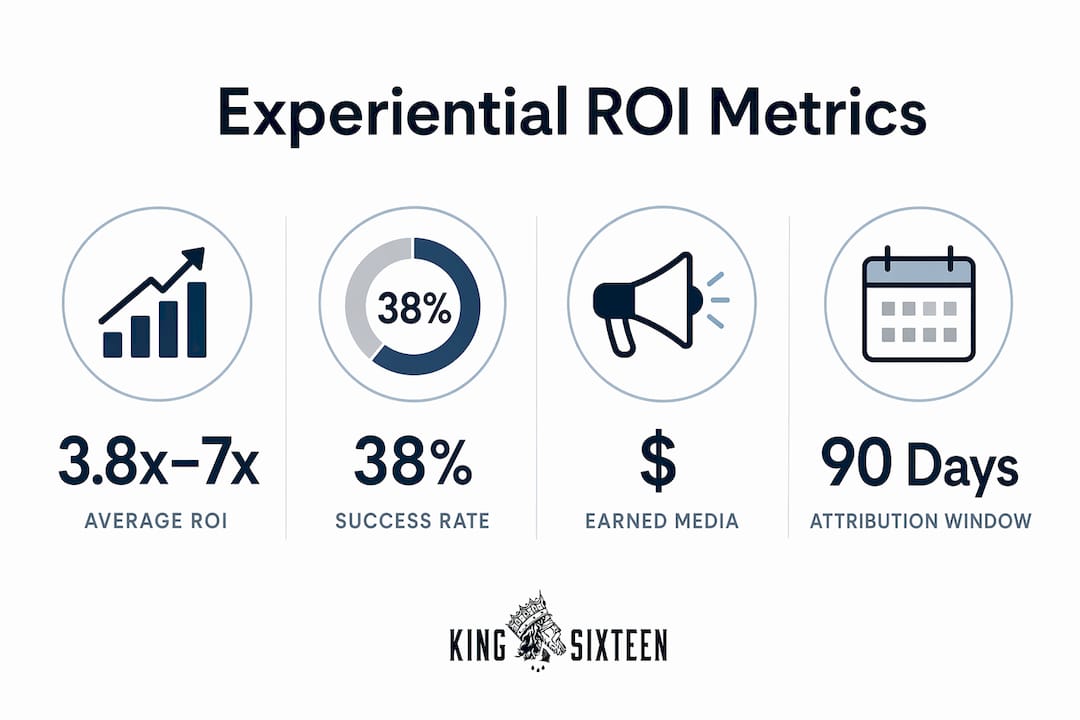
Experiential campaigns achieve a 38% success rate compared to 19.7% for digital ads. That is nearly double the rate of effective outcomes per dollar invested. Well-optimized experiential campaigns regularly deliver 5x to 7x returns, while digital advertising averages around 2x ROI. The difference comes from depth of engagement. A 30-second pre-roll ad creates a passive impression. A 20-minute brand experience creates a memory.
Digital ads often fail to replicate the emotional engagement and brand loyalty that experiential marketing delivers. That emotional depth translates directly into customer behavior. Customers acquired through experiential events tend to carry higher lifetime value than those from other channels, because the relationship starts with a positive, high-touch interaction rather than a click.
| Metric | Experiential | Digital Ads | Traditional Media |
|---|---|---|---|
| Average ROI | 3.8x–7x | ~2x | Variable, hard to isolate |
| Campaign success rate | 38% | 19.7% | No standard benchmark |
| Measurement complexity | High (multi-source) | Low to medium | High |
| Emotional engagement | Very high | Low | Medium |
| Attribution window | 30–90 days | Real-time | 30–60 days |
| Customer lifetime value | Higher than average | Average | Average |
Traditional media sits in its own category. TV and print generate broad reach but offer almost no direct attribution. Experiential sits at the opposite end: narrow reach, deep impact, and measurable outcomes when tracked correctly.
Pro Tip: When presenting experiential ROI to leadership, include a side-by-side comparison with your digital ad spend for the same period. The contrast makes the case better than any single number.
For a deeper look at why live experiences outperform paid media, the analysis at experiential vs. digital ads is worth your time.
How can marketing teams build a practical experiential ROI framework?
A repeatable measurement framework is what separates brands that scale experiential programs from those that treat each event as a one-off experiment.
-
Define outcomes before you set a budget. Building budgets around expected outcomes rather than available funds leads to better ROI decisions. Start with the revenue or brand equity target, then work backward to the investment required.
-
Build your data collection plan into the event design. Exit surveys, QR code registrations, and on-site lead capture tools need to be part of the experience architecture, not an afterthought. Structured exit surveys with validated conversion adjustments produce defensible ROI estimates rather than guesses.
-
Use a blended measurement model. Combine direct revenue attribution, brand equity survey data, lead value projections, and earned media valuation into a single report. Tracking both immediate and longer-term revenue impact gives the clearest picture of what an activation actually returned.
-
Apply a 90-day attribution window. Set a calendar reminder for 30, 60, and 90 days post-event to pull updated conversion data. Revenue that closes six weeks after an activation still belongs to that activation.
-
Build a benchmark library. Every event you measure adds a data point. Over time, you develop internal benchmarks for cost-per-lead, conversion rate by event type, and average earned media multiplier. Those benchmarks make future budget conversations much faster.
-
Report on returns, not costs. Multi-dimensional ROI metrics shift the budget conversation from defending spend to demonstrating concrete returns. Present the ROI story, not the invoice.
Pro Tip: Use a simple one-page ROI summary for executive stakeholders. Include total investment, total attributed revenue, brand equity shift, and earned media value. Four numbers, one page, clear decision.
For brands looking to connect measurement to activation strategy, the brand activation ROI guide covers how to design events with measurement built in from the start.
Key takeaways
Experiential ROI requires a blended measurement model combining direct revenue, brand equity data, and earned media value tracked across a full 90-day attribution window.
| Point | Details |
|---|---|
| Define outcomes first | Set revenue and brand equity targets before budgeting to anchor ROI expectations. |
| Use a 90-day window | Extending attribution beyond the event date captures 2.3x more revenue than short windows. |
| Blend your metrics | Combine direct revenue, survey data, lead value, and earned media into one defensible report. |
| Compare to digital benchmarks | Experiential campaigns hit a 38% success rate versus 19.7% for digital ads. |
| Build internal benchmarks | Each measured event adds data that makes future budget decisions faster and more accurate. |
The measurement gap is the real problem
Here is what I have seen repeatedly working with high-value brands on experiential programs: the activation itself is rarely the weak point. The measurement is.
Teams spend months designing an immersive product launch or brand environment, then spend two days on the post-event report. That imbalance is where ROI gets lost. When you cannot show a CFO a clear line from the event to revenue, the program gets cut regardless of how well it performed.
The brands that consistently grow their experiential budgets are not necessarily running better events. They are running better measurement programs. They track 90-day attribution windows. They survey attendees before and after. They calculate earned media value and include it in the total return. They present a blended ROI story rather than a cost summary.
There is also a strategic blind spot worth naming directly. Many teams measure experiential against the wrong benchmark. Comparing a product launch activation to a Google Ads campaign on a cost-per-click basis is not a fair fight, and it is not the right question. The right question is: what did this experience do to customer lifetime value, brand preference, and pipeline velocity? Those are the numbers that matter to a business, and they are the numbers experiential is uniquely positioned to move.
My recommendation is to treat measurement as a design constraint, not an afterthought. Before you book a venue or brief a fabrication team, define exactly what you will measure and how. That discipline changes the quality of every decision that follows.
— Tyler
How Kingsixteen helps brands measure and maximize experiential ROI
Kingsixteen builds experiential programs for brands that need results, not just reach. From product launches with Porsche and Audi to immersive activations for Ray-Ban and the Natural Diamonds Council, every program is designed with measurable outcomes in mind.

If you are ready to move beyond foot traffic counts and build an experiential program with real ROI accountability, Kingsixteen's experiential marketing services cover everything from concept and fabrication to data collection and post-event reporting. For brands that need a full-service partner on private events or large-scale productions, the team handles every detail so you can focus on the outcomes. The work speaks for itself. The measurement makes it undeniable.
FAQ
What is experiential ROI?
Experiential ROI is the total return generated by a live brand experience, combining direct revenue attribution, brand equity shifts, lead value, and earned media. It is calculated using the formula: (Revenue Attributed minus Total Cost) divided by Total Cost, multiplied by 100.
How do you calculate experiential marketing ROI?
Apply the standard ROI formula to revenue directly attributed to the campaign through promo codes, unique URLs, and post-event conversions tracked over a 90-day window. Add earned media value and brand equity shifts for a complete picture.
Why do experiential campaigns outperform digital ads?
Experiential campaigns achieve a 38% success rate compared to 19.7% for digital ads, because live experiences create emotional engagement and brand memory that passive ad formats cannot replicate.
What is the right attribution window for experiential ROI?
A 90-day attribution window is the industry standard. Brands that track 90 days capture 2.3x more revenue than those who stop measuring at 30 days or less.
What metrics should every experiential ROI report include?
Every report should include direct revenue attributed, brand awareness and preference scores from pre/post surveys, lead value projections based on historical conversion rates, and earned media valuation from social and press coverage.