Product launches are not one-day announcements. They are strategic, multi-touchpoint brand experiences that shape perception, drive demand, and influence purchasing decisions well beyond the event itself. Yet many marketing teams still treat them as a singular moment to execute and move on from. That thinking costs real revenue. When you understand a product launch event as the living, breathing intersection of brand storytelling, audience engagement, and measurable business outcomes, you start building experiences that echo long after the lights go down.
Table of Contents
- Defining a product launch event
- Core objectives and outcomes
- Essential steps to plan and execute a high-impact launch
- Measuring success: Beyond attendance and headlines
- Why the best launch events are only part of the puzzle
- Ready to deliver exceptional launch experiences?
- Frequently asked questions
Key Takeaways
| Point | Details |
|---|---|
| Strategic debut | A product launch event is a carefully crafted brand experience introducing a new product to its audience. |
| Business outcomes focus | Effective launch events drive buzz, sales, and brand engagement, tied to measurable objectives. |
| End-to-end planning | Integrate the launch as part of a larger go-to-market strategy for maximum long-term impact. |
| Meaningful metrics | Modern measurement goes beyond attendance, using competitive benchmarks and feedback for continuous improvement. |
Defining a product launch event
A product launch event is far more than a press conference or a flashy reveal. At its core, it is a marketing initiative and brand experience designed as the official debut of a new product or a significant product upgrade to a target market. That definition, while clean, understates the real scope. A launch event is a multi-dimensional brand experience that serves several strategic functions simultaneously: creating a controlled narrative environment, building emotional connection with an audience, and accelerating the path to purchase.
Think of it this way. A product exists before launch day. Engineers built it. Designers refined it. Your team believes in it. But none of that internal conviction translates to market demand on its own. The launch event is the moment you transfer that conviction to your audience. It is the bridge between what you know and what they feel.
"A product launch event is a marketing initiative/brand experience that serves as the official debut of a new product (or major upgrade) to a target market."
What separates a launch event from other marketing activities is intentionality and specificity. A brand awareness campaign casts a wide net. A trade show appearance positions you among competitors. A product launch event, done correctly, owns the room, owns the story, and owns the moment. It is built around one product, one audience, and one objective: make people feel something that moves them to act.
The core functions of a well-designed launch event include:
- Narrative control: You set the story before media, competitors, or critics can define it for you
- Audience education: You communicate product value in a curated environment free from distraction
- Emotional engagement: You create sensory experiences that make the product memorable, not just recognizable
- Conversion acceleration: You give buyers reasons and opportunities to commit, not just consider
- Content generation: You capture assets that fuel weeks of post-launch amplification
Brands that design exclusive event experiences understand this distinction intuitively. The event is not the finish line. It is the starting pistol.
Core objectives and outcomes

After outlining what a launch event is, it is critical to understand its intended objectives and the value it drives for brands and audiences. Because without clear objectives, even the most visually stunning event can fail to deliver business results.
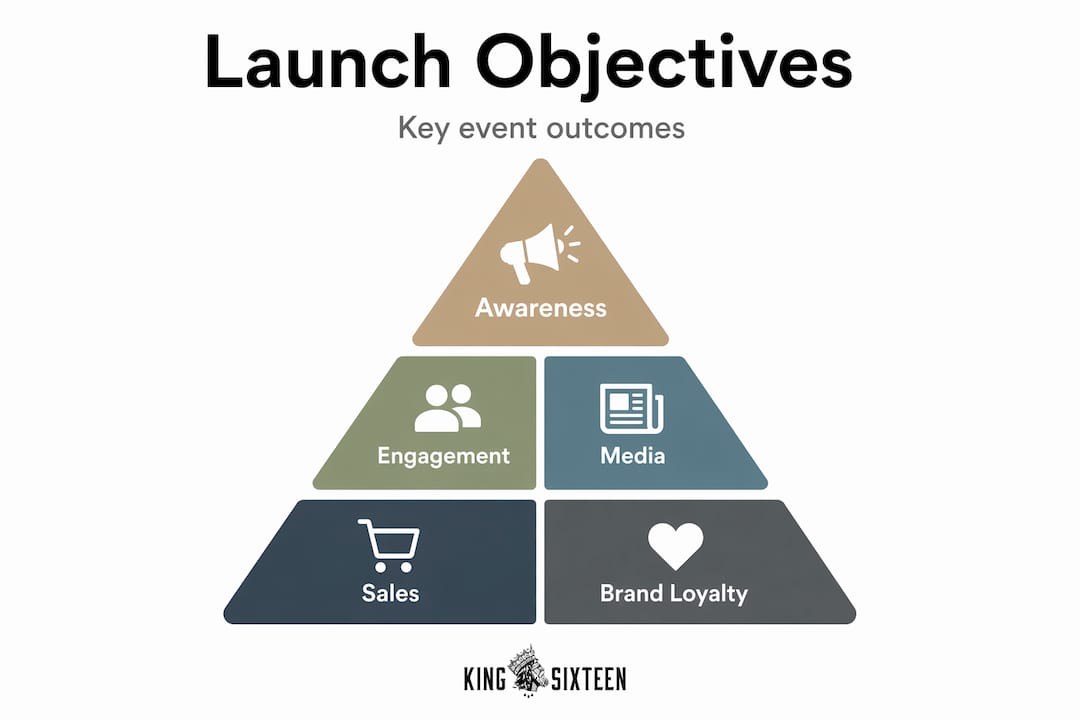
Well-executed product launch events aim to create awareness and excitement, help audiences understand the problem the product solves, and generate early momentum, including sales, while providing channels to engage and gather feedback. That is a lot to accomplish in a single experience, which is exactly why planning matters so much.
Here are the five core objectives that every high-impact launch event should address:
- Awareness: Generating buzz in your target market through press coverage, social sharing, influencer engagement, and word of mouth
- Education: Communicating the product's value proposition clearly and demonstrating differentiation from existing solutions
- Momentum: Driving trial, initial sales, pre-orders, or sign-ups to accelerate early adoption
- Engagement: Creating two-way communication channels that allow real-time feedback and foster ongoing relationships
- Perception setting: Establishing the brand narrative and product positioning that will carry forward through the full market lifecycle
Statistic callout: Research consistently shows that experiential marketing drives measurable engagement outcomes across consumer and B2B audiences alike, with in-person events remaining among the highest-converting touchpoints in a brand's marketing mix.
Smart brands connect their engagement and ROI strategies directly to these objectives from day one. They do not measure success by how many people showed up or how many photos were posted. They measure it by how many target buyers moved forward in the purchase journey.
Pro Tip: Before you finalize your event format, write down the single most important action you want a first-time attendee to take after leaving. Everything from the venue layout to the speaker lineup should support that one action.
The brands we work with at King Sixteen consistently outperform their competitors on launch metrics not because they spend more, but because they align every creative and logistical decision to a clear outcome. Clarity of purpose is what separates a memorable launch from a forgettable showcase.
Essential steps to plan and execute a high-impact launch
With clear objectives in mind, let's examine how to architect a launch event for success, from idea to execution. The process is neither mysterious nor overly complex, but it does require disciplined thinking at each stage.
-
Set SMART objectives tied to business outcomes. Your goals should be specific, measurable, achievable, relevant, and time-bound. "Generate buzz" is not a goal. "Secure 50 qualified sales conversations within 30 days of launch" is a goal. Build your launch planning strategies around outcomes you can actually track.
-
Segment your audience. Not every attendee has the same relationship to your product. Press, retail partners, existing customers, and new prospects need different touchpoints within the same event. Design tiered experiences that speak directly to each group.
-
Build the brand story first. Before you book a venue or design a set, nail the narrative. What does this product do that nothing else does? Why does it matter right now? What feeling do you want people to walk away with? Story first, logistics second.
-
Design the experience around the story. Every spatial, sensory, and interactive element should reinforce the narrative. Lighting, materials, sound, flow, demo stations, food and beverage selections: all of it communicates brand values. Use your launch checklist to ensure nothing falls through the cracks.
-
Embed real-time feedback mechanisms. In-event pulse surveys, QR-driven response tools, and facilitated Q&A sessions give you data in the moment, not just in the post-event debrief. That immediacy is invaluable.
-
Plan the post-event amplification cycle. Your content team should be capturing video, photography, testimonials, and social moments throughout the event. The post-launch week is when most brands lose momentum. Plan for it in advance. A strong brand activation guide will map this out for you.
-
Measure and iterate. Product launch event objectives should translate into measurable outcomes, not just attendance or engagement, with plans for pre-, during-, and post-event measurement and conversion. Close the loop by comparing actual results to stated objectives and document what you will do differently next cycle.
Here is a simple framework for thinking about metrics across your launch timeline:
| Phase | Key activities | Primary metrics |
|---|---|---|
| Pre-event | Invitations, RSVPs, press outreach | Response rate, confirmed attendance, media commitments |
| During event | Demos, presentations, networking | Engagement rate, demo completions, feedback scores |
| Post-event | Follow-ups, content distribution, sales | Conversion rate, media coverage, revenue attributed |
Consider streamlined event planning tools and platforms that allow your team to coordinate vendor timelines, run-of-show updates, and real-time logistics without relying on disconnected spreadsheets.
Pro Tip: Always tie your launch metrics to business outcomes, not just event buzz. If you cannot draw a straight line from an event metric to a revenue or retention outcome, question whether you are measuring the right thing.
Measuring success: Beyond attendance and headlines
A robust launch plan is only as good as its measurement framework. This is where many high-budget launches quietly fail. They generate impressive optics but struggle to demonstrate actual business return, leaving marketing teams on the defensive during post-launch reviews.
The most common mistake is treating attendance figures or press mentions as proof of success. Those are outputs, not outcomes. The modern standard for measuring launch event performance demands a deeper framework.
"A practical benchmark approach for launch PR/marketing compares performance against peers using standardized media-impact metrics rather than raw outputs (e.g., mentions without quality/context)."
This is where tools like Launchmetrics' Media Impact Value, known as MIV, become genuinely useful. MIV assigns a standardized monetary value to every media placement based on quality, reach, and contextual relevance. Instead of counting mentions, you are evaluating the actual market impact of each coverage piece. That is a meaningful shift in how you justify and refine your launch investment.
Here is a side-by-side comparison of traditional versus modern measurement approaches:
| Dimension | Traditional metrics | Modern metrics |
|---|---|---|
| Media performance | Total mentions, press clip count | MIV, share of voice vs. competitors |
| Audience engagement | Attendance numbers, social likes | Time on experience, demo completion, purchase intent |
| Sales impact | Anecdotal post-event sales | Attributed pipeline, 30/60/90-day conversion tracking |
| Feedback quality | General satisfaction surveys | Structured NPS, product-specific response data |
| Competitive context | Internal year-over-year comparison | Peer benchmarking against industry standards |
Building strong event branding essentials into your measurement approach also matters. When your event is visually distinctive and narratively coherent, the quality of media coverage improves naturally, because journalists and content creators have a compelling story to tell.
Qualitative feedback is equally important. Post-event interviews with key attendees, structured debrief sessions with your sales team, and analysis of social conversations give you signal that numbers alone cannot. The best launch teams synthesize both streams to build a 360-degree view of performance.
Why the best launch events are only part of the puzzle
Here is a perspective most marketing playbooks will not tell you directly: the product launch event itself is not your competitive advantage. What you do with it is.
We have seen brands execute beautiful, technically flawless events and walk away with minimal measurable return. Not because the event failed, but because it was treated as the destination rather than the catalyst. The launch event fires the starting gun. Everything after it determines whether you win the race.
Conventional launch thinking tends to undervalue three things consistently. First, cross-channel continuity. The messaging, visual language, and emotional tone established at your launch event should cascade immediately and consistently across paid media, social channels, email, retail environments, and your sales team's conversations. When those channels fragment after the event, you lose the momentum you just paid to create.
Second, content capture as a strategic asset. Your event should be producing weeks of post-launch content, not just a highlight reel. Raw footage, attendee reactions, founder interviews, product demonstrations, behind-the-scenes moments: all of it feeds the amplification engine. Brands that invest in dedicated content production at their launch event often find that the event's media reach triples over the following three weeks.
Third, the product feedback loop. Your launch audience is the highest-quality focus group you will ever have access to. Their live reactions, questions, and friction points are direct signals for your product team. Build mechanisms to capture that feedback systematically and route it to product leadership within days, not weeks. That speed-to-insight is a genuine competitive advantage that most brands leave on the table.
A practical example: consider a brand launching a new wearable technology product. The event generates strong media coverage and enthusiastic attendees. But the brand also captures 200 responses from a structured in-event survey, extracts 15 specific objections from demo conversations, and publishes a three-part content series using event footage. That content series generates more qualified web traffic in the 30 days after launch than any pre-launch campaign. The sales team enters post-launch conversations already armed with answers to the top objections. That is what end-to-end thinking looks like in practice.
Review our expert product launch strategies to see how this thinking translates into real execution frameworks for high-value brands.
The brands we admire most treat their launch events as the cornerstone of a coordinated go-to-market moment. Not a siloed spectacle. A strategic activation that connects product, marketing, sales, PR, and content into a single, coherent push. That is where the real return lives.
Ready to deliver exceptional launch experiences?
If your next product launch deserves more than a standard event playbook, you need a partner who builds experiences that move markets.
At King Sixteen, we design and execute experiential marketing solutions for established brands that need things done right, at speed, and without margin for error. From immersive environments to custom fabrication and full-scale production, our turnkey model handles every detail so your team stays focused on what matters. Whether you need a flagship private event that earns headlines or a full end-to-end event services partnership, we bring the strategic thinking and execution muscle your launch demands. Let's talk about what your brand deserves.
Frequently asked questions
What is the main goal of a product launch event?
The main goal is to debut a product to its market, generate excitement, drive early sales, and lay the foundation for long-term brand engagement. Well-executed product launch events create awareness, educate audiences on the problem the product solves, and build early momentum including initial sales and ongoing feedback channels.
How do you measure the success of a product launch event?
Success is measured through both qualitative and quantitative outcomes, including conversions, media impact, attendee feedback, and benchmarks against industry peers. A strong benchmark approach compares performance using standardized media-impact metrics rather than raw output counts like mentions alone.
What's the difference between a product launch event and a general marketing event?
A product launch event is specifically designed for the debut of a new or significantly updated product, making it a pivotal brand-building and sales-driving milestone. As defined, it is a marketing initiative built around a single product's entry into market, unlike broader marketing events that serve general awareness or relationship goals.
Should launch events include both in-person and virtual experiences?
Yes, hybrid events often maximize reach and engage segments unable to attend live, which strengthens overall results. In-person experiences drive depth of engagement while virtual components extend geographic reach and multiply your content distribution opportunities post-event.