What makes a brand unforgettable comes down to five disciplines executed together: simplicity, repeated distinctive assets, emotional resonance, authentic storytelling, and behavior that matches every promise you make. Brands that master all five create cognitive accessibility so strong that customers recognize them in under one second without reading a name.
- Cognitive load wins. Simple, consistent signals reduce mental effort. The brain files them faster and retrieves them more reliably.
- Repetition beats spectacle. Frequent, smaller touchpoints strengthen memory more than one massive activation.
- Operations seal the deal. A premium promise broken by poor service destroys recall faster than any competitor can.
Your next step: Run a 90-day asset audit. Identify your top three distinctive assets, confirm they appear consistently across every touchpoint, and brief one high-priority experiential activation around them.
Pro Tip: Don't start the audit with design. Start with customer interviews. Ask what they remember first. The answer is almost never what your team expects.

Table of Contents
- What the five-pillar memorability framework means for experiential work
- How to design distinctive assets and a repetition strategy that sticks
- Aligning live experience and operations so promises don't backfire
- Embedding memorability into campaign planning: timelines, budgets, and cadence
- Measuring memorability: KPIs and reporting for brand lift
- The five pillars in action: Kingsixteen client work
- Agency briefing checklist: what to ask and what to watch for
- Key Takeaways
- What most brands get wrong about memorability
- Kingsixteen builds the experiences that make brands stick
What the five-pillar memorability framework means for experiential work
The five-pillar framework gives marketing leaders a structured lens for designing, executing, and measuring immersive campaigns. Each pillar targets a different stage of how memory forms.
Simplicity reduces cognitive load so the brain can file your brand quickly. In an experiential context, this means one dominant visual idea per activation, not five competing themes.
Repetition of distinctive assets builds the "neural folder" that makes recall automatic. Emotion acts as the brain's save button, tagging high-arousal moments for long-term storage. A product launch that triggers genuine surprise or delight gets encoded more deeply than a polished but neutral presentation.
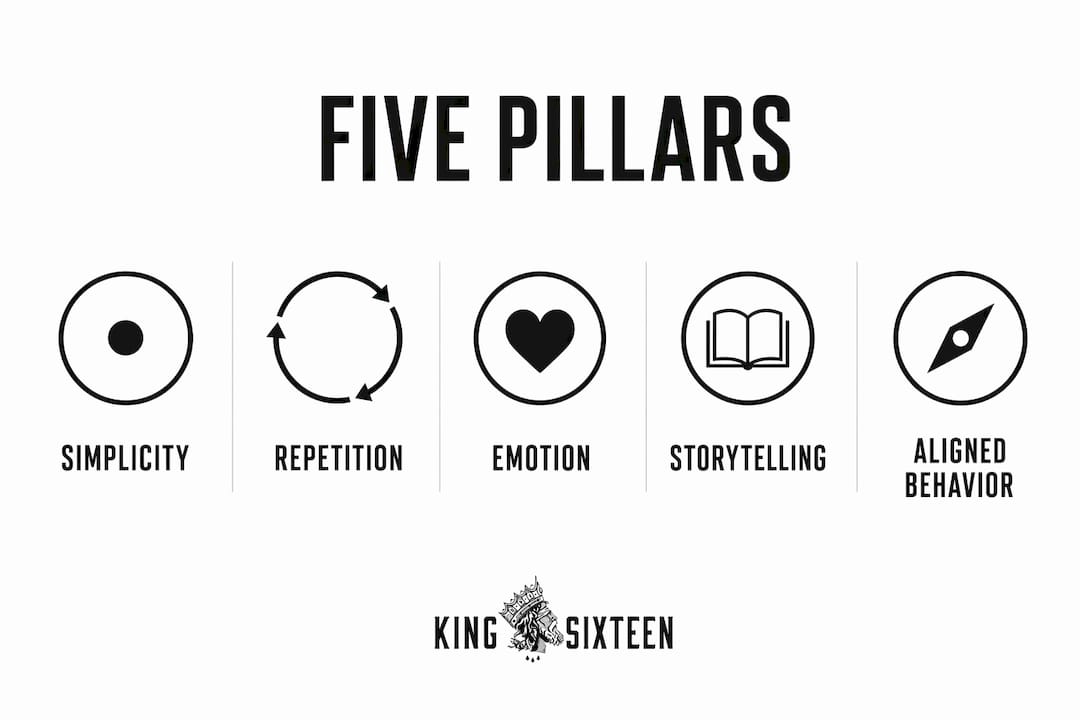
Authentic storytelling transfers brand meaning into long-term memory because narrative transportation increases retention. People remember stories far better than isolated facts. Place the customer as the protagonist, not the brand.
Aligned behavior is where most brands lose ground. Customers remember how a brand performs under pressure more than what its marketing claims. Every staff member at an activation is a brand asset.
Pro Tip: For immersive work, map each pillar to a physical touchpoint before production begins. If you can't name which pillar a design element serves, cut it.
How to design distinctive assets and a repetition strategy that sticks
Distinctive assets are the sensory cues that trigger instant brand recognition. For experiential programs, prioritize assets in this order: visual, sonic, tactile, motion, then scent.
| Asset Type | Signature Element | Primary Cue | Priority Touchpoints | Governance Owner |
|---|---|---|---|---|
| Visual | Logo mark, hero color | Sight | Entry, stage, packaging | Brand director |
| Sonic | Audio logo, ambient score | Sound | Welcome, transitions | AV lead |
| Tactile | Material texture, weight | Touch | Product demos, gifting | Fabrication lead |
| Motion | Signature animation | Sight + motion | Digital screens, reveals | Creative director |
| Scent | Branded fragrance | Smell | Venue entry, lounge | Ops manager |
Governance quick rules:
- Lock your top two assets as "protected." No modification without brand-director sign-off.
- Set a consistency threshold: any asset appearing in fewer than 80% of touchpoints is a gap, not a variant.
- Document HEX/PANTONE codes, audio file specs, and material grades in a single shared brief before fabrication begins.
Pro Tip: When budget is tight, invest first in your visual and sonic assets. They deliver the highest neural retrieval return per dollar because they fire simultaneously and reinforce each other.
See physical brand asset production for fabrication guidance on building these elements at scale.
Aligning live experience and operations so promises don't backfire
Operational misalignment is the most common cause of lost memorability. A premium positioning statement means nothing when guests wait 20 minutes for a drink or staff can't answer basic product questions.
Common red flags in experiential campaigns:
- Premium pricing signals paired with slow or undertrained service staff
- Brand messaging that contradicts the physical environment (luxury copy, budget fabrication)
- No escalation protocol when something goes wrong in front of guests
- Backstage chaos that bleeds into the guest experience
Alignment audit checklist:
- Frontline scripts reviewed and rehearsed against brand voice
- Escalation rules documented and tested before doors open
- Quality gates at venue entry, key touchpoints, and exit
- Backstage runbooks distributed to every vendor lead
Fast-track training works. A brief role-play session covering the most likely guest friction points outperforms longer slide deck training every time. Pair it with a one-page SOP each staff member keeps on their person. For a deeper look at delivering on brand promises at every touchpoint, the principles apply directly to live activations.
Embedding memorability into campaign planning: timelines, budgets, and cadence
Memorability is built through structured repetition over time, not a single spectacular moment. Here is how to plan for it.
Timeline phases:
- Strategy and asset development (weeks 1–6): Define pillars, lock distinctive assets, produce governance brief.
- Pilot activation (weeks 7–10): One controlled activation to test assets and ops alignment.
- Scaled cadence (months 3–9): Repeated activations at planned intervals, each reinforcing the same core assets.
- Reinforcement and measurement (months 10–12): Brand-lift studies, asset refinement, cadence adjustment.
Budget drivers for immersive activations:
- Custom fabrication (typically the largest single line item for premium activations)
- Venue and logistics
- AV and digital integration
- Staffing and training
- Rights, licensing, and music
- Repeat activation costs (often underbudgeted)
Invest disproportionately in fabrication and staffing. Those two categories have the highest direct impact on memorability because they shape the physical and human experience guests actually remember.
Cadence principle: Smaller, repeated activations with high-utility content consistently outperform infrequent large ones for recall. A brand appearing three times across a quarter with consistent assets will outperform a single large-scale event for long-term recognition.
Briefing checklist: Confirm distinctive assets are named and locked. Confirm repetition rules are written into the production brief. Assign a single owner for asset governance on every activation.
Measuring memorability: KPIs and reporting for brand lift
| Metric | Type | How to Measure |
|---|---|---|
| Unaided brand recall | Primary | Post-event survey, open-ended |
| Aided brand recognition | Primary | Post-event survey, prompted |
| Emotional arousal proxy | Secondary | Facial coding, biometric sampling |
| Attention dwell time | Secondary | Eye-tracking, session analytics |
| Consideration shift | Behavioral | Pre/post paired sampling |
| Trial or purchase intent | Behavioral | Survey + CRM tracking |
Testing recommendations:
- Run a short brand-lift study with a control cohort (non-attendees matched by profile) against attendees at 7 days and 30 days post-activation.
- Use pre/post paired sampling for experiential attendees to isolate the activation's contribution.
- Where budget allows, add attention or eye-tracking data at key asset touchpoints inside the venue.
Attribution tip: In integrated campaigns, credit repeated touchpoints proportionally. A single activation that follows three prior brand exposures will show inflated lift. Tag your touchpoints and report the sequence, not just the event.
Reporting template for executive updates: Headline metric (unaided recall shift), key learning (which asset drove the most recognition), and next experiment (what to test in the following activation). Keep it to one page.
The five pillars in action: Kingsixteen client work
Kingsixteen has applied this framework across a range of high-stakes activations. Three examples show how the pillars translate into real decisions.
Porsche: The strategy centered on sensory simplicity, letting the vehicle and a single dominant sound environment carry the brand. The sonic asset was engineered specifically for the space. Operationally, every staff interaction was scripted to reinforce precision and performance. The outcome: attendees consistently recalled the activation's atmosphere weeks later, not just the car.
Ray-Ban: Storytelling was the lead pillar. The activation placed the customer's personal narrative at the center, with the product as the tool of self-expression rather than the hero. Fabrication created tactile touchpoints that reinforced the brand's craft positioning. The operational note: product-handling protocols were rehearsed until they felt natural, not scripted.
Audi and Fossil: Both projects required tight asset governance across multi-day formats. The lesson from both: the brands that arrived with a locked asset brief executed faster, spent less on revisions, and produced stronger recall scores than those that finalized assets during production.
Repeatable insight: Lock your assets before production begins. Every revision made during fabrication costs twice as much as the same decision made in the strategy phase.
Agency briefing checklist: what to ask and what to watch for
When hiring or briefing an experiential partner, these questions separate agencies that protect memorability from those that just produce events.
- Can you show us how you document and govern distinctive assets across a multi-activation program?
- How do you train frontline staff to deliver brand voice under pressure?
- What is your measurement protocol for brand lift, and who owns the reporting?
- How do you handle asset changes mid-production without breaking consistency?
- What is your cadence recommendation for our budget, and how do you justify it against recall data?
- Who is the single point of accountability for ops alignment on activation day?
- How do you brief vendors on brand standards, and what quality gates do you use?
Proposal red flags: No asset governance documentation. Vague measurement plans ("we'll survey attendees"). Cadence recommendations that default to one large annual event. No named ops lead.
Acceptance criteria: Asset ownership is assigned in writing. Timelines include a pilot phase. Reporting cadence is agreed before contract signature. Ops handoff protocol is documented.
Key Takeaways
Memorable brands are built through five disciplines applied consistently: simplicity, repeated distinctive assets, emotional resonance, authentic storytelling, and operations that match every promise.
| Point | Details |
|---|---|
| Five pillars drive recall | Simplicity, repetition, emotional resonance, storytelling, and aligned behavior work together to build lasting recognition. |
| Repetition beats spectacle | Smaller, repeated activations with consistent assets outperform infrequent large events for long-term brand recall. |
| Operations seal memorability | Operational misalignment destroys recall faster than any competitor; train staff and lock runbooks before activation day. |
| Measure with paired sampling | Run pre/post brand-lift studies with a control cohort at 7 and 30 days post-activation to isolate true memorability gains. |
| Kingsixteen applies this framework | Kingsixteen's turnkey model covers strategy, asset governance, fabrication, and measurement across immersive activations for brands like Porsche, Audi, Ray-Ban, and Fossil. |
What most brands get wrong about memorability
The brands we see struggle most aren't failing because of bad creative. They're failing because they treat memorability as a campaign output rather than a discipline. They invest in one spectacular activation, measure the immediate buzz, and move on. Six months later, the recall data is flat.
The fix is structural, not creative. Asset governance comes first. Before you brief a single designer or fabricator, lock your distinctive assets and assign an owner. Then fix your ops alignment. A beautifully designed activation staffed by undertrained people is a liability, not an asset. Cadence comes last, because frequency only compounds what's already working.
The brands that stay in memory, the ones that build real brand loyalty rather than transactional repeat purchase, are the ones that show up consistently, behave consistently, and protect their assets relentlessly. That discipline is available to any brand willing to commit to it. If you want to discuss a tailored pilot built around these principles, we're ready to work through it with you.
Kingsixteen builds the experiences that make brands stick
If you're planning a product launch, a premium brand activation, or a multi-touchpoint campaign and you need it executed without margin for error, Kingsixteen is built for exactly that. We handle strategy, fabrication, staffing, AV, and measurement end-to-end, so your team focuses on the brand decisions, not the logistics.
Our clients include Porsche, Audi, Ray-Ban, Fossil, and the Natural Diamonds Council. Every project starts with asset governance and ends with a measurement report. Marketing leaders planning immersive experiential campaigns in 2026 can reach out directly to discuss scope, timeline, and activation cadence. Contact Kingsixteen to request a case study or start a conversation about your next activation.