Trade shows are one of the most expensive line items in your marketing budget, yet most activations deliver forgettable experiences that dissolve within days of the event ending. A well-designed experiential trade show activation changes that equation entirely. In-person events are the most trusted marketing channel for 80% of respondents, and 77% of marketers call events their most effective channel. The difference between a booth that gets walked past and one that generates pipeline comes down to three things: clear goals, smart preparation, and deliberate execution. This guide gives you all three.
Table of Contents
- Understanding the impact and goals of experiential trade show activations
- Essential preparation: planning tools and resources for your trade show activation
- Executing engaging experiential activations that captivate and convert attendees
- Measuring success: tracking ROI and maximizing post-event impact
- Why focusing on authentic interaction over flashy gimmicks drives lasting trade show success
- Connect your brand with King Sixteen's experiential marketing expertise
- Frequently asked questions
Key Takeaways
| Point | Details |
|---|---|
| Experiential activations build trust | In-person experiences create deeper engagement and stronger business growth than other marketing channels. |
| Plan with clear goals | Define measurable outcomes like lead generation and brand lift before designing your booth and activities. |
| Use interactive tech | Employ QR code lead capture and motion-based activations to attract attention and gather quality data. |
| Design open booths | Keep the front open for natural flow to engage multiple attendees simultaneously and avoid barriers. |
| Measure and follow-up | Track engagement metrics in real time and start post-event follow-up immediately to maximize ROI. |
Understanding the impact and goals of experiential trade show activations
The first question you should answer before booking floor space is not "what does our booth look like?" It is "what specific business outcome does this activation need to produce?" Brand lift, qualified pipeline, retention conversations, or product education — each goal shapes every decision that follows, from staffing to the interaction your visitors will have.
The business case for investing in real trade show engagement is strong. 83% of marketers say events directly help their business grow, and 70% of attendees rank in-person events as their primary source of professional learning. That second number is the one most brands miss. Your audience is not at the show to watch a demo reel. They are there to learn something they could not get from a webinar.
"The most effective activations treat attendees as participants, not an audience. When someone makes a choice inside your booth environment, they own a piece of the experience."
The brand engagement strategies that convert booth visitors into real opportunities share a common structure:
- A single, clear business objective that every element of the activation supports
- A defined audience profile so the interaction speaks directly to the person standing in front of you
- An engagement mechanism that requires participation, not passive observation
- A measurable signal that tells you whether the goal was met
Think of each activation goal as a filter. When you know you are there to generate qualified enterprise leads, you stop wasting floor space on branded merchandise and start investing in curated one-on-one conversations. When the goal is product education, networking and marketing growth become secondary to building the clearest hands-on demonstration possible.
With a clear understanding of why experiential activations matter, let's examine what you need to prepare before the event.
Essential preparation: planning tools and resources for your trade show activation
Getting your activation right on the show floor starts months before anyone steps through the convention center doors. The planning phase is where great activations are won or lost, and most brands underinvest here.
Start with your booth's physical layout. The temptation is to fill every square foot with messaging and product. Resist it. Leaving the front third of your booth open as an engagement zone for three to five people, without tables blocking entry, dramatically improves foot traffic conversion. Tables at the front are psychological barriers. Remove them and you signal openness rather than selling.

Plan your booth in three functional zones:
| Zone | Primary purpose | Key elements |
|---|---|---|
| Attraction | Draw foot traffic from the aisle | Motion, bold visuals, clear headline |
| Engagement | Hold attention and invite interaction | Demo stations, activities, staff conversations |
| Conversion | Qualify and capture leads | Private area, QR capture, CTA materials |
Technology selection matters enormously for booth experience enhancement. The tools you pick should capture meaningful data, not just count badge scans. QR code lead capture systems are now the preferred approach for most activations. They feed data directly into your CRM and allow you to track which specific interaction a visitor came from, which is far more useful than a raw lead count.
Your messaging needs to communicate value in under five seconds. Interactive exhibition strategies fail when the booth requires explanation before a visitor understands why they should stop. One large, clear headline that speaks to a specific pain point beats six panels of product features every time.
Pro Tip: Build your booth messaging by listing the top three questions your best customers asked before buying, then answer all three on a single panel. If you cannot do it in one panel, simplify the offering or reframe the message.
Following a brand activation step-by-step guide during planning keeps your team aligned and ensures no critical element gets left to the week of the show. You can also create immersive brand activations by mapping the visitor journey from first glance to lead capture before you finalize any design decision. Use AI analytics to measure brand awareness benchmarks before the show so you have a clean baseline for post-event comparison.
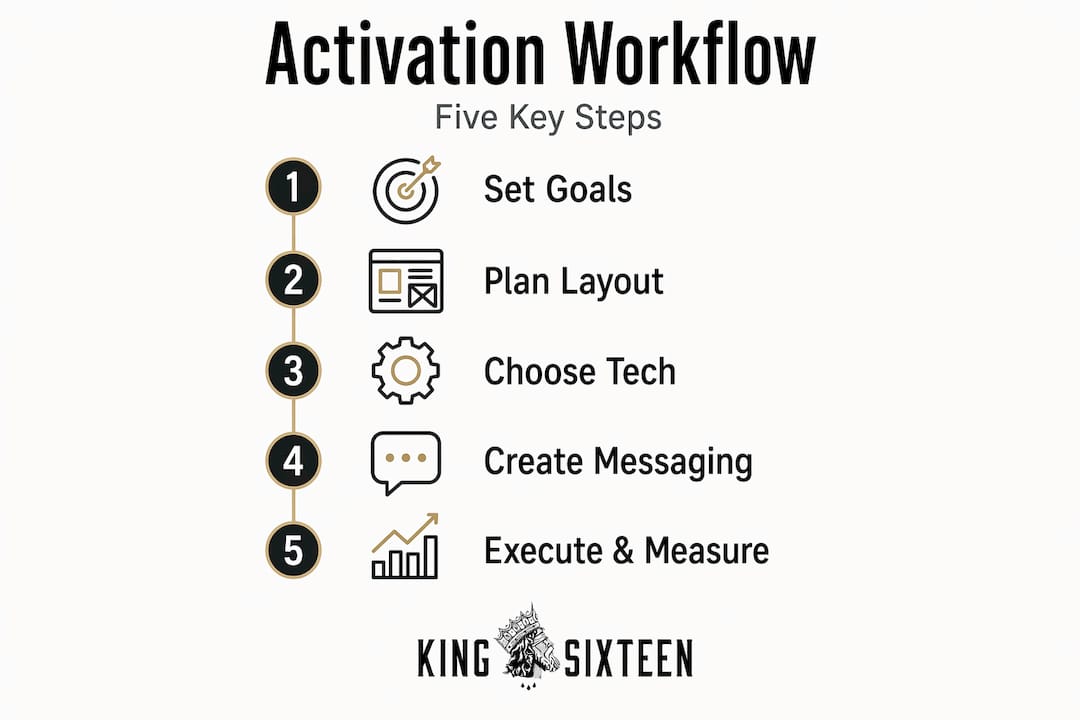
With these tools and design strategies ready, we can move to how to execute the activation effectively on the show floor.
Executing engaging experiential activations that captivate and convert attendees
Execution is where even well-planned activations lose momentum. The show floor is noisy, fast, and competing for the same people from every direction. Here is how to cut through it.
-
Layer your activation experience. A single demo is not enough. Build a sequence: an attention trigger at the aisle, an interactive middle layer where attendees participate, and an emotional payoff that creates a shareable or memorable moment. Each layer serves a different attendee who is at a different stage of interest.
-
Use motion intentionally. Moving booth elements draw traffic because motion creates natural curiosity. This does not mean a conveyor belt for every brand. It means thinking about what moves in your booth and whether it serves the story. A rotating product display, a live fabrication demonstration, or a staff member actively working rather than standing still all trigger the same instinct.
-
Deploy QR codes as data infrastructure, not afterthoughts. QR code lead capture systems cost 95% less than traditional badge scanners and offer real-time analytics. Place them at every engagement point, not just the exit. When you know which station generated the most scans, you know where to invest at the next show.
-
Train your booth staff as conversation architects. The best live event promotions in the world fail if the person at the booth opens with "Can I tell you about our product?" Staff should open with a question tied to the attendee's world, not a product pitch. The interaction should feel like a discovery for the visitor.
"Audience participation activities work best when the activity teaches something true about your brand. If the activity could be done in any booth, it is not differentiated enough."
Pro Tip: Set up a brief five-minute staff debrief at the end of each show day. The two questions to ask: "Which interaction generated the most engagement today?" and "What objection came up most often?" Those answers shape your next day's approach and feed directly into post-event content.
Strong brand activation ideas for the show floor also include workshop-style sessions that give attendees a tangible output, product customization experiences that create personalization and ownership, and side-by-side comparisons that let visitors arrive at their own conclusions rather than being told what to think.
Having implemented the activation, it is crucial to verify its success through accurate measurement and analysis.
Measuring success: tracking ROI and maximizing post-event impact
Most post-event reports count leads and call it measurement. That is not measurement. Measuring experiential marketing across layers, including engagement quality and revenue outcomes, is the approach that actually tells you whether the activation worked.
Here is a practical framework for what to track and when:
| Metric | When to capture | What it tells you |
|---|---|---|
| Dwell time | During the event | Whether the experience holds attention |
| Participation rate | During the event | How many visitors move from observing to engaging |
| Qualified leads | Within 24 hours | Whether traffic matches your target audience |
| Pipeline influenced | 30 to 90 days post-event | Whether conversations converted to revenue |
| Content reach | 7 to 14 days post-event | Whether activation content extended the brand story |
Real-time booth analytics using QR code lead capture eliminate the need for expensive badge scanning systems while giving you richer data. Each QR touchpoint tells you what the visitor engaged with, how long they stayed in the interaction zone, and what content they consumed after.
CRM integration is not optional for high-performing activations. Feed your lead data directly into your CRM the day the event ends, with tags that identify the specific activity each lead came from. This lets your sales team personalize every follow-up and gives you the attribution data you need to justify next year's budget.
- Segment leads by engagement depth — not just "lead" but "demo participant," "workshop attendee," or "personalized consultation"
- Build a post-event content sequence that references the specific activation so follow-up feels like a continuation, not a cold outreach
- Capture social amplification metrics from brand-tagged content that attendees posted during the event
Pro Tip: Film a short recap of the activation on the final day of the show. Edit it within 48 hours and send it to every lead as part of the first follow-up. Seeing themselves in or around your experience is one of the most effective ways to keep the brand connection warm.
A high-impact brand activation does not end when the booth comes down. The post-event phase is where you convert attention into pipeline, and most brands leave that opportunity on the table.
Why focusing on authentic interaction over flashy gimmicks drives lasting trade show success
Here is the thing we see most often: brands spend enormous amounts on production value and almost nothing on the actual conversation design. A booth with a wall-to-wall LED display, a custom scent, and a DJ is impressive for about 30 seconds. After that, attendees are looking for a reason to stay, and if the only answer is "look at how nice this looks," they will move on.
The activations we have seen generate real pipeline are not always the most expensive ones. They are the ones built around a genuine insight about what the attendee needs to learn, feel, or decide. A product demonstration that solves a specific problem the attendee recognized that morning will outperform a million-dollar installation with no clear purpose every single time.
Over-engineering the technology side of an activation is a common mistake. Augmented reality experiences, gamification layers, and sensor-triggered environments are genuinely powerful tools. But when the technology becomes the point rather than the vehicle, you lose the thread. Attendees remember the novelty, not the brand.
The brands that win on the show floor treat experiential marketing techniques as a business tool, not a creative exercise. They set goals that their CFO would recognize, they build interactions that serve their sales motion, and they measure outcomes that connect directly to revenue. Authentic trade show demonstration ideas come from product truth and audience empathy, not from asking "what has not been done before?"
You can use brand engagement strategies to anchor every creative decision to a business outcome. When you do, the activation becomes focused, the team executes with clarity, and the post-event story you tell internally is one of impact rather than impressions.
Connect your brand with King Sixteen's experiential marketing expertise
Knowing what makes an experiential trade show activation work is one thing. Building one that executes flawlessly under real show conditions is another challenge entirely. At King Sixteen, we design and produce activations for brands that need things done right, without the back-and-forth of managing twelve vendors at once.
Our team handles everything from concept and fabrication to staffing, AV, and CRM integration through a single trusted point of accountability. Whether you are planning a full experiential campaign or a targeted trade show presence at a major industry event, we bring the production rigor and creative thinking that turns floor space into a business asset. By partnering with King Sixteen, you transform your next trade show activation into an experience that attendees remember and decision-makers act on.
Frequently asked questions
What is an experiential trade show activation?
An experiential trade show activation is a marketing strategy that creates interactive, immersive brand experiences at trade shows to engage attendees and drive deeper connections beyond traditional static displays.
How can I measure the ROI of my trade show activation?
Track engagement depth, qualified lead volume, and pipeline influenced, and use QR code lead capture for real-time analytics and CRM integration to connect booth activity directly to revenue outcomes.
What elements make a trade show activation successful?
Success depends on clear business goals, an open booth layout, and experiential activations that build product demos, workshops, and genuine social or emotional payoffs into a single coherent experience.
How quickly should I follow up with leads from a trade show?
Leads go cold within 72 hours, so begin follow-up the day the event ends, referencing the specific activation or interaction to make the outreach feel personal rather than generic.