What makes interactive event ideas work at the premium level
The best interactive event ideas are not activities bolted onto an agenda. They are deliberate systems designed to make attendees feel something, do something, and remember something. At the premium level, that means layering space, branding, interaction mechanics, and measurement into a single cohesive experience.
The formats that consistently deliver include:
- VR/AR experiences that place attendees inside a brand narrative
- Social photo booths with custom filters, branded overlays, and 360° capture for instant social sharing
- Interactive food and drink stations where customization becomes the engagement mechanic
- Gamified contests including scavenger hunts, trivia, and leaderboard challenges
- Live polls, Q&A sessions, and campfire-style discussions that turn passive audiences into active participants
- Virtual event activities for hybrid formats, including avatar-based networking and digital escape rooms
Eventbrite identifies these formats as the top drivers of attendee memorability and brand growth. The difference between a good activation and a great one is whether each element connects to a measurable outcome.
Table of Contents
- Popular interactive formats that premium brands actually use
- Designing immersive activations that generate measurable engagement
- How to design interactive events that work for every attendee
- How Kingsixteen builds interactive experiences that last
- Tailoring interactive events to different audience demographics
- Common challenges in interactive event execution and how to fix them
- Kingsixteen turns your next activation into a brand milestone
- Key Takeaways
Popular interactive formats that premium brands actually use
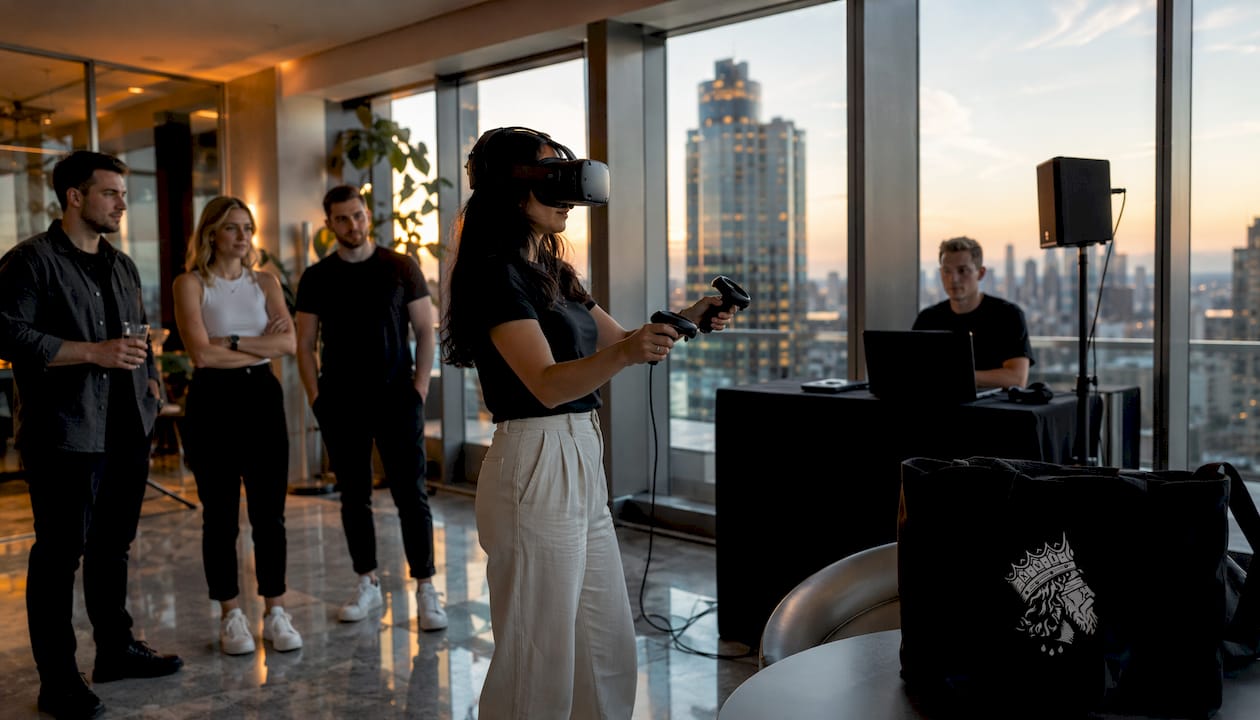
Technology-driven experiences set the tone for high-end activations. VR and AR are no longer novelties; they are expectation-setters. A well-executed AR scavenger hunt or a virtual skydiving simulator gives attendees a story to tell. These immersive brand experiences also generate shareable content that extends the activation's reach well past the event date.
Social photo booths remain one of the highest-ROI interactive formats because they require minimal facilitation and produce branded content at scale. The key is customization: touchscreen filter selection, branded backdrops, and event-specific hashtags that feed directly into a social campaign.
For food and beverage, the interaction is the experience. A customizable cocktail bar or a live chef station does more than feed guests. It creates a natural gathering point, slows dwell time, and sparks conversation. Brands like Fossil and Ray-Ban have used curated sensory stations to reinforce product aesthetics through taste and atmosphere.
Gamified contests deserve more credit than they typically get in premium contexts. A well-designed scavenger hunt with branded checkpoints, or a trivia competition tied to product knowledge, drives repeat participation and keeps attendees moving through the space. Competition and leaderboard mechanics are among the highest-engagement add-ons in brand activations. Churchill Downs and Porsche have both used structured competitive formats to deepen attendee investment in the experience.
Customizable swag stations add a personal dimension. When attendees co-create a keepsake, the brand becomes part of their story. Audi has used this mechanic to connect product personalization messaging directly to the event floor.
Designing immersive activations that generate measurable engagement
The Interactive Entertainment Group frames high-impact activations around four aligned layers: space, branding, interaction, and measurement. Remove any one of them and the activation loses coherence. The space must eliminate dead zones, the branding must be environmental rather than decorative, the interaction must be designed for participation rather than observation, and the measurement must be built in from day one.
Engagement scoring assigns weighted points to specific attendee behaviors: session attendance, booth visits, poll responses, and networking connections. This turns qualitative impressions into a prioritized prospect list for post-event follow-up. A marketer who attended three sessions, completed a product demo, and answered two polls is a different lead than one who walked through the door and left.
Pacing is where most activations underperform. Regularly incorporating interactive elements helps sustain involvement and reduce session drop-off. That cadence applies to physical activations too: if attendees go more than 15 minutes without a prompt to act, they disengage.
Pro Tip: Map your activation floor as a guest journey before you finalize any design. Identify every point where an attendee could stall, lose interest, or miss a branded moment. Then assign a specific interaction mechanic to each of those points. The goal is a continuous loop of prompts, not a series of isolated stations.
Operational complexity scales fast. BizBash's reporting on large-scale activations shows that cross-team coordination, queue management, and content capture require dedicated staffing plans, not improvisation. Integrating brand engagement data through real-time platforms lets you adjust pacing and staffing on the fly.
How to design interactive events that work for every attendee
Accessibility is not a compliance checkbox. It is a design decision that determines how many people can actually participate in your activation. The WCAG 2.1 Level AA standard governs digital interfaces in public venues, and ADA Title II requirements apply to physical installations. Both set a floor, not a ceiling.
Multimodal interaction is the practical application of that principle. Every interactive station should offer at least two input methods: touch and voice, or physical buttons alongside a QR-to-mobile interface. This serves attendees with motor impairments without creating a separate "accessible version" that feels like an afterthought.
Physical design specifics matter:
- Multi-height stations accommodate both standing and seated attendees
- Clear approach spaces of at least 36 inches allow wheelchair navigation
- Seated interaction options at every primary engagement point
Sensory accommodations extend the experience to attendees with visual or hearing impairments. Captions on video content, audio descriptions for visual installations, high-contrast display modes, and hearing loops at speaker-driven stations all serve real segments of your audience. Tactile guides and Braille descriptions, as used at events like the Touch the Art Experience in Austin, demonstrate what genuine inclusion looks like in practice.
Cognitive accessibility is often overlooked at premium events. Consistent navigation patterns, plain-language instructions, and error tolerance in digital interfaces reduce friction for all attendees, not just those with cognitive disabilities. When instructions are clear, participation rates go up across the board.
How Kingsixteen builds interactive experiences that last
Kingsixteen's approach to experiential marketing is built on one principle: every element of an activation should earn its place by contributing to a measurable outcome. That means the design, the fabrication, the staffing, and the data capture are planned together, not assembled separately.
The agency's portfolio includes activations for Porsche, Audi, Ray-Ban, Fossil, the Natural Diamonds Council, and Churchill Downs. Each of those engagements required a different interaction model, but the underlying structure was consistent: a branded environment designed to move guests through a narrative, with interaction mechanics at every stage and measurement built into the flow.
The turnkey model is what makes this possible at scale. Kingsixteen manages design, fabrication, AV, catering, staffing, venues, and digital integration through a single coordinated team. That eliminates the handoff failures that derail most large activations and keeps the guest experience coherent from arrival to exit.
Commitment to branded environment design and accessibility standards is embedded in the production process, not added at the end.
Tailoring interactive events to different audience demographics
A product launch for Porsche buyers requires a fundamentally different interaction model than a trade show activation targeting procurement managers. The format, pacing, and tone of every interactive element should reflect what your specific audience finds rewarding.
For executive and VIP audiences, low-friction, high-prestige interactions work best: private demos, curated tastings, and one-on-one expert sessions. These attendees respond to exclusivity and depth, not volume. For broader consumer audiences, competitive formats like leaderboards and photo contests drive participation because they create social proof in real time.
Age and digital fluency also shape format selection. Younger audiences adopt AR and avatar-based networking quickly; mixed-age groups benefit from parallel options, a digital path and a physical one, so no one is left behind. Leveraging audience participation data before the event, through pre-event surveys and registration data, lets you calibrate the interaction mix before the first guest arrives.
Brand storytelling is the connective tissue across all demographics. When the narrative arc of your activation is clear, attendees from different backgrounds can engage at their own depth without losing the thread.
Common challenges in interactive event execution and how to fix them
Queue buildup is the most common failure point in high-traffic activations. A single VR station with a five-minute experience creates a 30-person line within an hour. The fix is parallel capacity: multiple stations running the same experience, or a reservation system that distributes traffic across the event timeline.
Technology failure at a premium event is not just an inconvenience; it damages brand perception. Every digital interactive element needs a tested fallback. If the AR app crashes, the physical version of that interaction should be ready to deploy immediately.
Engagement drop-off mid-event usually signals a pacing problem, not an audience problem. If participation peaks in the first hour and fades, the activation lacks a second act. Scheduled surprises, new station reveals, or a mid-event competition launch can reset attention and bring disengaged attendees back into the experience.
Data capture gaps happen when measurement is treated as an afterthought. If your CRM integration is not tested before doors open, you will lose the lead data that justifies the entire investment. Build the data flow into the activation design, not the post-event debrief.
Staff alignment is the operational variable most brands underestimate. Every team member on the floor needs to know the guest journey, the interaction mechanics, and the escalation path for technical issues. A single uninformed staff member at a key station can break the experience for dozens of guests.
Kingsixteen turns your next activation into a brand milestone
When the stakes are high and the margin for error is zero, the production model matters as much as the creative concept. Kingsixteen delivers full-scale brand activations from concept through execution, handling every operational layer so your team can focus on the brand story, not the logistics.
From the immersive environments built for Porsche and Audi to the precision production behind Churchill Downs events, Kingsixteen's track record is built on activations that generate real data, real engagement, and real results. The turnkey model means one point of contact, one coordinated team, and no gaps between design intent and on-site reality. If you are planning a product launch, a conference, or a large-scale brand activation, get started with Kingsixteen and build something worth remembering.
Key Takeaways
Premium interactive event ideas generate measurable outcomes when space, branding, interaction mechanics, and data capture are designed as a single integrated system.
| Point | Details |
|---|---|
| Layer all four design elements | Space, branding, interaction, and measurement must align for an activation to produce real engagement data. |
| Pace interactions every 15 minutes | EventsAir recommends adding polls or exercises every 15 minutes to sustain involvement and reduce drop-off. |
| Score engagement for pipeline value | Weighted engagement scoring turns attendee behaviors into a prioritized prospect list for post-event follow-up. |
| Design for accessibility from day one | WCAG 2.1 AA and ADA Title II compliance is faster and less expensive to build in than to retrofit later. |
| Kingsixteen delivers turnkey activations | From Porsche to Churchill Downs, Kingsixteen manages every layer of premium brand activations end to end. |