An activation strategy is a deliberate plan to prompt audiences to engage actively with a brand, moving them past awareness into direct participation and measurable action. Unlike a broad advertising campaign, an activation strategy targets a specific moment, behavior, or decision point. It uses tools like experiential marketing, CRM integration, and engagement analytics to convert curiosity into connection. Brands like Porsche, Ray-Ban, and Audi have used activation strategies to create demand at product launches, not just build recognition. If you work in brand marketing or experiential production, understanding this discipline is the difference between an event people attend and one they remember.
What are the key components of an effective activation strategy?
Activation strategies require clear objectives to align all efforts and measure effectiveness. Without a defined goal, whether boosting awareness, driving immediate conversion, or building long-term loyalty, every downstream decision becomes guesswork. Your objective shapes your creative concept, your channel selection, and your evaluation criteria.
The six core components of any effective activation strategy are:
- Clear objectives: Define whether you are driving trial, purchase, loyalty, or advocacy. Each goal demands a different creative and operational approach.
- Audience segmentation: Go beyond demographics. Map psychographics, purchase behavior, and engagement history to identify who you are activating and why they should care.
- Creative concept: Build around emotional and sensory experiences. The concept must give your audience a reason to participate, not just observe.
- Channel and venue selection: The environment shapes the experience. A trade show floor, a pop-up in SoHo, and a private rooftop event each attract different audiences and create different impressions.
- Operational planning: Staffing, logistics, permitting, and compliance are not afterthoughts. They determine whether your concept actually executes as designed.
- Measurement and data collection: Define your success metrics before the activation launches. Use QR codes, digital interactions, and CRM tracking to capture engagement data in real time.
Pro Tip: Map every activation action to a specific customer value before you finalize the plan. Connecting tasks to tangible benefits like identifying stalled sales leads through CRM integration significantly increases completion and engagement rates.
How does an activation strategy differ from traditional marketing?

Brand activation and traditional marketing share the same ultimate goal: grow the brand. But they operate on entirely different mechanics. Traditional advertising broadcasts a message to a passive audience. An activation strategy creates a moment where the audience becomes a participant.
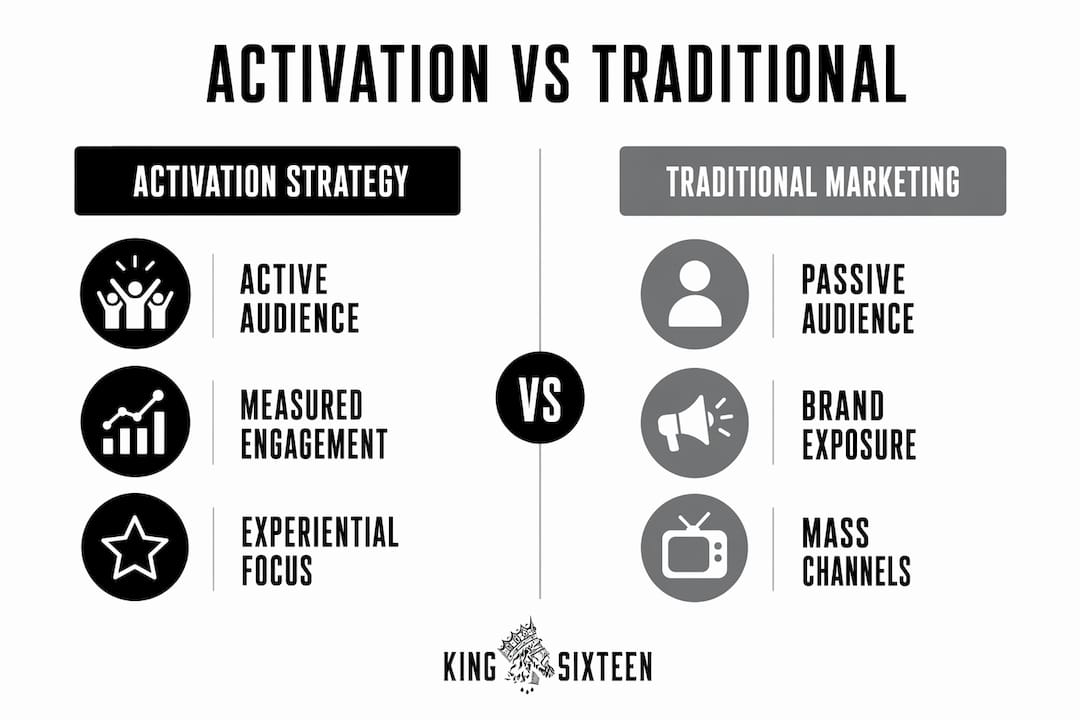
Experiential marketing places emphasis on live experiences with a clear start and end, delivering tangible brand moments that are distinct from ongoing marketing efforts. That specificity is what separates activation from a general campaign. Activation events have a defined location, a defined window, and a defined behavioral objective.
| Dimension | Traditional marketing | Activation strategy |
|---|---|---|
| Audience role | Passive receiver | Active participant |
| Duration | Ongoing or continuous | Time-bound with clear start and end |
| Primary objective | Awareness and reach | Engagement and direct action |
| Measurement | Impressions, reach, frequency | Participation rates, data capture, conversion |
| Brand experience | Message-driven | Sensory, emotional, and interactive |
The contrast matters because it changes how you allocate budget and measure success. A billboard campaign optimizes for reach. An activation optimizes for depth of engagement. Brand activation brings products to life through hands-on demos, immersive environments, and interactive campaigns rather than messages alone. That depth is what builds the kind of loyalty that advertising alone cannot buy.
What are common activation strategy examples in experiential marketing?
Activation strategies take many forms, and the best ones match the format to the audience and the brand's specific goal. The format is not the strategy. It is the vehicle for the strategy.
Common types of activation used in experiential marketing include:
- Pop-up experiences: Temporary branded environments in high-traffic locations. Glossier built its retail brand largely through pop-ups before opening permanent stores, using the format to create scarcity and social media momentum.
- Product sampling and live demos: Letting audiences touch, taste, or test a product removes purchase hesitation faster than any ad. Churchill Downs uses immersive brand environments to let guests experience the culture of horse racing firsthand.
- Trade show activations: Custom booth environments that go beyond display to create interactive moments. Trade show activations that incorporate live demos, games, or personalized consultations consistently outperform static displays in lead capture.
- Digital and social activations: Branded hashtag challenges, AR filters, and app-based experiences extend the activation beyond the physical space. The Natural Diamonds Council has used digital storytelling to connect emotional narratives to product consideration.
- Hybrid activations: Combining a live event with a digital layer, such as a live-streamed product reveal with an in-person VIP experience, multiplies reach without diluting the core brand moment.
- Immersive storytelling environments: Fully designed spaces where every element, from scent to sound to lighting, reinforces the brand narrative. Fossil and Audi have both used this approach to make product launches feel like cultural events rather than sales presentations.
Data collection during activations, through QR codes and digital interactions, allows real-time measurement and optimization of customer engagement. That data loop is what separates a one-time event from a repeatable, improving activation program.
How to develop an activation strategy that works in 2026
Developing an activation strategy is a sequenced process. Skipping steps, especially early operational ones, creates failures that no creative concept can recover from.
- Define your objective with precision. "Increase brand awareness" is not an objective. "Generate 500 qualified leads at the Chicago trade show in march" is. Specificity drives every decision that follows.
- Segment and profile your audience. Identify who you are activating, what they value, and what would compel them to participate. Build your concept around their motivations, not your brand's preferences.
- Develop the creative concept. Design an experience that delivers a clear emotional or sensory payoff. Immersive brand activations that engage multiple senses create stronger memory encoding than single-channel experiences.
- Lock in venue, permitting, and engineering early. A typical mid-to-large scale activation requires several months of planning, with the heaviest front-loading on logistics, venue selection, engineering, and permitting before fabrication begins. This is the step most teams underestimate.
- Build your operational plan. Assign staffing, define the run-of-show, confirm vendor contracts, and establish compliance protocols. Skipping engineering and permitting phases leads directly to costly on-site delays and activation failures.
- Integrate real-time guidance and data capture. Activation layers between sign-up and value realization work best when supported by real-time proactive guidance rather than scaling human staffing. Use technology to guide participants through the experience and capture behavioral data simultaneously.
- Measure, debrief, and iterate. Post-activation analysis is not optional. Compare results against your defined objectives, identify what drove engagement, and apply those findings to the next activation.
Pro Tip: Build your measurement framework before the activation launches, not after. Deciding what success looks like after the fact means you will always find a way to declare victory, even when the results do not justify it.
Key takeaways
An activation strategy is a time-bound, objective-driven plan that moves audiences from passive awareness to direct brand engagement through experiential, digital, or hybrid tactics.
| Point | Details |
|---|---|
| Define objectives first | Set specific, measurable goals before developing any creative concept or selecting a venue. |
| Front-load operational planning | Lock in venue, permitting, and engineering months before fabrication to prevent costly delays. |
| Match format to audience | Choose the activation type, pop-up, demo, hybrid, based on where your audience is and what motivates them. |
| Map actions to customer value | Connect every activation touchpoint to a concrete benefit for the participant to drive completion and engagement. |
| Measure in real time | Use QR codes, CRM integration, and digital interactions to capture data during the activation, not just after. |
Why operational discipline beats creative ambition every time
I have seen activations with extraordinary creative concepts fall apart on-site because the permitting was not finalized or the fabrication timeline was built on optimism rather than reality. And I have seen relatively simple activations, a well-staffed product demo in the right venue, outperform elaborate installations because the execution was airtight.
The industry conversation around activation strategy tends to center on the creative. What is the big idea? What is the immersive moment? Those questions matter. But they are secondary to the operational foundation. A stunning installation that opens two hours late, or a pop-up that cannot legally operate in its chosen space, destroys brand credibility faster than any competitor could.
What I find most underrated in activation strategy best practices is the discipline of linking every activation step to a clear customer benefit. Not a brand benefit. A customer benefit. When participants understand what they are getting from engaging, completion rates go up, data quality improves, and the brand association formed is positive rather than transactional.
The trend toward always-on activation, where brands maintain continuous engagement programs rather than one-off events, is real and growing. But it only works if each individual activation is executed with the same rigor you would apply to a flagship launch. Frequency without quality is noise.
— Tyler
How Kingsixteen builds activation strategies that deliver results
Kingsixteen designs and executes experiential marketing activations for brands that need more than a well-produced event. The work covers concept development, custom fabrication, venue procurement, staffing, AV, logistics, and digital integration through a single turnkey model. That means your team is not managing twelve vendors across a six-month timeline.
Clients like Porsche, Audi, Ray-Ban, Fossil, the Natural Diamonds Council, and Churchill Downs have used Kingsixteen to turn product launches and brand moments into experiences that generate demand and capture data. If you are planning an activation and need a partner who treats operational discipline as seriously as creative vision, Kingsixteen is built for that conversation.
FAQ
What is an activation strategy in marketing?
An activation strategy is a deliberate, time-bound plan designed to move audiences from passive awareness to active engagement with a brand. It uses experiential, digital, or hybrid tactics to prompt specific behaviors and create measurable brand connections.
What are the main benefits of an activation strategy?
Activation strategies generate direct audience participation, capture first-party data, and build emotional brand associations that advertising alone cannot create. They also produce measurable outcomes tied to specific business objectives like lead generation or product trial.
How long does it take to develop an activation strategy?
A mid-to-large scale activation typically requires several months of planning, with the bulk of that time front-loaded on venue selection, engineering, permitting, and logistics before fabrication begins.
What is the difference between brand activation and experiential marketing?
Brand activation is the strategic goal: prompting audiences to engage with and act on a brand. Experiential marketing is one of the primary methods used to achieve that goal, through live, sensory, and interactive experiences.
How do you measure the success of an activation strategy?
Success is measured against the specific objectives defined before the activation launches, using metrics like participation rates, leads captured, CRM data, social reach, and post-event conversion. Real-time data collection through QR codes and digital interactions makes measurement more accurate and immediate.