
Brand immersion is defined as the intentional creation of a multisensory, spatially consistent environment that surrounds consumers with every dimension of a brand's identity and narrative. Unlike a single campaign or product launch, immersion is a continuous state. It pulls people into a brand's world rather than pushing a message at them. Brands like Apple and Nike have built entire retail ecosystems around this principle, treating every surface, sound, and staff interaction as part of the story. The result is not just recognition. It is a felt experience that drives loyalty, advocacy, and measurable revenue growth.
What is brand immersion and why does it matter?
Brand immersion is the practice of designing environments where every touchpoint, physical, digital, auditory, and olfactory, works together to communicate a single, coherent brand identity. The industry term you will encounter alongside it is experiential marketing, which is the broader discipline of creating participatory brand encounters. Brand immersion is a specific, deeper application of that discipline. Where experiential marketing might describe a pop-up activation or a product sampling event, brand immersion describes the full architecture of a brand's sensory world.
The business case is concrete. Highly engaged customers from immersive brand experiences generate 20% to 40% higher revenue per transaction and show significantly higher repeat purchase rates. That uplift compounds over time because immersed customers become advocates, reducing acquisition costs for new buyers. Brand immersion is not a luxury tactic reserved for consumer giants. It is a revenue mechanism that any brand with a clear identity can deploy.

The distinction from traditional advertising is structural. A television spot asks a consumer to watch. An immersive brand environment asks them to participate, move through a space, touch a product, hear a curated soundtrack, and smell a signature scent. That shift from passive observation to active participation is what makes immersion stick in memory.
How does brand immersion create deeper consumer engagement?
The psychology behind immersion centers on multisensory stimulation. True immersion requires activating multiple senses simultaneously, including visual, auditory, tactile, and olfactory channels, to create strong emotional hooks. Each additional sense engaged deepens the emotional encoding of the experience. A consumer who sees your brand color, hears your brand sound, and touches your product texture in the same moment is far more likely to remember and return than one who only sees an ad.
Active participation amplifies this effect. Experiential marketing campaigns treat the audience as participants rather than spectators, using technology and environment design to create memorable encounters. When a person makes a choice inside an immersive environment, such as selecting a product configuration, navigating a branded space, or interacting with a live demonstration, they invest cognitive and emotional energy. That investment creates ownership of the experience.
There is a real risk here that marketers underestimate. Excessive brand interactions can cause engagement fatigue, negatively affecting brand attitude. Research published in the Journal of Marketing Analytics confirms that the balance between frequency and meaningfulness is critical. More touchpoints do not automatically mean deeper immersion. Poorly sequenced or redundant sensory inputs overwhelm rather than engage.
Key drivers of effective engagement in immersive environments include:
- Emotional resonance: The experience must connect to something the consumer already values or aspires to.
- Narrative coherence: Every element must tell the same story. Contradictions break immersion instantly.
- Physical agency: Giving visitors choices and movement within the space increases their sense of ownership.
- Sensory layering: Introduce sensory elements progressively rather than all at once to avoid overload.
Pro Tip: Map your sensory inputs against your brand values before you design anything. If your brand stands for calm precision, a loud, chaotic environment will undermine every dollar you spend on it.
What are the key components of successful brand immersion?
Effective immersive environments are built on a framework, not intuition. The 3-30-300 rule provides a practical structure: visitors must grasp the core brand essence within 3 seconds of entering, understand the value proposition within 30 seconds, and have meaningful exploration facilitated within 300 seconds. Overly complex layouts violate this rule and cause cognitive overload, which kills immersion faster than a weak visual identity.
The five structural pillars of a successful immersive brand environment are:
- Space design and visitor flow: Physical layout must guide attention without forcing it. Clear sightlines, anchor moments, and natural movement paths keep visitors engaged rather than confused.
- Visual communication hierarchy: Prioritize clarity over decoration. Designing immersive environments requires information hierarchy over elaborate, cluttered design. The most important brand message must be impossible to miss.
- Consistent sensory branding: Color, sound, scent, and texture must align across every element. A single off-brand element, such as generic background music or unbranded staff uniforms, breaks the spell.
- Staff as brand performers: Staff acting as performers with clear communication scripts significantly enhance the immersive experience. They are not support staff. They are the human layer of the brand story.
- Digital and physical coherence: Brand immersion must ensure coherence across all platforms. A stunning physical environment that connects to a generic website immediately undermines the investment.
Pro Tip: Treat your staff briefing like a theatrical rehearsal. Give them the brand narrative, the key messages, and the emotional tone you want visitors to leave with. Improvised staff interactions are the most common point of failure in otherwise well-designed immersive environments.
For a deeper look at how spatial choices affect retention, the Kingsixteen team has written specifically about brand environment design and its effect on customer engagement.
How does brand immersion differ from brand activation and experiential marketing?
These three terms are often used interchangeably. They describe related but distinct approaches, and confusing them leads to misallocated budgets.
Brand activation is focused on discrete events or campaigns designed to drive a specific action, such as a product trial, a social media share, or a purchase. It is campaign-level thinking. Experiential marketing is the broader discipline of creating participatory encounters that build brand recognition and emotional connection. Brand immersion is the most architecturally complete of the three. It treats the entire environment as a unified stage, with every element performing a role in the brand narrative.
Consider the difference in practice:
- A brand activation might be a Porsche test drive event at a dealership, designed to convert prospects into buyers over a single afternoon.
- An experiential marketing campaign might be a multi-city tour where Audi places vehicles in curated urban environments for public interaction.
- Brand immersion is what happens when you walk into an Apple Store. The layout, the lighting, the product placement, the staff behavior, and the sound environment all communicate the same message simultaneously and continuously.
The critical distinction is organizational commitment. Brand activation can be executed by an agency for a single campaign. Brand immersion requires the entire organization to align around a consistent sensory identity. It is not a project. It is a posture.
Omnichannel immersion adds another layer of complexity. Immersion strategies must adapt regionally and culturally to resonate authentically with varied audiences. A brand environment that works in New York may feel tone-deaf in Tokyo. Authentic immersion accounts for cultural context, not just brand guidelines.
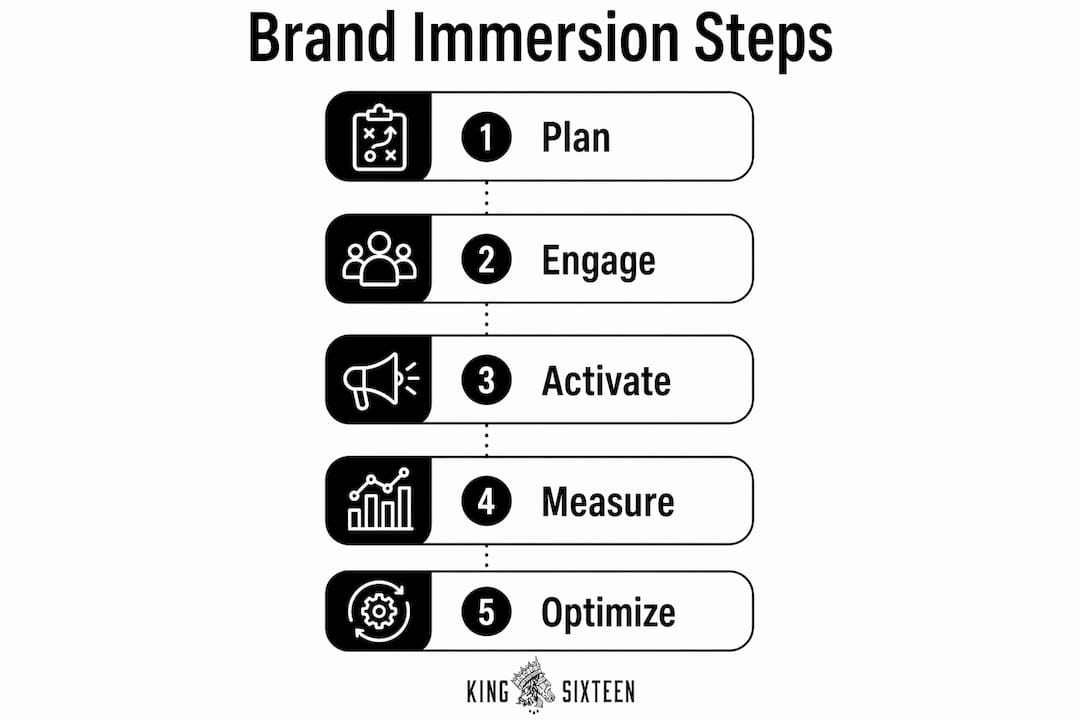
What practical steps should marketers follow to implement brand immersion?
Execution is where most brand immersion projects succeed or fail. The planning phase is where the outcome is actually determined.
- Conduct deep brand and audience research. You cannot immerse someone in a brand identity you have not fully defined. Start with a clear articulation of your brand's values, personality, and sensory vocabulary before touching a design brief.
- Map the customer journey and emotional arc. The user's emotional journey is the core deliverable of immersive marketing, not the physical space. Identify the emotional state you want visitors to arrive in, move through, and leave with.
- Align internal culture before external execution. Brand immersion fails when staff do not believe in or understand the brand story they are meant to embody. Internal alignment is not optional. It is a prerequisite.
- Layer sensory elements deliberately. Introduce sound, scent, and tactile elements in sequence rather than simultaneously. Each layer should reinforce the last, building toward a complete sensory picture.
- Measure engagement impact and iterate. Track dwell time, interaction rates, and post-experience sentiment. Use that data to identify which elements are working and which are creating friction or overload.
Common mistakes that undermine brand immersion projects:
- Prioritizing visual spectacle over narrative coherence
- Failing to brief staff on the brand story and their role within it
- Ignoring the digital touchpoints that visitors encounter before and after the physical experience
- Designing for the brand team's taste rather than the audience's emotional needs
Pro Tip: Build your measurement framework before you build the environment. Decide what success looks like in behavioral terms, not just aesthetic ones, and design the space to generate that data.
For a practical framework on planning and executing these campaigns, Kingsixteen's step-by-step guide to brand activations walks through the full process from brief to post-event analysis.
Key takeaways
Brand immersion is the most complete form of brand experience design, requiring multisensory coherence, organizational alignment, and a clear emotional arc to generate lasting consumer engagement and measurable revenue impact.
| Point | Details |
|---|---|
| Definition of brand immersion | It is the intentional creation of a multisensory, spatially consistent environment across all brand touchpoints. |
| Revenue impact | Immersed customers generate 20%–40% higher revenue per transaction and show higher repeat purchase rates. |
| The 3-30-300 rule | Visitors must grasp brand essence in 3 seconds, value proposition in 30, and explore meaningfully within 300. |
| Staff are part of the experience | Trained staff acting as brand performers are the human layer that makes or breaks immersive environments. |
| Immersion vs. activation | Brand activation drives a specific action; brand immersion is a continuous, organizationally aligned sensory environment. |
Why most brands get brand immersion wrong
Here is what I see consistently: brands invest heavily in the visual design of an immersive environment and then treat everything else as secondary. The lighting is perfect. The installation is Instagram-worthy. And then a staff member answers a question in a way that contradicts the entire brand narrative, or the visitor pulls out their phone and lands on a website that feels like it belongs to a different company entirely.
Brand immersion is not an aesthetic exercise. It is a systems problem. Every channel, every person, every touchpoint has to be part of the same story. The brands that get this right, Apple being the clearest example, have built internal cultures where the brand identity is as understood by the person at the front desk as it is by the CMO.
The other misconception I encounter is that immersion requires a massive budget. It does not. It requires clarity. A small retail environment with a coherent scent, a curated playlist, and staff who genuinely know the product story can outperform a multi-million-dollar installation that lacks narrative coherence. Sensory richness without clarity is just noise.
The brands that win with immersion treat it as an ongoing discipline, not a campaign. They evaluate, adapt, and refine the experience continuously. That commitment is what separates a memorable brand from one that people photograph and forget.
— Tyler
How Kingsixteen builds immersive brand experiences
Kingsixteen designs and executes immersive brand environments for established brands that need real outcomes, not just attention. From product launches for Porsche and Audi to large-scale activations for Ray-Ban and the Natural Diamonds Council, the team handles every layer of the experience, from spatial design and custom fabrication to staffing, AV, and digital integration. If you are ready to build a brand environment that your audience actually feels, Kingsixteen's experiential marketing services are built for exactly that. One team, full execution, zero margin for error.
FAQ
What is brand immersion in simple terms?
Brand immersion is the practice of designing every brand touchpoint, physical, sensory, and digital, to work together as a single, unified experience. The goal is to surround consumers with the brand's identity rather than simply showing it to them.
How does brand immersion differ from experiential marketing?
Experiential marketing describes participatory brand encounters at the campaign level. Brand immersion is a deeper, continuous application of that discipline, treating the entire brand environment as a unified stage rather than a single event.
What senses does brand immersion engage?
Effective brand immersion activates visual, auditory, tactile, and olfactory senses simultaneously to create strong emotional connections. Each additional sense engaged deepens memory encoding and emotional attachment to the brand.
Can brand immersion cause negative effects?
Excessive or poorly sequenced brand interactions can cause engagement fatigue, which negatively affects brand attitude. Research from the Journal of Marketing Analytics confirms that quality and meaningfulness of interaction matter more than frequency or sensory volume.
What is the 3-30-300 rule in brand immersion?
The 3-30-300 rule states that visitors must grasp core brand essence within 3 seconds, understand the value proposition within 30 seconds, and have meaningful exploration facilitated within 300 seconds. Environments that violate this sequence cause cognitive overload and reduce immersion effectiveness.