Brand perception is the total sum of consumer beliefs, emotions, and gut-level feelings formed from every interaction with a brand, not just its advertising. It lives in the mind of the customer, shaped by product quality, customer service, social media presence, and even the tone of a transactional email. Unlike brand identity, which you control, brand perception is what your audience actually concludes. Measuring it accurately with tools like Net Promoter Score (NPS), sentiment analysis platforms such as Brand24 and Mention, and qualitative interviews is the difference between brands that grow and brands that stagnate.
What is brand perception and how does it differ from related concepts?
Brand perception is defined as the emotional and cognitive summation of every consumer experience with a brand, distinct from what the brand intends to project. That distinction matters more than most marketing teams acknowledge. Your brand identity is the mission, personality, and visual language you craft internally. Brand awareness is whether consumers recognize your name or logo. Brand equity is the financial premium your reputation commands in the market. Brand perception sits at the intersection of all three, but it belongs entirely to the customer.
The table below clarifies how these concepts relate and where they diverge:
| Concept | Who controls it | What it measures |
|---|---|---|
| Brand identity | The brand | Intended mission, values, and visual language |
| Brand awareness | Shared (brand + market) | Recognition and familiarity among consumers |
| Brand equity | Market forces | Financial value attached to brand reputation |
| Brand perception | The consumer | Actual emotional and cognitive experience of the brand |
The practical implication is significant. A brand can invest heavily in identity work, win awards for its visual design, and still carry a negative perception among its core audience because the product experience or support interactions fall short. Porsche and Audi, for example, maintain strong brand equity precisely because their customer experience consistently reinforces their intended identity. The gap between what a brand says and what customers feel is where perception problems are born.
How to measure brand perception with the right tools
Measuring brand perception requires combining quantitative metrics with qualitative insight. Neither source alone gives you the full picture.
The most widely used quantitative tools include:
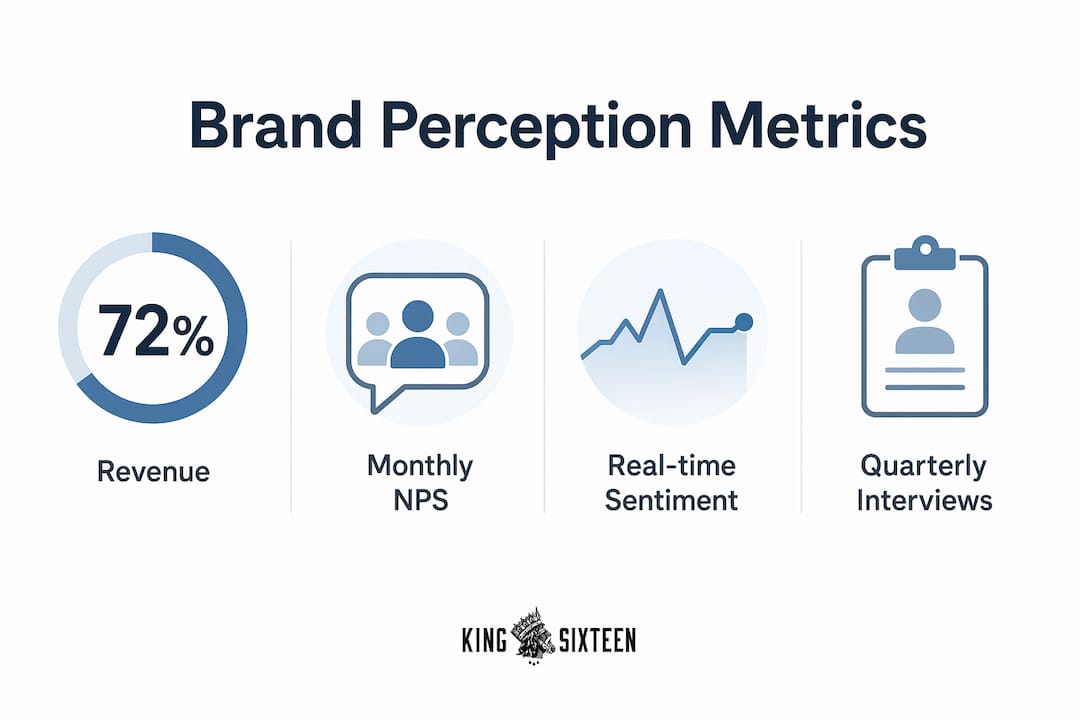
- Net Promoter Score (NPS): Asks customers how likely they are to recommend your brand on a 0 to 10 scale. NPS and CSAT scores are critical metrics for tracking alignment between customer experience and brand perception, particularly given that existing customers generate 72% of revenue. That figure means retention is a perception problem as much as a sales problem.
- Customer Satisfaction Score (CSAT): Measures satisfaction at specific touchpoints, such as post-purchase or post-support interactions.
- Social listening platforms: Tools like Brand24 and Mention track brand mentions across social media, forums, and news sites, categorizing them as positive, negative, or neutral. 51% of the most memorable brands actively engage customers on social media and use native analytics for sentiment and conversation monitoring. That level of engagement is not optional for brands competing for attention in 2026.
- Review platforms: Google Reviews, Trustpilot, and G2 function as unsolicited perception artifacts. Customers leave these reviews without prompting, which makes them more honest than survey responses.
- Qualitative interviews and focus groups: These reveal the emotional nuance that numbers cannot capture. Quantitative metrics give a baseline but lack the "why." Qualitative interviews and focus groups reveal the emotional reasoning behind loyalty and competitor choice.
Pro Tip: Balance structured surveys with unprompted feedback from forums like Reddit and Quora. Consumers on these platforms speak candidly about brands without any awareness of being surveyed, which surfaces perception gaps that NPS scores routinely miss.
The strongest measurement programs combine at least three of these sources. A brand tracking NPS monthly but ignoring Reddit threads about its customer support is operating with a partial map.
Common challenges in managing brand perception
Managing brand perception is harder than measuring it. Four challenges consistently trip up even experienced marketing teams.
-
The perception gap. The perception gap between intended brand identity and actual consumer perception is the primary source of marketing challenges. No campaign fixes a disconnect if the customer experience contradicts the brand mission. A luxury brand running aspirational advertising while delivering slow shipping and impersonal support creates cognitive dissonance that erodes trust faster than any competitor could.
-
Invisible experience flaws. Perception gaps often hide in experience flaws like confusing website UI or poor support interactions, detected only through unsolicited feedback on forums like Reddit threads. These flaws rarely surface in structured surveys because customers do not know what to attribute their frustration to. They just leave.
-
The dynamic nature of perception. Brand perception is a dynamic, rolling metric tracking consistency across touchpoints including physical stores, emails, and social mentions. Treating it as a fixed snapshot, measured once per quarter, means you are always reacting to problems rather than preventing them.
-
Siloed data. Marketing teams often own NPS data while customer support owns complaint tickets and product teams own usage analytics. When these data streams do not talk to each other, the perception picture is fragmented. Brands that close this gap, by building shared dashboards and cross-functional review cadences, manage perception far more effectively than those that keep data siloed.
Auditing multiple touchpoints, including website UX, support email tone, social media response times, and in-store or event experiences, is the only way to identify where perception is breaking down.
What is the impact of brand perception on revenue and loyalty?
Positive brand perception directly increases customer preference, willingness to pay, and repeat purchase frequency. These are not soft outcomes. They translate directly to revenue and lifetime value.

The revenue connection is concrete. Existing customers generate 72% of revenue, which means the perception your brand holds among people who already bought from you is more financially consequential than the impression you make on new prospects. Brands that neglect post-purchase perception, by delivering weak onboarding, slow support, or inconsistent product quality, are eroding their most valuable revenue base.
Trust is the mechanism that converts perception into purchase behavior. Consumers form subconscious emotional shorthand built from every touchpoint, not just corporate messaging. When that shorthand is positive, the brand becomes the default choice. When it is negative or ambiguous, even strong advertising cannot overcome the hesitation. This is why brands like Ray-Ban and Fossil invest in experiential environments and brand storytelling that reinforce their identity at every customer contact point.
In 2026, brand perception also affects discoverability. AI-powered search engines and recommendation algorithms increasingly weight brand authority and sentiment signals when ranking content and surfacing products. A brand with strong, consistent positive perception across review platforms, social channels, and earned media earns better organic visibility. Perception is no longer just a marketing metric. It is an SEO and growth asset.
Practical strategies to improve brand perception in 2026
Improving brand perception requires a structured approach that combines measurement discipline with experience design. Here is how to build that system.
Start with a hybrid measurement model. Pair NPS and CSAT scores with qualitative interviews conducted quarterly. NPS tells you the score. Interviews tell you the story behind it. Combining qualitative and quantitative data strengthens measurement accuracy and reveals the emotional drivers that numbers alone cannot explain.
Use social listening tools like Brand24 or Mention to track real-time sentiment shifts. Set up alerts for spikes in negative mentions, which often signal a product issue, a support failure, or a PR moment before it escalates. Connecting social media engagement data to your brand tracking dashboard gives you a live pulse rather than a delayed report.
Audit every customer touchpoint for friction and emotional tone. This means reviewing your website UX, onboarding emails, support response templates, packaging, and any in-person or event experience. Customer perceptions form as subconscious mental shorthand from cumulative touchpoints, so a single friction point, like a confusing checkout flow or a cold support reply, can undercut months of positive brand building.
Invest in experiential marketing to create direct, memorable emotional associations. Events, activations, and immersive environments give consumers a physical experience of your brand values that no digital ad can replicate. Brands that use experiential campaigns to connect with audiences in person consistently report stronger brand recall and deeper loyalty than those relying solely on digital channels.
Pro Tip: Treat brand perception as a rolling average, not a quarterly snapshot. Set up a monthly review cadence that pulls NPS data, social sentiment scores, and unsolicited feedback from review platforms into a single view. Patterns emerge faster, and you can course-correct before a perception problem becomes a revenue problem.
Finally, break down internal silos. Marketing, product, and customer support teams each hold a piece of the perception puzzle. A monthly cross-functional review where all three teams share their data and align on priorities is one of the highest-leverage habits a brand can build.
Key takeaways
Brand perception is owned by the consumer, not the brand, and managing it requires continuous measurement across every touchpoint where customers form opinions.
| Point | Details |
|---|---|
| Definition of brand perception | It is the emotional and cognitive sum of all consumer experiences, distinct from brand identity or awareness. |
| Revenue impact | Existing customers generate 72% of revenue, making post-purchase perception a direct financial priority. |
| Measurement approach | Combine NPS and CSAT with qualitative interviews and unsolicited social listening for a complete picture. |
| The perception gap | Mismatches between intended identity and actual experience are the leading cause of brand trust erosion. |
| Continuous monitoring | Treat perception as a rolling metric, not a fixed snapshot, to catch problems before they compound. |
Why brand perception is the metric I watch most closely
When brands come to us at Kingsixteen, they often arrive with a clear identity and a fuzzy perception. They know what they stand for. Their customers are less certain. What I have seen consistently over years of working with brands like Porsche, Audi, and the Natural Diamonds Council is that the gap between intention and experience is almost always wider than the marketing team believes.
The most common mistake I see is treating perception measurement as a marketing department task. It is not. Perception is formed in product, in support, in the parking lot at an event, and in the three seconds it takes a website to load. The brands that get this right build cross-functional accountability for perception data. They share it in leadership meetings, not just marketing reviews.
I also think the rise of AI-powered search in 2026 has made this more urgent than most teams realize. When an AI assistant recommends a brand, it is drawing on aggregated sentiment signals from reviews, forums, and social content. That means your brand perception is now a direct input into your discoverability. Brands that have neglected their perception health are going to find themselves increasingly invisible in AI-mediated search, regardless of how much they spend on paid media.
The fix is not complicated. Monitor unsolicited feedback, audit your touchpoints honestly, and use brand experience strategies that create genuine emotional resonance rather than just visual noise. Perception follows experience. Fix the experience, and the perception follows.
— Tyler
How Kingsixteen helps brands shape perception through experience
Brand perception is built in moments. The most durable impressions come not from ads, but from experiences that put consumers inside your brand story. At Kingsixteen, we design and execute immersive, in-person activations that create exactly those moments. From product launches that generate demand to custom-fabricated environments that make brands impossible to forget, our experiential marketing services are built for brands that need their perception to match their ambition. If you are ready to close the gap between what your brand says and what your audience feels, we are the team to call.
FAQ
What is the definition of brand perception?
Brand perception is the total sum of beliefs, emotions, and gut-level feelings consumers form about a brand through every interaction, from product use to customer support to social media. It is distinct from brand identity, which is what the brand intends to project.
How does brand perception differ from brand reputation?
Brand reputation refers to the public standing of a brand based on its track record and credibility, often shaped by media coverage and industry recognition. Brand perception is broader and more personal, encompassing the emotional and cognitive experience each individual consumer forms across all touchpoints.
Why does brand perception matter for revenue?
Existing customers generate 72% of revenue, which means the perception your brand holds among current customers directly determines retention and lifetime value. Positive perception increases willingness to pay and repeat purchase frequency.
What tools are used to measure brand perception?
The most effective tools include NPS and CSAT surveys for quantitative data, social listening platforms like Brand24 and Mention for real-time sentiment, and qualitative interviews or focus groups to capture the emotional reasoning behind consumer attitudes.
What is the perception gap?
The perception gap is the mismatch between a brand's intended identity and the actual experience consumers have. It is the primary source of marketing challenges and cannot be resolved through advertising alone. It requires fixing the underlying customer experience.