Brand presence is defined as the consistent visibility and recognized authority a brand holds across every touchpoint where its audience engages with it. It is not the same as being known. It is the active, ongoing state of being considered, trusted, and chosen. For marketing professionals and brand strategists, understanding this distinction is the difference between building equity and burning budget. This guide clarifies what brand presence means in practice, how it differs from brand awareness, and what it takes to measure and strengthen it in an AI-shaped market.
What is brand presence and how does it differ from brand awareness?
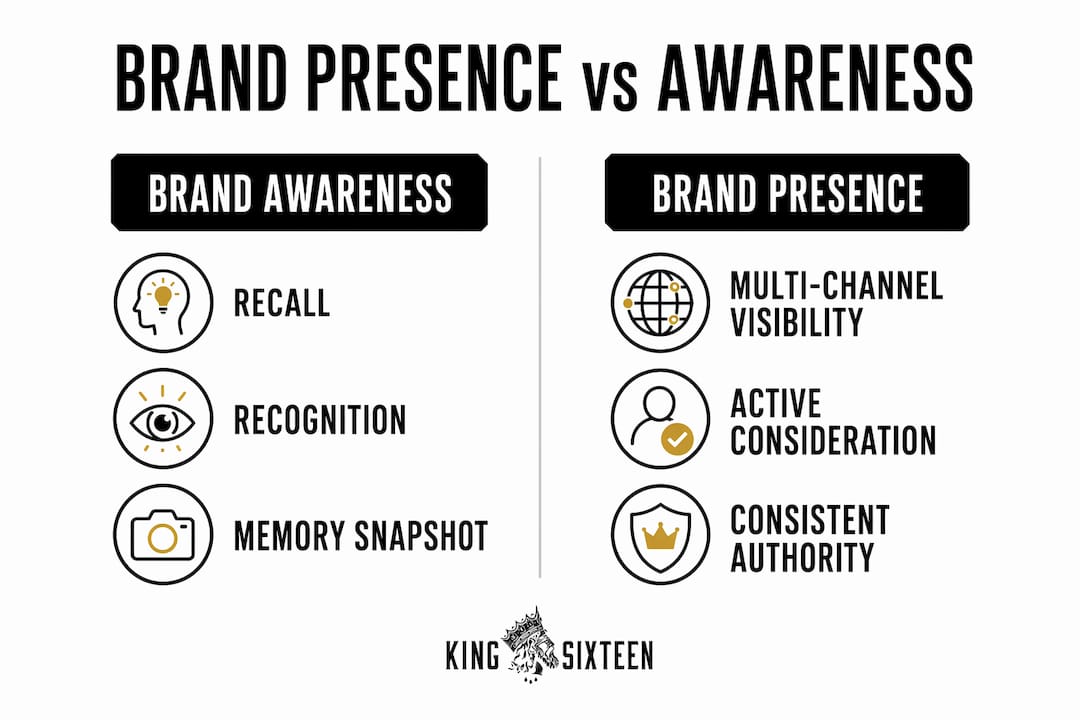
Brand presence is the active, multi-channel visibility a brand maintains to stay in consideration across the full buyer journey. Brand awareness, by contrast, is a memory metric. It measures whether someone can recall or recognize your brand. Presence is what keeps that memory alive and relevant between purchase cycles.
Think of it this way: brand awareness is a snapshot. Brand presence is the ongoing film. A buyer might be aware of Porsche without Porsche being present in their daily information environment. Presence requires consistent signals across search, social, physical spaces, and earned media.
The distinction also has a technical dimension. In SEO, a Brand Presence Score evaluates a brand as a distinct entity in Google's Knowledge Graph, using structured data and consistent Name, Address, and Phone (N-A-P) information. This is entity authority, not just backlink volume. It reflects how clearly search engines and AI systems understand who you are.
| Dimension | Brand awareness | Brand presence |
|---|---|---|
| Definition | Memory recall and recognition | Active visibility and authority across channels |
| Measurement | Surveys, aided/unaided recall | Share of voice, presence score, navigational searches |
| Nature | Passive and historical | Active and ongoing |
| SEO relevance | Limited | High, tied to entity identity and Knowledge Graph |
| Strategic goal | Be remembered | Be considered and chosen |
Key elements of brand presence include content consistency, entity-level SEO, physical touchpoints, social signals, and sentiment quality. None of these work in isolation. The brands with the strongest presence treat all five as a system, not a checklist.

Why is brand presence essential for competitive positioning?
The data on buyer behavior makes the importance of brand presence impossible to ignore. 68% of B2B buyers already have a preferred vendor before they start the formal purchase process, and front-runner brands win 80% of those deals. Presence is what earns the front-runner position before the RFP ever lands.
The compounding challenge is that 95% of B2B buyers are out of market at any given time. That means the vast majority of your audience is not actively buying right now. They are forming impressions, building preferences, and filing mental notes. If your brand is not present during that long, quiet period, you will not be in the room when they finally are ready to buy.
"Presence is not a campaign. It is the condition under which all your campaigns work." — RDLB
Brands that maintain clear positioning during market downturns or low-confidence periods gain durable preference. Brands that go dark face a costly re-earning process after 18 or more months of absence. The math is straightforward: cutting visibility does not save money. It increases customer acquisition costs significantly upon recovery.
The AI era adds another layer. Qualitative brand signals, such as how your brand is described, what sentiment surrounds it, and whether trusted sources reference it, now shape how AI-powered search tools represent you. Volume of mentions matters less than the quality and consistency of those signals.
How can you measure brand presence effectively?
Measuring brand presence requires moving past vanity metrics and into decision-grade data. The Online Presence Score, which runs on a 0–100 scale, functions as a brand health check relative to competitors. It is not an absolute grade. It is a benchmarking tool, and it should be tracked over time to inform marketing decisions, not celebrated as a one-time win.
Beyond that score, four metrics give you a complete picture:
- Share of voice: Your brand's mention volume as a percentage of total category conversation. This shows competitive standing in real time.
- Navigational searches: The volume of people searching your brand name directly. This is a proxy for unaided recall and active interest.
- Sentiment analysis: The emotional tone of mentions across platforms. Positive sentiment in AI-generated summaries is increasingly tied to recommendation likelihood.
- Entity authority: Whether your brand appears correctly in Google's Knowledge Graph, with consistent structured data and Schema markup across your web properties.
Pro Tip: Track your Presence Score monthly and benchmark it against two or three direct competitors. A rising score in a flat category signals you are gaining ground. A flat score in a growing category signals you are falling behind.
The Brand Presence Score in SEO specifically evaluates entity-level authority. This means your brand's N-A-P consistency, Schema markup, and Knowledge Graph recognition all feed into how search engines and AI tools understand and represent you. Brands that ignore this layer are leaving authority on the table.
What are proven strategies to improve brand presence?
Improving brand presence is a discipline, not a project. It requires consistent execution across both digital and physical channels, and it rewards brands that stay the course when others pull back.
Here is a practical framework:
-
Establish entity clarity. Audit your N-A-P data, Schema markup, and Google Business Profile. Make sure every platform where your brand appears tells the same story. Inconsistency confuses both search engines and buyers.
-
Build a content presence, not just a content calendar. Publish consistently on the channels your buyers use. Prioritize depth and authority over frequency. One well-researched article that earns citations beats ten thin posts that disappear.
-
Invest in physical touchpoints. Physical brand assets persist longer and deepen emotional ties in ways digital impressions rarely achieve. Merchandise, branded environments, and live activations create memory structures that outlast any paid campaign. Brands like Ray-Ban and Audi understand this. Their events are not just marketing. They are presence infrastructure.
-
Shape your AI footprint. Monitor how AI tools like ChatGPT and Perplexity describe your brand. The language used in those summaries reflects the quality and consistency of your digital signals. If the description is vague or inaccurate, your content and earned media strategy needs recalibration. Tools for AI-driven brand building can help you audit and shape that footprint systematically.
-
Maintain presence through market cycles. Disciplined, clear messaging maintained consistently drives efficiency and earns consumer attention, especially when competitors go quiet. Presence during low-confidence periods is not a cost. It is a competitive advantage.
Pro Tip: Design physical brand assets early in campaign planning, not as an afterthought. Branded environments and installations anchor campaigns and extend visibility well beyond the event itself.
For brands operating in high-value categories, the experiential marketing outperforms ads argument is well-supported. Physical experiences create the kind of emotional memory that no banner ad can replicate.
How does AI change the way brand presence works in 2026?
AI has shifted the rules of brand presence in one fundamental way: quality now outweighs quantity. In the pre-AI era, presence was largely a volume game. More mentions, more backlinks, more impressions. Today, AI evaluates brand descriptions for trustworthiness, sentiment, and contextual relevance before surfacing a brand in a response.
This has several direct implications for brand strategists:
- Trusted source signals matter more. If credible publications, industry analysts, and authoritative sites reference your brand positively, AI tools are more likely to represent you accurately and favorably.
- Sentiment quality shapes recommendations. A brand with 10,000 neutral mentions may rank lower in AI-generated responses than a brand with 2,000 strongly positive, contextually rich mentions.
- Entity identity is foundational. AI systems rely on structured data and Knowledge Graph entries to understand who a brand is. Brands without clear entity definitions are harder for AI to represent with confidence.
- Brand perception and presence are converging. How your brand is described online now directly shapes how it is presented in AI search results. Understanding brand perception in 2026 is no longer separate from managing presence.
The practical takeaway is this: every piece of content you publish, every event you activate, and every partnership you earn is now a signal that AI systems read and weigh. Presence strategy and content strategy are the same strategy.
Key takeaways
Brand presence is the upstream investment that determines whether all your downstream marketing efforts find a receptive audience or an empty room.
| Point | Details |
|---|---|
| Presence vs. awareness | Brand presence is active visibility and authority; brand awareness is passive memory recall. |
| Buyer behavior data | 68% of B2B buyers have a preferred vendor before searching, making early presence critical. |
| Measurement tools | Track Online Presence Score, share of voice, and entity authority as decision-grade metrics. |
| Physical touchpoints | Branded environments and live activations build emotional memory that digital alone cannot match. |
| AI era shift | AI evaluates sentiment quality and trusted source signals, not just mention volume. |
Brand presence is the strategy, not a tactic
I have watched brands pour significant budget into campaigns that underperformed simply because the brand had no presence before the campaign launched. The campaign had nowhere to land. No recognition, no trust, no context. It was like throwing a party no one knew to attend.
The brands I have seen win consistently treat presence as the upstream condition for everything else. They stay visible between campaigns. They show up physically, not just digitally. They protect their positioning when markets get uncertain, which is exactly when most brands go quiet and cede ground they will spend years trying to reclaim.
The physical dimension is where I see the biggest gap in most brand strategies. Digital presence is table stakes now. But the brands that are truly felt, not just seen, invest in environments, activations, and experiences that create genuine memory. Porsche does not just run digital ads. They put people in the car. That is presence at its most powerful.
My honest advice: audit your presence before your next campaign. Know your entity authority score. Know your share of voice. Know how AI tools describe you. Then build from there with discipline and consistency, regardless of what the market is doing around you.
— Tyler
Build brand presence that people actually feel
Understanding brand presence is one thing. Building it at a level that moves markets is another. At Kingsixteen, we design and execute immersive brand experiences that create the kind of physical and emotional presence no digital campaign can replicate on its own. From product launches to branded environments, we have helped Porsche, Audi, Ray-Ban, and Fossil turn presence into preference. If you are ready to make your brand felt across every channel, explore what we do and let's build something worth remembering.
FAQ
What is brand presence in simple terms?
Brand presence is the consistent visibility and authority your brand holds across all the channels and touchpoints where your audience encounters it. It is the ongoing state of being considered, not just recognized.
How is brand presence different from brand awareness?
Brand awareness measures whether someone remembers your brand. Brand presence measures whether your brand is actively visible and authoritative in the spaces where buyers form preferences and make decisions.
How do you measure brand presence?
The most reliable metrics are the Online Presence Score (0–100 scale), share of voice, navigational search volume, sentiment analysis, and entity authority in Google's Knowledge Graph. Track these monthly and benchmark against competitors.
Why does brand presence matter for B2B marketing?
Because 95% of B2B buyers are out of market at any given time, consistent presence ensures your brand is in consideration the moment they become active buyers. Brands that go dark lose that position and pay significantly more to recover it.
How does AI affect brand presence strategy?
AI search tools now evaluate the quality and sentiment of brand signals, not just volume. Brands with consistent entity data, positive earned mentions, and authoritative content are represented more favorably in AI-generated responses, making AI-driven brand measurement a core part of modern presence strategy.