High-end event production is the expert orchestration of technology, design, logistics, and creativity to craft immersive luxury experiences that captivate audiences and elevate brands. In the industry, this discipline is formally called live event production or experiential production, and it operates at a level where every detail carries strategic weight. For event planners and brand executives, understanding what is high-end event production means recognizing it as a multi-phase, multi-disciplinary process with clear workflows, contingency planning, and measurable outcomes. A 10–15% contingency buffer of the total event budget is the recognized standard for managing unforeseen technical or logistical challenges at this level.
What is high-end event production and how does it work?
High-end event production is defined as the full-cycle planning and execution of luxury events where technical precision, creative vision, and operational discipline work together. It goes far beyond booking a venue and hiring a caterer. The process covers everything from initial discovery sessions to post-event wrap-up, with each phase building on the last to protect quality and reduce risk.
Event production is where technical expertise meets creativity to bring an event vision to life. That definition holds at every budget level, but at the luxury tier, the stakes and the standards are both significantly higher. A product launch for a brand like Porsche or a summit for a financial institution demands that every sensory element, from the sound mix to the lighting temperature, reinforces the brand's identity.

The term "high-end" signals a commitment to premium service quality across every vendor, every touchpoint, and every moment of the guest experience. It also signals accountability. When something goes wrong at a luxury event, there is no acceptable excuse. That reality shapes how top-tier production teams build their workflows.
What are the key phases in luxury event production?
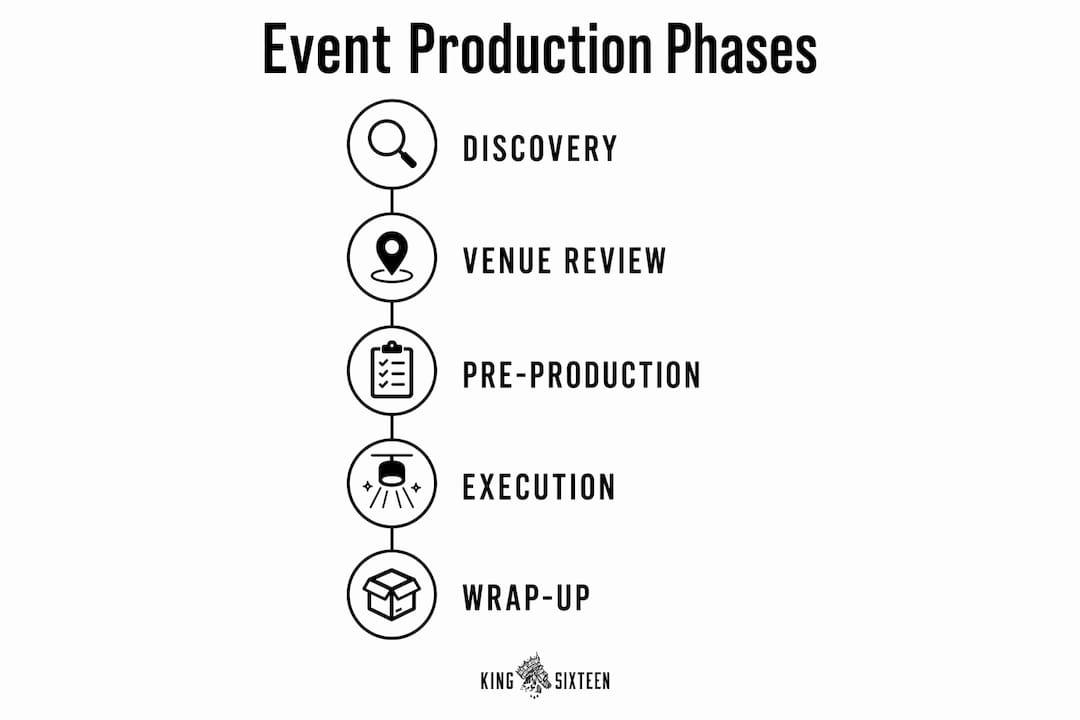
Disciplined, multi-phase workflows are the foundation of successful high-end event production. Each phase has a defined purpose, and skipping or rushing any one of them creates compounding risk.
- Discovery. The production team aligns with the client on goals, audience, brand standards, and budget. This phase sets the creative and logistical brief.
- Venue review. The team assesses the physical space for technical capability, load-in access, power supply, acoustics, and sight lines. A venue that looks beautiful on paper can fail in practice.
- Pre-production. Design, fabrication, AV programming, staffing, and vendor contracting all happen here. This is where a detailed run of show document gets built and rehearsal schedules are set.
- Execution. Load-in, rehearsals, the live event itself, and real-time problem solving. The run of show document governs every minute.
- Wrap-up. Load-out, vendor payments, post-event reporting, and debrief. This phase captures lessons that improve the next production.
The contingency budget deserves its own attention. A 10–15% reserve protects against last-minute equipment rentals, venue surcharges, or emergency staffing needs. Experienced producers treat this reserve as non-negotiable, not optional.
Pro Tip: Build your run of show document with countdown timers attached to each cue. When every team member sees "T-minus 4 minutes to keynote," the entire room self-corrects without a single radio call.
Pre-production planning also benefits from the same structured thinking used in content and marketing operations. Applying a pre-event planning framework to your production timeline keeps deliverables visible and deadlines accountable across every department.
How do technical and creative elements combine in premium events?
The most memorable luxury events feel effortless to attendees. Behind that feeling is a precise coordination between technical crews and creative directors that most guests never see.
Sound, lighting, video, staging, and decor each shape the attendee experience in distinct ways. Sound sets emotional tone. Lighting directs attention and creates mood. Video content reinforces messaging. Staging controls how speakers and performers command the room. Decor communicates brand identity before a single word is spoken.
Key technical and creative elements in top-tier production include:
- Lighting design. Color temperature, beam angles, and dynamic programming transform a neutral space into a branded environment.
- Audio engineering. Line array systems, wireless microphone management, and room acoustic treatment prevent the most common live event failures.
- Video and LED. High-resolution LED walls and projection mapping create visual depth that standard screens cannot match.
- Stage and set design. Luxury staging and decor align with brand identity and create a cohesive aesthetic that experienced designers deliver with visual authority.
- Hybrid and virtual integration. Virtual production requires designing a dedicated virtual stage and coordinating lighting and sound specifically for remote attendees, not just pointing a camera at the in-room experience.
Pro Tip: Brief your lighting designer with brand color hex codes, not just mood words. "Warm and premium" means different things to different people. A specific color value does not.
The coordination between creative directors and technical leads is where most productions either succeed or break down. Weekly production calls, shared design files, and a single point of contact for each discipline prevent the miscommunications that surface on load-in day.
What are the best practices for managing luxury event logistics?
Logistics at the luxury level require the same discipline as the creative work. Professional event producers rely on systems, not memory, to deliver consistent quality. Checklists, timing systems, and run of show management are what separate a flawless execution from a chaotic one.
Common best practices for exclusive event coordination include:
- Pre-event rehearsals. Full technical rehearsals with all AV systems live, all speakers confirmed, and all crew in position. Rehearsals reveal problems that walkthroughs miss.
- Vendor accountability. Every vendor receives a written brief, a confirmed call time, and a named point of contact on the production team. Verbal agreements at this level are not enough.
- Detailed checklists. Run of show documents and pre-event checklists are non-negotiable tools. They keep every department synchronized without requiring constant communication.
- Backup equipment on site. Spare wireless microphone packs, backup laptops loaded with presentation files, and redundant internet connections are standard practice at premium productions.
Last-minute equipment failures and venue issues are a constant reality in event production. On-site decision-making speed and pre-positioned backup equipment are what reduce their impact. The best production teams build contingency responses into the run of show itself, not just into the budget.
You can find more practical guidance on managing production challenges in Kingsixteen's resource library for planners and marketers.
How does high-end event production impact brand experience and ROI?
High-quality event production drives measurable marketing results, including increased brand loyalty, customer engagement, and positive return on investment. That connection between production quality and business outcome is why brand executives justify premium budgets for live experiences.
Immersive events create a sensory memory that digital advertising cannot replicate. When a guest walks into a space that has been designed, fabricated, and programmed to express a brand's identity at every level, the emotional impact is direct and lasting. That impact translates into measurable outcomes.
| KPI | What it measures | Why it matters |
|---|---|---|
| Net Promoter Score | Guest likelihood to recommend the brand | Signals long-term loyalty and word-of-mouth value |
| Social media reach | Organic content generated by attendees | Extends the event's impact beyond the room |
| Lead quality | Qualified contacts captured during the event | Connects production investment to pipeline |
| Brand recall | Post-event survey scores on brand recognition | Measures whether the experience landed |
The ROI case for luxury event management strengthens when production quality is treated as a brand investment, not a cost center. A poorly produced event with a premium guest list does more damage than no event at all. The production is the message. For a deeper look at how experiential events build brand equity, the connection between immersive design and long-term engagement is well documented.
Key Takeaways
High-end event production delivers measurable brand impact only when technical precision, creative vision, and disciplined logistics operate together across every phase of the process.
| Point | Details |
|---|---|
| Multi-phase workflow | Discovery, venue review, pre-production, execution, and wrap-up each protect quality and reduce risk. |
| Contingency budgeting | Reserve 10–15% of the total event budget to cover unforeseen technical or logistical costs. |
| Technical and creative alignment | Brief designers and engineers with specific brand standards, not vague mood descriptions. |
| Systems over memory | Run of show documents, checklists, and rehearsals are what separate flawless execution from chaos. |
| Production as brand investment | Event quality directly affects brand perception, loyalty, and measurable marketing ROI. |
What I've learned about where luxury productions actually break down
After working on productions for brands like Porsche, Audi, and the Natural Diamonds Council, the pattern I keep seeing is this: most luxury event failures are not creative failures. They are systems failures.
The creative brief is usually strong. The venue is usually beautiful. The budget is usually adequate. What breaks down is the handoff between departments, the assumption that a verbal agreement is a confirmed commitment, and the belief that a talented team can improvise their way through load-in day.
The productions that run flawlessly are the ones where every team member, from the lighting operator to the catering lead, has a printed run of show with their cues highlighted. They are the ones where the contingency budget was allocated before the first vendor was contracted, not scraped together after the first problem surfaced.
There is also a trend worth watching. The brands that get the most out of their production investment are the ones treating the event as a content engine, not just a live moment. They build the set for the camera as much as for the room. They plan the social content before load-in. They think about elevating brand presence that extends well past the event date.
The future of high-end event production is not just about what happens in the room. It is about what the room produces for the brand long after the guests have left.
— Tyler
Kingsixteen builds the productions that brands remember
Kingsixteen works with established brands and senior decision-makers who need events executed at the highest level, without margin for error. From product launches and brand activations to conferences and private events, the team handles design, fabrication, AV, staffing, catering, and logistics through a trusted vendor network built over years.
If you are planning a luxury event and need a production partner who treats every detail as a brand statement, Kingsixteen's experiential marketing services are built for exactly that. For private events requiring the same level of precision, the private events team is ready to build something worth remembering.
FAQ
What is high-end event production?
High-end event production is the full-cycle process of designing, planning, and executing luxury events through coordinated technology, creative design, and logistical systems. It operates across five phases: discovery, venue review, pre-production, execution, and wrap-up.
How much should you budget for contingency in luxury event production?
A contingency buffer of 10–15% of the total event budget is the recognized industry standard for managing unforeseen technical or logistical costs at premium events.
What makes event production "high-end" versus standard?
High-end production applies premium standards to every element, including custom staging, professional AV engineering, brand-aligned decor, and dedicated creative direction. The defining factor is that every detail is intentional and accountable to the brand's identity.
How do you measure ROI from a luxury event?
Key metrics include Net Promoter Score, social media reach generated by attendees, lead quality captured on site, and post-event brand recall scores from surveys. These connect production investment directly to marketing and business outcomes.
Why do luxury events require a run of show document?
A run of show document synchronizes every department, from AV to catering, around a shared timeline with specific cues. Professional producers treat it as the single source of truth that prevents miscommunication and keeps execution on track regardless of last-minute changes.