Turnkey event management is a full-service model where one provider handles every element of an event, from concept and venue to execution and follow-up, so your internal team never has to juggle dozens of vendors. The term comes from construction: you hand someone a project, they hand you back the keys when it's done. In event production, it means the same thing. You define the goal and the experience you want. Your provider builds it, staffs it, runs it, and wraps it. This model has become the go-to approach for marketing professionals and event planners who need fast, reliable execution without burning out their teams.
What is turnkey event management, and how does it work?
Turnkey event management is defined as an all-inclusive, ready-to-execute event solution where a single provider manages planning, logistics, vendor coordination, and on-site execution. The client sets the brief. The provider owns the outcome. That single point of accountability is what separates this model from traditional event planning, where the client often acts as the de facto project manager across ten different vendors.
Turnkey event production is built for speed, scalability, and efficiency. It delivers quick turnarounds without sacrificing quality, making it especially well-suited for repeated or large-scale events. That means a brand running quarterly activations in multiple cities can use the same tested framework each time, with consistent quality and predictable costs.

The process typically follows a clear lifecycle. The provider starts with a discovery phase to understand your brand, audience, and goals. From there, they handle creative direction, venue sourcing, vendor contracts, logistics, staffing, and on-site management. After the event, they deliver follow-up support, including data, recaps, and any post-event engagement.
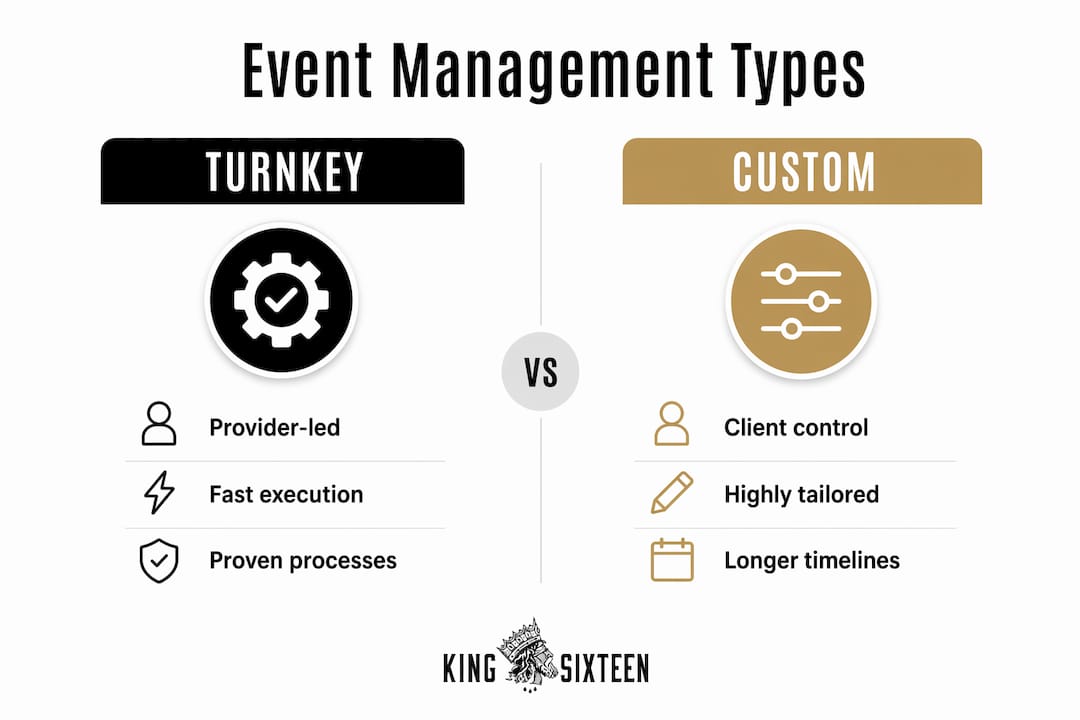
How does turnkey differ from custom event production?
Custom event production gives you high control and deep customization, but it requires significant time and internal resources to manage. Turnkey trades some of that granular control for speed, predictability, and a proven process. Neither model is universally better. The right choice depends on your goals, timeline, and internal capacity.
The table below maps the key differences between the two approaches.
| Category | Turnkey event management | Custom event production |
|---|---|---|
| Control level | Provider-led, client approves | Client-led, provider executes |
| Customization | Within a proven framework | Fully bespoke from scratch |
| Timeline | Faster, tested processes | Longer, built from the ground up |
| Internal resources needed | Minimal | Significant |
| Cost predictability | High | Variable |
| Best for | Repeatable, scalable events | One-of-a-kind flagship experiences |
Turnkey suits events that need proven processes and quick execution. Custom production suits bespoke experiences with higher complexity and a client team that has the bandwidth to manage them. Most high-performing marketing teams use both at different points in their event calendar.
Pro Tip: If your team is already stretched thin and your event has a fixed deadline, turnkey is almost always the right call. Save custom production for flagship moments where the extra control genuinely changes the outcome.
What services are included in a turnkey event solution?
A full-service turnkey provider covers every operational layer of an event. Turnkey event management includes venue selection, branding, logistics, staffing, live facilitation, and follow-up support. The provider bundles these into a coordinated package, so nothing falls through the gaps between departments or vendors.
Here is what a complete turnkey package typically covers:
- Venue sourcing and contracting: Site selection, negotiation, and contract management based on your audience size, location, and brand requirements.
- Creative and event branding: Concept development, environmental design, signage, and branded touchpoints that align with your visual identity. Kingsixteen's event branding work shows how this layer shapes the entire guest experience.
- Vendor management: AV, catering, floral, furniture, fabrication, and all third-party suppliers coordinated through a single point of contact.
- Logistics and shipping: End-to-end coordination of materials, equipment, and setup timelines from origin to venue.
- Staffing and on-site management: Trained event staff, brand ambassadors, and a production team managing the run of show in real time.
- Live facilitation: Experienced hosts or emcees who drive attendee engagement and keep the event on pace.
- Contingency planning: Pre-built backup plans for weather, vendor no-shows, technical failures, and other variables.
- Post-event support: Recap reports, data collection, and follow-up communications that extend the event's value beyond the day itself.
Providers manage all operational aspects including vendor contracts, setup, and contingency planning. That level of coordination is what makes turnkey solutions so effective for brands running events at scale.
What are the benefits of turnkey event management for planners?
The most direct benefit is bandwidth. Experts at The Urban Botanist identify prevention of team burnout as a primary driver for turnkey adoption, noting that it allows internal teams to dedicate 100% of their focus to strategic priorities rather than logistics. That shift matters enormously when your marketing team is also running campaigns, managing stakeholders, and preparing post-event reporting.
"Turnkey events relieve internal marketing teams by offloading logistics and vendor coordination, enabling full focus on guest experience and engagement." — The Urban Botanist
Beyond bandwidth, turnkey management delivers measurable operational advantages:
- Cost predictability: Fixed-scope packages reduce budget surprises. You know what you're spending before the event goes live.
- Reduced vendor risk: One provider owns the relationships and the accountability. If a vendor fails, your provider solves it, not you.
- Brand consistency: A single creative team manages all touchpoints, so your brand looks and feels the same across every element of the event.
- Faster execution: Tested processes and established vendor networks cut production timelines significantly compared to building from scratch.
- Scalability: The same framework can run in one city or ten. Kingsixteen's brand activation approach demonstrates how repeatable systems produce consistent results across markets.
- Professional guest experience: Live facilitation by experienced hosts ensures the event flows well and attendees stay engaged from arrival to close.
Turnkey event management also reduces the risks of last-minute vendor issues and logistical failures. That peace of mind has real dollar value when you're producing an event tied to a product launch or a major brand moment.
How to decide if turnkey event management is right for your event
The decision comes down to four factors: internal bandwidth, event complexity, budget structure, and brand alignment. Evaluating turnkey fit requires an honest look at all four before you commit to a model.
Use this checklist to assess whether turnkey is the right approach for your next event:
- Assess your internal capacity. Does your team have the time and headcount to manage multiple vendors, a production timeline, and on-site logistics simultaneously? If not, turnkey removes that burden entirely.
- Define your event type and scale. Turnkey works best for product launches, brand activations, corporate conferences, and repeatable events. Highly experimental or one-of-a-kind experiences may need a more custom approach.
- Review your timeline. Turnkey providers work faster because their systems are already built. If you have less than 90 days to execute, a turnkey model is almost always the more reliable path.
- Clarify your budget structure. Turnkey packages offer fixed pricing, which makes financial planning easier. If your budget is variable or approval-dependent, that predictability is a significant advantage.
- Evaluate brand alignment. Ask potential providers for case studies in your industry. A turnkey provider should demonstrate that their framework can flex to your brand standards, not the other way around.
- Check for full lifecycle support. The right provider handles pre-event planning, day-of execution, and post-event follow-up. Providers that only cover one phase are not truly turnkey.
Pro Tip: When vetting providers, ask specifically how they handle contingencies. A provider with no clear answer to "what happens if the AV fails?" is not ready to own your event.
Key takeaways
Turnkey event management is the most efficient model for marketing professionals who need consistent, high-quality event execution without overloading their internal teams.
| Point | Details |
|---|---|
| Single-provider accountability | One team owns planning, logistics, execution, and follow-up, removing vendor fragmentation. |
| Bandwidth protection | Offloading logistics lets your internal team focus entirely on strategy and guest experience. |
| Cost and risk control | Fixed-scope packages reduce budget surprises and eliminate last-minute vendor failures. |
| Scalability through tested systems | Proven frameworks allow the same quality to replicate across multiple markets or events. |
| Fit assessment is critical | Evaluate bandwidth, timeline, budget, and brand alignment before choosing turnkey over custom. |
What I've learned from watching brands choose the wrong model
Most event planning mistakes I've seen don't happen during the event. They happen six weeks before it, when a marketing team realizes they've taken on more vendor management than they can handle. The brief looked manageable. Then the AV company needs a revised spec, the venue changes its load-in window, and the fabrication timeline slips. Suddenly, your Head of Marketing is spending 20 hours a week on logistics instead of the campaign.
The brands that consistently produce great events treat their turnkey provider as a strategic partner, not a vendor. They share brand goals, audience data, and post-event metrics. They expect the provider to push back on ideas that won't land. That relationship dynamic produces better events than any checklist.
The one mistake I see even experienced planners make is assuming turnkey means generic. It doesn't. The best turnkey providers, Kingsixteen included, build their frameworks to flex around your brand. The structure is proven. The creative is yours. That combination is where the real value lives. If you're building a brand activation strategy and you're not sure whether turnkey fits, the answer is almost always yes, as long as you choose a provider who treats customization as a feature, not an exception.
— Tyler
Kingsixteen's turnkey event management for high-impact brands
Kingsixteen is built for brands that can't afford a mediocre event. The agency's experiential marketing services cover the full production lifecycle, from concept and fabrication to staffing, AV, and post-event reporting. Clients like Porsche, Audi, Ray-Ban, and Churchill Downs trust Kingsixteen because the turnkey model means one team owns the outcome, start to finish.
For marketing teams that need a private event executed with precision, or a brand activation that needs to scale across markets, Kingsixteen brings the vendor network, the creative direction, and the production discipline to make it happen. Reach out to discuss what a turnkey approach looks like for your next event.
FAQ
What is a turnkey event?
A turnkey event is one where a single provider manages every aspect of planning and execution, from venue and vendors to staffing and follow-up, so the client receives a finished, ready-to-run event.
What does turnkey event production include?
Turnkey event production covers venue sourcing, branding, logistics, AV, staffing, live facilitation, contingency planning, and post-event support, all managed by one provider.
How is turnkey event management different from hiring an event planner?
A traditional event planner coordinates on your behalf but often leaves vendor management and final decisions with the client. A turnkey provider owns the entire process and outcome.
When should I use turnkey instead of custom event production?
Turnkey is the right choice when your timeline is tight, your internal team lacks bandwidth, or you need a repeatable framework across multiple events. Custom production suits one-of-a-kind flagship experiences with more lead time.
How do I vet a turnkey event management provider?
Ask for case studies in your industry, request a clear contingency plan, and confirm they provide full lifecycle support covering pre-event, day-of, and post-event phases.