Event production is the process of orchestrating technical, creative, and logistical elements to create an immersive brand experience that generates measurable business value. For marketing professionals and brand decision-makers, understanding why invest in event production is the difference between a forgettable gathering and a moment that moves markets. Brands like Porsche, Audi, and Ray-Ban don't leave their live experiences to chance. They treat production as a core marketing investment, not a line item to trim.
Why invest in event production: the case for brand engagement
Audience attention is a finite commodity, and poor production quality causes attendees to perceive unprofessionalism before a single word of content is delivered. That perception forms in seconds. Once it forms, it's nearly impossible to reverse.
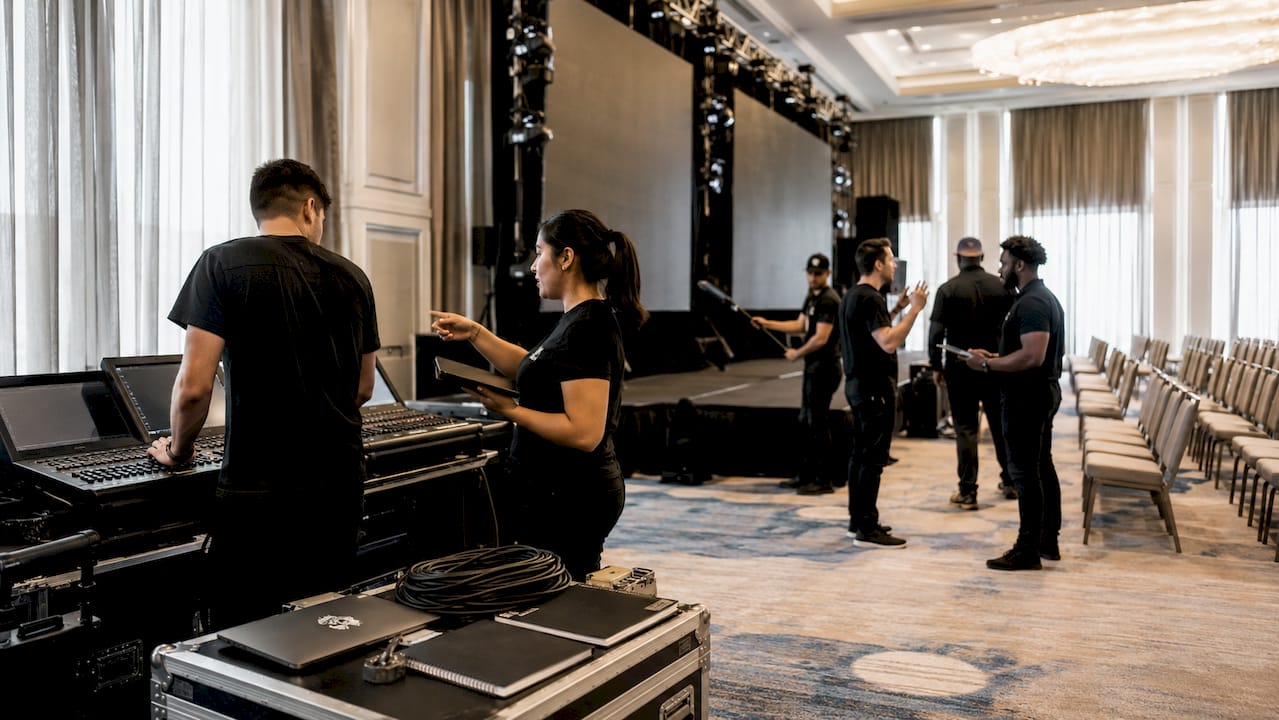
Professional event production treats engagement as its primary output, not a byproduct. Sound, lighting, visuals, and staging work together to craft a mood, reinforce brand identity, and hold attention across every moment of the program. When these elements are misaligned or underfunded, the message suffers regardless of how strong the content is.
The specific production elements that separate professional events from amateur ones include:
- Crisp, calibrated audio that carries every word clearly to every seat in the room
- Custom lighting design that shifts atmosphere from high-energy to intimate based on program flow
- Branded visual environments including LED walls, projection mapping, and set pieces that make the space feel intentional
- Unified staging that creates a consistent visual frame for speakers, panels, and product reveals
Professional AV teams elevate perceived professionalism and directly boost audience satisfaction. That satisfaction translates into stronger brand recall after the event ends.
Pro Tip: Invest in a pre-event site survey with your production team. Acoustic and lighting conditions vary dramatically between venues, and surprises on event day are expensive.
How full-service production reduces cost and risk
The instinct to manage production in-house or piece together individual vendors feels like cost control. In practice, it multiplies coordination overhead and opens the door to expensive failures.
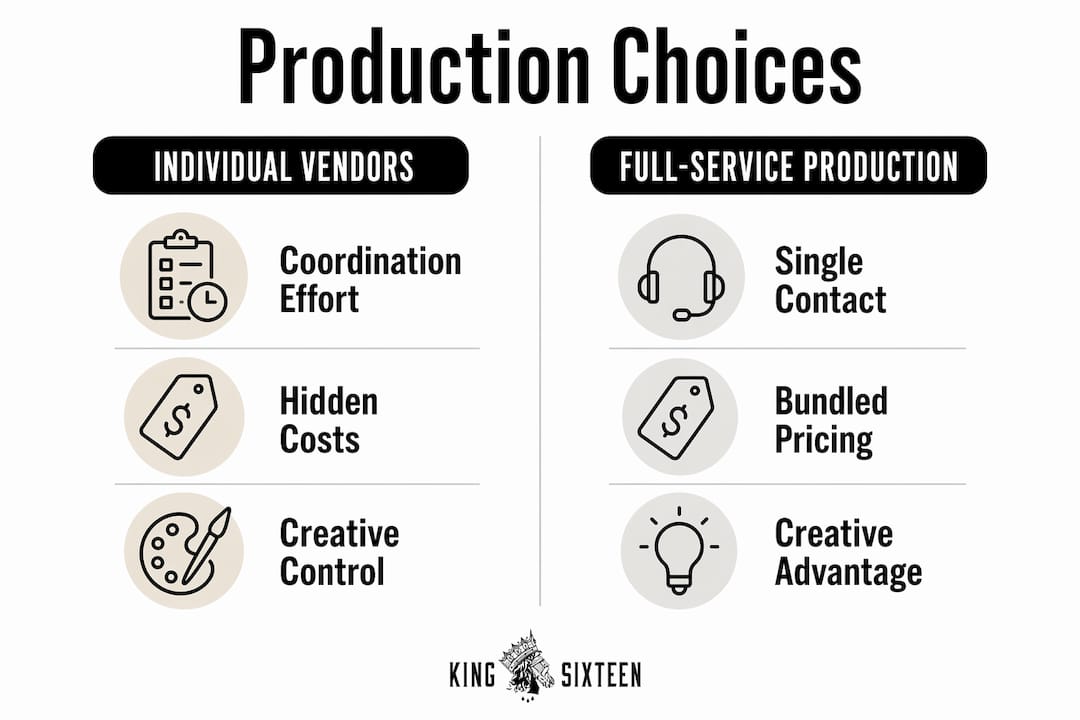
Partnering with a full-service production company lowers total event costs by bundling labor, logistics, and equipment under one contract. It also eliminates vendor duplication, which is one of the most common sources of budget bleed in large-scale events.
Here is how a full-service model reduces risk at each stage of production:
- Single point of contact. One production lead manages all technical vendors, which means faster decisions and fewer miscommunications between your internal team and the floor.
- Certified safety compliance. Experienced producers incorporate certified rigging inspections, detailed electrical load calculations, and safety-compliant designs that protect both attendees and your organization from liability.
- Redundant systems. Strategic event production includes backup AV and streaming failover plans designed during the planning stage, so the show continues without interruption if a technical component fails onsite.
- Predictable labor costs. Bundled contracts lock in pricing early, which protects your budget from last-minute rate increases from individual vendors.
- Contingency planning. Full-service teams build contingency protocols into the run-of-show, covering everything from power failures to speaker no-shows.
Budget cuts to lighting, staging, and sound often reduce ROI by diminishing message effectiveness and audience engagement. The savings on paper rarely survive contact with the actual event.
How does production planning align with marketing goals?
Strategic event production follows a structured timeline, and that structure is what keeps technical decisions connected to business outcomes. Successful organizations use a 12-month event production lifecycle with decision gates that align technical milestones and business goals, preventing last-minute failures.
The phases of that lifecycle move from discovery and design through procurement, rehearsals, execution, and post-event measurement. Weekly reviews at each phase keep accountability clear and scope creep contained.
The table below shows how production phases map directly to marketing objectives:
| Production phase | Marketing objective aligned |
|---|---|
| Discovery and goal-setting | Define audience outcomes and brand narrative |
| Design and concept approval | Lock visual identity, staging, and content themes |
| Procurement and vendor contracts | Confirm budget allocation against priority moments |
| Rehearsals and technical run-throughs | Validate message delivery and speaker preparation |
| Live execution | Deliver consistent brand experience to attendees |
| Post-event analytics and measurement | Assess ROI, engagement data, and content performance |
Failing to define audience outcomes before investing in technical production leads to misallocated budgets. The fix is straightforward: prioritize scenic design, content development, and speaker preparation over technical effects that don't serve the core narrative.
Decision gates at each phase function as quality checkpoints. They prevent the team from moving forward until key approvals are locked, which eliminates the reactive scrambling that derails most events in the final weeks.
What are the measurable business benefits of professional events?
The return on a well-produced event shows up in multiple places. Attendee satisfaction scores improve when production quality is high. Brand recall strengthens when visual and audio environments are consistent. And integrated streaming and event analytics allow tracking of attendance, engagement, and content performance, giving marketing teams the data they need to justify and refine future investment.
Consider a product launch scenario. A brand introduces a new vehicle to 500 media and trade guests. With professional production, the reveal sequence uses synchronized lighting, spatial audio, and a custom LED environment to create a moment that guests photograph and share. Without it, the same vehicle rolls into a generic ballroom with house lighting. The product is identical. The coverage is not.
Crisp visuals, professional sound, and unified staging create immersive experiences that reinforce brand identity and keep attendees engaged through the full program. That engagement extends the event's reach well beyond the room through social sharing, press coverage, and post-event content.
Hybrid and virtual capabilities further expand the ROI calculation. A live event that streams to a qualified remote audience doubles its reach without doubling its cost. Post-event measurement then becomes the foundation for continuous improvement, turning each event into a data asset for the next one. For a deeper look at how event data drives marketing outcomes, the connection between production quality and measurable engagement is direct and trackable.
Individual vendors vs. a full-service production company
The choice between managing individual vendors and hiring a full-service production company is fundamentally a question of where you want to spend your team's time and attention.
| Factor | Individual vendors | Full-service production company |
|---|---|---|
| Coordination effort | High. Your team manages each vendor separately | Low. One team manages all technical elements |
| Cost predictability | Variable. Rates and scope shift across vendors | Stable. Bundled contracts lock pricing early |
| Creative consistency | Risk of misalignment between vendors | Unified creative direction across all elements |
| Risk management | Distributed. Each vendor owns their piece only | Centralized. One team owns the full outcome |
| Problem resolution speed | Slow. Issues require multi-vendor communication | Fast. Single point of contact resolves on the spot |
Full-service production companies reduce coordination overhead by providing a single point of contact and managing every technical element. Streamlined decision-making results in faster problem resolution and predictable labor costs.
The hidden cost of the multi-vendor model is your internal team's bandwidth. Every hour your marketing director spends coordinating between an AV company, a staging vendor, and a lighting crew is an hour not spent on strategy, content, or audience experience. That opportunity cost rarely appears in the budget comparison, but it is real and significant.
For brands focused on brand engagement strategies, the full-service model also delivers a creative advantage. When design, fabrication, AV, and logistics are managed by one team, the final experience is coherent. When they are managed by five separate vendors, coherence requires luck.
Key takeaways
Professional event production is the single most direct investment a brand can make in the quality, consistency, and measurable ROI of its live marketing efforts.
| Point | Details |
|---|---|
| Production quality defines perception | Poor audio, lighting, or staging signals unprofessionalism before content is delivered. |
| Full-service models reduce total cost | Bundling labor, equipment, and logistics eliminates vendor duplication and controls budget. |
| Timeline planning prevents failure | A 12-month lifecycle with decision gates keeps technical choices aligned with business goals. |
| Measurable ROI requires analytics | Integrated streaming and post-event data tracking turn each event into a marketing asset. |
| Full-service beats multi-vendor for complex events | Single-point accountability delivers faster resolution, creative consistency, and lower internal overhead. |
What I've learned about where production investment actually pays off
The most common mistake I see from marketing teams is treating production as a cost to minimize rather than a lever to pull. They cut the lighting budget, downgrade the staging, and then wonder why the post-event survey scores are flat.
Here is what I know after years of producing events for brands like Porsche, Churchill Downs, and the Natural Diamonds Council: the moments that matter are specific. They are the product reveal, the keynote opening, the VIP reception environment. Those are the moments where production investment pays back at a multiplier. Everything else can be calibrated.
The second mistake is reactive planning. Teams that start production conversations 60 days out are already behind. The 12-month lifecycle framework exists because the decisions made in month one, like venue acoustics, power load capacity, and content architecture, determine what is possible in month twelve. You cannot reverse-engineer a great event from a bad foundation.
My advice is direct: set your audience outcomes first, then build your production plan around the moments that deliver those outcomes. Investing in moments that matter, such as scenic design, content development, and speaker preparation, delivers higher ROI than spending on technical effects that don't serve the narrative. Partner with a full-service team early, give them the business objective, and let them build the technical architecture to match. That is how you stop producing events and start building brand experiences.
— Tyler
How Kingsixteen turns production investment into brand impact
Kingsixteen is a full-service experiential marketing agency built for brands that need things done right, fast, and without margin for error. From product launches and corporate conferences to custom fabrication and immersive brand environments, Kingsixteen handles design, AV, staging, logistics, and digital integration through a trusted vendor network built over years of high-stakes production.
If you are ready to turn your next event into a measurable brand asset, Kingsixteen's experiential marketing services are built for exactly that outcome. Whether you are planning a product reveal, a multi-day summit, or a VIP activation, the team brings the creative authority and production discipline your brand deserves. Explore what a true production partnership looks like and see why established brands keep coming back.
FAQ
What is event production and why does it matter for brands?
Event production is the coordination of technical, creative, and logistical elements that bring a live brand experience to life. It matters because production quality directly shapes audience perception, engagement, and brand recall before a single message is delivered.
What are the main benefits of hiring a full-service event production company?
A full-service production company provides a single point of contact, bundled pricing, certified safety compliance, and redundant technical systems. These advantages reduce coordination overhead, protect your budget, and deliver a more consistent brand experience than managing multiple vendors separately.
How does event production ROI get measured?
Event production ROI is measured through integrated analytics tracking attendance, content engagement, social reach, and post-event survey scores. Streaming data and audience segmentation tools, like those covered in audience segmentation strategies, add precision to that measurement.
How early should production planning begin for a major event?
Production planning for a major event should begin at least 12 months in advance. The discovery and goal-setting phase locks in audience outcomes and venue requirements that determine every technical decision that follows.
What is the biggest mistake brands make with event production budgets?
The most common mistake is cutting spending on lighting, staging, and sound to reduce costs. Those cuts directly reduce message effectiveness and audience engagement, which lowers the return on every other dollar invested in the event.