Premium event staffing is defined as the deployment of rigorously vetted, brand-aligned professionals who deliver exceptional hospitality and operational support at high-profile events. Unlike general temp staffing, this model treats every staff member as a direct extension of your brand. The difference shows up in guest experience, legal protection, and event outcomes. For marketing and event professionals managing luxury activations, product launches, or corporate summits, understanding what is premium event staffing is the foundation for making smart staffing decisions that protect both your brand and your budget.
What is premium event staffing and how does it differ from standard hiring?
Premium event staffing is the practice of sourcing, training, and deploying specialized professionals who meet luxury hospitality standards, not just basic event requirements. The industry term for this model is "experiential staffing," and it operates on fundamentally different selection criteria than general event labor.
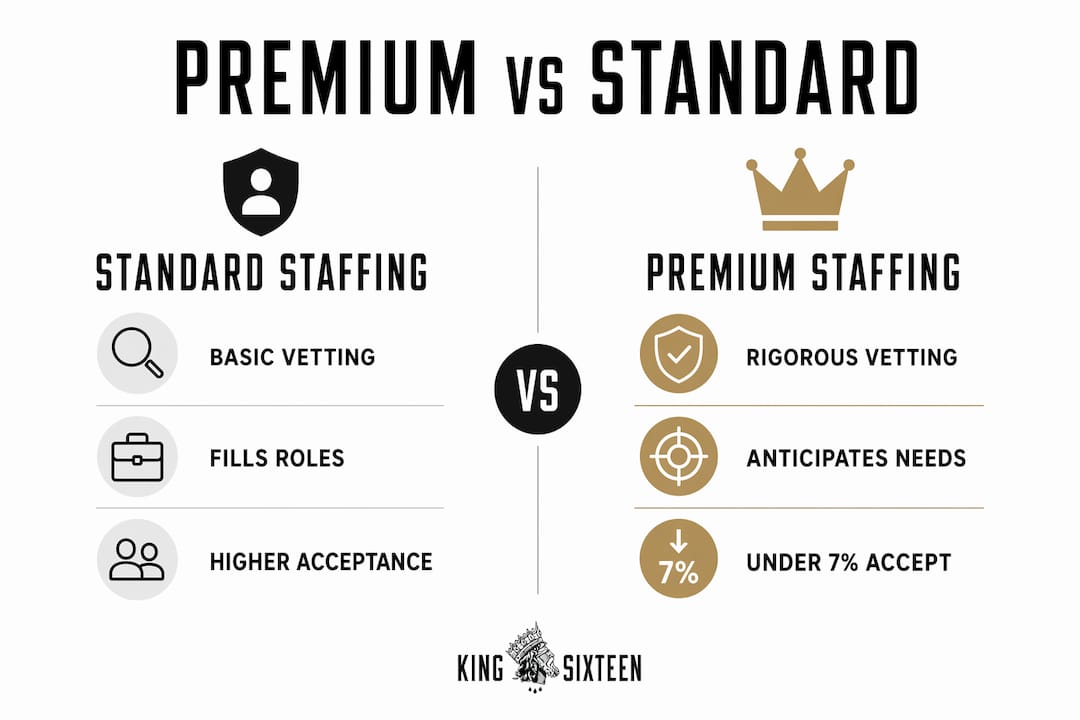
The most telling metric is acceptance rate. Top event staffing agencies accept fewer than 7% of applicants after vetting for specialized backgrounds, emotional intelligence, and composure under pressure. That selectivity produces a workforce that behaves differently on the floor.
Standard staffing fills roles. Premium staffing fills roles with people who anticipate guest needs before those needs become visible, refilling drinks before glasses empty, clearing surfaces before clutter forms, and managing crowd flow without being asked. This "invisible service" standard is the defining trait of luxury hospitality, and it cannot be trained in a one-hour orientation.

The shift happening across the industry is what some producers call the move from transactional hiring to strategic casting. Agencies now evaluate candidates the way film productions evaluate actors: for presence, composure, and brand alignment, not just availability. That shift protects brand equity in ways that a cheaper staffing model simply cannot.
How do premium agencies vet and train event staff?
The selection process at a premium agency goes well beyond a resume review. Candidates are evaluated across multiple criteria before they ever step onto an event floor.
- Specialized backgrounds: Candidates with luxury hospitality, fine dining, or brand ambassador experience are prioritized.
- Emotional intelligence: Screeners assess how candidates read social situations and respond to high-pressure moments without breaking composure.
- Visual consistency: Tailored uniforms and grooming standards are enforced to align with the brand aesthetic of each event.
- Onsite supervision: Senior supervisors manage pacing, coordination, and quality control throughout the event, not just during setup.
- Minimum shift commitments: Contractual minimums filter out low-commitment gig workers and reduce last-minute cancellations that can derail an event.
Pro Tip: Ask any agency you're evaluating to walk you through their rejection criteria, not just their selection criteria. The reasons they turn candidates away tell you more about their standards than their acceptance process does.
Training at this level covers event-specific briefings, brand values, guest profiles, and timing protocols. Staff arrive knowing the run of show, the VIP list structure, and the escalation path if something goes wrong. That preparation is what separates a flawless event from a recoverable one.
How does premium staffing reduce legal and operational risk?
The legal exposure in event staffing is real, and most event planners underestimate it until something goes wrong. Premium event staffing agencies eliminate the most common liability traps through their employment and insurance structures.
Premium agencies employ W2 workers, absorbing payroll taxes, workers' compensation, and legal compliance on your behalf. That matters because 1099 contractor arrangements shift liability back to the event host in many jurisdictions. If a contractor is injured on your event floor and was misclassified, the financial and legal consequences land on you.
Insurance coverage is the second major protection. Tier 1 venues require certificates of insurance with liability limits of $5 million or more. Premium agencies carry this coverage as standard. Budget staffing providers frequently do not, which means the event host absorbs the gap.
The contractual structure also matters operationally. Minimum shift durations and cancellation policies act as accountability infrastructure, ensuring the team that shows up is fully committed to the event. Gig-based staffing models lack this structure, and the result is last-minute no-shows at the worst possible moment.
Consider what that risk looks like in practice. A product launch for a brand like Porsche or Audi, with 300 guests and media coverage, cannot absorb a 20% staff no-show rate on event day. The reputational cost of a poorly staffed luxury event far exceeds the cost savings from cheaper labor.
What does premium event staffing cost, and how should you budget?
Pricing for premium event staffing follows a clear market structure, though the full cost picture is wider than the hourly rate alone.
General staff rates run $28–$45 per hour, while supervisors and specialized talent command $45–$75 or more per hour. Those rates reflect a 28–40% premium over budget staffing options. The premium exists because the agency is absorbing compliance costs, training investment, and insurance coverage that cheaper providers pass back to you.
The hidden cost layer is significant. Insurance compliance and W2 employment costs are often overlooked when planners focus only on hourly wages. When you account for these submerged costs, the true gap between premium and budget staffing narrows considerably. You are not paying more for the same output. You are paying for a different risk profile.
Geographic and seasonal factors also affect pricing. Union venue requirements in cities like New York, Chicago, and Los Angeles add compliance layers that non-union markets do not. Events during peak seasons, such as Q4 corporate events or major trade show weeks, carry demand premiums.
Pro Tip: Build your staffing budget around total event hours plus a 15% contingency for overtime and last-minute scope changes. Agencies that enforce minimum shifts will hold you to those hours regardless, so factor them in from the start.
The most effective budgeting approach focuses on quality over quantity. Premium staffing does not require doubling headcount. A smaller team of highly trained professionals who anticipate flow and manage timing delivers a better guest experience than a larger team of undertrained staff. For a deeper look at how staffing connects to brand outcomes, the event staffing process guide from Kingsixteen breaks down each phase in detail.
How to hire event staff from a premium agency
Hiring premium event staffing services is a process, not a transaction. The agencies that deliver consistently do so because their clients treat the briefing and onboarding process as seriously as the event itself.
- Verify compliance credentials first. Ask for proof of W2 employment structure, current certificates of insurance with liability limits, and workers' compensation documentation before any other conversation.
- Evaluate luxury event experience specifically. A strong track record in corporate conferences does not automatically translate to high-profile gala or product launch execution. Ask for references from events that match your format and guest profile.
- Deliver a detailed event brief. The brief should cover guest demographics, brand values, run of show, VIP protocols, escalation contacts, and dress code requirements. Agencies that do not ask for this level of detail are not operating at a premium standard.
- Confirm onsite supervision structure. Every premium event needs a dedicated supervisor whose sole job is quality control, not guest-facing service. Clarify the ratio of supervisors to staff before signing.
- Review cancellation and minimum shift policies. These policies protect you as much as the agency. An agency without them is not structured for reliability at high-stakes events.
Integrating staff into your event flow requires communication protocols that go beyond a pre-event briefing. Assign a single point of contact on your team for day-of coordination. That contact owns the relationship with the agency supervisor and resolves issues without escalating to event leadership. For practical guidance on engaging event attendees through well-briefed staff, Kingsixteen's approach to experiential staffing offers a useful framework. Aligning your staffing model with a broader marketing strategy also helps ensure your event investment compounds beyond the day itself.
Key Takeaways
Premium event staffing is the single most controllable variable in whether a high-profile event protects or damages your brand, and the decision starts with vetting standards, not hourly rates.
| Point | Details |
|---|---|
| Acceptance rates define quality | Top agencies accept fewer than 7% of applicants, ensuring only specialized professionals reach your event floor. |
| W2 structure protects you legally | Premium agencies absorb payroll taxes, workers' compensation, and compliance, removing liability from the event host. |
| Insurance minimums are non-negotiable | Tier 1 venues require COIs with $5 million or more in liability coverage, a standard only premium agencies reliably meet. |
| True cost exceeds hourly rates | Hidden compliance and insurance costs narrow the real gap between premium and budget staffing options. |
| Briefing quality determines execution | A detailed event brief covering guest profiles, brand values, and run of show is what converts good staff into great experiences. |
Why the "casting, not hiring" shift changes everything
The most important change I've seen in premium event staffing over the past several years is not about rates or compliance. It's about how the best agencies think about their people.
The old model treated staffing as a logistics problem. You needed 12 servers and a supervisor, so you filled 13 slots. The new model treats staffing as casting. You need people who embody a specific brand energy, read a room instinctively, and make guests feel attended to without ever feeling watched. That is a fundamentally different standard, and most planners do not realize they can demand it.
The misperception I hear most often is that premium staffing means doubling your budget. It does not. Better briefing, strategic positioning, and operational anticipation deliver a better outcome than simply adding more bodies. The ROI of premium staffing on brand perception and client retention is exponential compared to the short-term savings from cheaper options.
My honest recommendation: stop evaluating staffing agencies on price per hour. Evaluate them on their rejection rate, their insurance documentation, and the quality of questions they ask you during the briefing process. The agencies worth working with want to know your brand before they put anyone in front of your guests.
— Tyler
Kingsixteen's approach to premium event support
Kingsixteen builds events where every element, including the people, reflects the brand. For marketing and event professionals managing high-profile activations, that means staffing is never an afterthought.
Kingsixteen's experiential marketing services integrate premium event staffing directly into the production model. Staff are briefed on brand values, guest profiles, and event objectives before day one. Compliance, insurance, and supervision are handled within the same turnkey structure that covers design, fabrication, and AV. For private and corporate events where brand reputation is on the line, explore Kingsixteen's private event services to see how a fully integrated approach protects your event from the ground up.
FAQ
What is premium event staffing?
Premium event staffing is the deployment of rigorously vetted, brand-aligned professionals who deliver luxury-level hospitality and operational support at high-profile events. It differs from standard staffing through strict selection criteria, W2 employment structures, and comprehensive insurance coverage.
How much does premium event staffing cost per hour?
General premium staff typically cost $28–$45 per hour, while supervisors and specialized talent run $45–$75 or more per hour. Total budget requirements are higher when insurance compliance and W2 employment costs are factored in.
What insurance should a premium staffing agency carry?
Tier 1 venues require certificates of insurance with liability limits of $5 million or more. Any premium agency you hire should provide current COI documentation before the event contract is signed.
How do I evaluate a premium event staffing agency?
Ask for their candidate acceptance rate, proof of W2 employment, current insurance certificates, and references from events that match your format. Agencies that accept fewer than 7% of applicants and carry full compliance documentation are operating at a genuine premium standard.
Does premium staffing require a larger team than standard staffing?
Not necessarily. Experienced premium staff reduce operational friction by anticipating guest needs and managing timing and flow, which means a smaller, well-briefed team often outperforms a larger undertrained one.