Successful event planning delivers measurable business outcomes when three decisions are locked early: SMART goals tied to specific KPIs, a realistic timeline starting several months in advance for complex activations, and a single accountable delivery model. Get those three right, and everything else follows. Miss any one of them, and you're managing chaos instead of outcomes.
What success looks like in practice:
- A named KPI owner for every primary metric (leads, meetings booked, NPS)
- A technology and data capture plan specified before vendor contracts are signed
- A contingency buffer of 10–15% built into the approved budget
- A shared run-of-show distributed to every vendor and stakeholder before event day
- A single point of accountability for design, production, and on-site execution
Table of Contents
- Why senior marketers must treat events as strategic investments
- How do you set SMART goals and KPIs for a corporate event?
- Does your event format match your audience's actual expectations?
- What does a realistic budget and timeline look like?
- Turnkey agency or fragmented vendor management: which model fits?
- What belongs in every agency brief and vendor contract?
- How do you design the attendee journey and prove impact afterward?
- Common pitfalls that put high-profile activations at risk
- How to evaluate and brief an agency: the decision-maker's RFP checklist
- What high-profile brand activations actually deliver: proof points
- How should your event address sustainability and CSR?
- How do you keep stakeholders aligned through the planning process?
- What makes a creative concept worth commissioning?
- Why cultural sensitivity and inclusivity belong in the brief
- Key Takeaways
- The case for accountability over complexity
- Kingsixteen delivers the turnkey model this guide describes
- Useful sources and recommended reading
Why senior marketers must treat events as strategic investments
Events are not logistics exercises; they are one of the few marketing channels where your brand controls the entire environment, the message, and the moment. That control is either an asset or a liability, depending on how deliberately you use it.
Experiential programs drive lead generation, product demand, and brand salience in ways that digital channels rarely replicate. But only when the brief is built around business outcomes, not aesthetics. Agencies must link experiential elements to measurable outcomes, not just create beautiful environments.
Four decisions belong in the brief before any vendor conversation starts:
- Purpose: What specific business problem does this event solve?
- Audience: Who exactly must be in the room, and why?
- Primary KPI: What single metric defines success?
- Delivery model: Turnkey agency or fragmented vendor management?
Pro Tip: Consolidating to a single vendor for design, production, and logistics protects brand reputation. When something goes wrong at 9 PM on event night, you need one phone number, not twelve.
How do you set SMART goals and KPIs for a corporate event?
SMART goals drive every downstream decision: venue capacity, session design, technology stack, and post-event follow-up. Vague objectives produce vague results.
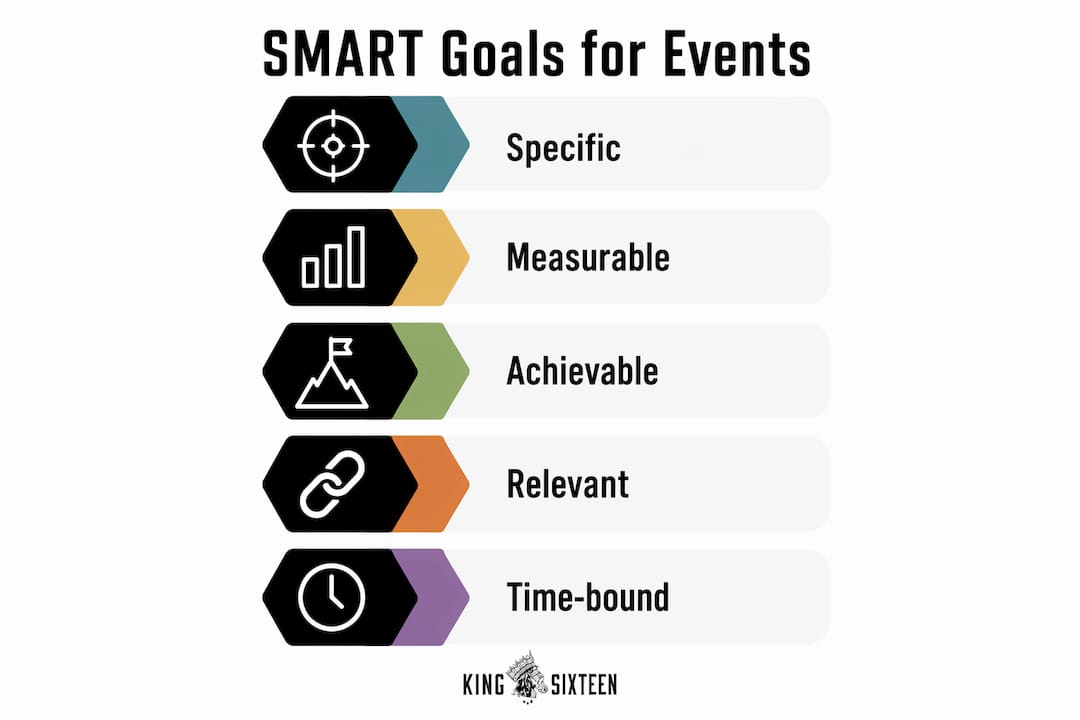
Three examples of SMART goals for common corporate objectives:
| Objective | SMART Goal | Primary KPI | Measurement Tool |
|---|---|---|---|
| Product launch | Generate qualified demo requests on event day | Demo completion rate | Badge scan + CRM sync |
| Demand generation | Book sales meetings within a few days post-event | Meetings booked | CRM (Salesforce/HubSpot) |
| Executive networking | Achieve NPS ≥ 70 among C-suite attendees | Net Promoter Score | Post-event survey (Qualtrics) |
Attendance numbers are a vanity metric for high-profile activations. Quality metrics — qualified leads, meetings booked, content downloads, and NPS — are what justify budget to the CFO.
For attribution to work, your brief must specify required technology integrations: CRM sync, email platform connection, badge scanning, and a real-time dashboard with a raw data export schedule. Specify these before you sign a vendor contract, not after.
Does your event format match your audience's actual expectations?
Purpose must dictate format before a single venue is shortlisted. An education-focused summit demands breakout rooms and structured content tracks. A product trial activation needs open floor space and demo stations. Confusing the two wastes budget and alienates attendees.
Use this checklist to validate format before committing:
- Does the venue support the primary experience type (theater, workshop, immersive, demo)?
- Are transport links accessible for your specific attendee profile?
- Is session length calibrated to attention span and decision-maker schedules?
- Does the networking design create the right density and serendipity?
- Have you confirmed accessibility requirements for your audience?
Pro Tip: Before locking a concept, run it past a small advisory sample of your actual target attendees. Thirty minutes of structured interviews can prevent a six-figure format mistake.
Knowing how to identify your target audience with precision before finalizing format decisions is one of the highest-leverage steps in the entire planning process.
What does a realistic budget and timeline look like?
Budget structure matters as much as budget size. Separate fixed costs (venue, AV, fabrication, permits) from variable costs (catering per head, staffing hours, freight). Name a financial owner and an approval process for each category. Vague budgets drive scope creep.

Reserve a 10–15% contingency and require vendors to price contingency scenarios — weather delays, shipping failures, late tech substitutions — so you can compare proposals on equal terms.
| Timeline Phase | Key Decisions | What Locks Here |
|---|---|---|
| 6–12+ months out | Scope, format, venue shortlist, delivery model | Venue deposit, agency contract |
| 4–9 months out | Vendor contracts, AV spec, fabrication brief | Production costs, lead times |
| 2–3 months out | Run-of-show draft, staffing plan, marketing push | Staffing rates, content deadlines |
| 1–2 months out | Tech integration testing, permitting, rehearsals | Permit approvals, final headcount |
| Event week | Final run-of-show, load-in, rehearsal | On-site logistics locked |
| Post-event | Data export, lead follow-up, debrief | Attribution window closes |
Changing a core vendor after the 4–9 month commitment phase dramatically increases cost and risk. The timeline is not a suggestion; it is a dependency chain.
Turnkey agency or fragmented vendor management: which model fits?
Turnkey agency delivery:
- Single contract, single point of escalation
- Cohesive brand experience across all touchpoints
- Faster decision-making under pressure
- Typically higher quoted cost, lower total risk
Fragmented vendor management:
- Perceived cost control through competitive bidding
- Higher coordination burden on your internal team
- Communication failures multiply across vendor boundaries
- Brand inconsistency risk increases with each additional vendor
Turnkey management reduces communication failure and keeps experiential elements cohesive. For high-profile activations where brand reputation is on the line, fragmented sourcing is a false economy.
Fragmented sourcing still makes sense for lower-stakes internal events where your team has deep production experience and bandwidth to manage multiple contracts.
Pro Tip: Include a single-point escalation clause in every agency contract. Define who has authority to make on-site decisions and what the response time SLA is for critical failures.
What belongs in every agency brief and vendor contract?
A complete logistics checklist for any high-profile activation:
- Venue: capacity, load-in access, power supply, Wi-Fi spec, ADA compliance
- AV/production: rigging points, backup equipment, technical rehearsal schedule
- Catering: dietary requirements, service timing, staffing ratios
- Security: credentialing, crowd management, emergency protocols
- Permits: local event permits, noise ordinances, fire marshal sign-off
- Insurance: general liability minimums, vendor certificate requirements
- Freight and storage: lead times, on-site storage allocation, load-out plan
- Staffing: roles, briefing schedule, on-site communication protocol
A run-of-show shared with all stakeholders is the single most effective mitigation against on-site execution failures. It aligns technical, catering, and production teams on timing, roles, and contacts. Require it as a deliverable, not an afterthought.
For event staffing, verify that every vendor carries their own liability insurance and that limits meet your venue's minimums before signing.
How do you design the attendee journey and prove impact afterward?
Map the attendee journey across five stages and identify where data is captured at each:
| Stage | Experience Design Goal | Data Captured |
|---|---|---|
| Pre-event comms | Build anticipation, confirm attendance | Registration source, email engagement |
| Arrival | First impression, brand immersion | Badge scan, check-in time |
| Main experience | Product engagement, content consumption | Demo completions, session attendance |
| Networking | Relationship formation, meeting quality | Meetings booked, connection data |
| Post-event | Follow-up, conversion, NPS | Survey responses, CRM pipeline |
Event technology platforms centralize registration, badge scanning, scheduling, and analytics across the full lifecycle. Specify required integrations in the brief: CRM, email platform, and real-time dashboard with a raw data export schedule.
Target KPIs to build into your measurement plan: qualified meetings generated, demo completion rate, content downloads, and post-event NPS. Each maps directly to a stage in the journey above.
Common pitfalls that put high-profile activations at risk
- No named KPI owner before the brief goes out
- Missing contingency budget (the 10–15% buffer skipped to hit a headline number)
- Venue locked before purpose and audience are confirmed
- Fragmented vendor communications with no shared run-of-show
- Technical sign-off delayed past the point of no return
When you see late technical sign-off, multiple last-minute vendor substitutions, or an agency that cannot produce a draft run-of-show on request, escalate immediately. Demand the run-of-show, the vendor contact matrix, and the contingency plan in writing.
How to evaluate and brief an agency: the decision-maker's RFP checklist
Strategic brief elements (include in every RFP):
- Primary objective and SMART goal statement
- Target attendee profile and expected headcount
- Primary KPI and measurement methodology
- Budget range (fixed and variable) with contingency allocation
- Timeline and key decision dates
Required deliverables to request:
- Concept design and experience narrative
- Vendor network list with named partners
- Sample run-of-show from a comparable activation
- Staffing plan with roles and briefing schedule
- Technology integration spec (CRM, badge scanning, analytics)
Contract red lines:
- Single-point escalation clause with named contact and SLA
- IP ownership of all fabricated assets
- Cancellation and force majeure terms
- Contingency budget approval process
- Post-event data delivery format and timeline
Key interview questions: Ask agencies to walk you through a production failure they managed and how the run-of-show protected the client. Their answer tells you more than any portfolio deck.
Pro Tip: Require a sample run-of-show as a mandatory submission artifact in your RFP. An agency that cannot produce one has never actually used one.
What high-profile brand activations actually deliver: proof points
Kingsixteen has produced activations for Porsche, Audi, Ray-Ban, Fossil, the Natural Diamonds Council, and Churchill Downs. Across those programs, the consistent pattern is the same: turnkey delivery reduces execution risk and keeps brand experience cohesive from concept through load-out.
- Porsche and Audi: Immersive product environments where every touchpoint, from spatial design to AV to staffing, was managed under a single contract. No brand inconsistency across vendors.
- Ray-Ban and Fossil: Consumer-facing activations where lead capture and CRM integration were specified in the brief and delivered as part of the production scope.
- Natural Diamonds Council: A brand awareness program where fabricated environments extended media reach beyond the event footprint.
- Churchill Downs: Live event production where run-of-show precision and on-site coordination were the margin between a memorable experience and a logistical failure.
The role of a skilled event producer in coordinating these dependencies is what separates a high-performing activation from one that simply happened.
How should your event address sustainability and CSR?
Sustainability in corporate event planning is no longer optional for brands with public ESG commitments. Practical steps include specifying zero-waste catering contracts, requiring vendors to document their carbon offset policies, sourcing fabricated assets designed for reuse or modular reconfiguration, and choosing venues with LEED certification or equivalent energy standards. Measure and report on waste diversion rates and carbon footprint as part of your post-event debrief. For brands like those Kingsixteen works with, sustainability choices are also brand signals — they show up in media coverage and attendee perception.
How do you keep stakeholders aligned through the planning process?
Stakeholder communication is where well-planned events quietly fall apart. Establish a single source of truth (a shared project brief or event management platform) that all approvers reference. Define approval gates at each timeline phase: concept sign-off, budget approval, vendor contracts, and final run-of-show. Assign a named communications lead who owns the update cadence and escalation path. Weekly written status updates to senior stakeholders prevent last-minute surprises and keep decision authority clear. When scope changes are proposed, route them through a formal change-order process with cost and timeline impact documented before approval.
What makes a creative concept worth commissioning?
A strong creative concept starts with a single, defensible idea: what do you want attendees to feel, believe, or do differently because they attended? That answer drives every design decision. The experience design framework works in three layers: the narrative (the story the brand tells), the environment (the physical and sensory space that carries that story), and the interaction (the moments where attendees engage directly with the brand). Live event branding that works at all three layers creates recall that outlasts the event itself. Require agencies to present the concept narrative before presenting design renders — the story should justify the space, not the other way around.
Why cultural sensitivity and inclusivity belong in the brief
A high-profile activation that alienates a segment of its intended audience is a brand risk, not just a planning oversight. Build inclusivity into the brief from day one: specify accessibility requirements (ADA compliance, captioning, dietary accommodations), review creative concepts with a diverse internal advisory group before external presentation, and audit speaker and talent rosters for representation. For events with international attendees, confirm that imagery, language, and cultural references have been reviewed for the specific markets represented. These are not afterthoughts; they are brand protection measures that belong in the RFP alongside AV specs and catering requirements.
Key Takeaways
Successful event planning requires SMART goals, a 6–12+ month timeline, a 10–15% contingency buffer, and a single accountable delivery model — all locked before vendor conversations begin.
| Point | Details |
|---|---|
| Lock SMART goals first | Define your primary KPI and measurement method before briefing any vendor or agency. |
| Build in contingency | Reserve 10–15% of total budget for vendor variance, production shifts, and last-minute changes. |
| Start the timeline early | Complex activations require 6–12+ months; committing vendors after the 4–9 month phase raises cost and risk. |
| Require a run-of-show | Demand a draft run-of-show from any agency shortlisted — it is the clearest proof of execution capability. |
| Kingsixteen turnkey model | Kingsixteen manages design, fabrication, AV, staffing, and logistics under one contract for brands like Porsche, Audi, and Ray-Ban. |
The case for accountability over complexity
There is a version of event planning that looks like control: multiple vendors, competitive bids at every line item, an internal team managing the coordination. In practice, that model transfers execution risk from the agency to your brand. Every handoff between vendors is a potential failure point, and on event day, failure points become brand moments.
The executives who commission the most successful high-profile activations are not the ones who manage the most vendors. They are the ones who ask the sharpest questions up front, lock the right decisions early, and then hold a single partner accountable for the outcome. That is not a philosophy. It is a production strategy.
Kingsixteen delivers the turnkey model this guide describes
If you are ready to move from framework to execution, Kingsixteen handles every element of a high-profile activation under one contract: concept and experience design, custom fabrication, AV and production, staffing, venue sourcing, logistics, and digital integration. No vendor coordination burden on your team. No brand inconsistency across suppliers.
Brands like Porsche, Audi, Ray-Ban, Fossil, the Natural Diamonds Council, and Churchill Downs have trusted Kingsixteen to deliver exactly this. If you are commissioning a product launch, brand activation, or conference and want a partner who can produce a sample run-of-show before you sign anything, start your brief here.
Useful sources and recommended reading
- Eventbrite: Event Planning Blog — SMART goals framework, budgeting, and ownership structures
- PheedLoop: The Complete Event Planning Timeline — Timeline phases, dependency locks, technology integration, and six-pillar framework
- Cvent: Event Planning Guide — Purpose-audience alignment and format selection
- Cvent AU: How to Plan an Event — Run-of-show requirements and on-site coordination
- Eve (goaskeve): How to Plan an Event Guide — Contingency budgeting and RFP artifact requirements
- Lyyti: What Is Event Planning — Strategic framing and agency accountability
- Kingsixteen: Experiential Marketing Services — Turnkey production scope and client portfolio